
Women's Triathlon Apparel: A Performance-Driven Buying Guide for 2026
Your kit is not a uniform; it is a bio-mechanical extension of your musculoskeletal system. If you treat your gear as a mere aesthetic choice, you are conceding precious seconds before the starting gun even fires. You understand the grit required to endure the grind, yet even the most disciplined athlete cannot overcome the physiological tax of poorly engineered women's triathlon apparel. Chafing during the run leg and inadequate support during the swim-to-bike transition are not just functional inconveniences. They are mechanical failures that drain your power and invite muscle fatigue through unnecessary vibration.
We agree that every watt matters and every movement must be efficient. This guide promises to help you master the science of gear selection to multiply your output and dominate every leg of the race. We will analyse the latest 2026 technical advancements in trisuits and compression clothing, focusing on how specific fabric densities reduce muscle oscillation and optimise thermoregulation across all three disciplines. You will learn to identify the engineering required for faster transition times and a chamois design that provides protection without the bulk, ensuring your physical potential is never limited by your equipment.
Key Takeaways
- Understand how technical gear functions as a bio-mechanical tool to multiply your physical output across the swim, bike, and run.
- Compare the aerodynamic efficiency of one-piece trisuits with the versatility of separates to determine which configuration suits your 2026 race goals.
- Master the selection of women's triathlon apparel by identifying critical features like gait-specific support and high-performance chamois engineering.
- Analyse the performance benefits of laboratory-validated kits designed to reduce muscle oscillation and maximise hydrodynamic speed.
- Implement a tripartite athletic framework to manage your physical state through every phase of preparation, action, and recovery.
The Science of Women's Triathlon Apparel: Engineering Peak Performance
Engineering is the difference between surviving the race and dominating it. Stop viewing your kit as mere athletic wear. High-performance women's triathlon apparel is a precision-engineered tool designed to multiply your physical output. Respect the grind. The transitions between swimming, cycling, and running impose unique physiological stresses that standard sportswear cannot mitigate. When you exit the water, standard fabrics retain weight and cause parasitic drag. On the bike, a lack of mechanical stability leads to wasted energy. By the run, muscle oscillation triggers premature fatigue. Our gear is built to eliminate these failures.
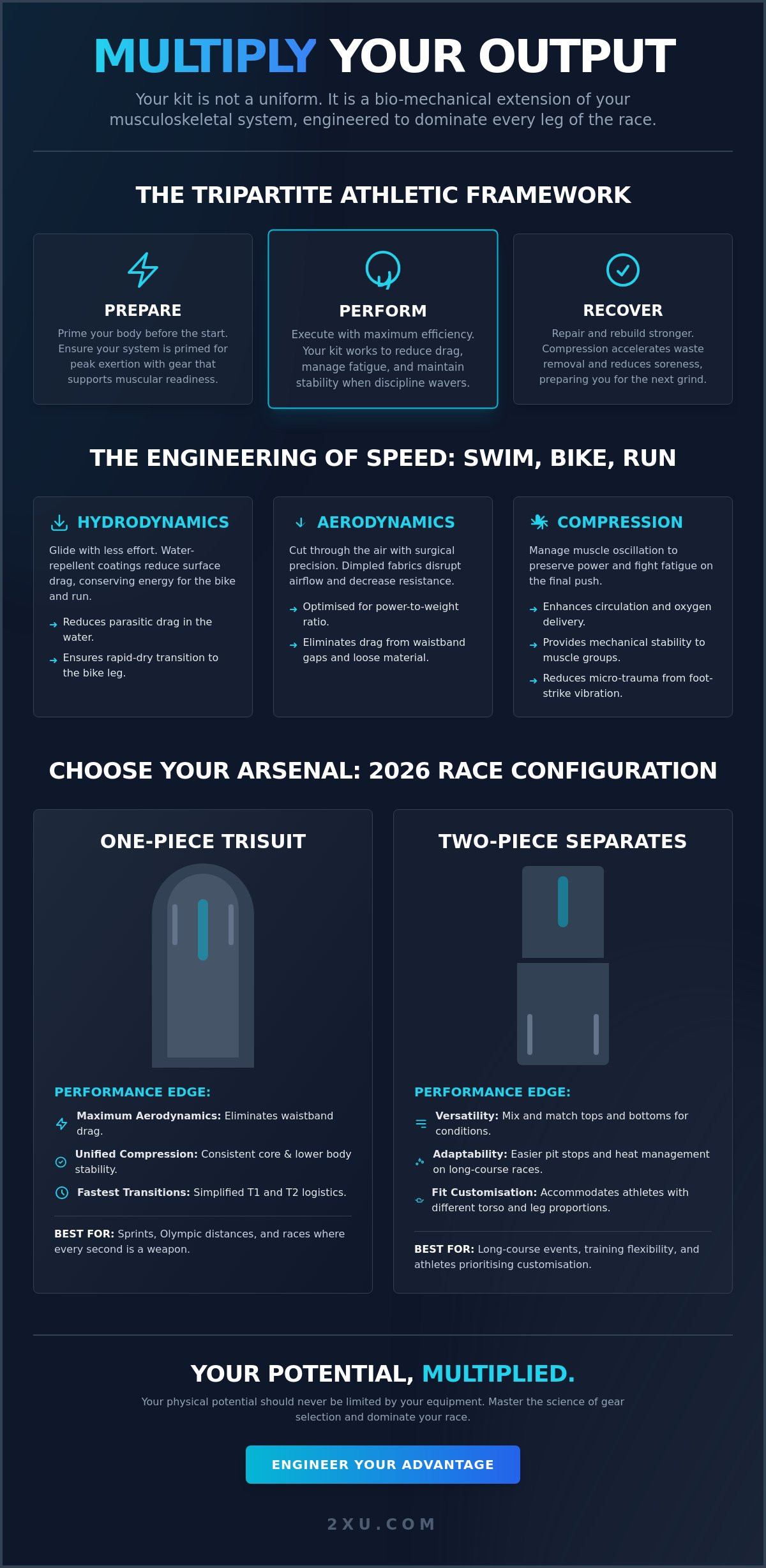
We utilise a Tripartite Athletic Framework to address every phase of your journey: Prepare, Perform, and Recover. This holistic approach ensures your body is primed before the start, supported during the peak of the effort, and repaired efficiently once the line is crossed. It isn't about style; it's about laboratory-validated results. Technical fabrics must do more than cover the body. They must manage moisture, reduce drag, and provide the structural integrity required to maintain form when your discipline wavers.
Hydrodynamics and Aerodynamics
Speed is a mathematical equation involving power and resistance. To reduce the resistance side of that formula, we employ advanced triathlon-specific clothing treated with water-repellent coatings. These molecular finishes reduce surface drag in the water, allowing you to glide with less effort. Once you transition to the bike, the focus shifts to aerodynamics. We integrate dimpled fabric structures in high-velocity zones to disrupt airflow and decrease air resistance. Rapid-dry technology is non-negotiable. It ensures the transition from water to air doesn't leave you carrying excess fluid weight that hampers your power-to-weight ratio and compromises thermoregulation.
The Role of Compression in Endurance
Muscle fatigue isn't just about oxygen; it's about stability. Graduated compression increases blood flow and oxygen delivery to active muscle groups, accelerating waste removal during the effort. More importantly, it manages muscle oscillation. Every foot strike on the pavement sends vibrations through your legs, causing micro-trauma that accumulates over kilometres. By dampening these vibrations, you preserve your musculoskeletal integrity for the final push. Women's triathlon apparel must provide this stability without restricting the range of motion required for a fluid swim stroke or an aggressive aero tuck.
- Enhanced Circulation: Targeted pressure zones facilitate faster venous return.
- Mechanical Stability: Compression panels align muscle fibres to maximise force production.
- Reduced Micro-trauma: Minimising vibration prevents the long-term fatigue that kills your run pace.
PWX fabric is a high-power, lightweight material engineered for multi-directional stretch. This proprietary technology ensures that the compressive benefits remain consistent throughout the entire race duration, regardless of the intensity of your movement.
Choosing Your Kit: One-Piece Trisuits vs. Two-Piece Separates
Selecting the right kit for 2026 isn't about aesthetics. It's about matching the mechanical properties of your gear to the specific distance of your race. The choice between a one-piece trisuit and two-piece separates is the first critical decision in building your high-performance arsenal of women's triathlon apparel. For short-course events like Sprints or Olympic distances, the one-piece suit is the undisputed standard for speed. It eliminates the waistband gap that creates parasitic drag on the bike leg, ensuring a streamlined profile that cuts through the air with surgical precision. Don't let gear be your bottleneck.
The Case for the One-Piece Trisuit
A one-piece configuration provides consistent graduated compression across the core and lower extremities. This structural unity prevents the top from riding up and the shorts from slipping, maintaining mechanical stability during high-intensity transitions. In races where every second counts, the one-piece design simplifies your T1 and T2 logistics. While athletes often cite the toilet break as a deterrent, modern suit engineering has largely solved this logistical hurdle. High-stretch textiles and strategically placed front zippers allow for rapid entry and exit without compromising the suit's aerodynamic integrity.
The Flexibility of Triathlon Separates
Long-distance events like the IRONMAN require a different strategic approach. Separates offer the versatility needed for mid-race kit adjustments or varying physiological needs over eight to seventeen hours of effort. If you require different sizing for your upper and lower body to achieve optimal compression, separates are the solution. During training phases, you can pair technical shorts with compression shirts to manage recovery while logging high-volume kilometres. This modularity allows for precision in managing the thermophysiology of an athlete, especially in fluctuating environments where cooling or heat retention becomes a survival factor.
Sleeved vs. Sleeveless: The Mobility Equation
The final variable is the sleeve. Sleeved designs are the superior choice for aerodynamic gains and UV protection on the bike, but they require precise tailoring to avoid restricting shoulder mobility during the swim. Sleeveless suits offer maximum freedom for the rotator cuff, which some athletes prefer for shorter, high-cadence swims. Regardless of your choice, ensure your kit is laboratory-validated to perform under the specific thermal loads of your target race. Explore the high-performance range of women's triathlon apparel at 2XU to identify the kit that matches your specific competitive trajectory.
Critical Features for the Elite Female Triathlete
Every detail in elite women's triathlon apparel must serve a mathematical purpose. If a feature doesn't subtract time or add power, it's dead weight. We focus on the engineering of the interface between your body and the machine. This is where the grind is won or lost. You don't need "comfort" in the traditional sense; you need mechanical efficiency that allows your body to perform at its peak for hours on end. Respect the discipline of gear selection as much as you respect your training block.
Triathlon-Specific Chamois Engineering
The chamois is the most critical interface between the athlete and the bike. Standard cycling pads are a liability in a triathlon. They are too thick, which causes them to absorb water during the swim and creates a restrictive "diaper" feel during the run. A precision-engineered triathlon chamois is significantly thinner. It provides enough cushioning to protect your soft tissue during a 180km bike leg while ensuring zero interference with your running gait. High-performance women's triathlon apparel utilises moisture-wicking textiles in the pad construction to prevent skin irritation and saddle sores once you exit the water.
Mechanical Stability and Muscle Support
Mechanical stability is a non-negotiable requirement for the elite athlete. We utilise Muscle Containment Stamping (MCS) to provide targeted support to key muscle groups. This technology maps the specific musculoskeletal structure of the quads and calves to reduce oscillation and protect against common injuries like shin splints. By aligning the muscle fibres through targeted compression, we achieve the 'Human Multiplied' concept. Your natural effort is amplified by this external stabilisation, reducing the energy leak that occurs with every foot strike. For the swim leg, the lessons learned from the buoyancy of a neoprene wetsuit are integrated into the core support panels to help you maintain a horizontal position in the water.
Pocket Architecture and Nutrition Management
Nutrition is the fourth discipline of triathlon. If your kit doesn't facilitate efficient fueling, it's failing you. High-performance pocket architecture must be laser-cut and bonded to the suit to eliminate parasitic drag. We position storage zones in the lower back or side panels where they have the least impact on your aerodynamic profile. These compartments are engineered to hold gels and salt tabs without the bounce that disrupts your rhythm or causes chafing. This level of technical detail is validated by scientific research on trisuit performance, ensuring that every pocket and seam is optimised for the unique thermal and mechanical demands of the race.
Standout Gear from the 2XU Women's Triathlon Collection
The 2XU collection is the physical manifestation of our commitment to laboratory validation. We don't guess. We engineer. Every garment in our range of women's triathlon apparel is designed to solve a specific physiological problem. Whether you are hunting a podium or conquering your first local race, your gear must be as disciplined as your training programme. Respect the effort you've invested by selecting equipment that refuses to compromise on speed or stability.
High-Performance Trisuits
The Light Speed Sleeved Trisuit represents the pinnacle of aerodynamic engineering. It utilises premium Italian-made fabrics with advanced cooling properties and integrated Muscle Containment Stamping (MCS) technology. As established in earlier sections, MCS maps the musculoskeletal structure to reduce muscle oscillation, preserving your power for the final run leg. For athletes focused on high-velocity air-flow management, the Aero range employs dimpled fabric structures to minimise drag on the bike. To understand the specific engineering behind each model in our arsenal, consult the ultimate triathlon suit guide.
Technical Wetsuits and Swim Skins
Dominate the water with the Propel Wetsuit series. The Propel P:1 and P:2 models are engineered with specialised buoyancy panels to correct your body position and rollbar technology to improve core stability during the rotation of your stroke. We use 39 Cell neoprene to achieve maximum flexibility through the shoulders and arms, ensuring your reach is never restricted by material resistance. This is not just about staying warm; it's about hydrodynamic efficiency. For precise instructions on achieving the optimal fit for your body type, refer to our triathlon wetsuit guide. This ensures your suit functions as a second skin rather than a mechanical hindrance.
Optimised Thermoregulation and Foundation Gear
Heat is a performance killer that drains your glycogen stores and elevates your heart rate. The Aero Vent range is specifically designed for hot race conditions, utilising high-filament yarns to wick moisture and facilitate rapid cooling through evaporation. For those entering the sport, the Core Trisuit provides the essential foundational kit required to handle the grind of a three-discipline race. It offers our signature commitment to quality and durability, providing a reliable platform for your first competitive milestones.
Equip yourself with gear that multiplies your potential and respects the grind of every training session. Shop the 2XU women's triathlon collection today and secure your competitive advantage for the 2026 season.
The 2XU Advantage: Multiplying Your Effort on Race Day
Performance is a calculation. It's the result of your discipline multiplied by the engineering of your gear. At 2XU, we don't rely on aesthetic trends or vague promises of comfort. Every piece of women's triathlon apparel we produce is the result of rigorous laboratory validation and collaboration with academic research teams. We understand the physiological tax of the grind. Our mission is to ensure that your equipment never becomes the limiting factor in your pursuit of a personal best. Your effort deserves to be multiplied, not mitigated.
From Readiness to Recovery
The Tripartite Athletic Framework of Prepare, Perform, and Recover is central to our design philosophy. Recovery begins the moment you cross the finish line. Graduated compression gear aids in lymphatic drainage post-race, accelerating the removal of metabolic waste and reducing muscle swelling. For athletes travelling to international events, managing travel fatigue is a prerequisite for success. Utilising flight pressure socks is a scientifically backed strategy to combat DVT and lower limb oedema during long-haul transit. 2XU gear is tested by elite athletes under extreme conditions to ensure absolute durability through the grind of a full season.
Optimising Your Selection
Precision in selection is mandatory. Technical fabrics only provide their full mechanical advantage when the fit is exact. Use our proprietary fit charts to verify your dimensions before committing to a race kit. Once acquired, maintain the integrity of your gear by following specific care protocols. Avoid high heat and harsh chemicals that degrade the elasticity of high-performance yarns. This ensures your compression power remains consistent across multiple race cycles.
Before you toe the line in 2026, run through a final performance data checklist. Verify that your suit's hydrodynamic coating is intact and that the compression gradients still meet laboratory specifications. Check every bonded seam for structural integrity. Ensure your nutrition pocket architecture allows for rapid access without breaking your aerodynamic profile. These details are the difference between a podium and a mid-pack finish. Don't leave your results to chance. Push your physical limits and demand more from your equipment with 2XU Triathlon Apparel. You've done the work. Now, wear the science.
Secure Your Competitive Advantage
You've analysed the engineering and decoded the science of performance. Now it's time to execute. Selecting high-performance women's triathlon apparel isn't an aesthetic afterthought; it's a strategic decision that dictates your hydrodynamic efficiency and musculoskeletal stability. By prioritising Red Dot award-winning fabric engineering and laboratory-validated compression technology, you ensure your body functions as a precision-tuned machine through every transition. We don't settle for average standards, and neither should you. As the official compression partner of elite sports institutes, we provide the technical tools required to multiply your natural output and endure the grind of the long course.
Every watt you've trained for and every minute of discipline you've logged deserves to be protected by the world's most advanced textiles. Your discipline has brought you to the starting line. Let our scientific validation take you to the podium. Respect the effort you've invested. Sharpen your edge with gear that refuses to compromise. Dominate the field in 2026.
Shop the 2XU Women's Triathlon Collection
Frequently Asked Questions
What should I wear under my women's triathlon suit?
Wear nothing under your trisuit. Technical fabrics are engineered for direct skin contact to facilitate efficient moisture transfer and prevent the mechanical friction caused by standard undergarments. Adding a layer will only trap sweat and lead to severe chafing during the run leg. High-performance kits include built-in support where necessary to maintain a streamlined profile.
Is a one-piece or two-piece trisuit better for my first triathlon?
A one-piece suit is usually better for your first race because it simplifies your logistics and eliminates distractions. It prevents the top from riding up and ensures consistent compression across your core. As established in the kit selection framework, the one-piece design is the most aerodynamic configuration for competitive efforts and prevents the "waistband gap" that creates drag.
How tight should a women's triathlon suit actually feel?
Your suit must feel exceptionally firm, almost restrictive when you're standing upright. Once you adopt an aggressive cycling or running posture, the graduated compression should feel like a second skin. If the material is loose or wrinkles, it'll cause parasitic drag in the water and skin irritation on the run. It must be tight enough to manage muscle oscillation effectively.
Can I wear my triathlon apparel for regular pool swimming?
Don't use your race kit for daily pool sessions. Chlorine is highly corrosive to high-performance textiles and will degrade the water-repellent coatings and elasticity of your women's triathlon apparel. Reserve your race kit for open water training and race day. Use dedicated training apparel for the pool to ensure your primary kit maintains its laboratory-validated performance properties.
How do I choose the right chamois thickness for an IRONMAN?
Select a thin, high-density chamois that prioritises moisture management over bulk. For an IRONMAN, you need enough protection for 180 kilometres of cycling without the pad acting like a sponge during the marathon. A thinner pad ensures zero interference with your gait when fatigue sets in. It's designed to provide a protective interface without retaining fluid after the swim transition.
Does women's triathlon apparel really improve my race times?
Technical women's triathlon apparel improves race times by reducing hydrodynamic drag and managing muscle oscillation. Laboratory testing proves that graduated compression delays the onset of fatigue by improving circulation and waste removal. These marginal gains are what allow you to maintain your target pace during the final kilometres of the race when your musculoskeletal system is under peak stress.
How do I wash and maintain my 2XU triathlon kit?
Rinse your kit in fresh water immediately after use and hand wash it in cold water with a mild detergent. Never use a tumble dryer or iron your gear. High heat destroys the technical fibres and the elasticity required for graduated compression. Air dry your kit in the shade to maintain the integrity of the fabric and the specialised UV coatings.
What is the difference between a trisuit and a swim skin?
A trisuit is your primary garment for the entire race, featuring a chamois for the bike leg and pockets for nutrition. A swim skin is a thin, hydrodynamic outer layer worn only during the swim in non-wetsuit legal races. You remove the swim skin in T1 to reveal your trisuit underneath. Swim skins lack a chamois and are designed solely to maximise speed through the water.