
Triathlon Wetsuit: A Performance-Driven Guide to Your Fastest Swim
The gap between your current swim split and your potential is not just a measure of training; it is a measure of technology. Yet the search for the optimal triathlon wetsuit is deliberately obscured by a flood of technical jargon and unsubstantiated marketing claims, leaving athletes to guess which features actually translate to speed. Mediocrity is not an option on race day, and your equipment must reflect that same unyielding standard. This is where ambiguity ends and performance begins.
This is not another product roundup. This is a definitive, performance-driven guide engineered to dismantle the confusion. We will deconstruct the science behind buoyancy profiles, flexibility panels, and hydrodynamic coatings, providing a clear methodology for aligning advanced wetsuit architecture with your unique physiology and swim mechanics. You will gain the expertise to confidently select, fit, and maintain your equipment, transforming it from a simple garment into a scientifically validated tool for multiplying your performance in the water.
Key Takeaways
- Master the core performance principles-buoyancy, flexibility, and hydrodynamics-to transform your wetsuit from simple gear into a competitive weapon.
- Assess your unique swim mechanics and race goals to select the specific triathlon wetsuit engineered to amplify your strengths and mitigate your weaknesses.
- Decode advanced materials science, from graduated neoprene paneling to slick hydrodynamic coatings, to make an informed, data-driven decision.
- Learn why a perfect, second-skin fit is the non-negotiable variable that multiplies the effectiveness of all other wetsuit technology.
Core Principles of Wetsuit Performance: Buoyancy, Flexibility & Hydrodynamics
A high-performance triathlon wetsuit is not merely an insulating layer; it is a piece of engineered equipment scientifically designed for one purpose: to make you faster in the water. Unlike wetsuits for surfing or diving that prioritize warmth and durability, every element of a triathlon-specific suit is optimized to overcome the physical forces that limit swim speed. This is achieved through the calculated synergy of three core principles: buoyancy, flexibility, and hydrodynamics. When engineered in unison, these pillars reduce drag, minimize energy expenditure, and maximize power output, ensuring you exit the water with more energy reserved for the bike and run.
Engineered Buoyancy: The Science of Lifting Your Profile
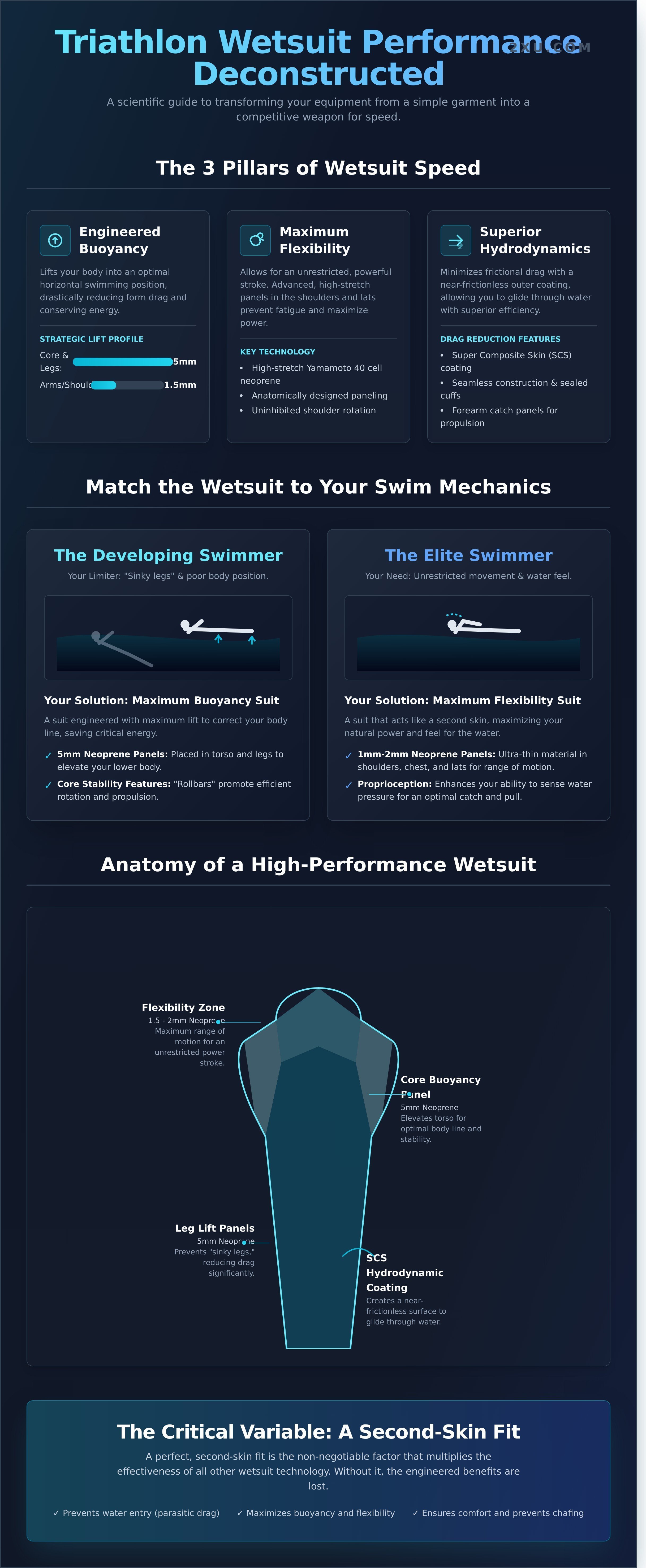
The foundation of wetsuit speed lies in its ability to lift your body into an optimal swimming position. The core science of how wetsuits work involves neoprene, a material containing thousands of nitrogen-filled micro-cells that create positive buoyancy. We strategically vary the neoprene thickness-using up to 5mm panels in the core and legs and thinner 1.5-2mm panels in the arms-to elevate the hips and legs. This engineered lift creates a perfectly horizontal body line, drastically reducing form drag and conserving the energy you would otherwise spend just staying afloat.
Maximum Flexibility: The Biomechanics of an Unrestricted Stroke
For an efficient freestyle stroke, unrestricted movement in the shoulders and lats is non-negotiable. An elite triathlon wetsuit utilizes advanced, high-stretch neoprene, such as Yamamoto 40 cell, in these critical zones. This allows for maximum reach at the start of your pull and uninhibited rotation throughout the stroke. Anatomically designed paneling that follows the body's musculature ensures the suit moves with you, not against you, preventing premature fatigue and maximizing power transfer with every single arm cycle.
Achieving Hydrodynamics: Minimizing Frictional Drag
Hydrodynamic resistance, or the frictional drag created as your body moves through water, is the primary force working against you. To combat this, advanced wetsuits feature a proprietary outer coating like a Super Composite Skin (SCS). This coating creates a near-frictionless surface, allowing you to glide through the water with superior efficiency. This is further enhanced by seamless construction and sealed cuffs that prevent water entry, which would otherwise create parasitic drag and weigh you down. Some designs even incorporate forearm catch panels to increase propulsion, turning the suit into an active tool for speed.
Athlete Profile Assessment: Matching Wetsuit to Your Swim Mechanics
The concept of a single 'best' triathlon wetsuit is a fallacy. Optimal performance is not achieved with a one-size-fits-all solution; it is unlocked by precisely matching advanced materials and construction to your unique biomechanics, experience level, and race-day conditions. The performance advantages are not theoretical; extensive research on wetsuit performance confirms significant reductions in drag and metabolic cost. Your objective is to select the engineered tool that corrects your limiters or enhances your strengths. This assessment is the first critical step.
For the Developing Swimmer: Prioritizing Buoyancy and Stability
Athletes building their swim form often contend with inefficient body position-specifically 'sinky legs' and a lack of core stability, which increases drag and energy expenditure. The solution is a wetsuit engineered for maximum buoyancy. Look for suits with 5mm neoprene panels strategically placed through the torso and legs to elevate the lower body. Features like proprietary rollbars are not gimmicks; they are engineered to augment core stability and promote a more efficient rotational axis, translating wasted energy into forward propulsion.
For the Elite Swimmer: The Flexibility and Feel Imperative
For the highly proficient swimmer with a powerful stroke and naturally horizontal body position, the equation changes. The primary demand shifts from buoyancy to uninhibited flexibility and proprioception. An elite-level triathlon wetsuit minimizes material thickness, employing advanced 1mm to 2mm neoprene through the shoulders, chest, and lats. This construction maximizes range of motion for a high-elbow catch and powerful pull phase. The goal is to achieve a 'second-skin' feel, allowing the athlete to sense the water pressure for an optimal catch, maximizing power output with every stroke.
Full-Sleeve vs. Sleeveless: A Decision Framework
This decision is a tactical calculation of thermal regulation versus mechanical freedom, dictated by water temperature and personal preference.
- Full-Sleeve: Delivers superior thermal protection and optimal hydrodynamics. The complete coverage reduces drag for maximum speed. The primary choice for most races, especially in water below 70°F (21°C).
- Sleeveless: Offers absolute freedom of shoulder movement, preferred by athletes who feel restricted or overheat easily. A viable option for very warm water conditions (above 72°F / 22°C) or for swimmers with a history of shoulder impingement.
Your choice must align with your physiological needs and race environment. Explore 2XU wetsuits engineered for every athlete profile.
Deconstructing Wetsuit Technology: Neoprene, Panels, and Coatings
An elite triathlon wetsuit is not merely a garment; it is a piece of advanced sporting equipment engineered for a single purpose: multiplying your performance. To dominate the swim leg, you must understand the materials science that separates podium-worthy gear from the rest. This is an inside look at the proprietary technology and hydrodynamic engineering that reduces drag, enhances buoyancy, and maximizes power output.
Neoprene Grades Explained: Yamamoto #39 and #40 Cell
Not all neoprene is created equal. The industry benchmark for performance is Yamamoto, a limestone-based neoprene with a uniform closed-cell structure that is more buoyant, flexible, and durable than inferior petroleum-based alternatives. High-performance suits strategically map different grades for specific outcomes:
- Yamamoto #39 Cell: Renowned for its exceptional buoyancy and durability. This is the workhorse, typically engineered into the core and leg panels to lift your body into the optimal horizontal swimming position, reducing form drag.
- Yamamoto #40 Cell: The pinnacle of flexibility. This material offers unparalleled elasticity and an unrestricted range of motion, making it essential for the shoulder and arm panels where movement is critical.
A suit that fails to specify its neoprene source is a suit that compromises on performance. Demand technical transparency.
Anatomy of Performance Panels: Catch, Kick, and Stability
Beyond the base material, advanced paneling unlocks hydrodynamic potential. Each section of a 2XU triathlon wetsuit is purpose-built. Grooved forearm ‘catch panels’ are engineered to increase the surface area and purchase on the water, translating directly into greater propulsion per stroke. Similarly, specialized lower leg panels enhance the kick phase. The most critical, however, are proprietary core stability panels that act as rollbars, minimizing inefficient body roll and maintaining a powerful, streamlined posture. This is a key component in optimizing the overall biomechanical effects of wetsuits, as it forces the athlete to engage their core and transfer power more directly through the water.
The Role of Linings and Zippers in Performance
The interior of a wetsuit is as critical as its exterior. A highly flexible inner lining must work in concert with the neoprene to enable maximum stretch and prevent restriction. This synergy ensures comfort and uninhibited movement. For race day, speed is paramount. A reverse zipper, which closes from top to bottom, is engineered for rapid, snag-free opening in the first transition (T1), saving critical seconds. Finally, a well-designed, low-profile neck seal is essential to prevent chafing and water ingress without constricting breathing-a detail that distinguishes an engineered suit from a basic one.
The Critical Variable: How to Achieve a Second-Skin Fit
Engineered buoyancy profiles, hydrophobic coatings, and advanced neoprene are all rendered useless by an improper fit. It is the single most critical variable in wetsuit performance. The correct fit for a triathlon wetsuit is not one of comfort, but of compression. It should feel like a second skin-unyieldingly snug on dry land, yet allowing for total freedom of movement in the water. Anything less is a compromise on your power output and race-day potential.
A Step-by-Step Guide to Putting on a Triathlon Wetsuit
Patience during this process is non-negotiable. Rushing leads to neoprene damage and a suboptimal fit that will restrict your performance.
- Start from the Feet: Use a plastic bag over your feet or wear socks to slide the legs on smoothly. Never use your fingernails; use only the pads of your fingers or wear gloves to prevent tears.
- Systematically Eliminate Gaps: Work the neoprene up your legs in small sections. It is crucial to pull all the material high into the crotch, leaving no air gap. This is the foundation for achieving proper fit in the upper body.
- Secure the Torso and Arms: Pull the suit up over your torso and slide your arms in one at a time. Methodically work any slack from the wrists up into the shoulders, ensuring the suit is seated high in your armpits.
- Zip and Finalize: Have a partner help you with the zipper. Once zipped, bend over and pull the material from your stomach up toward your chest to properly seat the neckline.
Key Fit Checkpoints on Dry Land
Validate the fit across these critical zones before entering the water:
- Neck Seal: The seal should be snug against the skin to prevent water entry, but it must not constrict your airway or carotid arteries. You should be able to breathe deeply without restriction.
- Shoulders and Lats: Perform full arm rotations. You should feel compression, but not a hard "wall" of resistance that will fatigue your shoulders during the swim.
- Crotch and Hips: There must be no significant sagging or air gap in the crotch. This indicates the suit is either too large or has not been pulled up high enough.
Common Fitting Mistakes and Their Performance Consequences
An incorrect fit directly translates to slower times. A suit that is too large will scoop water, creating hydrodynamic drag and causing you to expend energy staying warm. A suit that is too small will restrict diaphragmatic breathing and impede shoulder mobility, leading to rapid fatigue and a compromised stroke. The most common error-not pulling the triathlon wetsuit high enough into the crotch and armpits-creates tension across the shoulders, negating any advanced flexibility technology. Eliminate the guesswork. Use our scientifically developed size chart to find your perfect 2XU fit.
Engineer Your Advantage in the Water
Your performance in the water is not a matter of chance; it is a direct result of calculated equipment selection. As this guide has detailed, mastering the core principles of buoyancy, flexibility, and hydrodynamics is non-negotiable for any serious athlete. A superior triathlon wetsuit is not merely an accessory-it is a piece of scientifically engineered equipment designed to amplify your power, and achieving a second-skin fit is the final, critical variable that unlocks its full potential.
This unyielding, data-driven approach is ingrained in our DNA. Trusted by world champion triathletes and IRONMAN winners, 2XU wetsuits are meticulously constructed with proprietary materials and advanced paneling technology. Every design is scientifically validated to deliver optimal hydrodynamics and maximal power output. It is time to stop compromising and equip yourself with the advantage you've earned. Shop the 2XU Wetsuit Collection: Engineered for Your Next PR.
Dominate the swim. Annihilate your personal best. Human Performance. Multiplied.
Frequently Asked Questions
What is the difference between a triathlon wetsuit and a surfing wetsuit?
A triathlon wetsuit is engineered for speed and hydrodynamic efficiency, utilizing advanced, flexible neoprene in the shoulders and back to maximize range of motion for an optimal swim stroke. In contrast, a surfing wetsuit prioritizes thermal insulation and abrasion resistance, using thicker, less flexible neoprene that severely restricts swimming mechanics. For peak race performance, the two are not interchangeable; one is a tool for speed, the other for survival and warmth.
At what water temperature does a wetsuit become race-legal according to IRONMAN rules?
According to IRONMAN competition rules, wetsuits are optional for age-group athletes in water temperatures between 16°C (60.8°F) and 24.5°C (76.1°F). Wetsuits are mandatory below 16°C. Above 24.5°C, they are prohibited to prevent dangerous hyperthermia. Elite athletes face stricter regulations with a lower temperature threshold. Always verify the specific race-day ruling from officials, as local conditions can dictate final decisions for athlete safety and fair competition.
How do I prevent neck chafing from my wetsuit during a long swim?
Neck chafing is a biomechanical issue caused by friction between the wetsuit's collar and the skin during head rotation. To mitigate this, apply a high-viscosity, wetsuit-safe anti-chafe balm directly to the neck. A correctly fitted suit with a low-profile, SCS (Super Composite Skin) coated neckline is engineered to minimize this friction. This allows for uninhibited movement and maintains your focus exclusively on power output and performance.
How thick should my triathlon wetsuit be for different water conditions?
Optimal thickness balances thermal regulation and flexibility. For cold water below 16°C (61°F), a suit with a 5mm core and 3mm limbs provides maximum insulation. In moderate conditions (16-21°C / 61-70°F), a 3:5mm or 2:3mm panel combination offers a superior balance of buoyancy and flexibility. For warmer, wetsuit-legal swims above 21°C (70°F), a sleeveless or 1.5-2mm full-sleeve suit minimizes overheating while retaining a significant hydrodynamic advantage.
How long can I expect a high-performance triathlon wetsuit to last with proper care?
A high-performance triathlon wetsuit, engineered with premium Yamamoto neoprene, is designed for 3-5 seasons of competitive use, equating to approximately 100-150 swims. Durability is contingent on meticulous post-swim care: immediate rinsing with fresh, cold water and proper air-drying. While the suit may remain functional longer, the neoprene's elasticity and the hydrodynamic coating's efficacy will degrade over time, compromising its performance-enhancing properties. Elite performance demands equipment operating at its peak.
Is it faster to swim with or without a wetsuit in warm water?
Even in warm, wetsuit-legal water, swimming with a wetsuit is scientifically proven to be faster for the vast majority of athletes. The neoprene provides significant buoyancy, which elevates the body's position and reduces form drag. This optimized bodyline allows for a more efficient and powerful stroke. Furthermore, advanced coatings like SCS actively repel water, minimizing surface friction. The only exception is for elite swimmers whose technique is already near-perfect, and even then the advantage is debatable.