
Triathlon Suit with Sleeves vs Sleeveless: Engineering Your Ultimate Race Day Edge
A 17-watt power saving at 50 km/h can translate to a three-minute advantage over an Ironman distance bike ride, proving that your gear choice is as critical as your training block. When you evaluate a triathlon suit with sleeves vs sleeveless, you aren't just choosing an aesthetic; you're engineering a mechanical advantage. You've spent months in the hurt locker, grinding through dawn sessions to shave seconds off your personal best. You demand gear that respects that effort and doesn't leak power through aerodynamic drag or thermal failure.
Mastering the science of sleeve length allows you to optimise your aerodynamics, thermoregulation, and mechanical output when it matters most. This analysis provides the data-driven clarity you need to balance shoulder mobility during the swim against watt-saving efficiency on the bike. We will examine the latest 2026 regulations and technical performance markers to ensure your race-day kit multiplies your human capability rather than restricting it.
Key Takeaways
- Quantify the aerodynamic advantage of technical fabrics over skin to reclaim wasted watts and save critical minutes on the bike leg.
- Identify when to prioritise the mechanical freedom of sleeveless designs to ensure zero restriction during the swim catch and pull phases.
- Master the variables of a triathlon suit with sleeves vs sleeveless by analysing your target event's specific UV index and thermal load.
- Leverage advanced compression and proprietary SBR technology to stabilise muscle groups and maximise your sustained power output.
- Align your gear selection with 2026 regulation updates to ensure your performance engine remains legal and efficient from start to finish.
The Tactical Choice: Sleeved vs Sleeveless in the Pursuit of Peak Performance
Respect the grind. You don't dedicate hundreds of hours to the pool, the bike, and the pavement only to let your equipment dictate your ceiling. Your race kit is not just apparel; it's a critical component of your performance engine. In the pursuit of a personal best, every gear choice must be a calculated decision to accelerate your physical potential. This is the 'Human Multiplied' philosophy. It's the belief that when elite effort meets superior engineering, the results are exponential. You've earned your place at the start line through discipline; now you must ensure your kit doesn't leak the power you've worked so hard to generate.
The debate between a triathlon suit with sleeves vs sleeveless is a tactical analysis of trade-offs. On one side, you have the aerodynamic dominance of sleeved architectures. On the other, you have the mechanical freedom and rapid thermal regulation of sleeveless designs. For the data-driven athlete, a single second saved in transition or a handful of watts reclaimed on the bike isn't just a bonus. It's the return on investment for your technical scrutiny. If you aren't analysing your kit with the same intensity as your power files, you're leaving performance on the table.
The Evolution of the Modern Trisuit
Modern race wear has moved far beyond the basic swim-run gear of the early days. What began as simple, functional Triathlon equipment has evolved into laboratory-tested aerodynamic weapons. Advanced textile engineering now allows for high-performance fabrics that manage moisture and drag without the need for non-technical materials. In professional long-course racing, the shift toward sleeved suits is almost universal. This transition is driven by the undeniable data regarding boundary layer manipulation and UV protection during the grind of a 180km bike leg. Elite athletes no longer settle for standard fits; they demand engineered solutions that optimise every movement.
Why Every Watt and Second Counts
Drag is a relentless thief of energy. Over a 90km or 180km bike leg, the cumulative effect of aerodynamic resistance is staggering. When your suit works with your body to reduce drag, your metabolic cost decreases, leaving more in the tank for the run leg. Properly engineered compression in your trisuit also stabilises muscle tissue, reducing vibration and delaying the onset of fatigue.
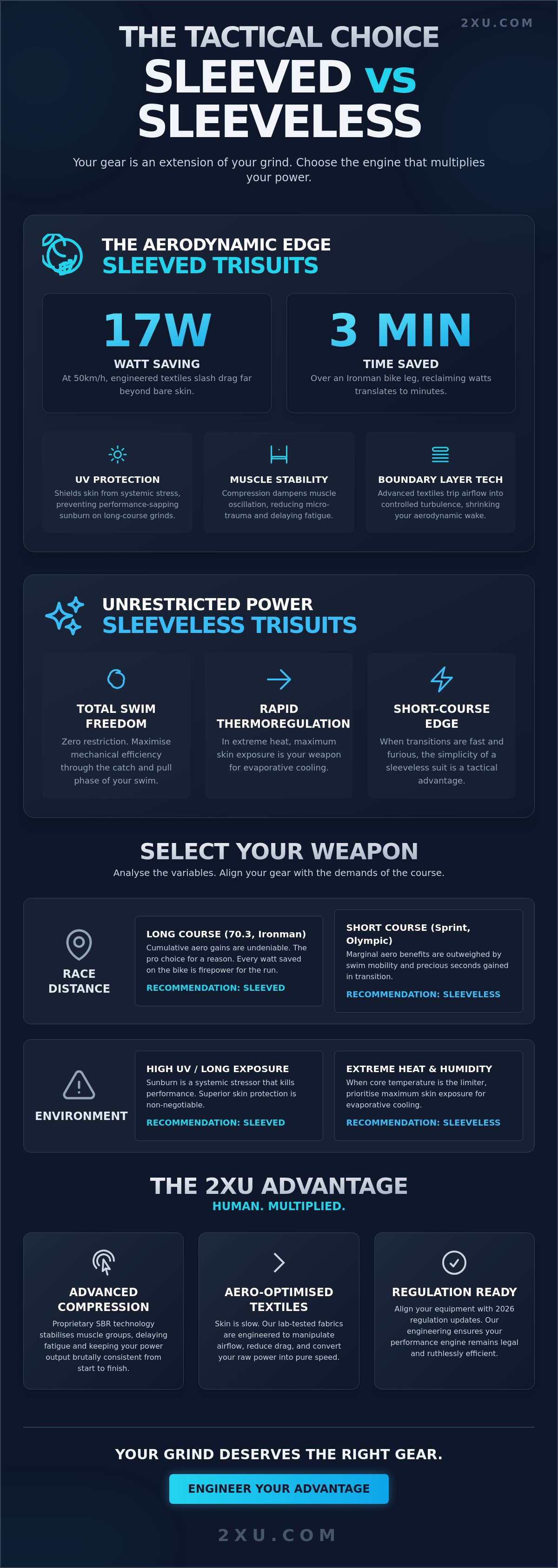
- Aerodynamic Savings: Technical sleeves can save up to 17 watts at 50 km/h, which can save three minutes over an Ironman distance.
- Mechanical Efficiency: Reducing the effort required to slice through the air allows for a more consistent power output.
- Thermal Management: Sleeved designs offer superior skin protection, preventing the physiological stress of sunburn during long-course events.
Every watt you reclaim is a watt you can put back into the pedals. For the athlete who respects the discipline, choosing the right suit is the final step in sharpening the blade for race day.
The Aerodynamic Edge: Engineering Speed with Sleeved Trisuits
Skin is a drag. While it might feel natural, human skin is aerodynamically inferior to engineered technical textiles. In the high-stakes environment of long-course racing, the choice of a triathlon suit with sleeves vs sleeveless often comes down to the physics of fluid dynamics. Airflow hitting a bare arm becomes turbulent almost immediately, creating a high-pressure wake that pulls you backward. By contrast, a sleeved suit uses specific fabric textures to trip the boundary layer into a controlled turbulence. This keeps the air attached to your body for longer, significantly reducing the size of the low-pressure wake behind you.
Recent aerodynamic analysis of sleeved suits confirms that the placement of specific seams and fabric dimples can drastically alter the drag coefficient. This isn't marginal; it's a fundamental shift in how you move through space. At 50 km/h, the 2XU Light Speed React provides a documented 17-watt power saving. That is the difference between a podium finish and falling back into the pack. You don't leave your power to chance; you engineer it.
Beyond the aero gain, sleeves provide mechanical stability. High-velocity cycling causes muscle oscillation in the upper arms, which leads to micro-trauma and metabolic waste accumulation. Compression-fit sleeves dampen this vibration, preserving your energy for the run. Simultaneously, they shield your skin from the brutal Australian sun. Sunburn isn't just a skin issue; it's a systemic stressor that forces your body to divert blood flow from your muscles to your skin for cooling. Protection is performance.
Aerodynamics and Surface Tension
Laminar flow is the goal. When air moves smoothly over your torso and shoulders, your drag coefficient drops. 2XU engineers every panel to ensure the transition from helmet to suit is seamless. Our laboratory testing proves that technical fabrics outperform bare skin in every wind tunnel metric. You can't out-train bad physics, but you can out-engineer it with a high-performance trisuit. This architecture ensures that airflow remains attached across the shoulders, reducing the overall pressure drag of the athlete's silhouette.
Protection and Thermal Management
Heat is the enemy of the grind. As your core temperature spikes, your heart rate climbs and your power output drops. Specialised cooling fabrics in sleeved suits facilitate rapid moisture evaporation, effectively acting as an external radiator. This reduces the physiological cost of thermoregulation, allowing more oxygen-rich blood to reach your working muscles. There is also a psychological edge to being encapsulated; the feeling of support and compression keeps your focus sharp when the fatigue starts to bite. Preventing that mid-race temperature spike is critical for maintaining your mechanical output during the final stages of the bike leg.
Unrestricted Power: The Mechanical Freedom of Sleeveless Designs
Aerodynamic dominance on the bike is a powerful argument, but the calculation for a triathlon suit with sleeves vs sleeveless shifts when you prioritise mechanical freedom. For many elite athletes, the primary objective is ensuring zero resistance during the critical catch and pull phases of the freestyle stroke. Any fabric over the shoulder, regardless of its technical engineering, introduces a marginal degree of tension. In a 3.8km swim, that micro-resistance compounds into significant muscular fatigue. A sleeveless design removes this variable entirely, allowing for pure, unadulterated shoulder kinematics that respect the thousands of hours you've spent perfecting your stroke.
Direct skin contact also provides a sensory advantage. Elite swimmers often rely on the 'feel' of the water to make millimetre-perfect adjustments to their pull efficiency and hand entry. This tactile feedback is essential for maintaining a high line in the water when you're grinding through choppy conditions. Additionally, transition efficiency is a factor that can't be ignored. Layering a sleeveless suit under a triathlon wetsuit is objectively faster and more reliable. It eliminates the risk of fabric bunching at the shoulders or sleeve-on-sleeve friction that can restrict movement. In the high-pressure environment of T1, the ability to strip your wetsuit and mount the bike without kit adjustments saves the precious seconds that separate the leaders from the chasers.
Optimising Shoulder Mobility
Freeing the axilla is essential for athletes with high-volume shoulders or exceptionally wide lats. Sleeved suits can occasionally create chafing points in the armpit during the high-repetition rotations of a long-course swim. Sleeveless architectures eliminate these potential fail points. This ensures your focus remains locked on the grind of the race rather than the irritation of your equipment. It is about removing every possible barrier to your maximum physical output.
Thermal Regulation in High Vapour Pressure Environments
In environments where humidity exceeds 80 percent, evaporative cooling becomes nearly impossible because the air is already saturated with moisture. In these high vapour pressure conditions, direct airflow to the underarms becomes a primary cooling mechanism. Sleeveless designs maximise this exposure, preventing core temperature spikes during the early stages of the run. This makes them a tactical choice for short, high-intensity sprint efforts where the aerodynamic penalty on the bike is outweighed by the thermal and mechanical advantages in the water. You choose the tool that fits the environment; you don't let the environment dictate your failure.
Distance and Environment: Selecting Your Weapon for the Race Day
Choosing between a triathlon suit with sleeves vs sleeveless is not a matter of personal style; it is a tactical protocol based on physiological thermal load and aerodynamic ROI. You don't guess your power targets. You shouldn't guess your kit selection either. To ensure your gear multiplies your effort rather than hindering it, follow this five-step engineering audit for your next race.
- Step 1: Evaluate the swim-to-bike ratio. If the bike leg represents more than 50 percent of your total race time, the aerodynamic advantages of sleeves generally outweigh the marginal swim resistance.
- Step 2: Analyse the expected UV index and ambient temperature. High UV exposure causes systemic stress. Sleeves protect your skin, preserving metabolic energy that would otherwise be spent on cooling and repair.
- Step 3: Factor in your bike speed. Aerodynamic drag increases exponentially with velocity. If you are holding 40km/h or higher, the watt-savings of engineered sleeves are non-negotiable. At 30km/h, the gap narrows, potentially favouring the cooling of a sleeveless design.
- Step 4: Audit your personal thermoregulation. Every athlete's engine runs differently. If you are prone to overheating in high humidity, the direct airflow of a sleeveless suit provides a critical thermal relief valve.
- Step 5: Test under load. Never debut a new architecture on race day. Respect the discipline of preparation by performing a full-intensity brick session in your chosen kit to ensure zero chafing or restriction.
Sprint and Olympic Distance Dynamics
Short-course racing happens in the 'red zone'. When you are operating at near-threshold intensity, heat dissipation is paramount. The high-intensity nature of sprint and Olympic distances often favours the rapid cooling of sleeveless designs. Additionally, in races won or lost by seconds, the faster transition times offered by a sleeveless kit can be the difference between making the lead pack or being left in the chase. However, if the course is exceptionally fast and flat, a sleeved triathlon suit remains the superior choice for maintaining laminar flow and maximising your mechanical output.
The Long-Course Endurance Equation
Ironman and 70.3 events are battles of attrition. Over 180km, the 'slow leak' of energy caused by wind resistance becomes a torrent. Sleeved suits are the gold standard here, providing a 17-watt advantage that compounds over hours of effort. Beyond the aero gain, the comfort factor of technical sleeves reduces long-term skin irritation and sun damage. Protecting your body from the Australian sun's energy-sapping heat is a primary performance factor that keeps your core temperature stable for the marathon ahead. Refine your tactical loadout by selecting from our elite range of performance trisuits to ensure your gear is as ready for the grind as you are.
The 2XU Advantage: Multiplied Performance Through Advanced Engineering
Your decision in the triathlon suit with sleeves vs sleeveless debate is only as effective as the engineering beneath the surface. At 2XU, we don't just manufacture apparel; we build performance systems. Every 2XU triathlon suit is an exercise in technical precision, integrating world-leading compression technology to stabilise muscle groups and maximise power transfer. We reject the average. We demand results that are mathematically superior, validated through rigorous laboratory testing and elite-level feedback. This is about ensuring your physical output is multiplied, not merely supported.
Our proprietary PWX and SBR technologies represent the pinnacle of technical textile engineering. While competitors rely on basic materials, we utilise specific polymer structures designed to provide high-power support while maintaining extreme flexibility. This isn't about comfort; it's about mechanical advantage. By reducing muscle oscillation, we delay the onset of fatigue, allowing you to sustain higher intensities for longer durations. This is the difference between fading in the final 10km and finishing with a surge. You've done the work in the hurt locker; our gear ensures that work isn't wasted.
Fabric Engineering vs. Standard Textiles
We use high-filament yarns to facilitate superior moisture management without the need for technical fillers. These engineered textiles are designed to move sweat away from the skin at a molecular level, ensuring you stay light and dry during the grind. Unlike standard fabrics that lose their shape when wet, our materials maintain mechanical stability even when fully saturated. This durability ensures your kit survives a full season of high-volume training and aggressive racing without compromising its aerodynamic or compressive properties. There is no room for equipment failure when you are pushing for a podium.
From Readiness to Recovery
Our Tripartite Athletic Framework—readiness, action, and recovery—informs every stitch. During the action phase, 2XU compression aids in venous return, ensuring oxygenated blood reaches your working muscles more efficiently during the run leg. This targeted pressure also reduces muscle damage during the brutal eccentric loading of a marathon. We provide the tools to double your potential, bridging the gap between your current limits and your ultimate performance goals. Respect the effort. Equip yourself with gear that matches your discipline and proves the concept that human is multiplied.
Master Your Mechanical Advantage
The decision between a triathlon suit with sleeves vs sleeveless isn't about preference; it is about the mathematical optimisation of your race day engine. We've analysed the 17-watt advantage of sleeved aerodynamics at 50 km/h and the unrestricted shoulder kinematics of sleeveless designs. You now have the protocol to audit your target event's environment and your own physiological thermal load. Respect the discipline of your training by choosing the architecture that preserves your power and protects your skin during the grind.
2XU provides the technical foundation to ensure your effort is never wasted. Our gear is the choice of World Champions, utilising proprietary PWX compression technology and laboratory-validated aerodynamic gains to sharpen your competitive edge. It's time to stop guessing and start engineering your results. Shop the 2XU Triathlon Collection and Multiply Your Performance. You've put in the dawn sessions and the long miles. Now, equip yourself with the engineering required to multiply your human potential. Go earn your finish.
Frequently Asked Questions
Is a sleeved triathlon suit faster than a sleeveless one?
Sleeved suits are aerodynamically superior on the bike leg. Engineered technical fabrics manipulate airflow more efficiently than bare skin, which reduces drag and reclaims wasted watts. While sleeveless designs offer more freedom in the water, the time gained on the bike usually outweighs the marginal swim difference in long-course events. When you evaluate a triathlon suit with sleeves vs sleeveless, the data proves that sleeves provide a significant mechanical advantage at high velocities.
Can I wear a sleeved triathlon suit under a wetsuit?
Yes, you can wear a sleeved suit under your wetsuit without compromising performance. To ensure zero restriction, ensure the sleeves are pulled tight and flush against the shoulder to avoid fabric bunching. This prevents friction between your kit and the neoprene, allowing for a natural stroke during the grind of the swim. Most elite athletes find that modern technical fabrics are thin enough to layer without adding bulk or restricting shoulder kinematics.
Do sleeved triathlon suits cause overheating on the run?
Properly engineered sleeved suits actually aid in cooling through rapid moisture evaporation. High-filament yarns act as a radiator, moving sweat away from the body to facilitate evaporative cooling even in direct heat. In extreme humidity, however, some athletes prefer the direct airflow provided by a sleeveless kit to manage their core temperature more aggressively. Your choice depends on your personal thermal load and the environmental vapour pressure of the race course.
Are sleeved triathlon suits legal in all IRONMAN events?
As of the 2026 season, sleeved trisuits are legal for all IRONMAN distances provided the sleeves do not extend past the elbow. You must also ensure your torso remains covered throughout the race. Be aware that front zippers must be fully connected for the final 100 metres of the run to avoid a 30 or 60-second time penalty. Always check the specific athlete guide for your event to ensure compliance with the latest technical regulations.
How should a triathlon suit fit to ensure maximum performance?
Your suit must fit like a second skin with zero wrinkles or loose fabric. Any bunching creates a pocket of air that increases drag and leads to chafing during high-volume efforts. The compression should be firm enough to stabilise muscle groups but not so tight that it restricts deep diaphragmatic breathing during the run. A perfect fit is essential to maximise the benefits of a triathlon suit with sleeves vs sleeveless architectures.
Does a sleeved suit provide better sun protection for long races?
Yes, sleeved suits offer superior UV protection for the shoulders and upper arms. Reducing your skin's exposure to the Australian sun prevents the physiological stress of sunburn, which can cause your core temperature to spike and heart rate to climb. This protection is a tactical necessity for the 180km bike leg in long-distance events. By shielding your skin, you preserve metabolic energy that your body would otherwise spend on thermal repair and cooling.
What is the best triathlon suit for a beginner?
Beginners should prioritise durability and mechanical stability. A suit from the 2XU Core series provides the necessary SBR technical fabrics and support required for your first season of racing. It offers a balance of performance and value, ensuring you have the tools to earn your place at the finish line without over-complicating your technical loadout. As you increase your bike speed and distance, you can transition to more specialised aerodynamic architectures.
How do I prevent chafing in a sleeveless triathlon suit?
Preventing chafing requires a combination of precise fit and technical lubrication. Ensure your suit is correctly sized to prevent the axilla from rubbing against loose fabric during the swim and run. Use a high-quality anti-chafe balm on high-friction areas and rely on SBR technical fabrics that are engineered to reduce skin irritation during the grind. Respecting the discipline of kit testing during training will help you identify and eliminate potential friction points before race day.