
Compression Shirts: The Scientific Guide to Performance & Recovery
Mediocrity is not in your vocabulary. Every training session, every competition, is an opportunity to push past your limits. Yet, a critical question persists in the world of elite athletics: are compression shirts a scientifically validated performance tool or simply marketing hype? The confusion surrounding technical terms like graduated compression and Muscle Containment Stamping (MCS) only fuels this uncertainty, leaving athletes to question their gear's true impact on power output and muscle oscillation, or whether it will restrict critical movement.
Doubt ends here. This is not another opinion piece; it is a definitive guide grounded in rigorous scientific evidence. We will deconstruct the precise mechanics of compression technology, demonstrating how it is engineered to contain muscle, reduce performance-inhibiting fatigue, and dramatically accelerate the recovery cycle. Forget the guesswork. By the end of this guide, you will possess the knowledge to select and utilize compression apparel that doesn't just fit-it functions to multiply your human performance.
Key Takeaways
- Master the core science of engineered pressure to understand how compression technology fundamentally differs from a standard tight-fitting garment.
- Unlock superior performance by learning how targeted compression reduces muscle oscillation to amplify power output and delay fatigue.
- Leverage compression shirts post-workout to accelerate the body's recovery process by enhancing blood flow and clearing metabolic waste.
- Ensure maximum effectiveness by selecting the correct graduated fit and technical fabric for your specific performance and recovery demands.
What is a Compression Shirt? Deconstructing the Technology
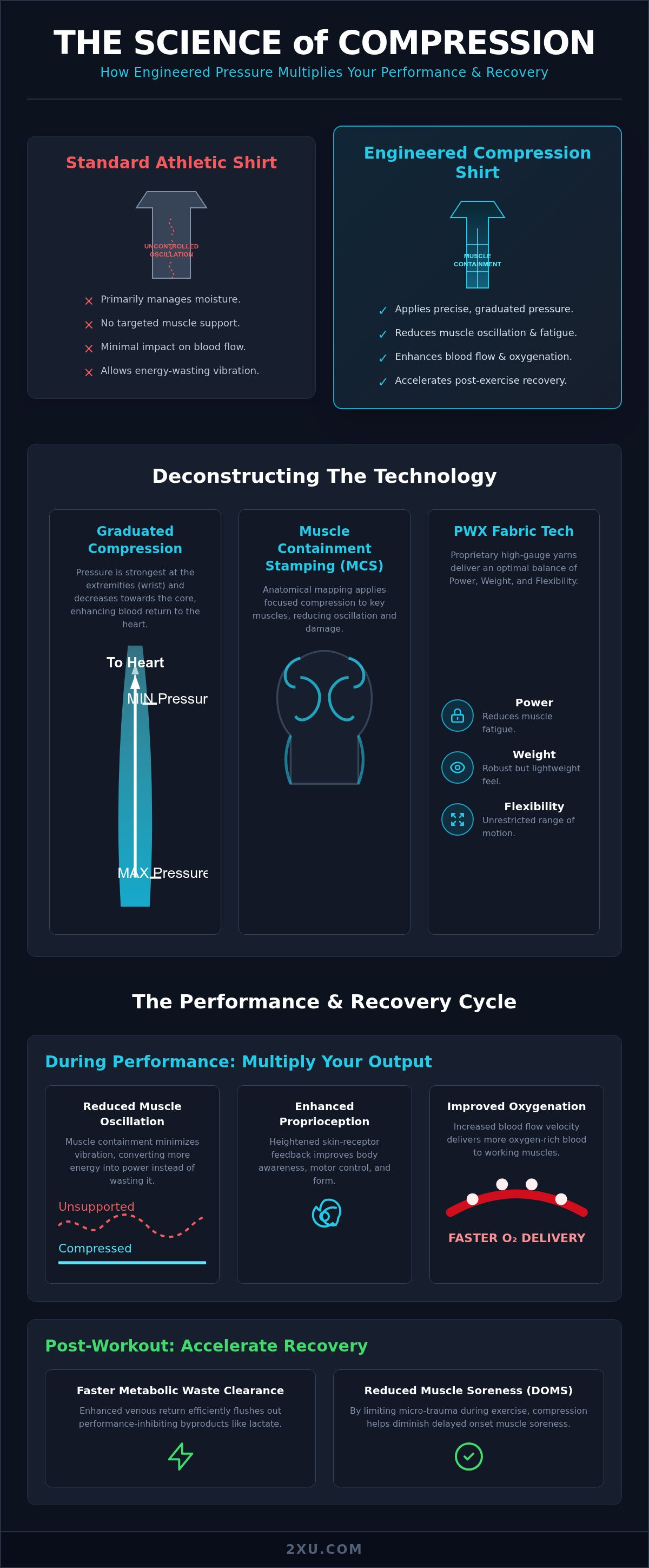
To dismiss compression shirts as merely 'tight tops' is to fundamentally misunderstand their purpose. These are not fashion items; they are engineered tools designed to multiply human performance. The core technology operates on a simple yet powerful principle: the application of precise, consistent mechanical pressure to the surface of the body. This creates a 'second skin' that supports muscles, enhances proprioception, and optimizes physiological function. Far more than a standard athletic base layer, which primarily manages moisture, a true compression garment is scientifically constructed to achieve two critical outcomes: elevate performance output and expedite post-exercise recovery. The foundational concept, as detailed in this overview of what a compression garment is, has evolved from medical science into a non-negotiable asset for the serious athlete.
The Principle of Graduated Compression
The cornerstone of effective compression technology is its graduated pressure profile. This is not uniform constriction. It is an intelligent system engineered to be tighter at the extremities-the wrists and forearms-and progressively looser as it moves towards the core. This mechanical gradient is meticulously calibrated to enhance venous return, accelerating the flow of deoxygenated blood back to the heart for re-oxygenation and the efficient clearance of metabolic waste like lactate.
Engineered Fabrics: The 2XU PWX Standard
The efficacy of any compression garment is dictated by its material science. Our proprietary PWX (Power-Weight-Flex) fabric sets the global standard, utilizing high-gauge elastomeric yarns to deliver powerful, consistent pressure that endures wash after wash. The fabric is engineered for an optimal balance of:
- Power: Reduces muscle oscillation and fatigue.
- Weight: Provides robust support without hindering movement.
- Flexibility: Ensures a complete and unrestricted range of motion.
This advanced textile also provides superior moisture-wicking for thermoregulation, extreme durability, and UPF50+ sun protection.
Anatomical Mapping and Muscle Containment Stamping (MCS)
MCS represents the apex of compression technology-a targeted system that functions as an exoskeleton for your key muscle groups. This advanced stamping is anatomically mapped to trace the precise contours of your major upper-body muscles, tendons, and fascia. By applying even greater, more focused compression to these critical areas, MCS drastically reduces muscle oscillation and the micro-trauma incurred during explosive or repetitive movements. The result is diminished muscle damage, reduced fatigue, and greater power output.
The Science of Performance: How Compression Shirts Multiply Your Output
The 'Perform' phase is where potential is converted into results. It is a non-negotiable window where every physiological advantage must be exploited. High-performance compression shirts are not mere apparel; they are engineered tools designed to manipulate physiological responses for superior output. The benefits are grounded in biomechanics and circulatory science, delivering measurable gains when it matters most.
Reduced Muscle Oscillation and Damage
Every foot strike, every explosive lift, generates impact forces that cause muscle oscillation-the uncontrolled vibration of muscle tissue. This excessive movement creates energy leaks, contributes to micro-trauma within the muscle fibers, and accelerates neuromuscular fatigue. Engineered compression directly counters this, applying precise, targeted pressure to contain the muscle. This containment minimizes oscillation, improving mechanical efficiency and ensuring more of your energy is converted into power, not wasted vibration.
Enhanced Proprioception and Motor Control
Peak performance demands flawless execution. Proprioception-your body's innate awareness of its position and movement in space-is the foundation of that control. The uniform pressure of a compression garment stimulates thousands of sensory receptors in the skin. This constant feedback creates a heightened state of awareness, allowing for superior neuromuscular control and more precise movement patterns. The result is improved form, greater stability, and a significant reduction in the risk of injuries caused by poor biomechanics.
Improved Blood Flow and Oxygenation
Your muscles are engines fueled by oxygen. Maximizing their output requires optimizing that fuel delivery. Medical-grade compression is engineered to increase arterial blood flow velocity during exertion, accelerating the transport of oxygen-rich blood to your working upper body muscles. While the full extent of performance benefits is a subject of rigorous study, as examined in this comprehensive scientific review on compression garments, the core mechanism is clear. Enhanced oxygenation supports greater power output and muscular endurance, while also facilitating the efficient removal of metabolic byproducts, delaying the onset of fatigue and keeping you performing at your peak for longer.
Accelerate Recovery: The Post-Workout Advantage of Compression
The work doesn't end when the last rep is finished. Elite performance is forged in the critical hours following intense exertion. The "Recover" phase is not optional; it is a non-negotiable component of the athletic cycle. This is where scientifically engineered compression gear transitions from a performance tool to an essential instrument of physiological restoration, multiplying your capacity for the next session.
Faster Lactate Clearance and Reduced DOMS
Strenuous exercise results in the accumulation of metabolic byproducts, including lactate, which contribute to post-exercise fatigue and soreness. The graduated pressure profile of a compression shirt is engineered to enhance venous return, accelerating blood flow and more efficiently flushing these substances from muscle tissue. This physiological mechanism is well-documented, with a comprehensive scientific meta-analysis on compression sportswear confirming its positive effects on recovery. By improving circulation and containing muscle oscillation, compression directly mitigates the micro-trauma that leads to Delayed Onset Muscle Soreness (DOMS), allowing you to return to training with less pain and greater strength.
Decreased Swelling and Inflammation
The microscopic muscle tears incurred during high-intensity training trigger a natural inflammatory response, resulting in swelling (edema) and pain. This is a necessary part of the adaptation process, but uncontrolled, it can prolong downtime. The external pressure from compression shirts helps to limit this swelling by promoting lymphatic drainage. The result is a quantifiable reduction in post-exercise pain and stiffness, enabling a faster and more complete return to peak operational capacity.
When to Wear for Optimal Recovery
To harness the full restorative power of compression, precise timing is critical. Application is not arbitrary; it is a calculated part of your training protocol. For maximum efficacy, adhere to the following guidelines:
- Immediately Post-Workout: Apply the garment as soon as possible after your session concludes. Wear for a minimum of 2-4 hours to capitalize on the body's peak recovery state.
- Overnight Restoration: For particularly demanding training blocks, wearing compression to sleep provides continuous pressure to aid cellular repair and reduce morning stiffness.
- Post-Competition Travel: Combat the effects of prolonged sitting after a race or game. Compression helps maintain crucial blood flow, preventing stiffness and accelerating recovery while you travel.
This strategic approach to recovery is what separates amateur effort from elite performance.
Choosing Your Engineered Fit: A Guide to the Right Compression Shirt
Understanding the science behind compression is the first step. Applying it is what separates peak performance from mediocrity. The effectiveness of your gear is not a given; it is a direct result of a precise, engineered fit tailored to your specific athletic discipline. This guide provides a decision-making framework to ensure the compression shirt you select is a tool for multiplying your output, not just another layer of fabric.
Sleeve Length: Targeting Your Coverage
The architecture of your top directly impacts its function. Your choice should be a calculated decision based on environment, activity, and desired outcome.
- Long Sleeve: Delivers full-arm graduated compression to reduce muscle oscillation and accelerate warm-up. Essential for cool-weather performance and provides maximum UPF 50+ sun protection during prolonged outdoor training.
- Short Sleeve: Focuses compressive power on the core, obliques, and shoulders. Ideal for disciplines requiring significant arm freedom while demanding unwavering core stability and postural support.
- Sleeveless: Engineered for an absolute, unrestricted range of motion. This design is the superior choice for weightlifting, CrossFit, and court sports where shoulder and arm mobility is paramount.
Finding Your Precise Compression Level and Size
True compression is a science of pressure, not just tightness. To unlock the physiological benefits, your fit must be exact. Always consult the 2XU size chart and use precise body measurements. The ideal fit is a second skin-applying consistent, firm pressure without ever restricting breathing or functional movement. Beware the common mistake of sizing down for 'more' compression. This critical error disrupts graduated pressure profiles and can restrict blood flow, negating all performance benefits.
Matching Features to Your Sport
Elite athletic gear is purpose-built. Different disciplines place unique demands on the body, and our range of compression shirts is engineered to meet them head-on.
- Running & Triathlon: Prioritize garments with advanced moisture-wicking fabrics like our X-VENT technology, superior breathability, and non-negotiable UV protection for endurance events.
- Weightlifting & CrossFit: Demand durability and targeted support. Look for our proprietary Muscle Containment Stamping (MCS) technology, which provides anatomical mapping to support key muscle groups in the core, deltoids, and pectorals during powerful, explosive lifts.
- Team Sports: Focus on abrasion resistance for on-field contact and flexible, powerful PWX fabric that supports rapid, multi-directional movements without compromise.
Your potential is waiting. The correct equipment is the key. Explore our range of scientifically engineered compression tops.
Engineer Your Advantage. Master Your Performance.
The science is definitive. More than just apparel, the right compression shirts are a critical piece of performance equipment. By strategically containing muscle oscillation, they enhance power output and endurance. Post-workout, their graduated pressure profile accelerates blood flow, clearing metabolic waste and significantly reducing muscle soreness. This is the proven formula for superior performance and faster, more effective recovery.
At 2XU, we don't just follow the science; we advance it. Our garments are engineered with scientifically proven PWX fabric and proprietary Muscle Containment Stamping (MCS) technology to deliver unparalleled results. This commitment to innovation is why we are trusted by world champion athletes and leading sports science institutes globally. Don't just train. Train smarter.
Shop Engineered Compression Shirts to Multiply Your Performance. Your peak is waiting to be reached.
Frequently Asked Questions
What is the difference between a compression shirt and a base layer?
A base layer's primary function is thermoregulation-managing moisture and temperature. In contrast, compression shirts are engineered athletic equipment designed to apply targeted, graduated pressure to your muscles. This pressure reduces muscle oscillation and improves proprioception, directly impacting performance and recovery. While both are worn against the skin, only compression provides a scientifically validated physiological advantage for the serious athlete.
How tight should a compression shirt feel when I first put it on?
Your compression shirt must feel noticeably firm and snug, providing a secure, second-skin fit without restricting range of motion or circulation. This is not a comfort garment; it is performance equipment. The engineered pressure is precise. You should feel supported and locked-in, not constricted. If breathing is difficult or you experience numbness, the fit is incorrect and must be adjusted for optimal performance and safety.
Can I wear a compression shirt all day for recovery or travel?
Absolutely. Wearing compression post-exercise or during long-haul travel is a critical component of an effective recovery protocol. The graduated pressure is engineered to enhance blood flow and lymphatic drainage, which accelerates the removal of metabolic waste like lactate and reduces delayed onset muscle soreness (DOMS). For extended wear, ensure the fit is correct to maximize these physiological benefits and expedite your return to peak performance.
What is the correct way to wash and care for my compression gear to maintain its effectiveness?
To preserve the engineered integrity of your compression gear, machine wash in cold water with similar fabrics. Do not use bleach or fabric softeners, as these chemicals degrade the proprietary elastomeric yarns and compromise the garment's compressive properties. Lay flat to dry away from direct sun; high heat from a dryer will permanently damage the advanced fabric structure and reduce its performance lifespan and effectiveness.
Are the benefits of compression shirts backed by scientific studies?
Unequivocally, yes. The performance and recovery benefits of compression apparel are validated by extensive independent and university-led research. Studies consistently demonstrate that medical-grade, graduated compression significantly reduces muscle oscillation, improves proprioceptive awareness, and accelerates post-exercise recovery by enhancing circulation. Our technology is not based on theory; it is grounded in quantifiable, scientific data and proven results from elite athletes.
Can a compression shirt help improve my posture during workouts?
Yes, a compression shirt serves as a powerful tool for postural correction during intense activity. The targeted pressure and firm fit enhance proprioception-your body’s awareness of its position in space. This heightened sensory feedback cues your core and shoulder musculature to maintain optimal alignment, reducing fatigue-induced form degradation and promoting a more powerful, efficient biomechanical output throughout your performance.