
Running Compression Shorts: The Scientific Edge for Performance & Recovery
The wall of muscle fatigue. The debilitating post-run soreness. The wasted energy from uncontrolled muscle oscillation on impact. These are not just symptoms of a hard run; they are scientifically proven barriers to your peak performance. Elite athletes understand that overcoming these limitations requires more than grit-it demands engineered equipment. Advanced running compression shorts are not merely an apparel choice; they are a critical performance tool, meticulously designed to combat these inhibitors at a physiological level.
This is your definitive guide to the science of compression. We will dissect how targeted muscle containment reduces damaging muscle vibration, accelerates blood flow for faster recovery, and ultimately improves your power output. Move beyond guesswork. Understand the data, identify the precise graduated pressure profile for your goals, and select the engineered pair that will not just support your ambition, but multiply it. Prepare to unlock a new caliber of performance.
Key Takeaways
- Understand the scientific mechanics of compression and how it directly impacts muscle physiology to reduce oscillation and fatigue.
- Leverage compression technology across the full athletic lifecycle to enhance preparation, multiply performance output, and accelerate post-run recovery.
- Discover why a precise fit is the most critical factor for effectiveness and learn the key criteria for selecting the perfect pair of running compression shorts.
- Distinguish between standard athletic wear and scientifically engineered apparel to ensure your gear is a performance tool, not just a garment.
What Are Running Compression Shorts and How Do They Differ?
Running compression shorts are not merely tight-fitting apparel; they are a piece of engineered performance equipment. Their fundamental purpose is to apply precise, consistent pressure to the major muscle groups used in running-the quads, hamstrings, and glutes. This scientifically calibrated pressure is the defining characteristic of any true compression garment, transforming a simple short into a powerful tool designed to enhance athletic output and accelerate recovery. They are distinct from standard athletic wear, representing a calculated investment in your performance potential.
The pressure they apply is meticulously engineered and exists in two primary forms:
- Uniform Compression: Applies a consistent level of pressure across the entire garment.
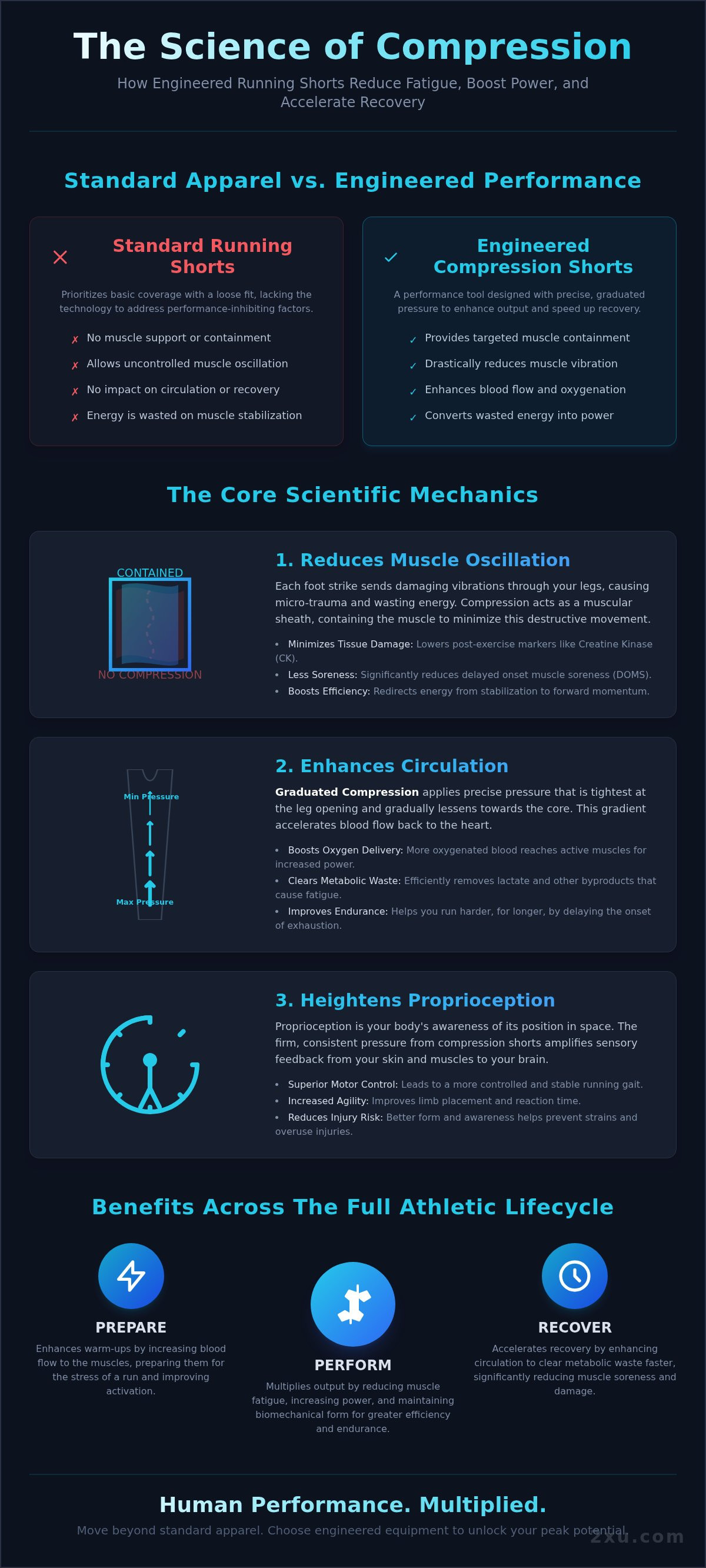
- Graduated Compression: A medically-derived and superior method where pressure is greatest at the extremity (the leg opening) and gradually decreases up towards the core. This gradient is engineered to accelerate blood flow back to the heart, enhancing muscle oxygenation and clearing metabolic waste more efficiently.
Standard Running Shorts vs. Compression Technology
While a standard running short prioritizes basic coverage and moisture-wicking with a loose fit, the technology behind running compression shorts is fundamentally different. Their objective is biomechanical: to support muscles, improve circulation, and reduce performance-inhibiting muscle oscillation. This is achieved through advanced fabric construction with a high elastane content, providing the powerful compressive force that standard athletic wear lacks. Furthermore, premium designs incorporate anatomical paneling that targets specific muscle zones for maximum stability and power output.
The Objective: Human Performance. Multiplied.
Compression technology is designed to work with your body's natural systems, amplifying their effectiveness. The goal is to mitigate the physiological factors that lead to premature fatigue, muscle damage, and post-exercise soreness. By containing muscles and improving circulation, compression gear allows you to train harder, perform stronger, and recover faster. This is the core of the 2XU philosophy. We don’t just create apparel; we create a system for unlocking your potential. The objective is clear: Human Performance. Multiplied.
The Science of Compression: How It Enhances Running Performance
The performance gains attributed to compression technology are not marketing hyperbole; they are the direct result of scientifically validated physiological mechanics. When you run, your body is a complex system under immense stress. Engineered compression garments intervene at a muscular level to optimize this system, turning wasted energy into forward momentum and mitigating exercise-induced damage. The benefits are threefold: reduced muscle damage, enhanced circulation, and heightened body awareness.
Muscle Containment: Reducing Oscillation and Damage
With every foot strike, impact forces send damaging vibrations-known as muscle oscillation-through your legs. This uncontrolled movement causes micro-trauma to muscle fibers and forces your body to expend valuable energy simply to stabilize itself. Compression garments are engineered to contain the muscle, drastically reducing this oscillation. This containment minimizes tissue damage, which is often validated by lower post-exercise levels of muscle damage markers like Creatine Kinase (CK). A comprehensive systematic review and meta-analysis has confirmed that compression can significantly reduce perceptions of muscle soreness and damage, allowing for faster, more effective recovery.
Enhanced Circulation for Power and Endurance
Superior performance is fueled by oxygen. Graduated compression is meticulously designed to apply precise pressure, which accelerates venous return-the rate at which deoxygenated blood is returned to the heart. This enhanced blood flow expedites the removal of metabolic waste products, such as lactate, that contribute to fatigue. The result is a more efficient circulatory system that delivers a greater volume of oxygenated blood to your active muscles, increasing your power output and delaying the onset of exhaustion.
Heightened Proprioception for Agility and Form
Proprioception is your body’s innate awareness of its position and movement in space. The firm, consistent pressure of high-quality running compression shorts amplifies sensory feedback from your skin and muscles to your brain. This heightened awareness leads to superior motor control, a more efficient running gait, and more precise limb placement. By improving your biomechanical form, you not only run more efficiently but also significantly reduce the risk of strains and overuse injuries.
Tangible Benefits for Runners: Prepare, Perform, Recover
The true advantage of elite compression technology is not a single benefit-it is a systematic enhancement of the entire athletic cycle. From the moment you prepare for a run to the critical hours of recovery afterward, engineered compression works to multiply your performance. These are not marginal gains; they are cumulative advantages that compound over a training block, allowing you to train harder, race faster, and recover smarter.
Prepare: Enhanced Warm-Up and Muscle Readiness
Your performance begins before the first step. By applying targeted pressure, compression shorts increase skin temperature and stimulate greater blood flow to the major muscle groups of the upper leg. This physiological response results in a more efficient warm-up, ensuring your quads, glutes, and hamstrings are primed and ready for the explosive demands of your run, reducing the risk of early-stage strain.
Perform: Increased Power and Sustained Endurance
During your run is where scientifically engineered running compression shorts prove their dominance. The benefits are multifaceted, designed to help you run stronger, for longer:
- Reduced Muscle Fatigue: Compression contains the muscles, drastically reducing muscle oscillation-the damaging vibration that occurs on impact. Less oscillation means less micro-trauma and a significant delay in the onset of fatigue.
- Sustained Power Output: By holding muscles in their optimal firing position, compression promotes a more efficient transfer of power, helping you maintain pace and form, especially in the later stages of a race or hard session.
- Superior Comfort: The seamless, second-skin fit eliminates chafing, a critical factor for endurance athletes pushing their limits over long distances.
Recover: Accelerated Muscle Repair and Reduced Soreness
The work is not over when you stop your watch. Post-exercise recovery is where fitness gains are solidified. Compression accelerates this process by enhancing venous return, which helps to flush metabolic byproducts like lactate faster. The result is a scientifically validated reduction in Delayed Onset Muscle Soreness (DOMS). As detailed by resources like Science for Sport, the evidence strongly supports compression's role in mitigating post-exercise muscle pain. By continuing to wear your shorts post-run, you enable your body to repair itself more efficiently, allowing you to return to high-intensity training with less downtime and greater consistency.
How to Select the Perfect Running Compression Shorts
Selecting performance apparel is not a matter of preference; it is a calculated decision. The efficacy of your gear is directly tied to its engineering, fit, and material science. To unlock the full potential of compression technology, you must choose a garment designed with meticulous attention to the demands of high-impact endurance sport. Mediocrity is not an option when your goal is to multiply performance.
Achieving the Correct Fit and Compression Level
Fit is the most critical variable. Your running compression shorts should feel snug and supportive, applying firm pressure without restricting movement or circulation. An optimal fit often features a graduated profile, engineered to be tighter at the leg hem to promote blood flow back to the heart. A fit that is too loose negates all compressive benefits, while one that is too tight can impede power output. Always consult the brand's sizing chart and use both waist and hip or thigh measurements for scientific accuracy.
Decoding Fabric Technology: Beyond Simple Spandex
Advanced compression is built from advanced fabrics. Look beyond generic elastane and seek out proprietary materials engineered for athletic performance, such as 2XU’s PWX (Power-Weight-Flex) fabric. This technology provides a scientifically validated balance of power, lightweight feel, and flexibility. Superior fabrics also offer zoned compression-applying targeted pressure to key muscle groups like the quads and glutes-and possess exceptional moisture-wicking properties for thermal regulation. Durability is paramount; the fabric must resist pilling and retain its compressive properties wash after wash.
Essential Features for Runners
The details separate standard apparel from high-performance equipment. For runners, key engineered features are non-negotiable:
- Waistband Design: A secure waistband is crucial. Options include internal drawcords for adjustable security or wide, flat power-mesh waistbands that reduce pressure and enhance comfort over long distances.
- Pocket Solutions: Functionality is key. Look for a secure zip pocket for essentials like keys or cards, and drop-in mesh pockets designed to hold gels and fuel without bounce.
- Inseam Length: This choice impacts coverage and feel. Shorter styles offer maximum freedom, while half-tights provide extended muscle support to the lower quad.
- Reflective Detailing: For the dedicated athlete training in low-light conditions, strategically placed reflective logos and trims are an essential safety feature.
To find gear engineered with these principles, explore the full range of scientifically constructed apparel at 2xu.com.
The 2XU Advantage: Engineered, Not Just Made
While the market is saturated with compression wear, a fundamental distinction separates the ordinary from the elite. Many garments are simply made; 2XU compression is engineered. We reject generic construction in favor of a meticulous, scientific methodology grounded in physiological research and independent validation. Our mission-Human Performance. Multiplied.-is built into every fiber, supporting the complete athletic cycle of preparation, performance, and recovery. For the serious runner, this distinction is the critical difference between dressing for a run and equipping for a new personal best.
Muscle Containment Stamping (MCS): The Ultimate Support
MCS represents the apex of compression technology, a revolutionary internal fabric mapping system designed for unparalleled anatomical support. This proprietary stamping traces the precise contours of key muscle groups critical to running-such as the quads, hamstrings, and glutes-along with their associated tendons and fascia. By applying powerful, targeted compression directly to these areas, MCS drastically dampens muscle oscillation and micro-trauma. This containment translates to reduced muscle fatigue, greater power output, and a significant decrease in post-exercise soreness.
PWX Fabric: The Foundation of Performance
The core of every 2XU garment is our proprietary PWX (Power-Weight-Flex) fabric. Engineered with advanced, high-gauge elastomeric yarns, PWX delivers a scientifically proven balance of powerful compression, lightweight feel, and multi-directional flexibility. Our graduated compression profiles are meticulously calibrated to increase blood flow and venous return, accelerating warm-ups and clearing lactate faster. Every fabric iteration undergoes rigorous testing for power and durability, ensuring it meets our uncompromising standards for consistent, long-lasting performance.
This unyielding focus on scientific validation and anatomical engineering is the 2XU advantage. We build solutions for athletes who demand equipment that is as ambitious and data-driven as they are. When you choose our high-performance running compression shorts, you are leveraging a system proven to enhance performance and expedite recovery. Do not just run; run stronger, longer, and smarter. Explore the 2XU range of running compression shorts.
The Verdict: Multiply Your Performance
The science is conclusive. Compression is not a fleeting trend; it is a fundamental performance advantage. By significantly reducing muscle oscillation and promoting greater blood flow, the right pair of running compression shorts becomes an indispensable tool in your athletic arsenal. This technology allows you to prepare with more focus, perform with greater power and endurance, and recover with unparalleled speed. It is the critical distinction between merely wearing apparel and strategically equipping your body for peak output.
Do not settle for imitation when you can have engineered innovation. 2XU’s proprietary MCS and PWX fabric technologies are the result of relentless scientific validation, trusted by world champion athletes and professional sports teams to deliver measurable results. This is equipment born from data, validated by elite sports science research institutes, and built for one purpose: to multiply your performance. Your ambition deserves gear that can match it.
It is time to feel the difference that science makes. Shop Scientifically Engineered Running Compression Shorts and unlock your true potential.
Frequently Asked Questions
How tight should running compression shorts be?
Optimal fit is critical for performance. Your compression shorts must feel snug and supportive, like a second skin, to effectively reduce muscle oscillation and enhance blood flow. The fit should be firm but never restrictive, allowing for a full and unimpeded range of motion. If the fabric is loose or bunches, the engineered compression benefits are negated. The goal is targeted pressure, not constriction, to maximize your power output and endurance.
Should I wear underwear with compression shorts?
For maximum performance, do not wear underwear with compression shorts. They are engineered with advanced moisture-wicking fabrics and streamlined construction to function as a high-performance base layer directly against the skin. Adding another layer creates unnecessary friction from seams, which can lead to chafing. It also traps moisture, compromising the garment's thermoregulatory properties and hindering your athletic output. Trust the engineered design to deliver superior results.
Can you wear running compression shorts by themselves or under other shorts?
Our running compression shorts are engineered for peak performance whether worn as a standalone garment or a base layer. Wearing them alone maximizes the benefits of our advanced, moisture-wicking fabrics for superior thermal regulation and aerodynamics. However, many athletes prefer layering them under loose-fitting shorts for additional coverage. This choice is based entirely on personal preference and does not compromise the core compressive benefits delivered to your muscles.
How do I wash and care for my compression shorts to maintain their effectiveness?
To preserve the integrity of the proprietary fabric and its compressive power, machine wash in cold water with like colors. Crucially, do NOT use fabric softeners or bleach, as these agents degrade the advanced elastomeric yarns. For optimal longevity, hang the garment to dry away from direct heat or sunlight. Do not tumble dry or iron. Proper care is non-negotiable for maintaining the scientifically calibrated compression levels required for peak performance.
What is the difference between running compression shorts and cycling shorts?
The primary distinction is sport-specific engineering. Cycling shorts are constructed with a padded chamois to reduce pressure and friction from the saddle during prolonged, static efforts. In contrast, running compression shorts are engineered without this bulk to allow for an unrestricted stride. Their paneling and Muscle Containment Stamping (MCS) are specifically mapped to support key muscles activated during the run gait, such as the quads, hamstrings, and glutes.
How long does the compression effect last in a pair of shorts?
The longevity of the compression effect is a direct result of fabric quality and adherence to care protocols. Our garments are engineered with powerful, durable yarns designed to withstand rigorous use. With proper care, the scientifically validated compression levels will remain effective for hundreds of performance and wash cycles. You will typically notice a loss of the "locked-in," supportive sensation when the garment has reached the end of its high-performance lifecycle.