
Triathlon Training Plan for Beginners: Engineering Your Elite Start
Most athletes approach their first race as a survival exercise, but mediocrity has no place in your training cycle. You aren't just looking to finish; you're looking to redefine what your body can achieve through disciplined preparation. It's understandable to feel overwhelmed by the complexity of balancing three disciplines or the fear that overtraining will lead to injury before you reach the starting line. With entry fees for sprint races reaching up to $165 and beginner gear costs often exceeding $2,000, the barrier to entry feels steep without a proven strategy.
This 12-week triathlon training plan for beginners is engineered to strip away the noise and focus on the scientific principles that multiply your potential. We'll provide a clear, actionable schedule grounded in physiological training zones to ensure every session serves a specific purpose. You will gain total confidence in your gear choices, from high-performance trisuits to advanced wetsuits, while respecting the grind required to earn your place. This guide delivers a meticulous 12-week programme, a breakdown of essential athletic sportswear, and the data-driven insights needed to master your first sprint triathlon with elite precision. Prepare to see your performance multiplied.
Key Takeaways
- Adopt an elite mindset by treating triathlon as a single integrated sport rather than three separate events to multiply your efficiency.
- Implement a structured 12-week triathlon training plan for beginners that transitions from technical foundations to high-volume performance phases.
- Utilise engineered gear as a performance multiplier, using advanced wetsuit technology to optimise buoyancy and swim mechanics.
- Accelerate your gains by shifting from passive rest to active recovery, using graduated compression to increase blood flow and reduce muscle soreness.
- Execute a precise race-day strategy through rigorous gear testing and disciplined pacing to ensure your training translates into peak power output.
The Beginner Triathlon Mindset: Why Training is a Science
Triathlon is not a hobby; it is a complex physiological puzzle. You must stop thinking of it as three separate sports. To succeed, you must view the transitions and the interplay between disciplines as an integral part of the event itself. This triathlon training plan for beginners is built on the reality that your body is a system that needs to be recalibrated for efficiency. Understanding what a triathlon entails requires more than just knowing the sequence of events. It requires a total commitment to the science of endurance and a rejection of the "just finish" mentality.
At 2XU, our philosophy is grounded in Human Performance. Multiplied. This is not a vague aspiration. It is a promise that consistent, disciplined training allows you to exceed your current biological limits. We structure this evolution through a three-part framework: Prepare, Perform, Recover. You do not simply "go for a run." You prepare your muscles with advanced compression, perform with technical precision in engineered trisuits, and recover with targeted pressure to ensure your next session is even more effective. Respecting "the Grind" is non-negotiable. Building an aerobic base takes time; there are no shortcuts to mitochondrial efficiency.
The Physiological Challenge of Multi-Sport Training
Training across three disciplines triggers mitochondrial biogenesis, the process where your cells create more energy-producing powerhouses. Swimming builds upper-body endurance, while cycling develops massive aerobic capacity. Running then tests your structural integrity. To bridge these, you must master the "brick workout." These back-to-back sessions, such as a ride immediately followed by a run, force your nervous system to adapt to the "jelly legs" sensation. This is a neurological adaptation, not just a physical one. Your brain must learn to recruit different muscle fibres instantly as you move from the saddle to the pavement.
Setting Your Performance Benchmarks
You don't need a laboratory to start. Establish your baseline by performing a 400-metre time trial in the pool and a 5-kilometre run at a sustainable, hard pace. While data is valuable, learning to master your Rate of Perceived Exertion (RPE) is more critical for a triathlon training plan for beginners than relying solely on heart rate monitors. It teaches you to listen to your body's internal feedback loops and manage power output across varying terrains. Base Training is the non-negotiable foundation of your 12-week journey, serving as the low-intensity period where you build the engine required to handle future high-intensity loads.
The 12-Week Performance Blueprint: Your Training Schedule
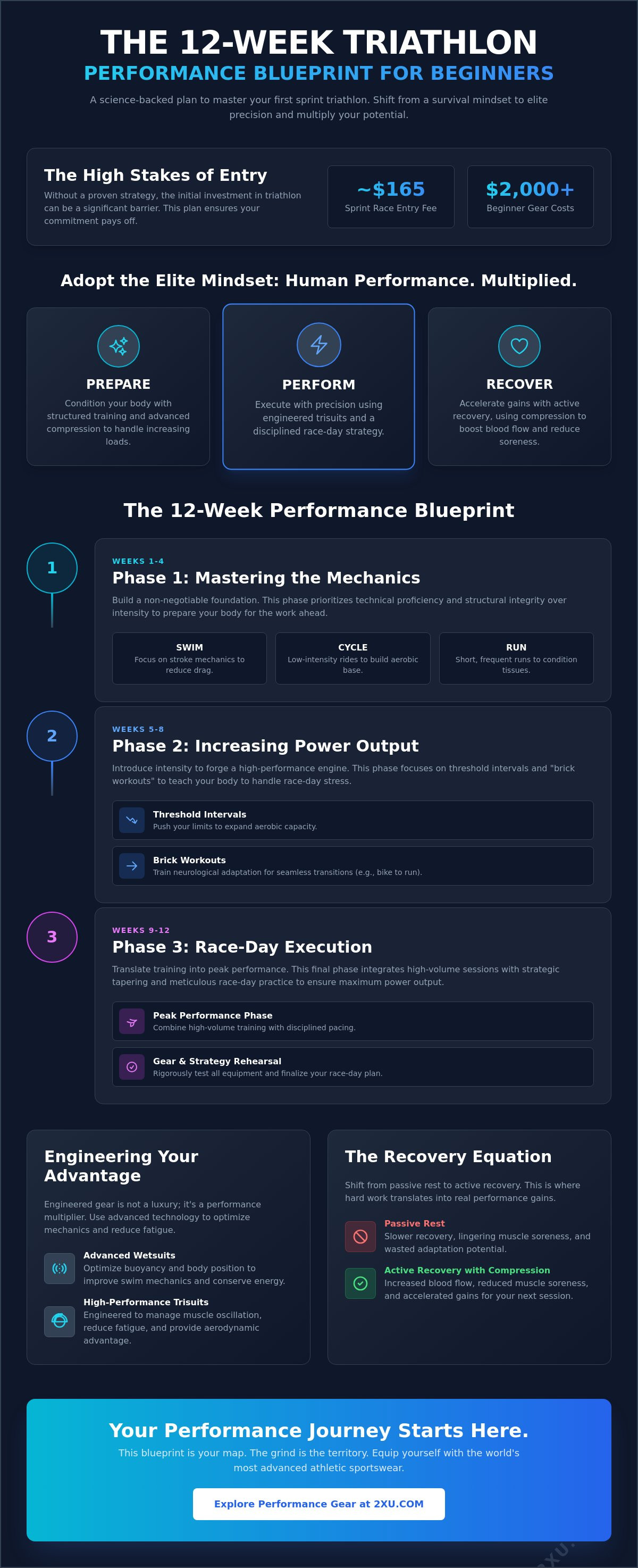
Survival is not a strategy. While generic programmes might suggest you can "go as slow as you want," this scientific 12-week triathlon training plan for beginners is designed to build a high-performance engine. We divide these 84 days into three distinct phases. Each phase has a specific physiological objective. We treat the rest day as a functional part of your programme. It is during these periods of stillness that your body adapts to the stress of training, turning hard work into actual performance gains.
Before you step onto the course of a sanctioned event, ensure you are familiar with the current regulations provided by USA Triathlon. As of May 2026, rules regarding buoyancy shorts and equipment are updated annually to maintain competitive integrity. Your 12-week journey must respect these standards while pushing the limits of your own biology.
Phase 1: Mastering the Mechanics
The first four weeks focus on technical proficiency. In the pool, we prioritise stroke mechanics over raw distance. Water is nearly 800 times denser than air; reducing drag is the most efficient way to multiply your speed. Cycling sessions remain at a low intensity to build fat-burning efficiency and aerobic capacity. We introduce short, frequent runs to condition your connective tissues for high-impact loads. This phase is about structural integrity. You are preparing your body to handle the intensity that follows. Optimise these early sessions by wearing athletic sportswear engineered to manage muscle oscillation and reduce fatigue.
Phase 2 & 3: Increasing Power Output
Weeks five through eight introduce threshold intervals. These sessions are designed to raise your functional power on the bike and your pace at lactate threshold during the run. We incorporate weekly brick sessions to simulate race-day fatigue and master the neurological transition between disciplines. The final phase, weeks nine through twelve, focuses on the "Peak and Taper." The science of the taper involves reducing training volume by 40 to 60 per cent while maintaining high intensity. This allows for glycogen replenishment and tissue repair without losing aerobic sharpness. By the time you reach the start line, your power output will be at its absolute maximum. Discipline in the taper is just as important as discipline in the grind. Do not be tempted to add extra kilometres in the final week; trust the data and the programme.
Engineering Your Advantage: Gear as a Performance Multiplier
Mediocrity stops at the equipment list. In a sport where seconds separate the elite from the pack, your gear is not a secondary consideration. It is the first step in multiplying your effort. Every piece of kit you select either multiplies your power output or acts as a drag on your potential. A high-performance triathlon training plan for beginners must include a rigorous assessment of technical apparel to ensure that the work you put into "the Grind" translates into measurable speed on race day. Technical apparel serves as a critical tool for thermoregulation and moisture management, keeping your core temperature stable while you push into high-intensity zones.
The Swim: Reducing Drag and Increasing Lift
Water provides significantly more resistance than air. To overcome this, a triathlon wetsuit is engineered to alter your physical relationship with the water. 2XU wetsuits utilise proprietary Yamamoto neoprene, a material that offers superior flexibility and durability. The inclusion of strategically placed buoyancy panels is a scientific necessity for the beginner. These panels lift the hips and legs into a horizontal, hydrodynamic position. This technical correction solves the "heavy legs" syndrome that plagues many new athletes, allowing you to conserve energy for the bike leg. When selecting your neoprene wetsuit, choose full-sleeve models for maximum hydrodynamics in water temperatures below 20 degrees Celsius, or sleeveless options for increased shoulder mobility in warmer conditions.
The Bike and Run: Optimising the Transition
Transition times are often where beginners lose their competitive edge. A dedicated triathlon suit is non-negotiable because it eliminates the need to change apparel between disciplines, potentially saving you several minutes in T1 and T2. These suits are engineered with ergonomic chamois designs that provide protection on the saddle without hindering your gait during the run. Anti-chafe technology and flatlock seams are essential to prevent skin irritation over long distances. As you move into the final leg, running shorts and tops featuring advanced ventilation zones become critical. These zones facilitate rapid evaporation, ensuring that sweat does not add unnecessary weight or cause chilling. Your gear should be an extension of your body, meticulously tested during your 12-week programme to ensure zero failures when the clock is running.
The Recovery Equation: Multiplying Your Gains Between Sessions
Gains don't happen during the interval; they happen during the repair. If your triathlon training plan for beginners only focuses on the sweat of the session, you are failing the science of performance. Discipline extends beyond the track and the pool. It requires a meticulous approach to the "Recover" phase of the 2XU framework. True athletes realise that rest is not an absence of work. It is a strategic period of physiological adaptation where your body rebuilds tissues stronger than they were before. Without this phase, "the Grind" simply leads to overtraining and structural failure.
Compression Technology: The 2XU Edge
Graduated compression is a scientific tool designed to increase blood flow and accelerate the removal of metabolic waste. By applying specific pressure profiles, compression shirts and tights reduce muscle oscillation, the primary cause of muscle micro-tears and subsequent soreness. Our proprietary Muscle Containment Stamping (MCS) technology provides targeted support to key muscle groups, such as the quads and calves, which endure significant load during the high-impact running sessions detailed in your 12-week blueprint. Elite athletes don't just wear compression during the performance; they utilise it during travel and immediately post-session to ensure the recovery cycle begins the moment the clock stops. This reduces downtime and ensures you can hit your next threshold session with maximum power output.
Active Recovery and Injury Prevention
Passive rest is often less effective than active recovery. Incorporating low-intensity "flush" rides or swims helps circulate oxygenated blood through fatigued muscles without adding further stress. These sessions should feel effortless, staying well below 60 per cent of your maximum heart rate. Alongside these movements, dedicated mobility work is essential to maintain the flexibility required for a sustained aerodynamic position on the bike. Tight hip flexors or a restricted thoracic spine will compromise your efficiency and increase drag. Recovery is where the actual 'multiplication' of performance occurs.
Fuel your adaptation with precision. Nutrition and hydration are the raw materials for tissue repair. You must replenish glycogen stores within 30 to 60 minutes of finishing a session to kickstart the recovery process. Combine this with the ultimate performance enhancer: sleep. High-output athletes require seven to nine hours of quality sleep to facilitate the hormonal release necessary for muscle growth and cognitive repair. Discipline in your sleep schedule is just as vital as discipline in your swim sets. To ensure your body is recovering at its peak potential, explore our range of recovery compression garments engineered for the elite athlete.
Race Day Execution: From Preparation to Performance
The final stage of your 12-week grind is not where you test new theories. It is where you execute a proven strategy. The "Nothing New on Race Day" rule is a scientific mandate. Every piece of equipment, from your trisuit to your specific hydration protocol, must have been rigorously tested during your triathlon training plan for beginners. Introducing untested variables increases the risk of mechanical failure or physiological distress, undermining months of disciplined preparation. Success on race day is the result of removing uncertainty through meticulous rehearsal.
Pacing is where most beginners fail. The adrenaline of the start often leads athletes to "blow up" within the first 500 metres of the swim, causing an unsustainable spike in heart rate and lactate accumulation. You must maintain the discipline to stay within your established training zones. Transitions, known as T1 and T2, are effectively the fourth discipline of triathlon. Speed here is free time. Treat your transition area with the same precision as a laboratory; every item must be placed ergonomically to ensure you move from water to bike, and bike to run, with elite efficiency. When the race enters the final stages and fatigue sets in, lean into the mental resilience you built during your 12-week programme. Respect the grind and trust your data.
The Final 24 Hours
Your performance in the final 24 hours determines your power output on the course. Focus on a high-carbohydrate loading protocol, aiming for 8 to 10 grams of carbohydrate per kilogram of body mass to fully saturate glycogen stores. Hydration must be consistent, using electrolyte solutions to maintain sodium balance. Perform a final gear check-out; ensure your bike is indexed, your helmet is secure, and your 2XU kit is laid out for rapid utilisation. Spend time visualising the course and the specific mechanics of your transitions to reduce pre-race cortisol levels and sharpen your focus.
Post-Race: The Cycle Begins Again
The moment you cross the finish line, the "Recover" phase of the 2XU framework restarts. Immediate recovery protocols are essential to mitigate muscle oscillation damage and accelerate tissue repair. Prioritise rehydration and light movement to flush metabolic waste, followed by the application of graduated compression to increase blood flow. Once the initial fatigue subsides, analyse your race data to identify the next performance bottleneck. Whether it was a slow T1 or a drop in power during the final kilometres, use these numbers to refine your next training cycle. Ready to start the grind? Shop the 2XU Triathlon Collection and prepare to multiply your potential.
Master the Grind and Multiply Your Results
You now possess the blueprint to transform from a novice into a disciplined competitor. This triathlon training plan for beginners isn't about mere participation; it's about mastering the physiological demands of the sport through a structured 12-week schedule. You've learned that every session serves a purpose, from technical swim drills to the critical recovery phase where your body actually rebuilds. Success is earned through the intersection of hard work and technical advantage.
We don't settle for mediocrity, and neither should you. 2XU equipment is used by world-champion triathletes because it's engineered to perform under the highest loads. Whether it's our proprietary PWX compression technology or Red Dot Award-winning wetsuit designs, our kit is built to ensure your effort is never wasted. Maximise your potential with 2XU's scientifically engineered triathlon gear and prove that human performance can be multiplied. Step onto the start line with total confidence. You've done the work. Now go claim your place.
Frequently Asked Questions
How many hours a week does a beginner triathlon training plan require?
A standard triathlon training plan for beginners requires between 4 and 8 hours of disciplined work per week. This volume typically covers two sessions per discipline alongside one dedicated brick workout. As you progress into the Build phase during weeks 5 to 8, the intensity increases while the time commitment remains efficient to prevent overtraining. Consistency during this period is the only way to multiply your aerobic capacity.
Do I need an expensive road bike for my first triathlon?
No, an expensive road bike is not a requirement for your first race. You can utilise a hybrid or mountain bike, provided it's serviced and safe for the course. However, a road bike offers a significant aerodynamic advantage and better power output through improved geometry. Focus on the engine you build during the 12-week grind rather than the price tag of your equipment.
What is a 'brick' workout and why is it important for beginners?
A brick workout refers to two disciplines performed back-to-back, most commonly a bike ride followed immediately by a run. These sessions are critical for beginners to train the neurological transition between different muscle recruitment patterns. It conditions your body to manage the "jelly legs" sensation experienced in T2, ensuring your running mechanics remain efficient and your pace doesn't drop due to fatigue.
How can I improve my swimming if I'm a beginner?
Focus on technical proficiency and drag reduction rather than raw yardage in the pool. Beginners should incorporate specific drills like "fingertip drag" to improve stroke efficiency and body position. Consistently using a pull buoy helps you feel the correct horizontal alignment required for elite performance. Training in the water 2 to 3 times per week is the non-negotiable standard for building a resilient aerobic base.
What should I eat during a sprint triathlon?
For a sprint distance, your primary focus is on hydration and electrolyte balance rather than heavy caloric intake. Most athletes complete the race in 60 to 100 minutes, meaning your pre-race glycogen stores should be sufficient. Carry a bottle with a high-quality electrolyte solution on the bike to maintain sodium levels. If your expected finish time exceeds 90 minutes, one energy gel during the bike leg provides a necessary glucose spike.
Is a wetsuit mandatory for my first race?
Wetsuits are mandatory when water temperatures fall below specific thresholds, typically 16 degrees Celsius in many sanctioned events. Even when optional, a wetsuit is highly recommended for beginners because it provides significant buoyancy and corrects body position. This technical advantage reduces drag and conserves your energy for the bike and run legs. Always check the official rules for your event 48 hours before the start.
How do I prevent shin splints during the running portion of training?
Prevent shin splints by strictly adhering to a gradual progression in your weekly mileage. Overuse injuries occur when the load exceeds the structural integrity of your connective tissue. Utilising graduated compression tights during and after runs reduces muscle oscillation and micro-tears. This protects the lower leg and accelerates the recovery phase, allowing you to maintain the discipline of your training schedule without forced downtime.
What is the difference between a sprint and an Olympic distance triathlon?
The primary difference is the total distance and the required endurance base for each event. A sprint triathlon typically consists of a 750-metre swim, 20-kilometre bike, and 5-kilometre run. An Olympic distance doubles these metrics to a 1.5-kilometre swim, 40-kilometre bike, and 10-kilometre run. While the physiological principles of power output remain consistent, the Olympic distance requires a more substantial volume of base training to master.