
How to Choose the Right Wetsuit Thickness: The Performance Guide
Research from the University of Minnesota Sea Grant program confirms that water strips heat from your body at least 24 times faster than air. For a high-performance athlete, this thermal loss is not just uncomfortable; it is a direct drain on your power output and metabolic efficiency. Mastering how to choose the right wetsuit thickness is the difference between fighting the elements and utilising technical gear to multiply your speed. You have likely experienced the mechanical restriction of a suit that is too thick through the shoulders or the energy-sapping shivers of a suit that is too thin. Mediocrity in gear selection has no place in an elite training programme.
We are going to master the science of neoprene thickness to balance thermal protection with elite mobility for your fastest swim yet. You will learn to decode the 3/2/1 numbering systems and apply precise thickness selections based on water temperature and race intensity. This guide provides a technical breakdown of how specific millimetre profiles, such as those engineered into the Propel Pro or P:2 models, impact buoyancy and hydrodynamic speed. Prepare to transition from guesswork to data-driven equipment selection that respects the grind and delivers results.
Key Takeaways
- Learn how to choose the right wetsuit thickness by decoding the millimetre ratings that protect your core while maintaining maximum range of motion.
- Use specific Celsius-based temperature charts to ensure you maintain thermal equilibrium without overheating during high-intensity race efforts.
- Correct your body position in the water by selecting thickness profiles that provide targeted buoyancy to lift the lower body and slash drag.
- Discover how engineered materials like Yamamoto neoprene allow for a thinner, more flexible suit that provides the same warmth as traditional, bulkier options.
- Maximise power output by choosing suits featuring Muscle Containment Stamping to reduce muscle oscillation and fatigue during the swim leg.
The Performance Paradox: Why Wetsuit Thickness Matters
In the water, thermal protection is a tactical requirement. While casual swimmers view a suit as a comfort item, the elite athlete understands that wetsuit thickness is the primary barrier against conductive heat loss. Research from the University of Minnesota Sea Grant program proves that water saps heat from the body 24 times faster than air. If you fail to understand how to choose the right wetsuit thickness, you aren't just getting cold; you are bleeding power. The "Multiplier" effect occurs when you select a millimetre profile that retains enough core heat to prevent muscle oscillation and shivering, allowing every watt of energy to be converted into forward propulsion. For the serious athlete, thickness is not a matter of comfort. It's a calculated decision to preserve the metabolic resources you've earned through the grind of training.
Thermal Equilibrium and Athletic Output
Thermal equilibrium in open-water swimming is the precise state where metabolic heat production equals environmental heat loss, ensuring core temperature stability for sustained power output. When your core temperature drops below this threshold, your body triggers a "cold shock" response. This isn't just a mental hurdle. It causes an immediate spike in heart rate and disrupts your stroke rhythm, forcing your respiratory system to work harder for less oxygen. Understanding wetsuit technology and insulation is vital because a suit that is too thin forces your body to divert blood flow from your working muscles to your vital organs. You cannot maintain an elite pace when your calves and forearms are starving for oxygenated blood. Precision in neoprene selection ensures your heart focuses on propulsion, not survival.
The Mechanical Cost of Neoprene
Every extra millimetre of neoprene comes with a mechanical tax. This is the performance paradox. While a thicker suit offers superior warmth, it creates massive resistance during the recovery phase of your stroke. You are essentially fighting the suit with every reach. Shoulder fatigue is the primary performance killer for triathletes who choose bulk over engineering. Elite suits solve this by using variable thickness. They place thicker neoprene in the core for warmth and buoyancy while utilising ultra-thin, high-stretch panels in the shoulders to preserve your range of motion. Mastering how to choose the right wetsuit thickness means finding the "sweet spot" where you stay warm enough to perform without carrying unnecessary resistance. Don't let your gear become an anchor. Choose a suit that respects your discipline and multiplies your effort.
Decoding the Millimetres: Understanding Thickness Ratings
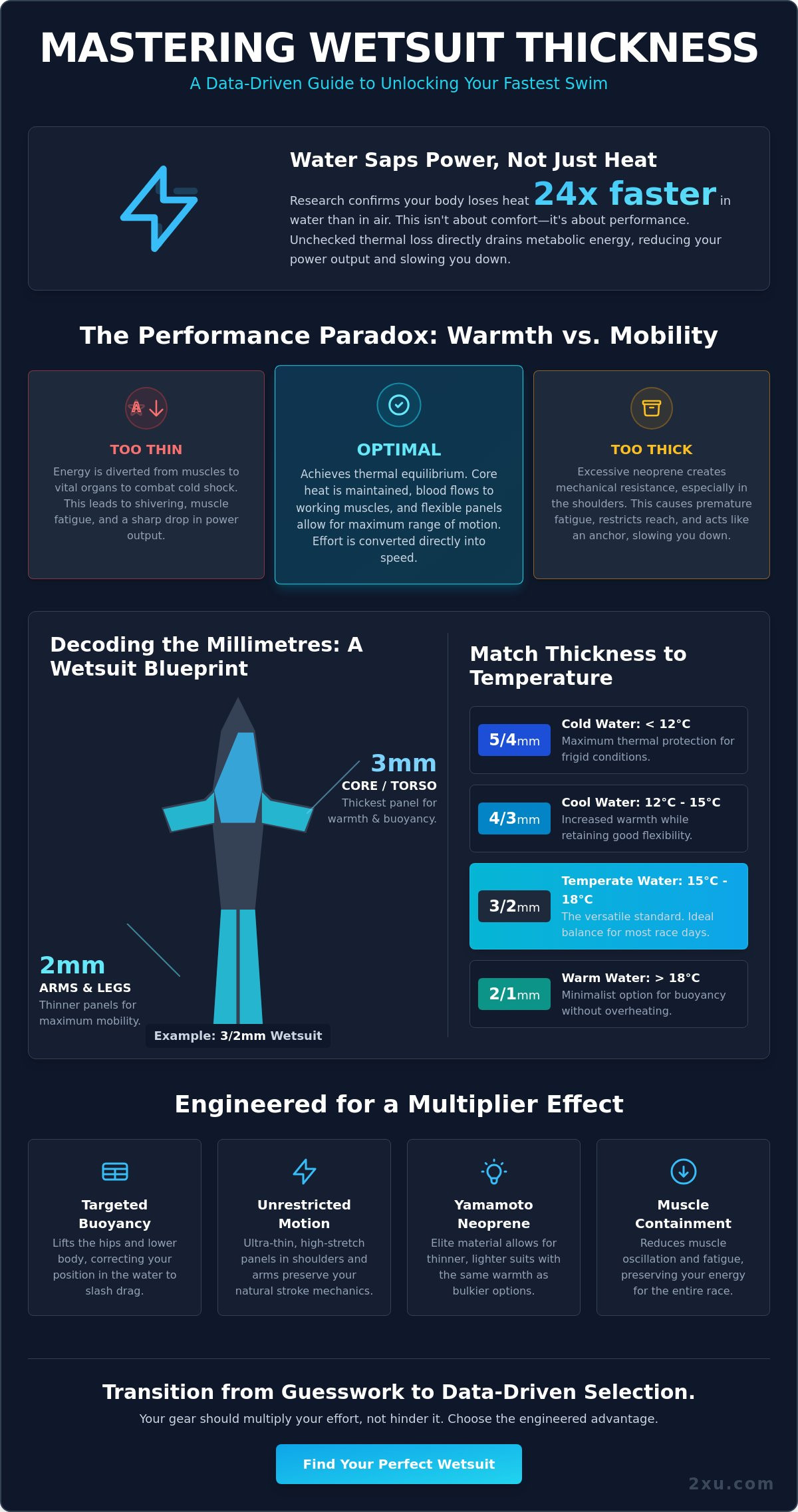
Wetsuit notation is a technical blueprint for hydrodynamic efficiency. When you see numbers like 3/2mm or 4/3mm, you're looking at a strategic map of thermal protection. The first digit represents the thickness in millimetres of the torso panels. This is the heavy lifting zone. It protects your vital organs and provides the buoyancy needed to keep your hips high in the water column. The second and third digits refer to the extremities. Thinner neoprene here is non-negotiable for mobility. If your arms are encased in 4mm rubber, your stroke rate will drop as you fight the material's resistance. Mastering how to choose the right wetsuit thickness involves understanding that neoprene wetsuit science dictates these specific ratios to maximise your power output.
The core requires the most insulation because your body prioritises organ temperature over limb circulation. When you're cold, blood retreats from your extremities. By using thicker neoprene on the chest and back, you maintain core warmth and keep oxygen-rich blood flowing to your working muscles. This is a tactical choice. Thinner limbs ensure that your range of motion remains uncompromised, allowing for a natural, efficient stroke.
The 3/2mm Standard: The Versatile Workhorse
This is the standard for water temperatures between 15°C and 18°C. In a 3/2mm triathlon suit, the 3mm core provides essential lift, while the 2mm shoulder panels allow for an aggressive reach. It is the go-to choice for most race days. If you're an experienced swimmer with a high stroke rate, this configuration offers the best balance of speed and protection. You'll find this balance in our high-performance triathlon wetsuits, engineered for those who refuse to compromise.
The 4/3mm and 5/4mm: Forging Through the Cold
When the grind takes you into water below 15°C, you need robust insulation. A 4/3mm suit is the sweet spot for winter training in temperate climates. At this thickness, seam construction is as important as the neoprene itself. GBS (Glued and Blind Stitched) seams are mandatory to prevent cold water from flushing the suit. In sub-12°C conditions, a 5/4mm suit becomes necessary. While the extra millimetre adds weight, it prevents the energy-sapping shivers that would otherwise end your session early. Respect the elements, but don't let them dictate your performance.
The Temperature Variable: Matching Neoprene to the Water
Precision is the hallmark of the elite athlete. You don't guess your split times, and you shouldn't guess your gear. While general guides offer a starting point, mastering how to choose the right wetsuit thickness requires a data-driven approach that accounts for environmental reality. Thermal protection is a sliding scale. As the thermometer drops, your margin for error narrows. Use this definitive Celsius-based guide to calibrate your equipment for the conditions you'll face on race day.
- 24°C and above: Wetsuits are often optional or legally prohibited in sanctioned triathlons. Consider a sleeveless suit or a high-performance trisuit to maximise speed without the risk of hyperthermia.
- 18°C to 23°C: This is the domain of the 2mm or 3/2mm suit. In these moderate temperatures, mobility and hydrodynamic efficiency take precedence over heavy insulation.
- 13°C to 17°C: Transition to a 3/2mm or 4/3mm profile. Your choice here depends on your body composition and the duration of your session.
- Below 12°C: This is extreme territory. You require a 5/4mm or 5/3mm suit. Accessories like hoods, gloves, and booties are no longer optional; they are essential to prevent the rapid onset of hypothermia.
Intensity and Metabolic Heat
The missing link in most gear guides is the "Effort Factor." Your body is a heat engine. A sprint-distance triathlete operating at 95 percent of their maximum heart rate generates significantly more metabolic heat than a long-course athlete pacing for an eight-hour day. If you are a high-cadence, high-intensity swimmer, you can often "down-gauge" your thickness. Choosing a 3/2mm suit for 14°C water might be a viable tactical move for a 750-metre blast, provided your stroke rate remains high enough to sustain core temperature. However, the risk of overheating in a suit that is too thick is real. Hyperthermia leads to vasodilation and premature fatigue, stripping away the very performance gains you're chasing. Respect the grind, but understand your own internal thermostat.
Environmental Factors Beyond the Thermometer
The water temperature is only one piece of the puzzle. Wind chill is a critical variable because it affects the "out of water" phase of your stroke. When your arm is in the recovery phase, air moving at 20 knots can accelerate heat loss through thin neoprene panels. Similarly, direct sun exposure provides radiant heat that can make a 16°C day feel like 20°C, whereas heavy cloud cover demands more robust protection. Finally, consider the water type. Freshwater is less buoyant than saltwater. In a lake or river, you may opt for a slightly thicker suit not just for warmth, but to provide the mechanical lift needed to maintain a flat, fast profile in less dense water.
The Buoyancy Factor: Thickness as a Speed Tool
Buoyancy is not a luxury; it is a mechanical advantage. For the majority of swimmers, "sinking legs" create a massive increase in frontal drag, forcing the upper body to work twice as hard to maintain forward momentum. Mastering how to choose the right wetsuit thickness allows you to manipulate your centre of buoyancy, lifting the hips and legs into a streamlined, horizontal position. A high-performance triathlon wetsuit utilises targeted thickness, often placing 5mm neoprene in the lower body, to correct this common technical flaw. By reducing the surface area exposed to water resistance, you slash your drag coefficient and convert more of your stroke power into actual velocity. Elite gear incorporates specific buoyancy panels that act as a tactical tool for speed, not just a flotation aid.
Body Position and Hydrodynamics
The application of 5mm neoprene through the core and upper legs serves a dual purpose. Beyond simple lift, these panels act as a stabiliser for the spine, reducing unnecessary lateral movement and "snaking" through the water. This stability is critical for maintaining an efficient stroke path. Scientific testing on aquatic performance indicates that an optimised body position can lead to a measurable reduction in oxygen consumption (VO2 max) at race pace. When you aren't fighting to keep your legs at the surface, your cardiovascular system can dedicate more resources to propulsion. Beginners or those with a heavy leg kick often benefit from maximum legal thickness in the lower panels to compensate for technical inefficiencies while they continue to respect the grind of training.
Thickness and Transition Speed
While thickness is your ally in the water, it can become an enemy in the transition area. Neoprene that is too thick at the ankles and wrists creates a bottleneck during T1. If you select a suit with uniform 5mm thickness throughout the legs, you risk a slow removal that can cost you 10 to 15 seconds on the ramp. High-performance engineering solves this by using "tapered" thickness. By reducing the neoprene to 1.5mm or 2mm at the exit points, we ensure the suit stretches easily over the heels and hands. 2XU engineers these zones specifically for a rapid, one-motion exit, allowing you to transition from the water to the bike without losing the lead you earned. Don't let poor gear selection ruin a fast swim. Shop our Propel series to find the perfect balance of buoyancy and transition speed.
Engineering the Multiplier: Why 2XU Wetsuits Lead the Pack
Elite performance is built on the foundation of superior materials. While others focus on heritage, 2XU focuses on the physics of the swim. We utilise high-grade Yamamoto neoprene, a material renowned for its unparalleled stretch-to-thickness ratio. This ensures that when you determine how to choose the right wetsuit thickness, you are receiving a garment that moves with your anatomy rather than against it. By incorporating 39-cell and 40-cell neoprene variations, we optimise flexibility in the shoulders and buoyancy in the core. This is not a generic piece of rubber. It is a meticulously engineered triathlon suit designed to sharpen your competitive edge.
A core differentiator in our engineering is the integration of Muscle Containment Stamping (MCS). This proprietary technology, usually reserved for our world-leading compression gear, is built into the suit to provide targeted support to active muscle groups. By reducing muscle oscillation and vibration during the swim, MCS helps preserve your energy for the bike and run legs. We don't just help you swim faster; we ensure you emerge from the water ready to dominate the rest of the race. This is the embodiment of our mission: Human Performance. Multiplied.
Zonal Engineering for Elite Athletes
Our engineers have developed a precise thickness map to solve the performance paradox discussed in earlier sections. This includes 5mm neoprene in the core for maximum lift, 3mm in the lower legs to maintain a horizontal profile, and ultra-thin 1.5mm panels under the arms for a zero-resistance stroke. To further slash drag, each suit features a Super Composite Skin (SCS) coating. This hydrodynamic layer reduces water resistance by a significant margin, allowing you to glide through the water with minimal friction. Every millimetre is placed with intent, ensuring your gear never dictates your limits.
The Final Fit Check
Science and data only deliver results if the fit is precise. You can master how to choose the right wetsuit thickness, but a suit that is too large will create pockets where water pools. This pooling destroys thermal efficiency and adds dead weight, effectively turning your high-tech gear into an anchor. The suit must feel like a second skin, with no gaps at the small of the back or under the arms. Respect the grind by ensuring your equipment is as disciplined as your training. Shop the 2XU Wetsuit Collection to find the exact thickness and fit required for your next breakthrough performance.
Master the Water with Precision Engineering
You now understand that high-performance gear is a mechanical multiplier. Selecting the right thickness isn't about comfort; it's about maintaining thermal equilibrium and peak hydrodynamic efficiency. By mastering how to choose the right wetsuit thickness, you ensure your metabolic energy is spent on propulsion rather than heat production. You've seen how targeted buoyancy panels correct your horizontal profile and how variable thickness preserves your natural stroke rhythm. These technical choices are what separate the elite from the average.
2XU gear is the choice of IRONMAN world champions because we refuse to compromise on scientific validation. Our proprietary Yamamoto neoprene technology delivers the maximum buoyancy required for elite speed while ensuring zero restriction through the recovery phase of your stroke. This is the equipment you need to respect the grind and achieve your next breakthrough. It's time to stop guessing and start performing at your absolute limit. Every session is an opportunity to sharpen your edge and earn your place through discipline.
Optimise your swim split with 2XU high-performance wetsuits
The water doesn't care about your excuses, only your output. Get race ready.
Frequently Asked Questions
Is a 3/2mm wetsuit thick enough for winter swimming?
A 3/2mm suit is generally insufficient for winter swimming in water temperatures below 14°C. While it offers superior mobility, the conductive heat loss in extreme cold will cause muscle oscillation and rapid fatigue. For true winter conditions in southern latitudes, you require the 4/3mm or 5/4mm technical profiles discussed earlier to maintain core temperature and protect your metabolic output during the grind of off-season training.
Can a wetsuit be too thick for triathlon racing?
Yes, excessive thickness leads to hyperthermia and mechanical resistance that can ruin your race. If you use a 5mm suit in 22°C water, your body will overheat, causing vasodilation and an elevated heart rate that saps your endurance. Understanding how to choose the right wetsuit thickness for specific race intensities ensures you don't fight against unnecessary rubber weight or risk the performance collapse associated with overheating.
How much does wetsuit thickness affect buoyancy?
Neoprene thickness has a linear relationship with displacement and lift in the water column. Every additional millimetre of Yamamoto neoprene adds significant buoyancy, which is why elite 2XU suits use 5mm panels in the lower body. This lift corrects "sinking legs" and reduces your frontal drag coefficient by up to 20 percent compared to swimming in a standard trisuit, directly translating to faster split times for the same effort.
What happens if I choose the wrong thickness for my race?
Choosing the wrong thickness results in a measurable performance decline through either thermal stress or mechanical restriction. If the suit is too thin, you'll lose energy through shivering and blood shunting to vital organs. If it's too thick, you'll suffer from premature shoulder fatigue. Both scenarios increase your oxygen consumption and decrease your velocity, proving that gear selection is as vital to your results as your training discipline.
Do I need different wetsuits for different seasons?
Serious athletes often require a two-suit rotation to manage seasonal temperature shifts and training demands. A 3/2mm suit is the versatile workhorse for spring and autumn racing, while a 4/3mm suit is often necessary for the winter grind. Using a single suit for all conditions is a compromise that sacrifices either mobility or thermal protection, which is a critical consideration when deciding how to choose the right wetsuit thickness for your training year.
How do I know if my wetsuit is providing enough thermal protection?
You have sufficient thermal protection if you can maintain a stable heart rate and stroke rhythm without the onset of shivering. If you experience "the claw" in your hands or a tightening in your chest, your neoprene is too thin for the environmental conditions. Effective insulation allows you to focus entirely on your propulsion and pacing rather than battling the energy-sapping effects of cold shock response.
Is there a difference in thickness between surfing and triathlon wetsuits?
Triathlon wetsuits feature specialised buoyancy mapping and thinner shoulder panels compared to standard surfing suits. While a surfing suit is designed for durability while sitting on a board, a triathlon suit is engineered for horizontal hydrodynamics and a high stroke rate. Surfing suits often lack the variable thickness ratios, such as 1.5mm underarms, that are essential for uninhibited swimming mechanics and rapid transition exits.
Does neoprene thickness affect the durability of the suit?
Thicker neoprene offers more physical material, but high-performance durability depends on the quality of the nitrogen-cell structure and outer coatings. Elite 2XU suits use Yamamoto 39 and 40-cell neoprene which, while thinner in the shoulders for mobility, is protected by a Super Composite Skin (SCS) coating. This coating increases surface durability and reduces friction. Respecting your gear through proper care is part of the discipline required to maintain your competitive advantage.