
Running Shorts Inseam Guide: Engineering Your Performance for 2026
Your inseam length is not a style preference; it is a critical engineering decision that affects your power output and mechanical efficiency. You understand that every gram of weight and every centimetre of resistance matters when you're chasing a personal best. This running shorts inseam guide allows you to master the mechanics of apparel to optimise your range of motion and eliminate the muscle oscillation that leads to premature fatigue.
We agree that nothing stalls a session like the restrictive pull of excess fabric during speedwork or the persistent irritation of chafing during long distance efforts. With high quality performance shorts now averaging between $60 and $100 in 2026, you cannot afford to invest in gear that hinders your biomechanics. This article provides a technical breakdown of 3, 5, and 7 inch inseams. You will learn how to select the precise length that provides the stability you need to multiply your performance and maintain a professional aesthetic that reflects your discipline.
Key Takeaways
- Understand why every millimetre matters in your kit. Learn how to eliminate mechanical drag by matching your inseam length to the specific demands of your stride.
- Discover why the 3-inch split short remains the elite standard for race day. This running shorts inseam guide explains how shorter lengths maximise range of motion during high-intensity efforts.
- Optimise your endurance sessions with longer inseams engineered for muscle stability and protection. Identify the specific conditions where 7-inch and 9-inch lengths are required to endure the grind.
- Leverage advanced compression liners and Muscle Containment Stamping (MCS) to significantly reduce muscle oscillation. Learn how targeted support can delay fatigue and multiply your total power output.
- Build a professional-grade apparel rotation using the 'Prepare, Perform, Recover' framework. Ensure you have the engineered tools necessary for every discipline in your training programme.
Defining the Inseam: The Mechanics of Athletic Fit
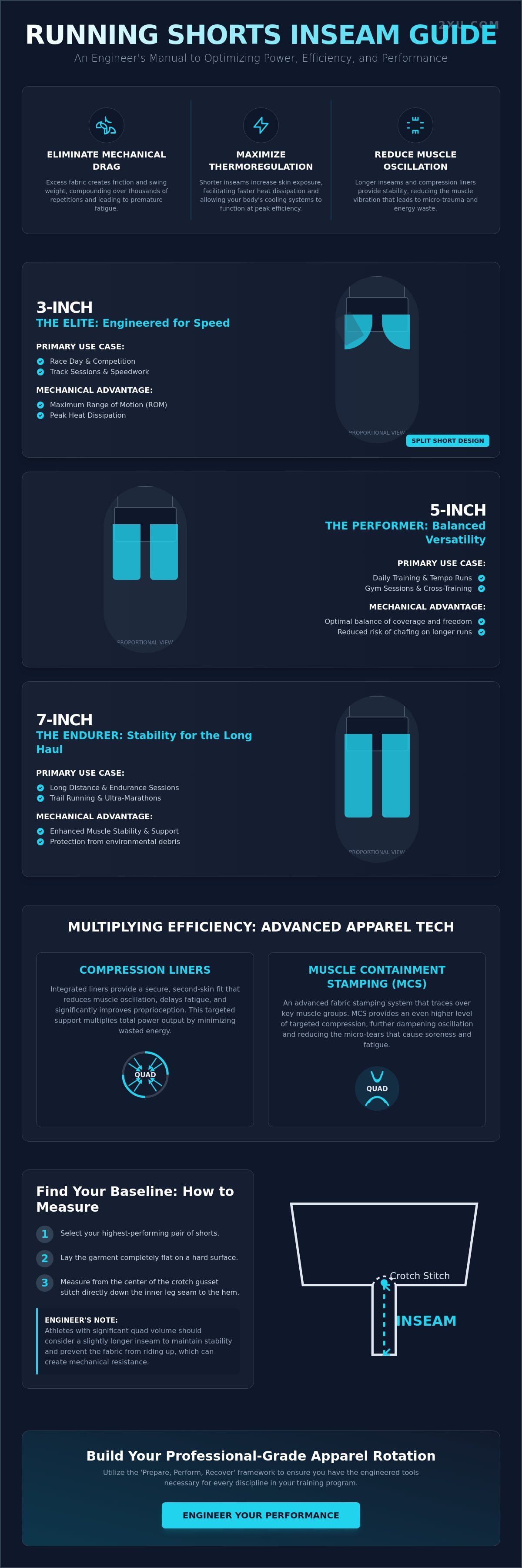
The inseam is the linear measurement from the crotch stitch to the bottom of the leg opening. In elite performance, this is not a subjective style choice. It is a technical specification. A millimetre of excess fabric is a millimetre of potential drag. Precision engineering requires you to treat your apparel like a component of your mechanical system. This running shorts inseam guide focuses on the physics of the stride and how your kit affects your power output.
Thermoregulation is a primary factor in maintaining high-output efforts. Your body generates immense heat during the grind. Excess fabric acts as an insulator, trapping heat against the large muscle groups of the quads and hamstrings. Shorter inseams facilitate faster heat dissipation through increased skin exposure, allowing your internal cooling systems to function at peak efficiency. When you optimise your kit, you optimise your engine. We don't settle for mediocrity because every watt of power must be preserved.
How to Measure Your Ideal Inseam
To engineer your performance, you must first establish your baseline. Use a flexible measuring tape to find your optimal coverage point. Follow these steps to audit your current equipment:
- Select your highest-performing pair of shorts that currently feels most efficient during speedwork.
- Lay the garment flat on a hard, level surface to ensure no fabric bunching occurs.
- Measure from the centre of the gusset stitch directly down the inner leg to the hem.
Athletes with significant muscle volume must account for thigh circumference. A short inseam on a high-volume quad may ride up, creating mechanical resistance and increasing the risk of skin-to-skin friction. This running shorts inseam guide suggests that if your quads are highly developed, you may need a slightly longer inseam to maintain stability. The inseam serves as a critical metric for reducing aerodynamic and mechanical resistance.
The Impact of Length on Stride Frequency
Mechanical interference is the enemy of speed. During high-knee drives, excess fabric creates friction between the thighs. This resistance compounds over thousands of repetitions, leading to premature fatigue. Running shorts with shorter inseams reduce the swing weight of the limb. Physics dictates that every gram of fabric at the end of your lever requires more metabolic energy to move. Even a 20-gram difference in fabric weight can impact your efficiency over a marathon distance.
Your primary discipline dictates your selection. Sprints and track intervals require the absolute minimum 3-inch inseam to facilitate explosive movement. Ultra-endurance athletes often opt for a 5-inch or 7-inch inseam to balance weight with protection against environmental debris and equipment friction. Respect the distance you're covering by choosing the tool that matches the demands of the terrain. Earn your place at the front of the pack by obsessing over these details.
The 3-Inch and 5-Inch Elite: Engineered for Speed
When seconds determine the gap between a personal best and the middle of the pack, your equipment must be invisible. The 3-inch and 5-inch inseams represent the pinnacle of speed-focused engineering. This running shorts inseam guide identifies these specific lengths as the primary tools for high-intensity output where every gram of weight and every millimetre of fabric resistance is calculated. You don't train this hard to be slowed down by poorly designed gear.
Maximum range of motion (ROM) is the non-negotiable requirement for speedwork. By minimising leg coverage, you remove the physical barriers that impede the hip flexors and hamstrings during the drive phase of your stride. Furthermore, heat dissipation is critical for maintaining your core temperature. Shorter inseams increase the skin surface area available for evaporative cooling. This prevents your internal engine from overheating when you're pushing through the final repetitions of a track session or the closing kilometres of a race.
The Mechanical Advantage of the Split Short
The 3-inch split short is a masterclass in biomechanical design. It features overlapping fabric panels at the side seam that allow the leg to move independently of the garment's structure. Track athletes and elite racers prioritise this length because it facilitates explosive power without the drag of excess material. By using advanced engineered fibres, we eliminate the friction that causes inner-thigh irritation. This ensures your focus remains entirely on the grind, not on the discomfort of your kit. You earn your speed through discipline; your gear should simply enable it.
The 5-Inch Mid-Length: Balance and Versatility
The 5-inch inseam is the most popular choice for the modern athlete because it offers a sophisticated balance between performance and coverage. It's the workhorse of a professional kit, providing enough stability for the quads while maintaining the stride frequency required for tempo runs. Many athletes find that practical advice for long-distance runners often points to this mid-length for community races and half-marathon training blocks where versatility is key.
This length is ideal for 5K sprints through to full marathon preparation. It provides a professional aesthetic that reflects your discipline without sacrificing the mechanical efficiency needed for high-output efforts. If you're ready to sharpen your performance, consider integrating high-performance running apparel into your rotation. Whether you're on the track or the road, the 5-inch length delivers consistent results for those who refuse to settle for mediocrity.
The 7-Inch and 9-Inch Standard: Stability for the Long Haul
Endurance is a game of attrition. While shorter lengths prioritise raw speed, the 7-inch and 9-inch inseams are engineered for the athlete who respects the grind of high-volume training. This running shorts inseam guide identifies these lengths as essential tools for managing the mechanical stress of 4+ hour efforts. When your session moves beyond the track and into technical environments, coverage becomes a performance variable that dictates your ability to endure.
Skin-on-skin contact is a primary cause of performance-ending irritation. Long-distance efforts often lead to "chub rub," where inner-thigh friction creates painful abrasions. Longer inseams provide a physical barrier that eliminates this friction entirely. By choosing a 7-inch or 9-inch length, you ensure that your focus remains on your power output rather than the discomfort of skin irritation. We don't compromise on protection because we don't compromise on results.
Trail Running and Environmental Protection
Technical terrain demands a higher level of kit resilience. Navigating through dense brush or rocky paths exposes your legs to external abrasions and debris. A 7-inch inseam provides the necessary coverage to prevent scratches and stings that can disrupt your rhythm. This length balances the need for protection with the mechanical freedom required for steep climbs. For a deeper dive into the technical specifications of your gear, consult Running Shorts: The Ultimate Guide to Engineering Your Performance. Precision in your selection ensures you can dominate the trail without distraction.
Stability and Muscle Containment
Longer inseams offer a significant mechanical advantage: increased surface area for integrated compression technology. A 9-inch inseam allows for maximum coverage of the quadriceps and hamstrings, which is critical for reducing muscle oscillation. This vibration, caused by the impact of every foot strike, leads to micro-tears and premature muscle fatigue. By containing the muscle mass more effectively, you preserve energy for the final stages of your run.
- Quadriceps Support: Stabilises the large muscle groups during downhill descents.
- Hamstring Protection: Reduces the risk of strain during high-mileage weeks.
- Recovery Efficiency: The 9-inch length is an ideal tool for low-intensity recovery runs, providing warmth and graduated support to flush out metabolic waste.
Every centimetre of fabric in our training apparel is calculated to multiply your performance. You earn your fitness through discipline. We provide the engineering to protect it.
Compression Liners: Multiplying Your Efficiency
The internal architecture of your apparel is as vital as the external shell. While the external fabric manages aerodynamics and protection, the liner is the engine room of your kit. Most basic garments include a standard brief, but elite performance requires an integrated system. This running shorts inseam guide emphasizes that your choice of inseam must support the mechanical function of the compression liner beneath it. When you align these two variables, you create a high-performance environment that sustains power output over the duration of the grind.
Integrated liners outperform standalone underwear because they are engineered to work in tandem with the short's chassis. Standard underwear often shifts during high-knee drives, leading to bunching and mechanical resistance. Our technical fibres are engineered polymers designed to move moisture away from the skin at a rate that standard materials cannot match. This moisture transfer is critical. It prevents the accumulation of sweat weight, ensuring your kit remains lightweight from the first kilometre to the last.
The Science of Muscle Oscillation
Muscle oscillation is the involuntary vibration that occurs within your muscle tissue every time your foot strikes the pavement. This vibration wastes metabolic energy and contributes to the micro-trauma that causes premature fatigue. By using graduated compression, particularly in a 5-inch or 7-inch liner, you provide the structural support necessary to contain this movement. This containment facilitates more efficient blood flow, aiding in the removal of metabolic waste. Just as you optimise your upper body with a Compression Shirts: The Scientific Guide to Performance & Recovery, your lower body requires the same level of scientific rigour to maintain peak efficiency.
Eliminating Chafing Through Fabric Engineering
Irritation is a symptom of poor engineering. We utilise circular knit technology and flatlock seams to ensure a smooth, low-profile fit that eliminates skin-on-skin friction. These are not basic fabrics; they are advanced engineered polymers meticulously assessed for their durability and elasticity. This precision construction ensures that the liner stays in place regardless of your stride frequency. MCS technology within the liner maps directly to the quadriceps to reduce muscle strain and maximise power output. This targeted support is what separates high-performance gear from mediocre alternatives. If you are ready to upgrade your training arsenal, explore our advanced compression clothing to experience the difference that professional engineering makes. Respect the effort you put into your training by wearing gear that works as hard as you do.
Selecting Your Arsenal: A Guide for Every Athlete
Success in 2026 is built on the foundation of strategic preparation. You don't show up to a track session with the same mindset as a recovery trail run, so your equipment shouldn't be identical either. This running shorts inseam guide concludes by implementing our 'Prepare, Perform, Recover' framework. This system ensures you have the engineered tools necessary to sustain your training load and multiply your results. Respecting the grind means acknowledging that every session has a specific mechanical requirement that must be met with precision.
By following this running shorts inseam guide, you eliminate the guesswork from your preparation. Elite athletes don't rely on a single pair of shorts; they build a rotation. Matching the inseam length to the discipline of the day ensures that your range of motion is never compromised and your muscles are always supported. You earn your place in the pack through discipline. We provide the kit that works as hard as you do to ensure your power output remains consistent.
Building a High-Performance Rotation
A comprehensive rotation allows you to optimise your output across the entire athletic lifecycle. Your arsenal should include three distinct categories to handle the various demands of your training programme:
- The Speed Kit: Utilise 3-inch split shorts for track intervals and race day. These are designed for maximum limb speed and minimal weight. When every split second counts, these provide the mechanical freedom you've earned through hours of effort.
- The Endurance Kit: Select 5-inch or 7-inch 2-in-1 shorts for your weekly long efforts. The integrated compression liners provide the stability needed to manage muscle oscillation over 20, 30, or 40 kilometres of impact.
- The Recovery Kit: Deploy 9-inch compression-heavy shorts for post-race movement and low-intensity flush runs. The increased coverage provides maximum graduated support to help you recover faster and get back to the grind sooner.
Final Checklist for the Dedicated Runner
Before you commit to your next training block, perform a technical audit of your gear. Check for waistband security. A slipping waistband is a distraction that wastes mental energy and disrupts your rhythm. Ensure your pockets are positioned for bounce-free nutrition storage, allowing you to carry the fuel you need without affecting your centre of gravity. We maintain rigorous Australian English standards in our global quality control to ensure that every stitch meets our unyielding demands for excellence.
Mediocrity has no place in your training programme. If you're ready to master the mechanics of your stride and eliminate the variables that hold you back, it's time to upgrade your kit. Shop the 2XU Running Shorts Collection and Multiply Your Performance. Your potential is waiting to be unlocked through precision engineering and relentless effort. Don't settle for gear that doesn't respect the work you put in.
Master Your Mechanical Efficiency
Your performance is the result of thousands of hours of discipline. This running shorts inseam guide has provided the technical roadmap to ensure your equipment matches that level of commitment. You've learned that selecting the correct inseam is a critical engineering decision that balances range of motion with essential muscle stability. Whether you're deploying a 3-inch split for track intervals or a 7-inch 2-in-1 for technical trails, every centimetre must serve your power output.
Our apparel is rigorously tested by elite research teams to confirm that our proprietary Muscle Containment Stamping (MCS) technology effectively reduces fatigue. By utilising graduated compression, we ensure you recover faster and return to the grind with maximum strength. Don't let mediocre gear compromise your biomechanics. Multiply your output with 2XU Engineered Running Shorts and experience the difference of precision engineering. The road ahead is demanding. Ensure you're equipped to dominate it.
Frequently Asked Questions
What is the most popular inseam for marathon running?
The 3-inch split short is the standard for marathon racing because it provides the maximum range of motion required for 42.2 kilometres of repetitive movement. Many competitive athletes choose this length to minimise fabric weight and maximise heat dissipation during high-intensity efforts. If you require additional storage for nutrition, a 5-inch inseam often provides better pocket stability without sacrificing mechanical efficiency.
Do I need to wear underwear with running shorts that have a liner?
You don't need to wear underwear with running shorts that feature an integrated liner. These liners are engineered to provide direct support and manage moisture transfer while eliminating the friction caused by additional layers. Adding a second layer of underwear increases the risk of chafing and traps heat against the skin, which compromises your internal cooling system and reduces your overall power output.
How do I prevent my running shorts from riding up?
Ensure your shorts have an integrated compression liner to prevent the fabric from riding up during high-knee drives. A liner with a 5-inch or 7-inch length provides more surface area to grip the quad, maintaining its position throughout your stride. If riding up persists, audit your sizing; shorts that are too small for your muscle volume will naturally migrate upward under the tension of your movement.
Is a 5-inch or 7-inch inseam better for gym and running hybrid training?
A 7-inch inseam is superior for hybrid training because it provides necessary coverage for movements like squats and deadlifts while remaining efficient for running. This length offers protection against equipment friction in the gym and ensures stability during multi-directional movements. This running shorts inseam guide recommends the 7-inch option for athletes who prioritise versatility and protection in their daily training programme.
Does inseam length affect the risk of chafing?
Inseam length directly impacts the risk of skin-on-skin chafing, particularly during long-distance endurance efforts. Shorter 3-inch shorts expose more of the inner thigh, which can lead to irritation if you don't use a topical anti-chafe agent. A 5-inch or 7-inch compression liner creates a physical barrier that eliminates this friction, allowing you to maintain your focus on the grind without the distraction of skin irritation.
What inseam length do professional runners typically wear?
Professional runners typically wear a 1-inch to 3-inch inseam for competition to achieve the lowest possible swing weight. Every gram of fabric at the end of the limb requires metabolic energy to move; therefore, minimal coverage is the elite standard for race day. For daily training, these same athletes often shift to a 5-inch inseam to provide additional protection and storage during high-volume weeks.
How should I care for technical running fabrics to maintain their elasticity?
Wash your technical apparel in cold water and avoid using fabric softeners, which can clog the pores of engineered polymers and reduce moisture-wicking efficiency. Always air dry your kit to preserve the elasticity of the fibres. Exposure to high heat in a dryer can damage the integrity of compression fabrics, leading to a loss of muscle containment and a breakdown of the graduated pressure profile.
Can compression liners in shorts help with existing hamstring strains?
Compression liners featuring Muscle Containment Stamping (MCS) assist with managing hamstring strains by providing targeted support to the muscle group. This technology reduces muscle oscillation and vibration during the impact phase, which prevents further micro-trauma to the injured tissue. While not a replacement for medical advice, integrated compression is a critical component of the "Recover" phase in our performance framework to help you return to peak efficiency.