
Are Compression Pants Good for Lifting? The Science of Multiplying Your Power
Your central nervous system isn't just fighting the iron; it's fighting the wasted energy of every micro-vibration in your muscle tissue. You've felt that instability in a deep squat or the muscle oscillation that drains your power during a heavy deadlift. Many serious athletes ask, are compression pants good for lifting, or are they just another layer of training apparel? The reality is that mediocrity has no place in your kit. To multiply your performance, you need gear that functions as a neurological and physiological tool to stabilise your movement.
We understand the toll of the grind and the frustration of DOMS stalling your training frequency. This article explores how elite-grade compression, like the 2XU Force or Light Speed React Tights, stabilises your muscle groups to maximise power output and reduce waste energy. You'll discover how to enhance proprioception for better form, accelerate recovery between sessions, and lower the risk of soft tissue injury. We're breaking down the science to show you exactly how to stay under the bar longer. It's time to sharpen your discipline and ensure every rep counts.
Key Takeaways
- Learn how technical compression eliminates energy leakage by containing muscle oscillation during explosive compound lifts.
- Discover how engineered garments answer the question, are compression pants good for lifting, by sharpening proprioception and joint awareness under heavy loads.
- Understand the recovery architecture needed to flush metabolic waste and accelerate muscle repair, allowing you to return to the grind faster.
- Explore the engineering behind Muscle Containment Stamping (MCS) and how it provides targeted reinforcement for your quads and glutes.
- Identify why standard loose training apparel is a performance liability and how technical fabrics manage the thermal demands of an intense session.
Are Compression Pants Good for Lifting? The Scientific Verdict
Success on the platform is a game of margins. Every kilogram added to the bar is the result of meticulous preparation and the elimination of inefficiency. If your muscles are vibrating or shifting during a heavy eccentric phase, you are leaking power. This wasted energy is the difference between a successful lockout and a failed attempt. When questioning are compression pants good for lifting, you must look beyond the aesthetics. The scientific verdict is clear: high-performance compression is an essential tool for any athlete who demands maximum stability and refuses to accept mediocrity in their results.
Technical compression is not merely tight clothing. It is a precision-engineered system designed to apply specific, graduated pressure to key muscle groups. While standard gym wear might feel snug, it lacks the mechanical integrity to support soft tissue under the massive internal pressures of a heavy squat or deadlift. By containing the muscle, you reduce oscillation and ensure that every ounce of force is directed into the lift. This is how human performance is multiplied. Mediocrity in your gear leads directly to mediocrity in the rack; you cannot expect elite results from sub-par equipment.
The Difference Between Tightness and Technical Compression
Many lifters mistake standard leggings for a functional compression garment. The distinction lies in the engineering of the fabric and the pressure profile. Elite gear utilises a graduated pressure profile, which is tighter at the extremities to assist blood flow and provide a structural "wrap" effect. Standard fabrics often fail when stretched to their limit; they thin out and lose their ability to provide tension. In contrast, technical garments use high-filament fibres that maintain their compressive power even at the bottom of a deep squat. This consistent tension provides the sensory feedback your brain needs to maintain perfect form under load.
Who Benefits Most: From Powerlifters to Bodybuilders
The benefits of compression gear extend across every lifting discipline. For powerlifters, the primary advantage is the stabilisation of the quads, hamstrings, and glutes, which helps maintain a rigid torso and strong drive. Olympic lifters rely on the proprioceptive feedback to ensure precision during the explosive second pull. Even bodybuilders find value here; the increased blood flow and reduced muscle damage allow for the high-frequency training required for hypertrophy. If you are still wondering, are compression pants good for lifting for the average gym-goer, the answer is yes. If you respect the grind and show up with the discipline to improve, you deserve the tools that protect your progress. Every athlete must earn their place, but the right engineering ensures that no effort is wasted.
How Compression Multiplies Your Lifting Performance
To dominate the grind, you must understand that performance isn't just about raw strength; it's about efficiency. Every movement under the bar requires your body to manage internal forces that threaten your stability. When athletes ask, are compression pants good for lifting, they're often looking for a physical edge. The truth lies in how technical garments interface with your physiology to eliminate energy waste. By optimising blood flow, these garments ensure that oxygenated blood reaches your muscle tissue during high-intensity sets while accelerating the removal of metabolic byproducts during rest periods.
Maintaining muscle temperature is another critical factor. During long rest intervals between heavy sets, your muscles can cool down, increasing the risk of strains when you re-engage with the iron. High-performance compression keeps your muscle groups primed and warm, ensuring they remain elastic and ready for explosive output. This is a core part of the science behind compression, where the focus shifts from simple attire to a functional tool that supports the athletic lifecycle of prepare, perform, and recover.
Proprioception: The Secret to Perfect Form
Proprioception is your body’s ability to sense its position and movement in space without looking. In the middle of a heavy squat, your brain needs constant data to maintain the correct path. Technical compression garments provide a continuous tactile stimulus to the skin, which activates receptors that send feedback to your central nervous system. This heightened awareness allows for micro-adjustments in your technique, ensuring your knees don't cave and your spine remains neutral. Better form naturally leads to higher power output. When your brain trusts your body's position, it can recruit more motor units to move the load. If you want to sharpen this connection, exploring elite compression clothing is the first step toward technical mastery.
Containing the Oscillation: Why Stability Matters
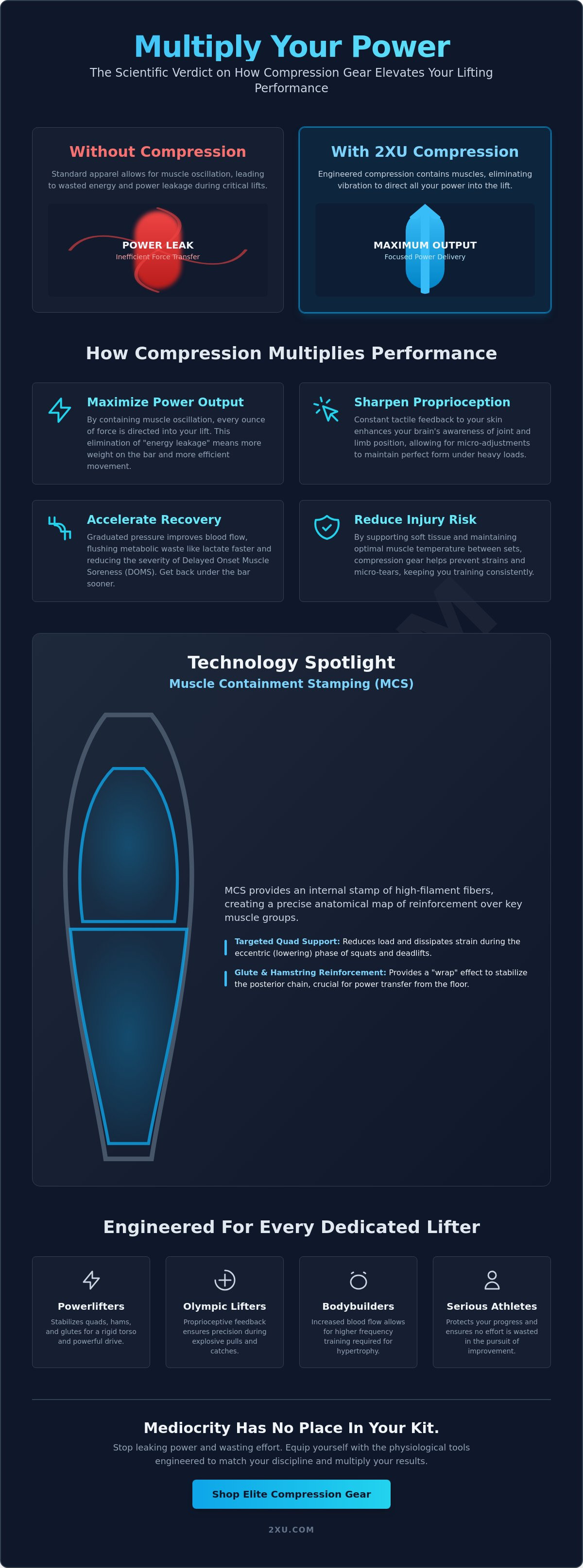
Every time you hit the floor during a dynamic movement or brace for a heavy eccentric phase, your muscles experience vibration. This is known as muscle oscillation. Muscle oscillation is the unnecessary movement of muscle fibres that drains energy reserves. When your muscle tissue is left to shake, your body must work harder to stabilise itself, leading to premature fatigue and increased micro-tears in the soft tissue. By containing the muscle within a firm, supportive structure, compression gear acts like a second skin that dampens these vibrations. This containment preserves your energy for the lift itself rather than wasting it on internal stabilisation. It's a fundamental reason why are compression pants good for lifting is answered with a resounding yes by those who understand the mechanics of power.
Stabilising the Grind: Compression vs. Traditional Gym Wear
Mediocrity has no place in a high-performance training environment. While some lifters argue that you should wear whatever feels comfortable, this casual approach ignores the performance liability of loose clothing. Baggy shorts and oversized shirts offer zero support for soft tissue and can even interfere with your range of motion or get caught on the bar. When you ask, are compression pants good for lifting, you aren't just asking about comfort. You're asking if your gear is actively working to stabilise your body. Technical gear is the uniform of the disciplined; it signals a psychological shift from being a spectator to being an athlete ready to dominate the grind.
Traditional cotton is a sponge for moisture and a heat trap. It becomes heavy, loses its shape, and causes friction that leads to chafing and distraction. A scientific review on compression garments confirms that these technical tools significantly mitigate the decline in muscle strength after exercise induced fatigue. This isn't just about looking the part. It's about using The Science of Compression: Unlock Peak Performance to ensure your muscles are supported from the first warm up to the final heavy set.
The Risk of Non-Technical Fabrics
Standard gym wear lacks the mechanical integrity required for heavy compound movements. Cotton and basic technical blends often fail to provide the "wrap" effect needed to contain muscle oscillation. Without this containment, your muscles waste energy on lateral movement rather than vertical force. Moisture wicking is also critical. High-filament technical fibres move sweat away from the skin to maintain optimal grip and prevent the skin irritation that ruins focus. By avoiding basic fabrics and choosing advanced technical blends, you maintain the tension and thermal regulation required for an elite session. Power is precision, and precision requires gear that stays in place.
Graduated Compression: Support Where You Need It
2XU engineering utilises a graduated pressure profile that is meticulously tested using the Salzmann pressure measurement device. This ensures that pressure is highest at the extremities, driving blood back toward the heart to improve circulation and nutrient delivery. During a heavy lift, a firm, high-rise waistband is essential for core stability and effective bracing. It provides a tactile surface for your abdominals to press against, reinforcing your intra-abdominal pressure. This focus on the "Prepare, Perform, Recover" lifecycle ensures that your gear supports your body through every phase of the lift. If you want to multiply your results, you must choose tools engineered for the demands of the iron.
Recovery Architecture: Bouncing Back from Heavy Sessions
Training is merely the catalyst. The actual physiological adaptation occurs after you leave the rack. If you fail to manage your recovery, you are leaving progress on the table. When evaluating are compression pants good for lifting, the focus often stays on the platform, but the real advantage lies in how they architect your downtime. High-performance compression accelerates the removal of blood lactate and metabolic waste; this ensures your muscle tissue returns to an anabolic state as quickly as possible.
Delayed Onset Muscle Soreness (DOMS) is often viewed as a badge of honour, but for the serious athlete, it is a logistical hurdle. Excessive soreness stalls training frequency and compromises the quality of subsequent sessions. By utilising technical garments, you reduce the inflammatory response and clear the debris of a heavy session. This is a scientific approach to performance that mirrors the principles found in our Compression Shirts: The Scientific Guide to Performance & Recovery. Respecting the grind means respecting the science of the bounce-back.
Flushing the System: Lactic Acid and Beyond
Post-exercise recovery relies heavily on venous return; the process of moving deoxygenated blood back to the heart. Technical compression acts as an external pump for your lymphatic system, applying the pressure needed to move fluid through the body. This mechanical assistance is vital after a high-volume session where metabolic byproducts accumulate in the lower extremities. Accelerated blood flow post-lift reduces the chemical signals that trigger muscle pain. By flushing these toxins, you decrease swelling and provide a clear path for nutrient delivery to damaged fibres.
The 24-Hour Recovery Strategy
The discipline of an elite athlete does not end when the gym lights go out. Wearing compression tights for several hours after a leg session is a critical component of a complete training programme. This 24-hour strategy ensures that the benefits of graduated pressure continue to support your vascular system while you rest. Integrate compression into your post-leg-day routine by donning your recovery gear immediately after showering. This commitment to marginal gains distinguishes those who merely exercise from those who train for breakthrough results. To secure your next session's success, shop our power recovery compression range today.
Engineering the Ultimate Lift with 2XU Technology
Generic compression gear treats your limbs like simple cylinders, applying uniform pressure that ignores the complexity of your anatomy. 2XU engineering takes a different approach. When you ask are compression pants good for lifting, the answer depends on the precision of the muscle mapping. Our proprietary Muscle Containment Stamping (MCS) technology is a breakthrough in lifting support. It provides a targeted layer of reinforcement that traces the exact lines of your quads and glutes. This isn't just about tightness; it's about anatomical reinforcement where lifters face the highest mechanical stress.
The foundation of this stability is our PWX fabric. This material is high-power, lightweight, and engineered to withstand the extreme tension of a heavy session. Unlike basic technical blends that stretch out and lose their integrity over time, PWX maintains its compressive power through thousands of reps. To ensure our claims are backed by data, every garment is assessed using the Salzmann pressure measurement device. This confirms that the graduated pressure profile is accurate and effective for driving performance. Mediocrity doesn't enter our minds, and it shouldn't enter your kit.
Anatomical Mapping: Support That Moves With You
Standard braces are often bulky and restrictive, which can alter your mechanics during complex movements. MCS provides a second skin of stability for the knee and hip joints without compromising your range of motion. During a deep squat or a heavy deadlift, this stamping acts as a physical guide for your muscle fibres. It ensures that your muscles stay aligned and contained under the bar, reducing the risk of soft tissue injury. This is the difference between wearing a pair of tights and wearing an engineered system. If you want to know are compression pants good for lifting at an elite level, look at the mapping that supports your form through every centimetre of the lift.
The 2XU Commitment: Human Performance. Multiplied.
Human Performance. Multiplied. is more than a tagline; it's a promise to the athlete who refuses to settle. Elite lifters choose 2XU because they understand that success is built on the accumulation of marginal gains. Don't settle for mediocrity in your gear or your gains. The grind demands discipline, and your equipment should reflect that commitment. Earn your place in the gym with the best tools available and push your limits with confidence. Sharpen your focus, respect the iron, and use the science of 2XU to multiply your power output. The platform is waiting.
Dominate the Platform: Multiply Your Potential
The iron doesn't lie, and neither does the data. We've established that technical compression is a fundamental tool for those who respect the grind. By containing muscle oscillation and sharpening your proprioceptive feedback, you ensure that every watt of power is directed into the lift. If you've been asking, are compression pants good for lifting, the scientific evidence and the results of elite athletes provide a definitive answer. You don't settle for mediocre training; don't settle for mediocre gear.
2XU engineering is built on the rigorous standards of sports science. Our proprietary Muscle Containment Stamping (MCS) technology provides the anatomical reinforcement needed for heavy compound movements. Every garment is meticulously tested with Salzmann pressure measurement devices and endorsed by elite coaches who demand the absolute best. It's time to sharpen your discipline and prepare your body for the next breakthrough. Multiply your lifting power with 2XU Compression Gear and leave nothing to chance. Stay focused. Stay disciplined. Earn your results.
Frequently Asked Questions
Do compression pants actually help you lift more weight?
Yes, they assist by improving mechanical efficiency and motor unit recruitment during explosive movements. By reducing muscle oscillation and energy leakage, you preserve force that would otherwise be wasted on internal stabilisation. This allows your central nervous system to focus entirely on the lift, which is why are compression pants good for lifting for those chasing a new personal best. They don't replace raw strength, but they ensure your output is maximised.
Should I wear compression tights under my gym shorts?
You can wear them as a base layer, but technical compression is engineered for direct skin contact to be most effective. The fabric must interface with your skin to activate proprioceptive receptors and provide the correct graduated pressure profile. While many athletes prefer the look of shorts over tights, the performance benefits come from the mechanical tension of the garment against the muscle. Ensure your outer layer doesn't restrict the movement of the compression fabric.
Can compression pants prevent lifting-related injuries?
They significantly lower the risk of soft tissue injuries by stabilising muscle groups and maintaining thermal regulation during rest periods. By dampening vibrations during the eccentric phase of a lift, you reduce the micro-tears that lead to strains. They provide a structural wrap for the quads and hamstrings, which supports the joints without the bulk of a brace. Discipline in your form is primary, but technical gear provides an essential safety margin.
How tight should my compression pants be for weightlifting?
Your gear should feel firm and highly restrictive without pinching or cutting off your circulation at the joints. For lifting, an Extra Firm (25-28 mmHg) or Firm (23-25 mmHg) profile is often ideal to provide the necessary containment. You should feel a distinct "wrap" effect around your major muscle groups. If the fabric bunches or feels loose in any area, you aren't receiving the full physiological benefits of the technology.
Will compression gear restrict my range of motion during squats?
No, elite-grade gear like our PWX fabric is engineered to be highly flexible while maintaining consistent tension. Unlike heavy neoprene sleeves or bulky braces, technical compression moves with your anatomy throughout the entire range of motion. It provides support at the bottom of a deep squat without resisting your natural path. This allows you to hit depth with confidence, knowing your muscles are contained and supported through the most difficult part of the lift.
How long should I wear compression pants after a heavy leg day?
Wear your recovery-specific tights for at least 2 to 4 hours post-session to maximise the removal of metabolic waste. For the most intense sessions, wearing them overnight can further accelerate the recovery of muscle strength. This duration allows the graduated pressure to assist venous return and reduce the inflammatory markers that cause DOMS. It's a critical phase of the "Prepare, Perform, Recover" framework that ensures you are ready for your next session.
Is there a difference between running compression and lifting compression?
Yes, lifting-specific gear often incorporates targeted muscle mapping like Muscle Containment Stamping (MCS) to support explosive power output. While running gear focuses on endurance and repetitive motion, lifting apparel is designed to contain the high-impact oscillations of the quads and glutes under heavy loads. When considering are compression pants good for lifting, you should choose garments engineered for the specific anatomical demands of the rack rather than the track.
Do compression pants help with lower back support during deadlifts?
They provide essential tactile feedback for better abdominal bracing, though they don't replace the structural support of a dedicated lifting belt. A high-rise, firm waistband offers a surface for your core to press against, which helps you maintain intra-abdominal pressure during the pull. This heightened sensory feedback sharpens your awareness of spinal position. It ensures you stay tight and disciplined through the most demanding phases of a heavy deadlift or clean.