
Triathlon Gear for Ironman Distance: Engineering Your Performance for the 226km Grind
An Ironman isn't just a test of your will; it's a managed calculation of physical decay over 226 kilometres. You understand that the final marathon is won or lost in the technical details of your preparation and the relentless discipline of your choices. You've likely experienced the soul-crushing fatigue that follows poor hydrodynamics or the debilitating chafing that turns a ten-hour race into a twelve-hour survival mission. It's a brutal reality of the sport that even the most elite engine will fail if the mechanical interface isn't optimised for the grind.
This guide will teach you how to master the science of triathlon gear for ironman distance to multiply your physical output and eliminate gear-related failures. We'll show you how to leverage advanced material technology and aerodynamic designs to protect your biological systems against the rate of decay. You'll learn the technical requirements for everything from World Triathlon-compliant footwear to high-performance compression clothing and trisuits. We're moving beyond basic equipment lists to engineer a setup that ensures faster split times and a significantly accelerated recovery period. Prepare to sharpen your strategy and prove that your human potential is multiplied through superior engineering.
Key Takeaways
- Reduce the energy cost of movement by understanding the engineering behind mechanical efficiency across all three disciplines.
- Use buoyancy architecture in your wetsuit to maintain an optimal hip position and preserve leg power for the run.
- Engineer your bike split with triathlon gear for ironman distance that balances aerodynamic drag reduction with long-course comfort.
- Apply compression technology to stabilise muscle groups and minimise the micro-tears that lead to physical decay during the marathon.
- Validate your entire kit through a strategic performance checklist to ensure zero gear-related failures on race day.
The Ironman Physical Load: Why Performance Engineering Matters
The Ironman is a 226-kilometre calculation. It is a relentless battle against biological decay where your body is the engine and your equipment is the chassis. Respecting the grind means acknowledging that a 140.6-mile race is not just a test of aerobic capacity, but a test of structural integrity. Every kilometre beyond the halfway mark represents a point where the energy cost of movement begins to rise exponentially. If your equipment isn't engineered to mitigate this rise, you aren't just racing the clock; you're racing a mechanical failure of your own physiology. This focus on mechanical reliability is mirrored in the logistics sector, where Jagelo Haulage provides the secure container transport solutions needed to maintain peak efficiency across the UK's major ports.
Mechanical efficiency is the cornerstone of long-course success. In a standard triathlon, minor inefficiencies are often masked by raw power. However, when the body enters the final five hours of an Ironman, 'good enough' gear becomes a liability. Selecting high-performance triathlon gear for ironman distance is about more than comfort. It is about reducing the oxygen cost of every pedal stroke and every stride. Our philosophy at 2XU is built on the concept that the human is multiplied. We engineer apparel that acts as a performance multiplier, ensuring that the effort you put in is translated directly into forward momentum rather than being lost to friction, drag, or muscle vibration.
Managing the Rate of Decay
Muscle oscillation is the silent thief of energy during the marathon. Every time your foot strikes the pavement, a vibration travels through the muscle, causing micro-tears and accelerating fatigue. Technical compression clothing is designed to wrap and stabilise these muscle groups, significantly reducing this oscillation. This engineering doesn't just delay the onset of fatigue; it protects your power output for the closing stages of the race. Furthermore, maintaining thermoregulation over a 10 to 17-hour day is a technical challenge. Elite-level gear uses advanced fabric structures to manage moisture and airflow, preventing the core temperature spikes that lead to total system shutdown. Wearing gear designed for this level of output provides a psychological edge. You aren't just an athlete; you're a pilot in a specialised cockpit.
The Gear-Efficiency Correlation
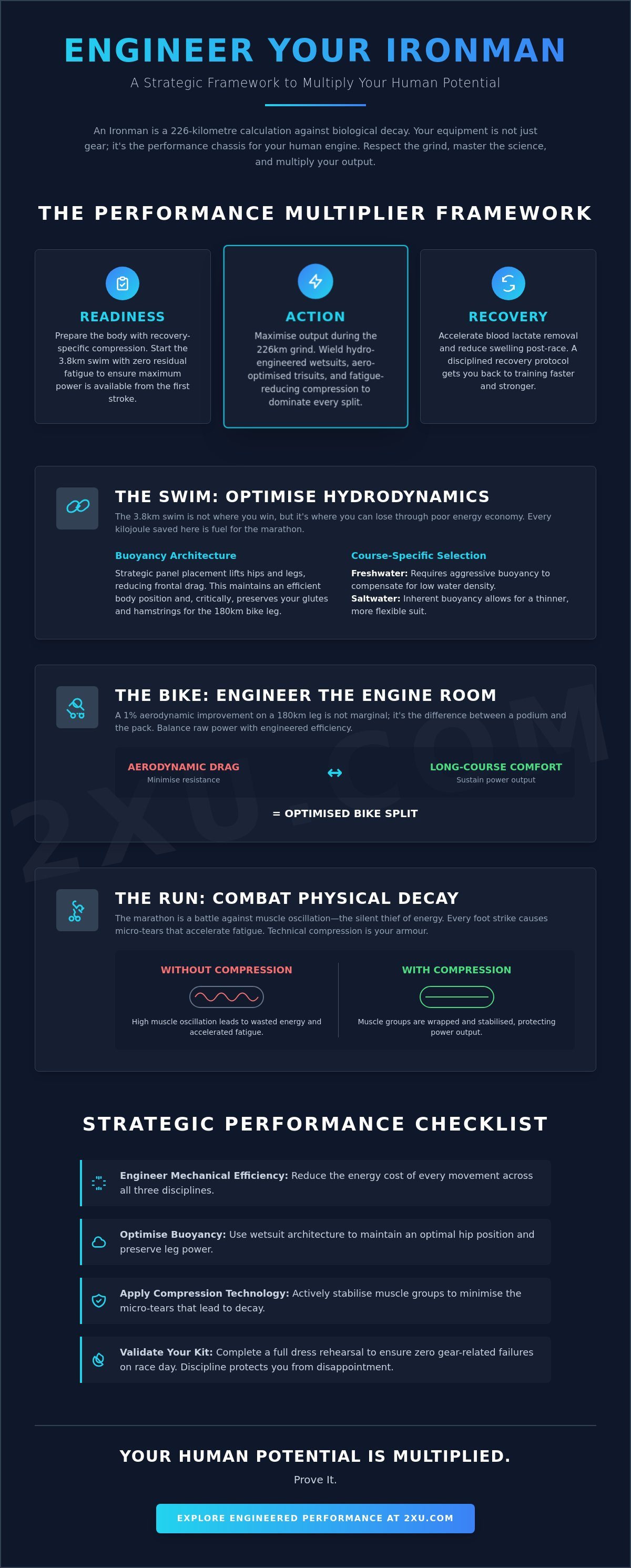
The difference between short-course and long-course strategy lies in the cumulative effect of marginal gains. A 1% improvement in aerodynamics on a 20km bike leg is negligible. On a 180km bike leg, it's the difference between a podium finish and a mid-pack result. Your triathlon gear for ironman distance must be viewed through our tripartite framework:
- Readiness: Preparing the body with recovery-specific compression to ensure you start the 3.8km swim with zero residual fatigue.
- Action: Using hydro-engineered wetsuits and aero-optimised trisuits to maximise output during the 226km grind.
- Recovery: Accelerating the removal of blood lactate and reducing swelling immediately following the finish line to get you back to training faster.
This holistic approach ensures that your performance is protected from the first siren to the final step.
The Swim Split: Optimising Hydrodynamics and Buoyancy
The 3.8km swim is the gateway to the grind. It is not where you win the race, but it is certainly where you can lose it through inefficient energy expenditure. Your choice of triathlon wetsuit must be a calculated decision based on the course environment. Saltwater courses offer inherent buoyancy, allowing for a more flexible, thinner suit. In contrast, freshwater lake swims demand a suit with aggressive buoyancy architecture to compensate for the lack of mineral density in the water. You can't afford to let your legs sink and create a massive anchor of drag before you've even touched your bike.
Buoyancy architecture is the strategic placement of neoprene panels to lift the hips and lower body. This is critical. By elevating your profile, you reduce frontal drag and, more importantly, preserve your glutes and hamstrings for the 180km bike leg. Research into The Ironman Physical Load confirms that metabolic efficiency during the swim directly correlates to power output later in the day. Every kilojoule saved in the water is a kilojoule available for the marathon. If you're fighting to keep your head above water, you're burning fuel you'll desperately need at kilometre 30 of the run.
Hydrodynamic coatings on the suit's surface reduce skin friction to near-zero levels. When you're moving through the water for over an hour, these marginal gains in drag reduction accumulate. However, buoyancy is useless if it compromises shoulder flexibility. High-performance triathlon gear for ironman distance must allow for a natural, uninhibited stroke. Fatigue in the deltoids and lats during the swim is often the result of resisting the suit rather than the water. To truly dominate the water, you need equipment that works with your biology. Explore our range of high-performance triathlon wetsuits to find your perfect hydrodynamic match.
Neoprene Science and Buoyancy Profiles
The engineering of a neoprene wetsuit involves varying panel thicknesses, typically ranging from 1.5mm in the shoulders for maximum rotation to 5mm in the core and upper legs for lift. Higher-grade 40-cell neoprene offers superior elongation and flexibility compared to 39-cell, which is often used in zones requiring more structural support. Under current WTC and World Triathlon regulations, an Ironman-legal wetsuit must not exceed 5mm in thickness at any point of its construction.
Swim Accessories for the 3.8km Journey
Success in the water requires more than just a suit. Your goggle selection should prioritise anti-fogging technology and wide-peripheral vision to ensure efficient sighting in choppy conditions. In colder environments, a silicon cap provides necessary heat retention, while a latex cap may be preferable in warmer waters to prevent overheating. Don't overlook the importance of anti-chafe lubricants in high-friction zones. Apply these liberally to the neck and underarms to prevent the skin abrasions that turn the subsequent bike and run into a test of pain tolerance. Discipline in the small details prevents a failure in the large ones.
Trisuit Architecture: Balancing Aerodynamics with Long-Course Comfort
Your triathlon suit is the only piece of equipment that remains in constant contact with your body for the entire 226km journey. It is your primary skin. While a sprint distance race allows for minor fit issues, the Ironman distance will amplify every microscopic flaw into a race-ending injury. Engineering your kit requires a ruthless focus on resilience. You aren't just looking for speed; you are looking for a textile interface that manages heat, moisture, and friction while you operate at your physical limit.
On the 180km bike leg, aerodynamic drag is the dominant force of resistance. High-performance triathlon gear for ironman distance utilises advanced fabric textures, such as dimpled shoulder panels, to trip the boundary layer of air and reduce the wake behind the rider. This mechanical advantage is non-negotiable. Additionally, your chamois must be a masterpiece of minimal engineering. A thick, absorbent pad is a liability; it retains water from the swim and sweat from the bike, leading to severe saddle sores. You require a low-profile, high-density chamois that provides specific pressure relief on the saddle but remains unobtrusive during the marathon. This balance is what separates elite apparel from average sportswear.
Surviving the midday sun requires integrated UV protection and moisture-wicking properties that do not degrade over ten hours. Cooling technologies often incorporate heat-reactive treatments to actively lower skin temperature. As noted in this Ironman distance gear guide, every element of your kit must be tested under extreme conditions to ensure it can withstand the intensity of the 226km grind. Don't leave your comfort to chance.
One-Piece vs. Two-Piece Trisuit
The debate between one-piece and two-piece suits is a matter of aerodynamic priority versus operational utility. A sleeved one-piece suit is objectively faster in a wind tunnel. It eliminates the transition gap between the top and shorts where turbulent air can accumulate. However, a two-piece kit offers practical advantages for athletes who require more frequent pit stops or have unique torso-to-leg proportions. Your choice should reflect your target split times and your body's specific thermoregulation needs. If you are chasing a podium, the one-piece is your weapon of choice.
Fabric Innovation and Pockets
Nutrition management is a core pillar of Ironman success. Your suit must feature strategically placed rear or side pockets that allow for easy access to gels and salt tabs without creating a drag penalty. Fabric innovation has moved beyond simple elasticity. We now use high-tension fibres to provide mild compression, which supports the muscles and reduces the oscillation mentioned in previous sections. Ensuring that all seams are flat-locked and moved away from high-friction zones is the only way to eliminate the chafing that can turn a sub-four-hour marathon into a painful walk. Discipline in selection leads to dominance in execution.
The Compression Advantage: Multiplying Power Output and Reducing Fatigue
The transition from the 180km bike leg to the marathon is where your structural integrity faces its final trial. At this stage, your body is struggling to maintain form against the relentless force of gravity. Compression is not a passive accessory; it is an active component of your triathlon gear for ironman distance designed to sustain your physical output when your nervous system begins to falter. By providing external pressure to the major muscle groups, compression shirts and tights act as a secondary support system, ensuring your muscles remain aligned and efficient through every kilometre of the run.
The primary benefit of active compression is the mitigation of muscle oscillation. As discussed in our analysis of the Ironman load, every foot strike sends vibrations through the soft tissue, causing micro-tears that lead to the debilitating fatigue known as 'the wall'. High-performance compression dampens these vibrations, protecting the muscle fibres from unnecessary damage. Additionally, this equipment enhances proprioception, which is your brain's awareness of body position. When fatigue sets in during the final 20 kilometres of the marathon, your form naturally degrades. Improved proprioceptive feedback helps you maintain a compact, efficient stride, reducing the energy cost of movement and preventing the 'shuffling' gait that invites injury.
Enhanced venous return is the second pillar of compression science. By applying graduated pressure, these garments assist the heart in clearing metabolic byproducts from the working muscles. This internal "cleaning" process is vital for maintaining power output over a 140.6-mile course. To ensure your engine continues to fire at maximum capacity, you must stabilise the chassis. Equip yourself with the industry-leading compression clothing designed to sustain your power through the final mile.
Active Compression for the Marathon
Calf sleeves and compression socks are essential tools for the final 42.2km. Unlike standard athletic tights, medical-grade compression is engineered with a specific pressure profile measured in millimetres of mercury (mmHg). This ensures the compression is tightest at the ankle and gradually decreases up the leg. Graduated compression creates a pressure gradient that forces blood from the extremities back toward the heart, accelerating the clearance of lactate and metabolic byproducts. This mechanical assistance allows you to maintain a higher intensity for a longer duration.
Post-Race Recovery Engineering
The race does not end at the finish line; the recovery phase is the first step of your next training block. The 24-hour window following an Ironman is critical for reducing systemic inflammation and swelling. Utilising high-pressure recovery gear compresses the interstitial space, preventing the accumulation of fluid in the limbs. For athletes travelling to destination races, flight pressure socks are a non-negotiable requirement to combat travel-induced fatigue and deep vein thrombosis. This meticulous approach to recovery engineering ensures a rapid 'Return to Grind', allowing you to resume your performance programme with minimal downtime.
Finalising Your Ironman Kit: A Strategic Performance Checklist
The final phase of your preparation is the gear audit. This is where you eliminate the variables that lead to mechanical failure. The 'Nothing New on Race Day' rule is a scientific mandate, not a suggestion. Every piece of triathlon gear for ironman distance you intend to wear must have survived at least one five-hour brick session during your peak volume phase. If you haven't tested your nutrition storage at race intensity or verified the anti-chafe properties of your trisuit seams under a heavy sweat load, you're inviting disaster. Respect the grind by ensuring your equipment is as disciplined as your training.
Strategic layering is your defence against the thermal volatility of a 140.6-mile day. You might start in 16-degree water at 7 AM and finish a marathon under a 30-degree sun, or conversely, cross the line in the cooling damp of 10 PM. Your technical apparel must manage these shifts through superior moisture-wicking and thermoregulation. Maintenance is equally critical to your success. To ensure your fabrics retain their high-tension elasticity, rinse them in cold, fresh water immediately after use and avoid mechanical heat. Degradation of the elastane fibre reduces the compression benefits we've established in previous sections, compromising your mechanical stability when you need it most.
The Essential Ironman Checklist
Your kit must be organised into three distinct phases of action. Conduct a final audit of these essential items 48 hours before the siren:
- Swim: Performance-engineered wetsuit, dual goggle sets (tinted for morning glare, clear for low light), medical-grade anti-chafe, and a secure timing chip strap.
- Bike: Aero-optimised trisuit, CPSC-approved aero helmet, specialised cycling shoes, and integrated aerodynamic hydration and nutrition storage systems.
- Run: Graduated compression socks or calf sleeves, UV-protective visor, lightweight moisture-wicking running apparel, and a high-tension race belt.
Transition Mastery
Efficiency in T1 and T2 is about mechanical flow and cognitive clarity. Organise your transition bags with a logical sequence in mind. Every second spent searching for a visor or a race belt is a second of lost momentum. Compression plays a vital role here, specifically in managing the 'heavy leg' sensation as you transition from the bike to the run. By maintaining venous return during the final kilometres of the 180km ride, you ensure your legs are physiologically ready for the immediate impact of the marathon. Precision in transition is the hallmark of an elite athlete who understands that the race is won in the margins.
Explore the 2XU Triathlon Collection and multiply your performance.
Dominate the 226km Calculation
Success in long-course racing is determined by your ability to manage the rate of physical decay. You've learned how buoyancy architecture in your wetsuit preserves your legs for the bike and how aerodynamic fabric engineering in your trisuit minimises drag over 180 kilometres. Selecting the correct triathlon gear for ironman distance is a commitment to mechanical efficiency. By utilising scientifically validated compression to dampen muscle oscillation, you protect your power output for the final stages of the marathon. This is how you multiply your potential.
Our gear is engineered for 226km of endurance and is the choice of World Champions who refuse to settle for average standards. Every fabric and feature has undergone rigorous laboratory validation to ensure it withstands the intensity of the grind. Don't leave your result to chance by using unproven equipment. Shop the 2XU High-Performance Triathlon Range and equip yourself with the technology required to push your physical limits. The road to the finish line is brutal, but with the right engineering, you'll earn your place among the elite. Respect the process. Own the result.
Frequently Asked Questions
What is the most important piece of triathlon gear for an Ironman?
The trisuit is the most critical component because it is the only piece of triathlon gear for ironman distance that you wear for the entire 10 to 17 hour duration. It must manage thermoregulation, aerodynamics on the bike, and muscle support on the run. A failure in trisuit engineering leads to debilitating chafing or heat exhaustion, which can end your race regardless of your fitness level. Discipline in selecting this interface is paramount.
Can I wear a one-piece trisuit for the entire Ironman race?
You can and should wear a one-piece trisuit for the entire race to maximise aerodynamic efficiency and eliminate the gap where turbulent air accumulates. While two-piece kits offer convenience for bathroom breaks, the one-piece design provides superior muscle stabilisation and a streamlined profile. Modern long-course suits are engineered with front zippers to allow for easier entry and exit during the rare transition or pit stop without sacrificing speed.
Do I really need a wetsuit for an Ironman swim?
A wetsuit is essential for any Ironman swim where the water temperature is below 24.5 degrees Celsius, which is the standard age-group cutoff. Beyond thermal protection, the buoyancy architecture lifts your hips to reduce drag and saves your leg muscles for the 180km bike leg. Unless the race is officially wetsuit prohibited, you are sacrificing a significant mechanical advantage and wasting precious kilojoules of energy by not wearing one.
How does compression gear help during a long-distance triathlon?
Compression gear functions by reducing muscle oscillation and enhancing venous return to clear metabolic byproducts from your system. During the marathon, the constant impact causes micro-tears in the muscle fibres; graduated compression dampens these vibrations to delay the onset of fatigue. It also improves proprioception, helping you maintain an efficient running gait when your central nervous system begins to falter in the final hours of the 226km grind.
Should I choose a sleeved or sleeveless trisuit for my first Ironman?
Choose a sleeved trisuit for your first Ironman to take advantage of superior aerodynamics and better UV protection. Research indicates that sleeved suits significantly reduce drag on the bike compared to sleeveless options. Additionally, protecting your shoulders from 180 kilometres of direct sun exposure prevents the skin temperature spikes that lead to early dehydration. It's a calculated choice to protect your engine for the run.
What is the best way to prevent chafing during a 140.6-mile race?
The most effective method to prevent chafing is the aggressive application of high-viscosity, waterproof lubricants combined with gear featuring flat-locked seams. Focus on high-friction zones including the neck, underarms, and inner thighs before the swim and again in transition if necessary. Using high-performance triathlon gear for ironman distance that moves seams away from these friction points is a structural requirement for surviving the 226km distance without skin failure.
How many sets of gear do I need for Ironman training vs. racing?
You need at least two sets of primary gear: one for high-volume training and one dedicated for race day. Your race-day kit must be broken in during at least three peak sessions to ensure fit and function under stress. However, you shouldn't use your race-day wetsuit or trisuit for every daily session, as the technical fibres and coatings will eventually degrade, reducing their performance-multiplying properties when they matter most.
Is there a difference between men's and women's triathlon gear for long distances?
The primary differences lie in the anatomical engineering of the chamois and the specific compression profiles tailored to different muscle densities and skeletal structures. Women's trisuits and compression garments are designed with specific hip-to-waist ratios to ensure the fabric remains taut against the skin. This prevents the pocketing of air or water that creates drag, ensuring that every athlete receives the maximum mechanical advantage from their equipment choices.