
How Compression Tights Aid Muscle Recovery: The Science of High-Performance Recuperation
Why settle for passive rest when you can engineer a faster return to peak power? Recovery is not a suggestion; it is a calculated biological process that dictates the ceiling of your next performance. You have likely felt the frustration of heavy, unresponsive legs after an endurance session or the sharp bite of Delayed Onset Muscle Soreness (DOMS) hindering your training consistency. We understand that for the performance-obsessed, every hour spent sidelined is a missed opportunity to gain an edge.
This article explores the meticulous engineering and physiological mechanisms of how compression tights aid muscle recovery, moving beyond simple comfort to address the mechanics of human repair. We will demonstrate how graduated pressure profiles accelerate venous return and reduce the markers of muscle damage in your system. By analysing 2025 research and laboratory-validated principles of mechanical stabilisation, we provide a roadmap to reduce muscle oscillation and inflammation. You'll learn how to leverage these scientific strategies to multiply your physical output and ensure your body is always ready for the next high-intensity interval. This is about respecting the grind by mastering the science of the recuperation phase.
Key Takeaways
- Master the biological response to high-intensity labour by understanding the inflammatory cascade that triggers DOMS.
- Learn how mechanical stabilisation reduces muscle oscillation and vibration to prevent micro-trauma during impact.
- Discover the physiological mechanisms of how compression tights aid muscle recovery by optimising venous return and metabolic clearance.
- Establish an elite recovery protocol that includes a minimum four-hour post-workout wear time and overnight usage for deep tissue repair.
- Harness the power of proprietary engineering to multiply your athletic potential through validated mechanical stabilisation.
Understanding Post-Exercise Physiological Stress and DOMS
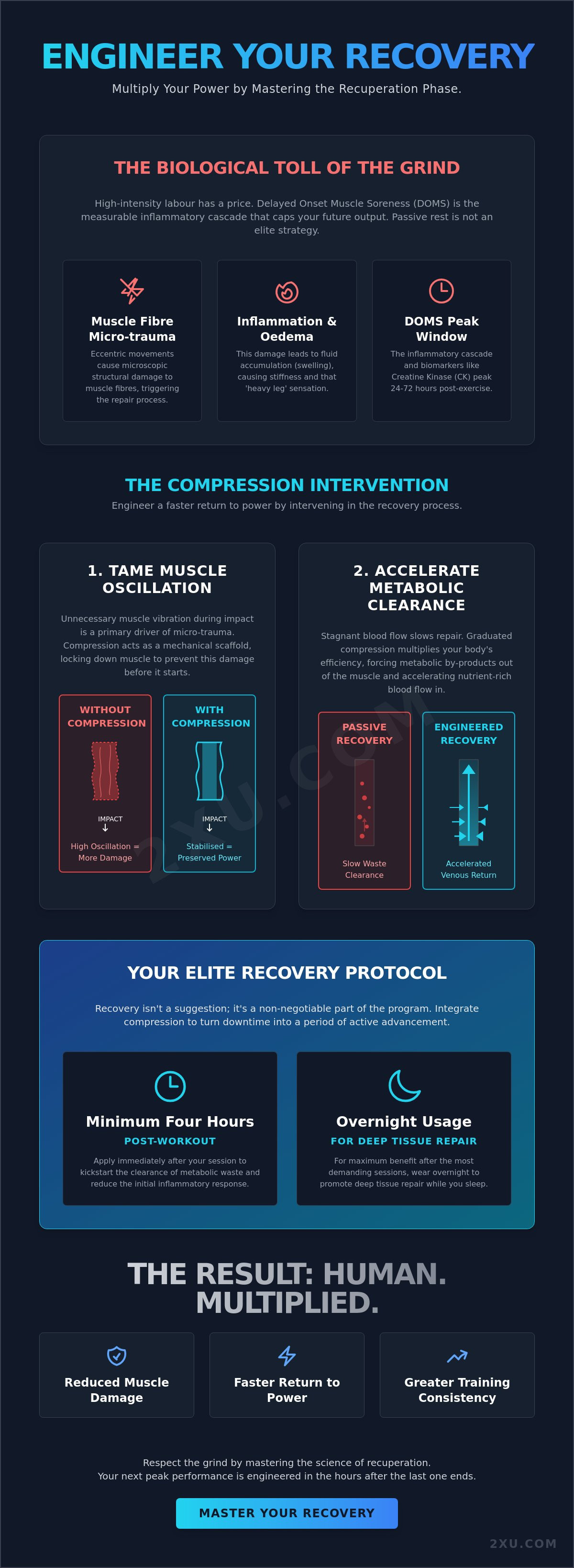
Delayed Onset Muscle Soreness (DOMS) is the biological price of high-intensity labour. It is not merely a sensation of discomfort; it is a measurable inflammatory cascade that typically peaks 24 to 72 hours after you have pushed your physical limits. During this window, your system exhibits specific biomarkers of muscle damage, most notably elevated levels of Creatine Kinase (CK). These enzymes leak into the bloodstream when muscle cell membranes are compromised. At the elite level, we view athletic excellence through a strict tripartite framework: Prepare, Perform, Recover. Recovery is the critical third pillar. If you ignore the physiological stress of the grind, you are intentionally capping your future output.
The Biological Cost of the Grind
Every eccentric movement you perform causes microscopic structural damage to your muscle fibres. This micro-trauma triggers a physiological response that leads to oedema, or fluid accumulation within the tissue. This swelling is the primary driver of post-workout stiffness and the heavy leg sensation that halts training consistency. Achieving breakthrough results requires a proactive approach to managing these biological costs. You cannot afford to wait for your body to fix itself at its own leisurely pace. Elite performance demands that you intervene in the inflammatory process to ensure your muscle architecture remains resilient and ready for the next load.
Why Passive Rest is Not Enough
Passive rest is a strategy for the average. It is not a strategy for the elite. When you remain sedentary after a session, blood flow can become stagnant, which significantly slows the removal of metabolic by-products that hinder cellular repair. This is where an engineered Compression garment changes the equation. By applying external pressure to the limbs, you are effectively multiplying the efficiency of your internal systems.
Understanding how compression tights aid muscle recovery involves recognising that you are bypassing biological bottlenecks. You are not just resting; you are actively accelerating the repair process through mechanical intervention. This engineered approach forces metabolic waste back into central circulation for faster clearance. It turns the recovery phase from a period of stagnation into a period of active advancement. By utilising high-performance apparel, you ensure that every minute of downtime is working toward your next peak power output. Respect the grind by refusing to accept the slow pace of unassisted recovery.
The Biomechanics of Compression: Reducing Muscle Oscillation
When your foot strikes the ground during a high-intensity run, a shockwave travels through your entire kinetic chain. This force creates muscle oscillation, which is the unnecessary vibration of muscle tissue during impact. This vibration is not a passive byproduct; it is a primary driver of exercise-induced damage. These rapid, uncontrolled movements stretch and shear muscle fibres, leading to the micro-trauma and inflammation discussed in our analysis of physiological stress. By applying a high-tension mechanical "wrap" around major muscle groups, high-performance yarns dampen this vibration. This dampening effect is a fundamental reason for how compression tights aid muscle recovery, as it proactively reduces the total volume of damage your system must repair post-session.
The evidence for this mechanical intervention is robust. A 2025 systematic review and meta-analysis confirms that providing this level of external support significantly reduces the decline in muscle strength and power after fatiguing exercise. By securing the muscle architecture in a fixed, stable position, you are essentially preserving your biological resources for the next effort. This is not about comfort; it is about the physics of performance and ensuring that your body is not wasting energy on unproductive tissue movement.
Engineering Stability into Every Movement
High-performance compression acts as an external scaffold for the quads, hamstrings, and calves. By locking these muscle groups in place, the garment improves overall mechanical efficiency. Your muscles no longer have to work as hard to maintain alignment or stabilise themselves against the force of impact. Muscle oscillation is a primary driver of exercise-induced damage. Reducing this vibration allows for a faster return to peak power because the metabolic "repair bill" your body faces after the grind is substantially lower. This engineered stability allows you to push harder for longer while ensuring your recovery phase begins from a position of strength rather than extreme depletion.
Technical Fabrics vs. Standard Athletic Gear
Standard athletic apparel often fails because it relies on basic elastane blends that lack the necessary tension for true stabilisation. These materials might feel tight on the shelf, but they quickly lose their shape and fail to provide consistent pressure through a full range of motion. Elite compression clothing utilises high-power yarns that are designed for 360-degree fabric stretch. This ensures that the mechanical integrity of the wrap remains intact whether you are at full knee flexion or peak extension. These engineered materials are built for durability, maintaining their calibrated pressure over hundreds of training sessions. While basic gear degrades, these technical fabrics continue to multiply your potential by providing the unyielding support your physiology demands.
Optimising Circulation: Venous Return and Metabolic Clearance
Mechanical stability is only half the battle. Once you've dampened the physical impact of the grind, you must address the internal fluid dynamics that dictate repair speed. Effective recuperation requires a forced acceleration of the circulatory system to move beyond the limitations of unassisted biology. This is how compression tights aid muscle recovery at a cellular level: they act as an external circulatory pump, ensuring that your blood doesn't pool in your lower extremities after a high-load session.
The Physics of Graduated Pressure
Graduated compression is not just a tight fit. It is a precisely engineered pressure gradient that is highest at the ankle and decreases systematically as it moves toward the hip. This differential is essential for overcoming gravity. By applying more pressure at the furthest point from the heart, the garment facilitates venous return, pushing deoxygenated blood back through the valves and toward the lungs for re-oxygenation. Precise millimetres of mercury (mmHg) measurements are the gold standard here. Without this specific calibration, a garment cannot provide the physiological benefits required for elite recovery. Recognise that compression shirts provide similar circulatory advantages for the upper body, ensuring holistic metabolic clearance across all major muscle groups.
Flushing the System Post-Workout
High-intensity labour produces a significant volume of metabolic by-products, specifically lactic acid and carbon dioxide. If these metabolites remain stagnant in the tissue, they exacerbate the inflammatory response and prolong stiffness. Accelerated circulation flushes these wastes out of the system, clearing the slate for your next training session. This process does more than just remove waste; it increases the velocity of oxygenated blood returning to the site of damage. Oxygen is the critical fuel for repairing muscle fibres. Faster delivery means faster repair.
Implementing an Elite Recovery Protocol with Compression Tights
Disciplined recovery is what separates the podium from the pack. You don't leave your physiology to chance after the final rep. Understanding how compression tights aid muscle recovery requires a strict chronological approach to the post-exercise window. This is not about casual comfort; it's about a systematic intervention in your body's repair cycle. A 2022 study from Victoria University in Australia confirmed that full-length compression is most effective when worn for at least four hours post-workout. This duration ensures that the mechanical clearance of metabolic waste is thorough and that the inflammatory cascade is properly managed.
The Immediate Post-Session Window
The transition from your running shorts to full-length recovery tights should be immediate. The first 60 minutes after high-intensity labour are critical for initiating the repair process. During this time, your muscle cell membranes are at their most permeable, and the potential for oedema is at its peak. Immediate compression limits the initial inflammatory response by providing an external scaffold that prevents fluid from pooling in the interstitial spaces of the muscle tissue. By compressing the limbs early, you lock in the benefits of your session while simultaneously accelerating the removal of Creatine Kinase and other biomarkers of damage.
Recovery for the Long Haul: Sleep and Travel
Elite athletes never leave recovery to chance, especially during periods of stasis. Sleep is your body's primary window for deep tissue repair and protein synthesis. Wearing compression tights overnight maintains a consistent circulatory pump during hours of inactivity, ensuring that oxygenated blood continues to reach damaged fibres. This overnight protocol prevents the morning stiffness that often follows a heavy training block.
The same logic applies to travel. If you are on the move, flight pressure socks and full-length tights are essential tools to combat travel-induced "heavy legs." They facilitate venous return when you are confined to a seat, preventing the blood pooling that can sabotage your next performance. Integrate this mechanical support with optimal hydration and protein intake to ensure your system has the raw materials and the circulatory efficiency to rebuild. Command your recovery with the same intensity you bring to your training.
Ready to engineer your next breakthrough? Invest in laboratory-validated compression clothing and master the science of the recuperation phase.
Multiplying Your Potential: Why 2XU Engineering Outperforms
Average standards don't produce elite results. While standard athletic gear relies on basic construction, our commitment to rigorous laboratory validation and academic collaboration ensures every garment serves as a precision instrument. We don't guess. We measure. This data-driven approach defines how compression tights aid muscle recovery by ensuring the pressure applied is exactly what your physiology requires to flush metabolic waste and stabilise tissue. Our proprietary circular knit technology is the foundation of this process. It provides a consistent, 360-degree graduated pressure profile that unyielding materials simply cannot match. These high-performance yarns are engineered for durability, resisting the corrosive breakdown typically caused by sweat and chlorine, so your recovery tool maintains its integrity over the long haul. Our mission is clear: to multiply human performance through superior engineering that leaves nothing to chance.
Laboratory-Validated Performance
We utilise specialised industrial instrumentation to verify every millimetre of mercury (mmHg) across the garment. 2XU gear is not just apparel; it is a validated performance tool designed to multiply your natural capabilities. We reject the "one size fits all" mentality of the mass market. Our obsession with quality means we frequently partner with world-leading research teams to prove our claims through peer-reviewed data. This meticulous sports science ensures that the mechanical "wrap" you feel around your muscles is functioning at the highest possible level of efficiency. When you wear our gear, you are wearing the result of hundreds of hours of testing and technical refinement. It's an unyielding commitment to excellence that separates us from those who rely on marketing fluff rather than measurable results.
The Final Verdict: Earn Your Place
Gear is a multiplier, not a replacement for the grind. You must still do the work. You must still push through the high-intensity intervals and the long endurance sessions that test your resolve. However, respecting your effort means investing in your recovery as much as your training. By utilising superior engineering, you ensure that your body is always ready for the next challenge. Don't let your potential be capped by outdated recovery methods or inferior equipment. Accelerate your repair process and return to peak power output faster than the competition. You've earned your place on the starting line through discipline. Now, ensure you stay there through smarter recuperation. Shop 2XU Compression Tights and accelerate your recovery.
Command Your Recuperation
Passive rest is for the uncommitted. True athletic advancement requires a scientific approach to managing the biological costs of high-intensity labour. You have seen the evidence: reducing muscle oscillation preserves tissue integrity, while graduated pressure accelerates the clearance of metabolic waste. By mastering how compression tights aid muscle recovery, you ensure that every hour of downtime is a calculated investment in your next session. This is the difference between stagnation and exponential growth.
We have engineered our gear to exceed industry standards through proprietary circular knit technology and rigorous laboratory validation. This 360-degree support is why we're trusted by elite triathletes and pro runners globally to deliver consistent, graduated compression that doesn't falter. Don't leave your potential to chance. Respect the grind by providing your body with the mechanical scaffolding it demands to rebuild stronger. Shop 2XU High-Performance Compression Tights and multiply your physical output. Your next peak performance is earned in the recovery phase.
Frequently Asked Questions
How long should I wear compression tights for recovery after a run?
Wear your recovery tights for a minimum of four hours following your session. Research from Victoria University confirms that this duration is necessary to significantly improve circulation and metabolic clearance. For high-intensity sessions or long endurance runs, immediate application is mandatory to halt the inflammatory cascade before it peaks.
Can I sleep in my compression tights to speed up muscle repair?
Sleeping in compression is a validated strategy for deep tissue repair. It maintains the physiological pump while you are in a state of stasis, ensuring that oxygenated blood continues to reach damaged fibres. This overnight protocol prevents blood pooling and fluid accumulation, which are the primary causes of morning stiffness after a heavy training block.
Do compression tights actually help with DOMS and muscle soreness?
They are highly effective at mitigating the symptoms of Delayed Onset Muscle Soreness (DOMS). By understanding how compression tights aid muscle recovery, you can see that reducing oedema and clearing metabolic waste directly lowers perceived soreness. This mechanical intervention allows for a faster return to peak power output by limiting the structural damage caused by post-workout swelling.
Is it better to wear compression during or after exercise for recovery?
You should ideally do both to maximise your results. Wearing them during exercise reduces muscle oscillation and micro-trauma, while post-exercise wear focuses on circulation and metabolic clearance. If you must choose one window for recovery specifically, the hours immediately following your session are the most critical for flushing metabolites and reducing inflammation.
How tight should recovery compression tights feel?
They must feel firm and provide a clear graduated pressure profile from the ankle upward. The fit should act as an unyielding scaffold that secures your muscle groups without restricting your natural range of motion. If the fabric bunches or feels loose in any area, the engineering is compromised and the pressure gradient will fail to improve venous return.
Do compression tights prevent injuries like shin splints?
They assist in injury prevention by dampening the vibrations that cause tissue shearing and micro-tears. Shin splints often result from excessive muscle oscillation during high-impact activities. Providing an external mechanical wrap for the lower leg reduces the stress on the periosteum and surrounding muscle architecture, allowing you to maintain training consistency without setbacks.
For those seeking professional orthopedic support or rehabilitation tools to complement their recovery, Ortopedia Suiza offers a wide range of specialized products designed to improve quality of life.
Can I use compression tights for recovery if I am a beginner athlete?
Recovery is not exclusive to the elite; it is a requirement for anyone subjected to physical load. Beginner athletes often experience higher levels of physiological stress and longer recovery windows as their bodies adapt to new training demands. Using technical apparel helps manage this adaptation phase and ensures you can back up your sessions with less discomfort.
How do I wash my compression gear to maintain its recovery properties?
Wash your gear in cold water using a mild detergent and avoid fabric softeners. Softeners coat the technical yarns and destroy the moisture-wicking and compression properties required for performance. Always air dry your garments in the shade to maintain the elasticity and mechanical integrity of the proprietary circular knit technology.