
Cold Weather Compression Clothing: The Athlete’s Guide to Engineering Winter Performance
Winter is not a season for retreat; it's a high-stakes laboratory where the elite athlete engineers a mechanical advantage over the elements. While others succumb to muscle stiffness and the restrictive weight of heavy layers, you can choose to leverage the science of thermal regulation. Integrating high-performance cold weather compression clothing into your kit isn't just about comfort. It's a calculated decision to maintain optimal muscle temperature and reduce the vibration-induced fatigue that leads to injury.
You understand that the grind doesn't stop when the temperature drops, yet the post-exercise chill caused by inefficient moisture management remains a constant threat to your recovery. We'll show you how to master your internal climate and multiply your physical output by utilising moderate compression levels of 20-23 mmHg. This article breaks down the technical framework of moisture wicking and muscle support, proving that human potential is multiplied through precision engineering and unyielding discipline.
Key Takeaways
- Understand the biological mechanics of cold-induced performance loss and how to counteract vasoconstriction to maintain sustained power output.
- Discover the engineering behind X-HEAT technology, which utilises infrared-capturing yarns to transform body heat into a functional performance engine.
- Learn to select the correct cold weather compression clothing by balancing mechanical support with thermal requirements for your specific athletic discipline.
- Master the professional layering system that prioritises a high-performance base layer to maintain optimal muscle temperature without the restriction of bulky outerwear.
The Science of Thermal Compression: Why Cold Weather Demands More
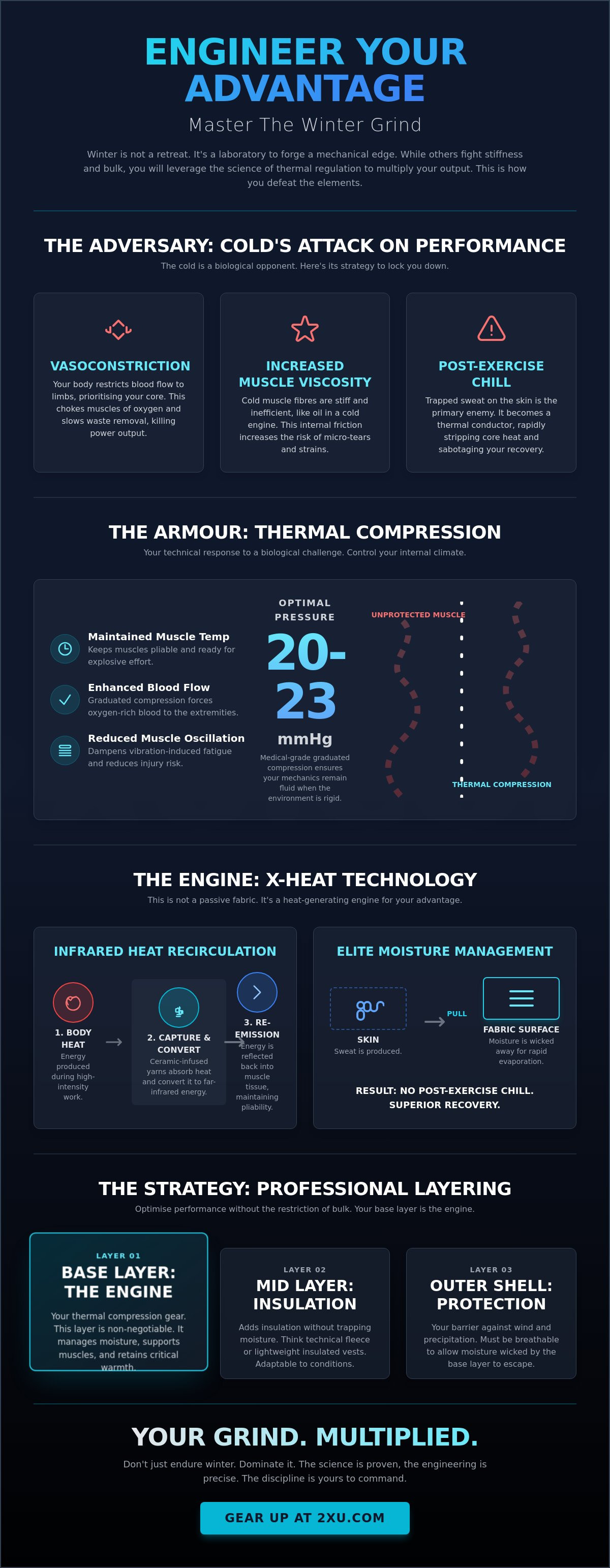
The cold is a biological adversary that demands a technical response. When you step into sub-zero air, your body initiates a defensive retreat known as vasoconstriction. It prioritises the core, pulling blood away from the working muscles in your legs and arms to protect vital organs. This physiological response reduces oxygen delivery and slows down the removal of metabolic waste. Without the right gear, your power output drops as your body fights itself just to stay warm. You aren't just fighting the wind; you're fighting your own biology.
Low temperatures also increase muscle viscosity. Think of it like oil in a cold engine; it's thick, resistant, and inefficient. Cold fibres are less pliable, creating internal friction that makes them highly susceptible to micro-tears and strains. High-quality cold weather compression clothing functions as a mechanical catalyst to reverse these effects. By maintaining muscle temperature and promoting circulation, you effectively shorten your warm-up window and extend your peak power duration. You stay ready to perform from the first kilometre to the last.
Combating Vasoconstriction and Muscle Stiffness
Graduated compression is your primary tool against the body's natural urge to restrict peripheral blood flow. By applying specific pressure gradients, these garments force blood back toward the heart, ensuring that oxygen-rich blood continues to reach the extremities despite the external chill. This mechanical stability is vital when muscles are cold and vulnerable. It dampens the muscle oscillation that causes fatigue and provides a structural safety net against sudden, explosive movements. Thermal compression is the precise integration of advanced heat-retention technology with medical-grade pressure. Utilising a compression garment engineered for winter performance ensures your mechanics remain fluid when the environment is rigid. It keeps you moving with precision while others are locked up by the cold.
The 2XU Multiplication: Human Potential vs. The Elements
We don't accept average standards, and neither should you. The concept of "Human Multiplied" is grounded in the belief that thermal regulation is a prerequisite for elite performance, not a luxury. By controlling your internal climate, you unlock the ability to push past the limits that stop the unconditioned. Our research into the Science of Compression establishes the baseline for how targeted pressure enhances biological recovery and mechanical stability. Elite performance requires gear that works as hard as the athlete. You respect the grind; we provide the engineering to ensure that grind yields maximum results. Winter is not an excuse to slow down. It's an opportunity to sharpen your discipline and outpace the competition while they retreat indoors.
Engineering the Edge: Key Features of X-HEAT Technology
Warmth usually comes at the cost of mobility. Traditional winter gear relies on thickness to trap air, creating a bulky profile that increases drag and restricts your range of motion. X-HEAT technology rejects this compromise. It's not a passive fabric; it's a heat-generating engine designed to maintain your mechanical advantage in the harshest conditions. By integrating cold weather compression clothing with advanced thermodynamic properties, we've engineered a solution that keeps you light, fast, and thermally protected. You don't have to choose between insulation and aerodynamics.
Heat-Generating Fibres and Infrared Energy
Body heat is wasted energy if it isn't captured and repurposed. X-HEAT utilises engineered performance yarns infused with ceramic particles that act as a microscopic thermal mirror. These technical fibres absorb the heat your body generates during high-intensity intervals and convert it into far-infrared energy. This energy is then recirculated back into the muscle tissue. This mechanism is particularly critical during rest periods or stationary drills when your heart rate slows. While standard gear allows your temperature to plummet, X-HEAT maintains a consistent thermal baseline, ensuring your muscles remain pliable and ready for the next explosive effort. You stay warm because your gear is working as hard as your metabolism.
Moisture Wicking and Antibacterial Properties
Moisture is the primary enemy of winter performance. If sweat remains on your skin, it acts as a thermal conductor, rapidly stripping away your core heat once you stop moving. Our moisture-wicking architecture is designed for the high-performance athlete who doesn't have time for a post-exercise chill. These technical fibres pull sweat away from the skin surface and disperse it across the fabric's outer layer for rapid evaporation. Optimizing Your Layering System requires this foundational dry-zone to prevent metabolic drain and maintain your focus on the objective.
Respecting the grind means training day after day, regardless of the forecast. To support multi-day training blocks, we've integrated powerful antibacterial technology into the yarn structure. This prevents the growth of odour-causing bacteria, ensuring your gear remains fresh even under high-stress conditions. The durability of these technical fibres is tested in laboratory settings to withstand the rigours of elite training without losing their compression calibre or thermal efficiency. This is gear built for the long haul. To experience this engineering first-hand, explore our full range of athletic sportswear and dominate the winter season with unyielding confidence.
Selecting Your Armour: A Buyer’s Guide to Cold Weather Tights and Tops
Selecting your kit is a tactical decision. You don't just buy gear; you select armour that aligns with your specific athletic discipline. High-performance cold weather compression clothing must provide more than a simple barrier against the wind. It has to deliver mechanical support to the muscle groups doing the heavy lifting while managing the biological heat your body generates. For runners and cyclists, the priority is often the lower extremities, where maintaining blood flow is the difference between a breakthrough performance and a premature exit due to cramping.
Fit is non-negotiable. Don't confuse "tight" with "compression." True compression is a calculated measurement of pressure, typically rated between 20-23 mmHg for moderate-level performance. If the garment just feels small, it's restricting your movement rather than enhancing your output. You need to look for durability markers that separate professional gear from average sportswear. This includes reinforced flatlock seams to prevent chafing during high-repetition movements and high-tension waistbands that stay secure under load. Strategic heat-trapping zones should protect critical muscle attachments without adding unnecessary mass.
X-HEAT Compression Tights: Protecting the Powerhouse
The legs are your engine. X-HEAT Compression Tights are engineered to provide targeted support to the glutes, quads, and calves, reducing the muscle oscillation that leads to fatigue. When you're operating in sub-zero temperatures, the brushed interior of these tights provides essential next-to-skin comfort without adding bulk. This technical lining traps a thin layer of air to insulate, while the compression keeps blood moving. A secure, adjustable waistband ensures zero-distraction movement, allowing you to focus entirely on the grind and your physical objectives.
Long Sleeve Compression Tops: Core Temperature Control
Your core is the command centre for thermal regulation. A long sleeve compression top is essential for maintaining core warmth and ensuring blood flow reaches your arms. This is critical for athletes who rely on an unrestricted arm swing, such as runners or cross-country skiers. Our technical fibres provide 360-degree stretch, ensuring the garment moves with you rather than against you. For those transitioning from the water to the cold air, refer to our Ultimate Triathlon Suit Guide to understand how to engineer your fastest race day in varying climates. Whether you're on the road or the trail, your top should act as a second skin that manages moisture and heat with mathematical precision.
The Layering System: Optimising Performance for the Grind
Mastering the elements requires a systematic approach to your kit. You don't just put on clothes; you build a performance environment. An effective layering system allows you to maintain a stable core temperature while your external environment fluctuates. Each layer has a mathematical purpose in the preservation of your mechanical output. When you deploy cold weather compression clothing as the foundation of this system, you establish a dry, warm microclimate that adapts to the intensity of your session.
- Step 1: The Base Layer. Place your X-HEAT compression garments directly against the skin. This proximity is vital for the technical fibres to capture body heat and recirculate infrared energy effectively.
- Step 2: The Mid-Layer. For extreme sub-zero sessions, add a breathable technical fleece. This layer traps additional air for insulation without blocking the moisture-wicking path established by the base.
- Step 3: The Shell. Deploy a windproof or waterproof layer only when conditions involve high-velocity wind, sleet, or heavy rain. This protects your thermal engine from external cooling.
- Step 4: Regulation. Active heat management is a discipline. Use zips and vents to dump excess heat as your heart rate climbs, preventing the buildup of internal moisture.
Managing High-Intensity Intervals
Interval training in the cold presents a unique challenge: you risk overheating during the work and freezing during the recovery. X-HEAT engineering is superior for this duality. It provides the necessary breathability to dump heat during explosive efforts while the ceramic-infused yarns maintain your muscle temperature the moment you stop. The common objection that compression causes overheating is solved by technical wicking architecture that moves sweat to the surface before it can saturate the fabric. Respect the grind by removing all friction from your morning. Prepare your full layering kit the night before. This eliminates the opportunity for excuses when the temperature drops. To build your professional winter kit, explore our range of training apparel and prepare to outwork the competition.
Post-Workout Recovery in the Cold
The session doesn't end when you stop moving. In cold environments, the risk of a metabolic crash is high if you allow your temperature to drop too rapidly. Keep your compression garments on after the session ends. This sustained pressure aids in lactate clearance and maintains blood flow while your heart rate returns to baseline. You can find more detail on how compression aids muscle recovery through enhanced circulation and reduced swelling. Transition into dry clothing as soon as possible, but keep the compression active to ensure the work you put in today translates into a stronger performance tomorrow. Discipline in recovery is what separates the elite from the average.
Standout Gear: Top Picks from the X-HEAT Collection
Engineering a superior winter performance requires more than a single garment; it requires a complete ecosystem of technical apparel. The X-HEAT collection represents the pinnacle of cold weather compression clothing, designed to provide a comprehensive thermal seal while maintaining the mechanical stability your muscles demand. Every piece in this range is a result of meticulous laboratory testing, ensuring that your physical output remains uncompromised by the external environment. You don't just wear this gear. You deploy it as a tactical advantage against the elements.
- X-HEAT Compression Tights. These are the foundational component of any serious winter kit. They provide targeted support to the major muscle groups of the lower body, reducing fatigue and maintaining optimal internal temperatures during high-intensity sessions.
- X-HEAT Long Sleeve Compression Top. This garment is essential for core protection. It ensures that blood flow to the arms remains consistent, protecting your extremities from the biological retreat caused by sub-zero air.
- X-HEAT Compression Vest. Designed for the athlete who requires core insulation without any restriction of arm movement. This is the professional choice for high-velocity activities where aerodynamics and mobility are paramount.
- X-HEAT Neck Gaiter and Accessories. These technical pieces complete the thermal seal. They prevent heat escape from the neck and head areas, ensuring your body doesn't waste energy trying to compensate for exposed skin.
Why the X-HEAT Collection is the Professional Choice
The X-HEAT collection features over 180 products tailored for specific athletic needs, reflecting a commitment to precision that average brands cannot match. Each piece undergoes rigorous laboratory validation using specialized instrumentation to verify its thermal retention and graduated compression calibre. We don't rely on generalized claims. We rely on data. This is the 2XU promise: gear that multiplies your effort by turning biological heat into a functional mechanical advantage. When you choose X-HEAT, you're choosing a system that has been engineered to withstand the most demanding training blocks on the planet.
Your Move: Commit to the Winter Grind
The weather is a variable you cannot control, but your response to it is a choice. Don't let a drop in temperature dictate your training schedule or your results. Respect the grind by equipping yourself with the engineering required to dominate. Browse the full range to find the specific performance match for your discipline. Whether you're preparing for a winter triathlon or maintaining your running volume through July, our technical fibres provide the stability and warmth you need to succeed. Shop the X-HEAT Collection now and multiply your winter performance. Earn your progress through discipline and the right equipment.
Master the Winter Environment
Success in sub-zero conditions is not a matter of chance; it's a result of precision engineering and unyielding discipline. You now understand that thermal regulation is the mechanical catalyst for sustained power. By utilising proprietary X-HEAT infrared technology, you can capture wasted energy and recirculate it into your working muscles. This technical advantage, combined with graduated compression for faster recovery, ensures that your body remains a high-output engine regardless of the external forecast. The brushed interior for sub-zero comfort provides the necessary barrier against the elements without the restriction of traditional bulky layers.
Integrating cold weather compression clothing into your kit is the final step in mastering your internal climate. Every session is an opportunity to sharpen your resilience and outwork those who choose to stay indoors. Don't let the season dictate your limits. Take the data, apply the science, and prove that your potential is multiplied through hard work and the right gear. Shop the X-HEAT Collection today and dominate the grind. Your breakthrough performance is waiting.
Frequently Asked Questions
Is cold weather compression clothing better than standard thermals?
Cold weather compression clothing is superior to standard thermals because it provides mechanical muscle support and enhances circulation while retaining heat. Standard thermals rely on passive insulation to trap air; however, our technical fibres actively capture and recirculate body heat. This ensures you maintain peak power output without the restrictive bulk of traditional layers. It's the difference between merely surviving the cold and engineering a performance advantage.
Can I wear X-HEAT compression gear for indoor gym sessions?
You can wear X-HEAT gear indoors, but it is specifically engineered for sub-zero thermal regulation. The ceramic-infused yarns are designed to capture heat, which may lead to overheating in a climate-controlled gym environment. For indoor sessions, we recommend our standard compression range which focuses on moisture management and muscle stability without the additional thermal layer. Save the X-HEAT collection for the grind in the elements where its heat-generating properties are required.
How do I choose the right size for winter compression tights?
Selecting the right size requires a precise match to your height and weight on our specific size charts. Compression must be firm enough to provide the graduated pressure necessary for circulation, typically 20-23 mmHg, without restricting your range of motion. If the garment is too loose, you lose the mechanical support; if it's too tight, you risk restricting blood flow. Always prioritise the height and weight data over your standard clothing size for an elite fit.
Does cold weather compression really help prevent injuries like shin splints?
Targeted compression significantly reduces the risk of shin splints by dampening muscle oscillation and providing mechanical stability to the lower leg. During high-impact activities on cold surfaces, your muscles are more prone to micro-trauma. Our technical garments wrap the calf and shin muscles, minimising the internal vibration that leads to inflammation. This structural support is a critical component of injury prevention when training through the winter months.
How should I wash and maintain my X-HEAT gear to ensure its longevity?
Maintain the longevity of your X-HEAT gear by washing in cold water on a gentle cycle and avoiding the tumble dryer. Heat and harsh chemicals can degrade the technical fibres and the ceramic particles responsible for infrared energy recirculation. Use a mild detergent and never use fabric softeners, as they clog the moisture-wicking architecture. Air dry your garments in the shade to preserve the elasticity and graduated compression calibre of the fabric.
Can I wear compression tights under my normal running shorts?
Wearing compression tights under running shorts is a standard practice for many athletes seeking additional coverage or a specific aesthetic. While our tights are designed to be worn as a standalone high-performance layer, they function perfectly as a base layer. The flatlock seams and zero-bulk construction ensure that adding shorts over the top won't cause chafing or restrict your stride. Focus on the performance benefits of the compression rather than the layering preference.
What is the lowest temperature X-HEAT gear is designed for?
X-HEAT gear is engineered to perform in sub-zero environments, functioning as a specialised form of cold weather compression clothing that maintains muscle temperature as conditions reach freezing. The exact limit depends on your metabolic output and layering system. When used as a foundational base layer in a tripartite system, it provides the thermal regulation necessary for the most extreme winter training blocks. It ensures your mechanics remain fluid when the environment is rigid.
How does infrared technology in the fabric actually work?
Infrared technology works through ceramic-infused performance yarns that absorb the heat your body naturally radiates. These technical fibres convert that thermal energy into far-infrared rays and reflect them back into your muscle tissue. This process facilitates deep tissue warming and maintains a consistent core temperature during rest intervals. It's a closed-loop system of energy recirculation that multiplies your biological efficiency when the mercury drops.