
How to Choose Running Apparel: Engineering Your Performance for 2026
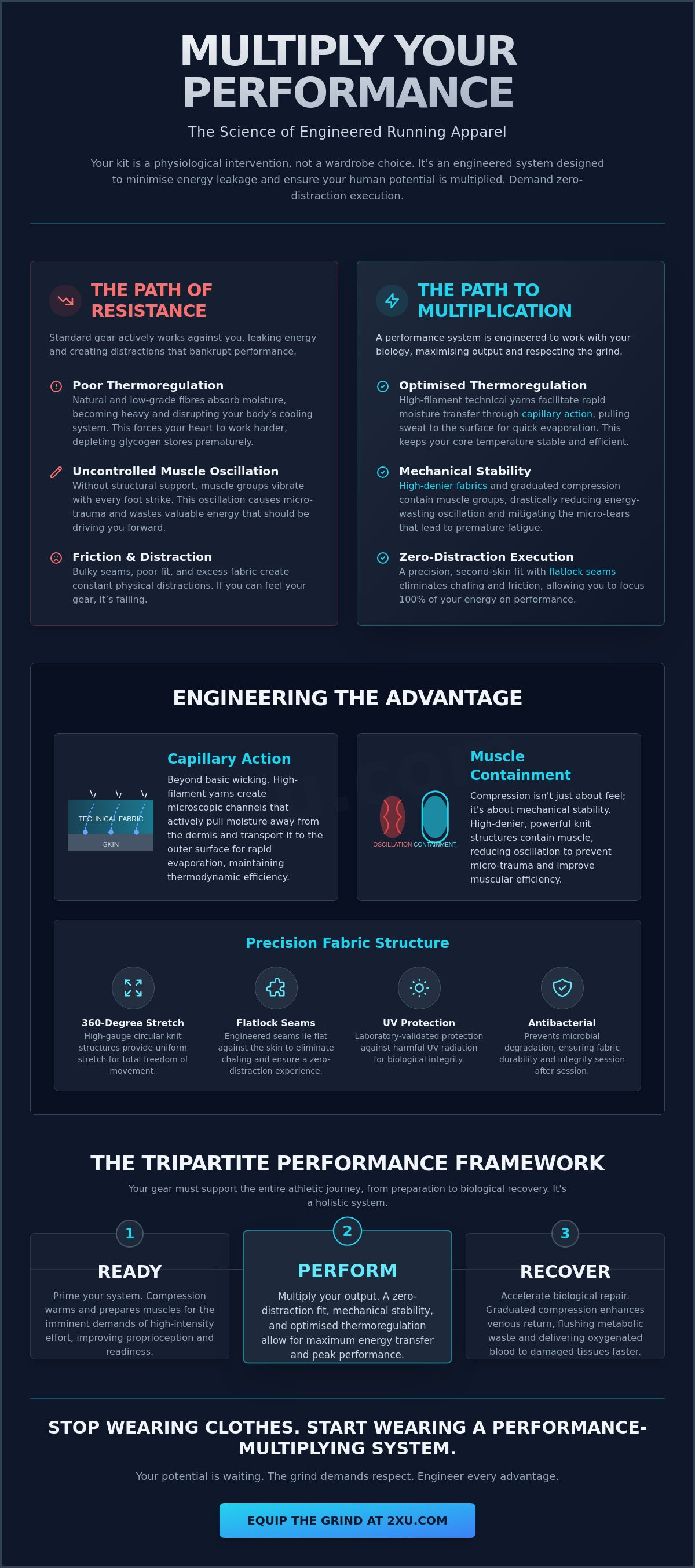
Your running kit isn't a wardrobe choice; it's a physiological intervention. You understand that every training session is a calculated investment in your own potential, yet poor gear selection often bankrupts your performance before the final interval. If you're still battling skin irritation or the energy-sapping effects of muscle oscillation, you're fighting your equipment instead of the clock. Mastering how to choose running apparel is the first step in moving from a casual participant to a data-driven athlete who demands zero-distraction execution.
We agree that the grind is hard enough without the added weight of poor moisture management or thermal instability. This article promises to help you master the science of technical gear selection to optimise thermoregulation, mechanical stability, and biological recovery. We will examine the engineering required for the 2026 landscape, including the critical shift toward PFAS-free technical fabrics and the use of high-gauge circular knit structures that provide 360-degree stretch. It's time to stop wearing clothes and start wearing a performance-multiplying system designed to stabilise your mechanics and ensure your human potential is multiplied.
Key Takeaways
- Reframe your gear as a system of engineered polymers designed to minimise energy leakage and multiply your physical output.
- Master how to choose running apparel by prioritising high-filament technical yarns that facilitate rapid moisture transfer through capillary action.
- Establish a foundation for mechanical stability with compression layers that mitigate muscle oscillation and premature fatigue.
- Secure a zero-distraction run by selecting precision-fit garments featuring flatlock seams and firm, second-skin compression levels.
- Leverage laboratory-validated technology to ensure your kit supports the entire athletic journey from preparation to biological recovery.
Engineering Your Run: Why Performance Apparel is a Tool, Not a Covering
Stop viewing your running kit as a fashion statement or a basic covering. It is a tool. Specifically, it is a system of engineered polymers designed to achieve precise athletic outcomes. When we discuss "Human Multiplied," we refer to the reduction of energy leakage through mechanical and physiological support. Standard activewear prioritises "comfort," which is a low-bar metric for the casual jogger. For the serious athlete, comfort is a byproduct of efficiency, not the primary goal. Learning how to choose running apparel means shifting your perspective from aesthetics to engineering.
We operate within a tripartite framework: Ready, Perform, and Recover. This holistic approach ensures that your gear is working for you before you hit the pavement, during the peak of your effort, and long after the session ends. Professional athletes rely on performance apparel to bridge the gap between biological limits and peak output. By selecting gear that respects the grind, you ensure that every training session yields the maximum possible return on your effort.
The Mechanical Cost of Poor Gear
Excess fabric weight and poor aerodynamics are silent killers of your split times. If your gear is heavy with moisture or lacks a streamlined profile, you're fighting unnecessary resistance. Even more critical is the impact of muscle oscillation. This is the unintended vibration of muscle tissue that occurs during every foot strike. This oscillation leads to micro-trauma and premature fatigue. Every joule of energy spent stabilising a vibrating muscle is a joule that isn't driving you toward the finish line. Zero distraction is the standard. If you can feel your gear, it isn't doing its job correctly.
Biology vs. Environment: The Role of Thermoregulation
Thermoregulation is the body's ability to maintain its internal temperature despite external conditions. When you overheat, your body initiates a cooling response that redirects oxygenated blood away from your skeletal muscles toward the skin surface. This process rapidly depletes your glycogen stores and forces your heart to work harder to maintain the same pace. You aren't just fighting the terrain; you're fighting your own biology.
Technical fabrics are engineered to facilitate rapid moisture transfer through capillary action. Unlike natural fibres that absorb and hold sweat, these technical yarns pull moisture to the outer surface where it can evaporate quickly. This keeps your core temperature stable and your muscles functioning at their peak efficiency. When considering how to choose running apparel, you must prioritise materials that manage your biology as effectively as they manage the elements.
The Science of Technical Fabrics: Beyond Moisture Wicking
Most runners believe moisture-wicking is the pinnacle of fabric technology. It's actually the baseline. To understand how to choose running apparel that multiplies your output, you must look at the microscopic structure of the material. Performance fabrics are constructed from engineered polymers designed to facilitate capillary action. This process involves technical yarns that pull liquid sweat away from the dermis and transport it to the outer surface of the garment. Rapid evaporation isn't just about dryness; it's about maintaining the thermodynamic efficiency of your engine.
2XU rejects the average standards found in high-street activewear. We demand superior elasticity and durability that survives the high-repetition friction of the grind. Our kits incorporate laboratory-validated UV protection and antibacterial treatments. These treatments aren't luxury additions. They are essential for preventing microbial degradation of the fabric and protecting your biological integrity during prolonged exposure to the elements. If your gear doesn't fight for you, it's just extra weight.
Muscle Containment and Stability
Mechanical stability is the difference between a strong finish and a physical breakdown. High-denier fabrics provide the structural integrity required to contain muscle groups, significantly reducing the micro-tears caused by repetitive impact. Graduated compression technology is engineered to be tightest at the extremities, which improves venous return and ensures oxygenated blood reaches your tissues faster. You can explore The Science of Compression: Unlock Peak Performance to understand how these pressures are measured and validated in a laboratory setting.
Breathability and Airflow Mapping
Cooling is a matter of strategic engineering. We use airflow mapping to place high-filament mesh panels in primary heat zones, such as the axillae and lower lumbar region. This isn't just surface-level drying. It is deep-tissue cooling. The density of the fabric weave is varied to balance wind resistance with maximum vapour escape. When you're deciding how to choose running apparel, look for these zones of differentiation. Every millimetre of fabric must serve a purpose. High-performance outcomes require high-performance tools. You can view our range of engineered running apparel to find gear that matches your ambition.
Strategic Layering: Building Your Performance Kit
Layering is a tactical decision, not a matter of habit. A modular approach to gear allows you to adapt to fluctuating intensities and environmental variables without compromising your mechanical stability. When you master how to choose running apparel, you move from reactive dressing to proactive performance engineering. Each layer must serve a distinct physiological purpose within your tripartite framework of readiness, performance, and recovery.
The base layer is your foundational engine. It provides the compression required to oxygenate tissues and reduce muscle oscillation. Above this, mid layers such as technical singlets or tees act as the primary conduit for airflow and moisture transfer. For protection against the volatile Australian elements, outer layers must be lightweight shells that block wind and rain without creating a greenhouse effect. Complete the system with accessories, including socks and headwear, that are engineered for specific contact points to prevent friction and manage sweat at the extremities.
Warm Weather: Maximising Heat Dissipation
In high-temperature environments, your primary objective is the mitigation of thermal load. Choosing lightweight singlets and technical running shorts ensures maximum ventilation and unrestricted range of motion. Light colours are mandatory for solar reflection when training under intense UV indices. You must also account for the corrosive nature of salt residue. Engineered polymers used in elite gear are tested to maintain their elastic integrity even when saturated with sweat and minerals. This prevents the fabric from becoming heavy or abrasive during long-distance sessions in the heat.
Cold Weather: Insulation Without the Bulk
Cold weather demands insulation that does not sacrifice your power-to-weight ratio. Thermal compression is the elite solution. It retains essential body heat to keep muscles pliable while maintaining the graduated pressure needed for venous return. Technical vests are often superior to full jackets for high-intensity work; they protect the core organs while allowing maximum arm mobility and heat escape through the limbs. Breathability remains critical. If moisture is trapped against the skin in winter, it leads to a rapid drop in core temperature once intensity fluctuates. Understanding how to choose running apparel for winter means prioritising vapour escape just as much as heat retention. Don't let the chill break your discipline.
Precision Fit: Eliminating Friction and Energy Leakage
Fit is the final variable in the performance equation. If your gear shifts, bunches, or restricts your movement, you are leaking energy through mechanical inefficiency. Meticulous fit ensures that the technical advantages of your kit are actually delivered to your muscles. When you evaluate how to choose running apparel, you must move beyond generic sizing and subjective comfort. Follow this four-step protocol to ensure your gear is an extension of your body, not an obstacle to it.
- Step 1: Assess Compression Levels. Your base layers should provide a firm, second-skin feel. If the fabric ripples or sags, you aren't receiving the graduated pressure required for mechanical stability and venous return.
- Step 2: Inspect Seam Construction. Prioritise flatlock seams. These are engineered to lie flat against the skin, eliminating the raised edges that cause irritation during high-repetition sessions.
- Step 3: Evaluate Waistband Stability. A shifting waistband breaks your rhythm and forces mid-run adjustments. Ensure the gear stays anchored during the peak of the grind without restricting your breathing.
- Step 4: Verify Range of Motion. Test your hip flexion and shoulder rotation. Elite gear uses engineered polymers to provide multi-directional stretch, ensuring your mechanics remain unhindered through every phase of your stride.
Anatomical Mapping and Movement
We use 3D anatomical mapping to ensure every garment moves in synchronisation with your natural gait. This precision engineering accounts for the complex articulations of the hips and shoulders. Multi-directional stretch is a non-negotiable requirement for both agility and endurance. Specific seam placement is not an aesthetic choice; it is a hallmark of elite engineering designed to follow the body's natural contour lines. This prevents the fabric from fighting your movement, allowing you to maintain peak power for longer durations.
The Anti-Chafe Protocol
Friction is the enemy of the long-distance athlete. Identifying potential friction points, such as the inner thighs and underarms, is a critical part of knowing how to choose running apparel for high-intensity work. High-performance shorts now feature engineered liners that provide support and moisture management, effectively replacing the need for bulky undergarments that trap heat and moisture. Flatlock seams are essential for reducing skin irritation over high-mileage weeks. By eliminating these distractions, you can focus entirely on your physical output. Secure your competitive edge by selecting precision-fit running apparel designed for the elite standard.
The 2XU Advantage: Multiplying Human Capability
Choosing 2XU means selecting a performance partner that operates at the intersection of sports science and mechanical engineering. Every garment we produce undergoes rigorous laboratory validation to ensure it meets the unyielding standards of the elite athlete. We don't guess; we measure. By utilising specialised industrial testing machinery, we validate that our technical yarns provide the precise millimetres of mercury (mmHg) required for effective compression. Understanding how to choose running apparel is about recognising the difference between a brand that follows trends and one that follows the data.
Your kit is a long-term investment in your physical output. To maintain the integrity of the engineered polymers within your gear, you must adhere to a strict care programme. Avoid high heat and chemical-heavy fabric softeners, as these can degrade the elasticity and moisture-transfer capabilities of the technical yarns. Wash in cold water and air dry. This discipline ensures your equipment continues to stabilise your mechanics and manage your biology session after session.
Perform: The Active Phase
During the active phase of your run, 2XU running shorts and tees are engineered to facilitate peak power output. These tools minimise energy leakage by containing muscle groups and optimising airflow through strategic mesh placement. There is also a distinct psychological edge provided by elite-level equipment. When you step onto the track in gear that is laboratory-validated, you possess the confidence that your tools are as ready for the grind as you are. For a deeper dive into specific garment engineering, consult our guide on Running Shorts: The Ultimate Guide to Engineering Your Performance.
Recover: The Post-Run Engine
The run doesn't end at the finish line; it ends when your body has successfully repaired the micro-trauma of the session. Transitioning to recovery-specific compression is the final step in our tripartite framework. Graduated pressure is mathematically engineered to be tightest at the ankle, which assists the heart in flushing lactic acid and metabolic waste from the extremities. This process reduces delayed onset muscle soreness and oxygenates tissues faster, allowing you to return to the track with minimal downtime. You can explore the data behind these biological processes in The Science of Compression: Unlock Peak Performance.
Master Your Mechanics for the Next Session
The evolution of your performance depends on the precision of your tools. We have established that elite gear isn't just clothing; it's a physiological intervention designed to minimise energy leakage. By prioritising mechanical stability through graduated compression and thermodynamic efficiency via engineered polymers, you eliminate the distractions that lead to premature fatigue. Mastering how to choose running apparel ensures that every watt of power you generate is directed toward forward propulsion and biological recovery.
You've put in the work; now give your body the technical support it deserves. Our equipment is used by elite athletes globally and is backed by peer-reviewed laboratory validation to ensure peak efficiency under pressure. Every stitch and panel is engineered for the ultimate grind, promising to help you exponentially increase your physical output. Don't compromise your potential with average standards.
Shop the 2XU Running Collection and Multiply Your Performance
The track is waiting. Go and earn your results.
Frequently Asked Questions
How should compression tights fit for running?
Compression tights must provide a firm, second-skin fit to deliver laboratory-validated graduated pressure. If the fabric ripples at the joints or sags at the ankles, the mechanical stability is compromised. You should feel a distinct lock-in effect that stabilises muscle groups without restricting your natural range of motion. This fit is essential for improving venous return and reducing the muscle oscillation that leads to premature fatigue during the grind.
Is it better to run in shorts or tights?
The choice depends on your specific performance objective for the session. Running shorts are superior for maximum heat dissipation and ventilation during high-intensity intervals or warm-weather sessions. Compression tights are the elite choice for long-distance endurance or recovery sessions where muscle containment and mechanical stability are the priorities. When considering how to choose running apparel, evaluate the environmental temperature and the physiological load of the scheduled workout.
What is the best fabric for running in hot weather?
High-filament engineered polymers are the gold standard for hot-weather performance. These technical yarns facilitate rapid moisture transfer through capillary action, pulling sweat away from the skin 25% faster than standard knitted fabrics. Look for materials with a high degree of breathability and strategic airflow mapping. Maintaining a stable core temperature is critical for preserving glycogen stores and ensuring your physical output doesn't drop as the mercury rises.
Can I wear compression gear for every run?
You can wear compression gear for every session, provided the pressure levels match the intent of the run. Use high-power fabrics for high-impact training to mitigate muscle micro-tears and oscillation. For slower recovery sessions, graduated compression acts as a post-run engine to flush metabolic waste. Consistent use of technical apparel ensures your body is always in a state of readiness, performance, or recovery, effectively multiplying your long-term capability.
How do I prevent chafing during a marathon?
Eliminating friction requires a multi-layered approach to gear engineering. Ensure your kit features flatlock seams and engineered liners that replace the need for bulky, moisture-trapping undergarments. Chafing is often a byproduct of salt residue and fabric movement; therefore, a precision fit that stays anchored during the grind is mandatory. This zero-distraction protocol is essential for maintaining mechanical efficiency over 42.2 kilometres without skin irritation becoming a performance-limiting factor.
Do I need a different kit for trail running vs road running?
Trail running demands higher fabric durability and specific environmental protection compared to road running. Trail kits often require high-denier fabrics to resist abrasion from vegetation and technical vests for hydration and gear storage. Road kits prioritise aerodynamics and maximum heat dissipation. Knowing how to choose running apparel for specific terrains involves assessing the mechanical demands of the surface and the potential for volatile weather shifts in off-road environments.
How long does high-performance running apparel last?
High-performance apparel typically maintains its technical integrity for 50 to 100 wash cycles if maintained correctly. The lifespan of engineered polymers depends on your adherence to a strict care programme; avoid high heat and chemical softeners that degrade elasticity. Once you notice a reduction in the lock-in feel of the compression or a decrease in moisture-wicking efficiency, the garment has reached its physiological limit and must be replaced.
Why is technical gear better than standard gym wear?
Standard gym wear is designed for general aesthetics, whereas technical gear is a system of engineered polymers designed for specific athletic outcomes. Technical apparel provides laboratory-validated benefits such as graduated compression, UV protection, and rapid capillary action for thermoregulation. Gym wear often lacks the high-filament yarns and mechanical stability required to manage the intense physiological demands of high-mileage running. Don't settle for average coverings when you can wear performance-multiplying tools.