
How to Care for a Triathlon Wetsuit: The Elite Performance Protocol
Your triathlon wetsuit is a precision-engineered extension of your own physiology, designed to multiply your mechanical output and optimise your body's position in the water. If you treat it like a standard piece of swimwear, you're actively sabotaging your performance potential. Mastering how to care for a triathlon wetsuit is not about basic hygiene; it's about maintaining the molecular integrity of high-performance neoprene to prevent fingernail tears and the debilitating loss of flexibility that occurs when materials become brittle. Average maintenance leads to average results, but elite athletes know that gear failure is a choice.
We understand the frustration of discovering a preventable tear or a lingering odour during your final taper. This guide delivers the elite performance protocol required to sanitise, restore, and protect your investment with scientific precision. You'll learn a rigorous, step-by-step decontamination routine and gain the structural knowledge needed to ensure your buoyancy remains uncompromised. Follow these protocols to guarantee that when you hit the water, your equipment is as prepared for the grind as you are.
Key Takeaways
- Understand the physics of neoprene degradation to prevent buoyancy loss and maintain your hydrodynamic advantage in the water.
- Implement a precise 15-minute decontamination protocol that teaches you how to care for a triathlon wetsuit by neutralising abrasive salt crystals immediately after use.
- Protect the structural integrity of your gear by employing specific storage methods that eliminate material fatigue and permanent creasing.
- Master the mechanics of the don to prevent fingernail nicks and mechanical stress on the high-performance membrane during transitions.
- Extend the functional lifespan of your equipment through proactive maintenance and the 2XU standard for professional structural assessment.
The Physics of Performance Preservation: Why Triathlon Wetsuit Care is Non-Negotiable
A high-performance neoprene wetsuit is not a garment; it is a sophisticated elastomer engineered for buoyancy and thermal regulation. It functions as a mechanical aid that optimises your body's horizontal position in the water, reducing frontal resistance and allowing for maximum propulsion. Mastering how to care for a triathlon wetsuit is a performance imperative that separates the elite from the amateur. When you neglect the technical requirements of your gear, you aren't just shortening its lifespan. You are actively sabotaging your swim splits. Micro-cell degradation directly impacts your buoyancy, forcing your core and legs to work harder to maintain a streamlined profile. This increases your metabolic cost before you even reach the first transition.
Disciplined maintenance is an extension of the grind. The same rigour you apply to your power zones and interval sessions must be applied to your post-race protocols. The financial and performance ROI of a well-maintained suit is undeniable. A suit that retains its molecular integrity provides a consistent speed coefficient, ensuring that your physical output is multiplied rather than wasted on overcoming material resistance.
The Molecular Degradation of Neoprene Cells
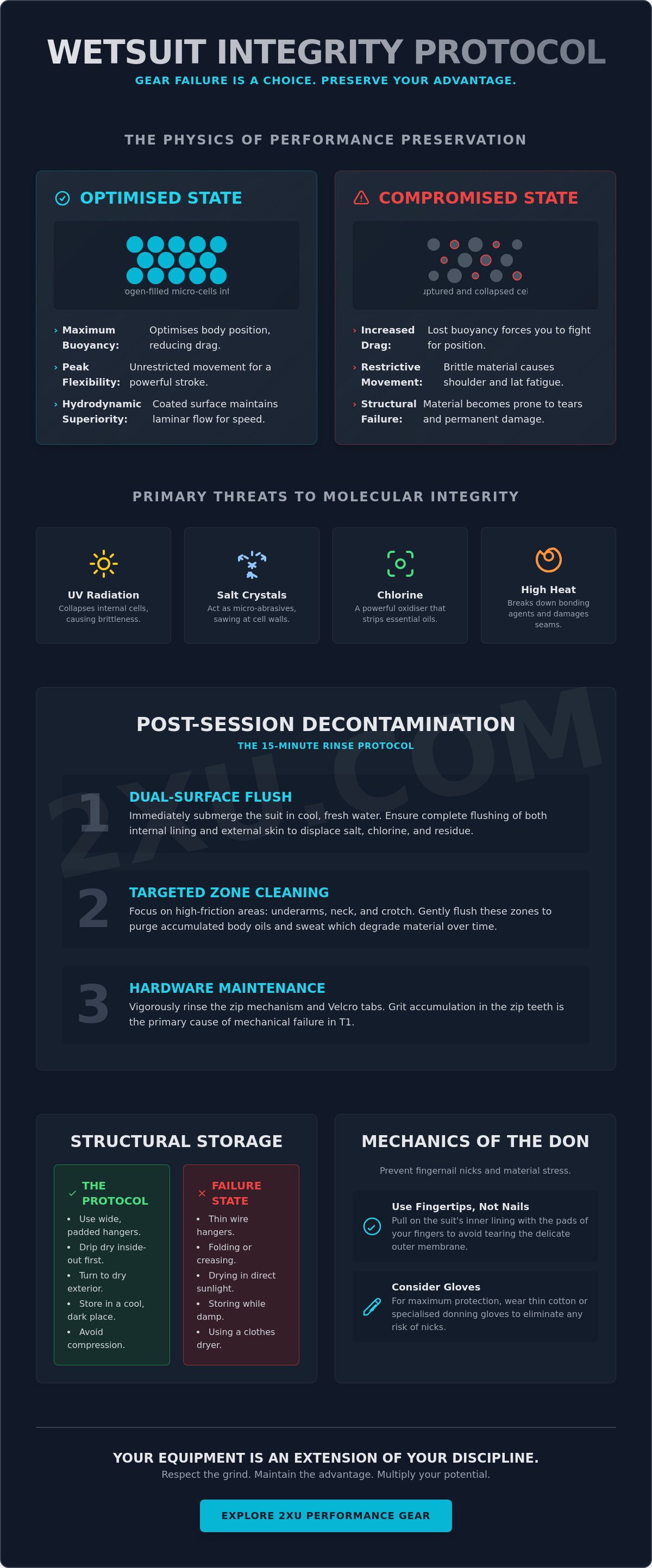
The core of your wetsuit consists of thousands of microscopic nitrogen-filled cells. These cells provide the lift and flexibility required for an efficient stroke. Exposure to UV radiation and harsh chemical environments causes these cells to rupture or collapse. As the material loses its internal pressure, it becomes stiff and brittle. Neoprene fatigue is the loss of elastic memory in the cell structure. Once this memory is compromised, the suit no longer moves with your body. Instead, it acts as a restrictive shell that fights against your muscular expansion, leading to premature fatigue in the lats and shoulders.
Hydrodynamics and the Speed Coefficient
Water is 800 times denser than air. In this environment, surface friction is the enemy of speed. High-end suits feature proprietary coatings designed for maximum water slippage. When you fail to follow an elite care protocol, micro-scuffs and tears create turbulent flow across the suit's surface. This increases drag and disrupts the laminar flow required for peak velocity. Furthermore, material suppleness is the primary driver of shoulder mobility. A suit that has lost its flexibility restricts your reach during the recovery phase, shortening your stroke length and decreasing your overall efficiency. Preserving the specialised outer membrane is the only way to ensure your gear performs at its laboratory-validated potential on race day.
Post-Session Decontamination: The 15-Minute Rinse Protocol
The transition from the water to the transition area marks the beginning of your gear's recovery phase. You must act before the suit dries. When saltwater evaporates, it leaves behind microscopic salt crystals that embed themselves within the fabric lining and the neoprene pores. These crystals act as jagged micro-abrasives. Every time the suit flexes, these minerals saw away at the elastomer's cellular walls, leading to internal structural failure. Mastering how to care for a triathlon wetsuit starts with immediate neutralisation of these elements. If you train in chlorinated environments, the risk is even higher. Chlorine is a powerful oxidiser that strips the essential oils from the material, rendering it brittle and prone to cracking. High heat is equally destructive. Hot water breaks down the specialised bonding agents that hold your suit together. Always use cool, fresh water to preserve the engineered integrity of your triathlon wetsuit.
Step-by-Step Decontamination Sequence
- Step 1: The Dual-Surface Flush. Submerge the suit in cool, fresh water. Ensure the water reaches every square centimetre of both the internal lining and the external smooth skin to displace salt and chemical residue.
- Step 2: Targeted Zone Cleaning. Focus on high-friction areas such as the underarms, neck, and crotch. These zones accumulate body oils and sweat, which can degrade the neoprene over time if not thoroughly purged.
- Step 3: Hardware Maintenance. Rinse the zip mechanism and Velcro tabs vigorously. Grit accumulation in the zip teeth is the primary cause of mechanical failure during T1. Ensure the track is clear of all debris.
The Science of Drying Without Damage
Drying your suit inside-out is a mandatory protocol for maintaining lining integrity. This method ensures the fabric closest to your skin dries first, preventing the growth of odour-causing bacteria and mould. It also protects the delicate outer coating from accidental environmental damage. Solar radiation is a silent killer of high-performance gear. UV rays "cook" the neoprene, causing irreversible photochemical degradation that destroys elasticity. Never leave your suit in direct sunlight. Airflow is your primary tool for restoration. Avoid the common trap of leaving damp gear in the boot of your car. The stagnant, humid environment accelerates material breakdown. Instead, hang the suit in a shaded, well-ventilated area to allow moisture to evaporate naturally. This discipline ensures your equipment is ready for the next session without compromising its performance profile.
Structural Engineering: Storing Your Wetsuit to Prevent Material Fatigue
Storage is the silent phase of the performance grind. While the rinse protocol removes chemical threats, your storage methodology determines the long-term structural integrity of the neoprene elastomer. Mismanagement during this phase leads to material fatigue, a condition where the neoprene loses its elastic memory and structural density. Understanding how to care for a triathlon wetsuit requires a shift in perspective. You must view storage as a preservation of engineering rather than simple equipment housing. The primary antagonist during this phase is gravity. When a suit is suspended incorrectly, its own mass exerts a constant, localised force that causes the material to stretch and thin at the contact points. This results in permanent shoulder divots and a compromised fit that allows water ingress, destroying your hydrodynamic efficiency.
Crease mechanics are equally critical. Neoprene is composed of nitrogen-filled cells that possess a specific "memory" of their manufactured shape. When you fold a suit, you compress these cells along a single axis. If left in this state, the compression becomes permanent, creating a structural weakness that serves as a precursor to seam failure. Mid-season accessibility is no excuse for poor discipline. Whether you are prepping for a session tomorrow or archiving your gear for the off-season, environmental stability is mandatory. Your storage zone must be cool, dark, and dry. Fluctuations in temperature and humidity accelerate the breakdown of the cellular bonds, leading to a suit that feels "dead" and unresponsive in the water.
Hanger Selection and Gravity Stress
Wire hangers are strictly prohibited for elite gear. Their narrow profile concentrates the entire weight of the suit onto a minimal surface area, guaranteeing material failure. You must use a specialised wide-bridge hanger. These tools distribute the vertical load across a broader surface, mimicking the natural curvature of the human shoulder. If a wide-bridge hanger is unavailable, utilise the "Pants Bar" alternative. By hanging the suit doubled over a thick, padded bar at the waist, you halve the vertical load and eliminate the stress on the shoulder seams entirely. This simple mechanical adjustment exponentially increases the lifespan of the material.
The Roll Method for Maximum Longevity
For long-term archiving, rolling is the superior protocol. This method eliminates the risk of crease-induced failures by ensuring the material remains in a continuous, low-tension state. Start from the base of the legs and roll the suit upward toward the shoulders, ensuring the sleeves are tucked neatly across the chest before the final rotation. This technique prevents the formation of "memory creases" that compromise the speed coefficient of the outer membrane. Once rolled, place the suit in a breathable mesh bag. Store it in a climate-controlled environment to prevent atmospheric degradation and ensure that when the next race season arrives, your gear is ready to multiply your output.
The Mechanics of the Don: Protecting the Membrane During Entry
The most critical phase of equipment maintenance occurs before you even enter the water. Donning a high-performance suit is a high-stakes procedure where a lack of discipline leads to immediate material failure. Fingernail management is non-negotiable. Even a well-manicured nail can slice through the delicate outer membrane, creating crescent-shaped nicks that compromise the suit's speed coefficient. To truly master how to care for a triathlon wetsuit, you must treat the entry process with the same precision as your stroke mechanics. This is not just about putting on clothes; it is about seating a technical membrane against your physiology without inducing mechanical stress.
Entry Technique: A Disciplined Approach
Never pull the suit from the external smooth skin. Instead, use the pads of your fingers to grip the internal fabric lining. This distributes the force across the reinforced interior rather than the vulnerable exterior elastomer. The "Plastic Bag" technique is an essential protocol for reducing friction during limb entry. By placing a small bag over your hand or foot, you allow the limb to slide through the restrictive wrist and ankle seals without over-stretching the material. Once the suit is on, you must eliminate air pockets in the crotch and armpits. A suit that is not seated correctly creates excessive tension on the seams. This "seam shear" is a primary cause of premature failure. If the crotch of the suit is too low, every shoulder rotation pulls against the lower chassis, eventually popping the waterproof seals. Always utilise a helper for the final zip-up to ensure the track is perfectly aligned and clear of the internal zip flap.
Lubrication: Friction Reduction Without Chemical Damage
Lubrication is a tool for transition speed and skin protection, but it carries significant chemical risks. Petroleum-based products are strictly prohibited. These substances act as solvents that dissolve the molecular bonds of the neoprene, causing the material to delaminate and lose its structural integrity. You must use only water-based or specialised triathlon lubricants designed for high-end gear. Target your application to the neck, wrists, and ankles to facilitate rapid removal during T1. For athletes demanding peak performance from their gear, choosing the right triathlon wetsuits and maintaining them with approved lubricants is the only way to ensure race-day reliability. High-performance output requires high-performance preparation. Respect the material, and it will multiply your speed on the course.
Optimising the Lifecycle: Professional Maintenance and the 2XU Standard
Elite performance is a product of relentless discipline and superior engineering. Mastering how to care for a triathlon wetsuit involves recognising when your own maintenance reaches its technical limit. Professional assessment becomes necessary when you observe delamination at the primary seams or a significant loss of material rebound. The 2XU commitment is to manufacture gear that multiplies human output, but this exponential gain is only possible when the equipment's molecular integrity is preserved. You must realise when a suit has reached the end of its functional lifespan. Once the buoyancy-to-drag ratio is marginalised by cellular collapse or pervasive material thinning, the suit no longer serves as a performance multiplier. It becomes a liability.
A spent suit often exhibits a leathery texture or a visible loss of the specialised outer coating. These are indicators that the speed coefficient has been compromised. At this stage, no amount of decontamination can restore the original hydrodynamic efficiency. Respect the grind by knowing when to replace your gear to ensure your physical efforts are not wasted against equipment failure. Honour the warranty by seeking expert advice for structural concerns that exceed basic repair protocols.
DIY Repair Protocol for Minor Nicks
Fingernail nicks are the most common form of surface damage. They are preventable but often occur during the intensity of a rapid transition. You must seal these punctures immediately using specialised neoprene adhesive. The protocol requires a clean, dry surface. Apply the glue sparingly to both sides of the nick, allow it to become tacky, and then press the edges together firmly. This creates a chemical bond that restores the membrane's integrity. Ignoring a minor tear is a strategic error. Under the high-torque loads of a race-day swim, a 2mm nick can quickly expand into a catastrophic seam failure, allowing water to flood the suit and destroy your buoyancy.
The Final Checklist for Race Readiness
Your pre-race inspection should be as meticulous as your data analysis. Check every millimetre of the zip track for grit. Inspect the Velcro neck closure for fibre accumulation that could cause chafing. Ensure all seam tape is flush against the lining. Linking your gear maintenance to your triathlon wetsuit performance strategy is the final step in your preparation. Discipline in the laundry room leads to confidence on the starting line. When you stand on the beach, you should have total certainty that your equipment is ready to perform. The athlete and the gear must be equally prepared for the challenge ahead. Stay focused. Trust the protocol. Multiply your potential.
Secure Your Competitive Advantage
Elite performance is never an accident. It's the result of rigorous discipline applied to every variable, including the preservation of your equipment. By implementing the 15-minute rinse protocol and adhering to structural storage standards, you ensure that your gear remains a performance multiplier. Mastering how to care for a triathlon wetsuit is the final piece of your competitive strategy. It protects the hydrodynamic efficiency you need to crush your swim splits and ensures your material integrity remains uncompromised.
When your current suit no longer provides the required buoyancy or flexibility, it's time to upgrade to the laboratory-validated standards of the elite. Our range utilises proprietary Yamamoto Neoprene technology, specifically engineered for maximum buoyancy and flexibility. This gear is validated by elite Ironman athletes worldwide to ensure it withstands the most demanding race conditions. Explore the 2XU Triathlon Wetsuit Collection to find your next speed advantage. Respect the grind, maintain your gear, and prepare to multiply your output on race day.
Performance Preservation: Frequently Asked Questions
Can I use regular shampoo or dish soap to wash my wetsuit?
No, you must never use household detergents or regular shampoos on your gear. These substances contain harsh surfactants that strip the essential oils from the neoprene, leading to premature brittleness and loss of elastic memory. Only use pH-neutral, specialised wetsuit shampoos designed to sanitise the material without compromising the molecular bond of the elastomer. Protecting the material's integrity requires the right chemical tools.
How do I fix a small fingernail tear in my neoprene?
Use a specialised neoprene adhesive to seal fingernail nicks immediately. Clean the area with fresh water and ensure it is completely dry before applying a thin layer of glue to both sides of the tear. Wait for the adhesive to become tacky, then press the edges together firmly for 30 seconds to restore the membrane's hydrodynamic integrity. Small repairs prevent catastrophic seam failures during race-day loads.
Is it safe to pee in my wetsuit during a race or training?
Uric acid is chemically corrosive and will degrade the fabric lining and neoprene bonds over time. While common in endurance events, it is a performance risk that requires an immediate, thorough flush with fresh water post-race. Failure to decontaminate the suit will lead to odour buildup and irreversible material breakdown in the crotch and lower chassis. Respect the gear by maintaining a clean internal environment.
How long should a high-performance triathlon wetsuit realistically last?
A high-performance suit realistically lasts between 3 to 5 seasons when you follow a rigorous maintenance protocol. Understanding how to care for a triathlon wetsuit is the difference between a suit that lasts five years and one that fails in twelve months. Lifespan is determined by the number of stretch cycles and exposure to environmental stressors. Once the material feels stiff, the buoyancy-to-drag ratio is compromised and the suit must be replaced.
Can I leave my wetsuit in the car between sessions?
Never leave your suit in a vehicle between sessions. Temperatures inside a parked car can exceed 50 degrees Celsius, which causes the nitrogen-filled cells in the neoprene to expand and rupture. This thermal stress destroys the suit's buoyancy and flexibility, turning your precision gear into a dead weight that no longer multiplies your physical output. Discipline extends to your gear's environment, not just your training hours.
Does pool chlorine permanently damage the neoprene?
Chlorine is a powerful oxidant that causes permanent, cumulative damage to neoprene. It strips the material of its suppleness and causes the specialised outer coating to peel. If you must use a triathlon wetsuit in a pool, you must perform an immediate, aggressive fresh water flush to neutralise the chemicals before they can bond to the elastomer. Average care in chlorinated water leads to rapid material failure.
Should I store my wetsuit inside-out or right-side out?
Dry the suit inside-out to protect the external smooth skin and ensure the lining is fully sanitised. This is a fundamental step in how to care for a triathlon wetsuit properly. For long-term storage, turn the suit right-side out and use a wide-bridge hanger or the roll method. This prevents the lining from sticking to itself and maintains the memory of the engineered shape for your next race.
What is the best way to travel with a wetsuit to avoid creases?
The roll method is the only way to travel without inducing permanent structural creases. Start from the ankles and roll the suit upward, ensuring the sleeves are folded flat across the chest before the final rotation. Place the rolled suit at the top of your luggage to avoid compression from heavier gear, preserving the speed coefficient of the neoprene. Proper packing ensures your gear performs at its laboratory-validated potential.