
Are Compression Shorts Good for Cycling? The Scientific Verdict for Elite Performance
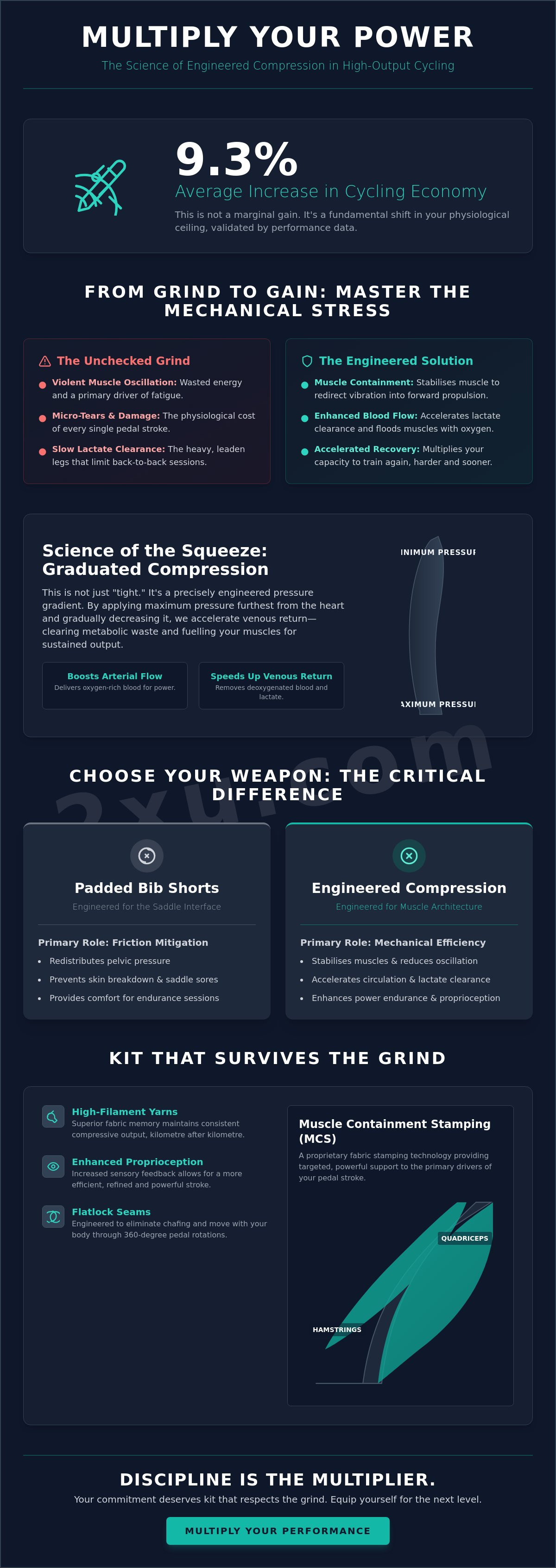
A study in the International Journal of Sports Physiology and Performance found that cyclists wearing compression garments saw an average 9.3% increase in cycling economy. This is not just a marginal gain; it is a fundamental shift in your physiological ceiling. You have felt the violent muscle oscillation during high-cadence intervals and the heavy, leaden legs that follow a six-hour ride. If you are asking, are compression shorts good for cycling, the answer is found in the data of muscle containment and venous return. Respecting the grind means equipping your body to handle the mechanical stress of every single pedal stroke.
We understand that elite performance is earned through discipline and rigorous validation. You will discover how engineered compression optimises your cycling stroke, reduces muscle fatigue, and accelerates recovery on and off the saddle. We will break down the science of graduated pressure and explain how to eliminate chafing while maintaining power endurance. This is your technical guide to reducing muscle damage and mastering the transition from the bike to the run.
Key Takeaways
- Understand why the answer to "are compression shorts good for cycling" is found in their ability to stabilise muscle groups and reduce power-sapping oscillation during high-cadence intervals.
- Distinguish between the friction-reduction role of padded bib shorts and the mechanical efficiency provided by medical-grade compression garments.
- Discover how graduated pressure increases arterial flow and accelerates blood lactate clearance to multiply your recovery speed between sessions.
- Identify critical engineering features like high-filament yarns and flatlock seams that ensure your kit survives the grind of 360-degree pedal rotations.
- Learn how proprietary Muscle Containment Stamping (MCS) provides targeted support to the quadriceps and glutes to maintain power endurance on long-distance rides.
Defining the Role of Compression in High-Output Cycling
Elite cycling is a game of mechanical precision and physiological efficiency. You do not just ride; you execute a repetitive, high-force movement thousands of times per hour. To understand why are compression shorts good for cycling, you must look beyond the aesthetic. These are not merely tight garments. They are precision-engineered tools designed to apply specific, calculated pressure to the primary drivers of your pedal stroke: the quadriceps, hamstrings, and glutes. Tight is a feeling. Compression is a measurement.
While many casual riders mistake a restrictive fit for performance, true compression is a science of pressure gradients. An effective compression garment provides a mechanical framework that supports the muscle architecture while facilitating essential biological processes. The primary goal is to enhance blood flow and minimise the micro-tears that occur during the brutal repetitive motion of a long-distance grind. By wrapping the muscle in a high-tensile fabric, you create a more stable environment for power production.
The Mechanics of Graduated Compression
Engineering a pressure differential is the hallmark of elite kit. Graduated compression works by applying the highest pressure at the lower extremities and decreasing it toward the heart. This specific gradient encourages venous return, allowing deoxygenated blood to move more efficiently through the system even under heavy load. We achieve this through circular knit technology and superior fabric memory. Unlike standard fabrics that lose their tension after a few kilometres, high-performance compression maintains a consistent output. If your gear is just tight, it might actually restrict arterial flow. When it is engineered, it multiplies your circulatory capacity and ensures your muscles receive the oxygen required for sustained output. This is the difference between average gear and a performance multiplier.
Cycling-Specific Muscle Stabilisation
Every time your foot hits the bottom of the stroke at a high cadence, your muscles experience oscillation. This vibration is not just uncomfortable; it is a primary driver of fatigue and muscle damage. By wrapping the quadriceps and hamstrings in a stable, compressive sleeve, you significantly reduce this lateral movement. This stabilisation preserves energy that would otherwise be wasted on muscle vibration, redirecting it into the pedals. Are compression shorts good for cycling? If you value power endurance, the answer is in the stabilisation of your lower limbs. Protecting your muscle fibres from the grind of endurance sessions is not about comfort. It is about maintaining your mechanical efficiency when the competition starts to fade. You earn your place at the front of the pack through discipline and superior preparation. Your kit should reflect that commitment.
- Reduced Oscillation: Minimising muscle vibration preserves energy for forward propulsion.
- Prevention of Micro-tears: Stabilising the muscle fibres protects them from the eccentric stress of the pedal cycle.
- Enhanced Proprioception: Increased sensory feedback allows for a more efficient, refined stroke.
Compression Shorts vs. Padded Bike Shorts: The Critical Differences
Padded bike shorts, commonly referred to as bibs, are engineered for the saddle interface. Their primary objective is the mitigation of friction and the redistribution of pressure across the pelvic floor. In contrast, compression shorts are designed to support the internal architecture of the leg. They focus on muscle containment and circulatory acceleration. While traditional bibs provide comfort, they often lack the technical tensile strength required for true graduated compression. You must distinguish between a garment that protects your skin and one that powers your muscles.
If you are wondering, are compression shorts good for cycling, the answer depends on your specific performance objective. Elite athletes don't settle for "good enough." They select gear based on the mechanical demands of the session. The choice is a matter of duration, intensity, and the specific physiological cost you are willing to pay during the grind. Efficiency is the only metric that matters when you are pushing toward your physical limit.
When to Choose a Chamois
For endurance sessions exceeding three hours, the chamois is non-negotiable. It prevents the skin breakdown and saddle sores that can derail a training block. However, standard padded shorts often allow for excessive muscle oscillation because their primary focus is surface-level comfort rather than structural support. To solve this, advanced triathlon suits bridge the gap. They combine high-filament compression fabrics with low-profile pads that offer protection without the bulk. This hybrid approach ensures you maintain mechanical efficiency without sacrificing skin integrity during a long-distance effort. You get the benefit of saddle protection while the compression fabric keeps your muscles stabilised for the final push.
When Compression Alone Suffices
There are specific scenarios where the pad is an unnecessary weight. During short, high-intensity anaerobic intervals, your priority is maximal power output and muscle stabilisation. Pure compression shorts are superior here. They provide a tighter wrap on the quadriceps, ensuring every watt is directed into the drivetrain rather than lost to muscle vibration. If you are asking if are compression shorts good for cycling during a crit race or a sprint session, the data suggests the stabilisation of the muscle mass is more critical than saddle padding.
Additionally, multi-sport athletes often find that a heavy chamois hinders the run split by retaining water and altering gait. Compression alone provides the necessary support for the bike leg while allowing for a fluid, unrestricted transition. You can also use compression shorts as a high-performance base layer under unpadded mountain bike gear to gain the benefits of increased blood flow on technical climbs. To maximise your power endurance on the bike, explore our range of compression clothing designed for elite output. This allows you to maintain a high power-to-weight ratio without the bulk of traditional gear.
How Graduated Compression Multiplies Your Power and Recovery
Graduated compression is not a passive layer. It is an active biological intervention. When you ask, are compression shorts good for cycling, you are really asking if you can force your physiology to work harder for longer. Peer-reviewed data from 2025 confirms that the answer lies in a 33% reduction in muscle displacement during high-intensity intervals. By applying pressure that is tightest at the distal points, these garments accelerate the velocity of blood flow. This increases the delivery of oxygenated blood to the working muscles while simultaneously flushing out the metabolic by-products of high-intensity effort.
Blood lactate clearance is a critical bottleneck for any cyclist pushing past their threshold. Engineered compression reduces this bottleneck by improving the efficiency of the circulatory system during the ride. This means you aren't just recovering faster after the session; you are recovering in real-time while you are still on the saddle. Efficiency is the only metric that matters during the grind. Biology is not a suggestion; it is a system to be optimised.
Beyond the internal chemistry, compression provides a heightened sense of proprioception. The increased sensory input from the skin to the brain allows for a more precise execution of the 360-degree pedal stroke. You become more aware of your leg position and muscle activation. This leads to a more refined and efficient technique that saves energy over hundreds of kilometres. If you are asking, are compression shorts good for cycling, consider the mechanical advantage of a more disciplined stroke.
The psychological impact is equally tangible. That "locked-in" sensation provides a feeling of stability and readiness that is essential for maximum efforts. When your kit feels like an extension of your muscular system, you are mentally prepared to push into the pain cave. You don't just feel faster; you possess the structural support to be faster.
Oxygenation and the Aerobic Threshold
Delivering oxygen to the quadriceps during the power phase of the stroke is the difference between a breakthrough and a blow-up. Graduated compression helps maintain arterial pressure, ensuring that the oxygen-rich blood reaches the muscle fibres even as they contract under heavy load. This delays the transition to an anaerobic state, effectively raising your aerobic ceiling. At a cadence of 90 RPM, the mechanical pressure of graduated compression works in tandem with the muscle pump to facilitate rapid venous return, ensuring metabolic waste is cleared before it can compromise power output.
Accelerated Recovery and Reduced DOMS
Recovery doesn't start in the shower. It starts on the road. By limiting muscle displacement, compression reduces the severity of Delayed Onset Muscle Soreness (DOMS) and limits the accumulation of Creatine Kinase. This reduction in inflammation means you can return to high-intensity training sooner without compromising your schedule. Discipline requires a body that can handle the volume. For a deeper physiological dive, explore the science of compression and how it redefines the limits of human recuperation.
Choosing Your Gear: Engineering the Perfect Fit for the Grind
Choosing the right equipment is a prerequisite for elite output. When you evaluate if are compression shorts good for cycling, the technical specifications of the garment must be your primary filter. High-filament yarns are essential because they provide the durable, long-lasting power required to withstand the mechanical stress of thousands of pedal revolutions. Inferior fabrics fail under this load, losing their compressive profile and becoming a liability rather than an asset. You don't need gear that merely looks the part; you need gear that survives the friction of the road.
Precision engineering extends to the construction of the seams. Flatlock seams are mandatory to eliminate the risk of chafing during the continuous 360-degree pedal rotation. If your gear causes skin irritation, your focus shifts from power production to pain management. Additionally, advanced moisture-wicking properties regulate core temperature and prevent the accumulation of sweat, which can increase drag and lead to skin breakdown. A secure waistband is equally critical. It must maintain its position during aggressive, out-of-saddle efforts without restricting diaphragmatic breathing. Efficiency requires a kit that stays out of your way while you focus on the numbers.
Fabric Integrity and Longevity
Medical-grade circular knit technology is the gold standard for performance. This manufacturing process ensures an even distribution of pressure and superior fabric memory, allowing the garment to outlast cheaper performance blends that rely on low-quality elastomers. Cheaper gear often loses its compression "power" after just a few wash cycles, rendering the "graduated" aspect of the pressure profile useless. You must avoid non-performance materials that hold moisture, as they increase the weight of the garment and create unnecessary aerodynamic drag. Invest in gear that maintains its structural integrity through the most brutal training blocks. To secure the technical advantage needed for your next session, shop our range of compression clothing engineered for high-output athletes.
Sizing for Performance, Not Comfort
Performance compression is not meant to feel like casual wear. To achieve the physiological benefits discussed earlier, you must prioritise a firm, compressive fit that supports the muscle mass without restricting joint mobility at the hip or knee. Accuracy in measurement is non-negotiable. Use the "two-finger" rule at the leg hem. You should be able to slide two fingers under the fabric, ensuring that blood flow is not constricted while maintaining a secure seal against the skin. Never size up for a "relaxed" fit. If the garment is loose, the pressure gradient is compromised, and the answer to are compression shorts good for cycling becomes a definitive no. You must earn the results, and that starts with wearing the gear exactly as it was engineered to be worn.
2XU Compression: Pushing the Limits of Human Potential
2XU does not manufacture casual fitness wear. We engineer high-performance systems for those who demand breakthrough results. When you ask, are compression shorts good for cycling, the answer is found in our proprietary Muscle Containment Stamping (MCS) technology. This is not just a technical fabric; it is a structural reinforcement system. We subject our garments to rigorous validation by world-leading research institutions to ensure every claim is backed by tangible data. We exist for the athlete who respects the grind and refuses to settle for average standards.
Our commitment to laboratory validation distinguishes us from competitors who rely on vague marketing claims. By using specialised instrumentation to measure pressure and muscle displacement, we have developed a kit that handles the transition from the bike to the run with zero compromise. This multi-sport versatility is critical for triathletes and cross-training enthusiasts who need gear that performs across every discipline. Efficiency is the only metric that matters when you are pushing your physical output to the limit.
The MCS Advantage for Cyclists
Muscle Containment Stamping (MCS) is a revolutionary approach to athletic support. By applying targeted stamping that traces the key muscle fibres, we reduce the strain on the quadriceps and glutes during high-intensity efforts. This targeted support is vital during standing climbs and explosive sprints where muscle oscillation is at its peak. MCS provides a mechanical advantage that allows you to maintain power output when fatigue begins to set in. If your training programme involves high-impact work off the bike, integrating our running shorts ensures your recovery starts the moment your feet hit the pavement. Consistency in your kit leads to consistency in your results.
Aspirational Performance
Choosing 2XU means joining a global community of elite athletes who possess an obsession with quality and performance. We don't just provide apparel; we provide a performance multiplier that exponentially enhances your natural physical potential. You have put in the work. You have embraced the discipline. Now, you need the technical foundation to prove that your potential is limitless. Are compression shorts good for cycling? Only if they are engineered to the highest standards of sports science. Do not compromise on your equipment. Shop 2XU Compression and dominate your next ride.
Master Your Mechanical Efficiency
The scientific evidence is absolute. If you are asking if are compression shorts good for cycling, the answer is found in the 33% reduction in muscle displacement and the tangible increase in cycling economy. You have the data. You have the discipline. Now, you need the technical foundation to execute your potential. We have established that true performance is built on graduated pressure and targeted support that respects the mechanics of the pedal stroke.
By utilising high-filament yarns and proprietary MCS technology, you can stabilise your muscle architecture and accelerate the clearance of metabolic waste. Our gear is validated by the Australian Institute of Sport to ensure that your effort is never wasted on mechanical inefficiency. The grind doesn't stop, and neither should your progress. Equip yourself with the tools required to push beyond your current aerobic threshold and recover faster for the next session. You have earned your place on the road; now, own the results.
Multiply your power output with 2XU Compression
Frequently Asked Questions
Can I wear compression shorts under my cycling bibs?
You can wear unpadded compression shorts under your cycling bibs, but you must ensure the interface does not compromise your biomechanics. This layering technique provides a secondary level of muscle stabilisation for the quadriceps and hamstrings. However, it can increase heat accumulation and moisture retention if the fabrics are not engineered for high-output breathability. Many elite athletes prefer a dedicated trisuit or integrated compression liner to maintain a streamlined profile and prevent chafing during the grind.
Do compression shorts help with saddle sores?
Compression shorts are not a primary solution for saddle sores, as their engineering prioritises muscle containment over skin protection. Saddle sores are typically caused by friction and bacterial accumulation at the saddle interface. While the firm fit of compression gear can reduce lateral skin movement, it lacks the specialised padding of a chamois designed to redistribute pressure. You should rely on high-quality bibs for skin integrity and use compression to optimise your physiological output and recovery. For those seeking the highest standards in pressure relief, products like As4480.1 Medical Sheepskin exemplify how medical-grade certification ensures skin protection and tissue health.
How long should I wear compression shorts after a ride for recovery?
Wear your compression shorts for a minimum of three to four hours post-ride to achieve significant physiological benefits. This duration allows the graduated pressure to facilitate venous return and accelerate the clearance of blood lactate from the lower limbs. Some data-driven athletes extend this period to eight hours or wear them overnight following extreme endurance efforts. The objective is to reduce inflammation and muscle displacement, ensuring you are prepared for the next high-intensity training block.
Is it better to have padded or unpadded compression shorts for cycling?
The choice between padded and unpadded gear depends entirely on your session objective and ride duration. Unpadded compression shorts are superior for short, high-intensity intervals where power-to-weight ratio and maximal muscle stabilisation are paramount. For endurance sessions exceeding two hours, a padded option is essential to prevent pelvic floor discomfort and skin breakdown. Elite multi-sport athletes often select low-profile padding that provides the necessary protection on the saddle without hindering the mechanical efficiency of the run.
Do compression shorts improve my FTP (Functional Threshold Power)?
Compression gear can indirectly improve your FTP by increasing cycling economy and delaying the onset of anaerobic fatigue. Are compression shorts good for cycling performance metrics? The research suggests they optimise your aerobic threshold, allowing you to sustain higher wattages for longer durations. By reducing muscle oscillation, you preserve energy that is typically lost to vibration. This mechanical efficiency allows you to push closer to your physical limit during time trials and sustained climbs.
What is the difference between running compression and cycling compression?
Cycling-specific compression is engineered to account for the seated position and the unique mechanics of the 360-degree pedal rotation. While running compression focuses on absorbing the vertical impact forces on the calves and quads, cycling gear prioritises the power phase of the stroke. The fabric panels are often cut to provide maximum tension while the hip is in a flexed position. This ensures the pressure gradient remains consistent throughout the entire range of motion on the bike.
How do I wash my compression gear to maintain its elasticity?
Respect your equipment by using cold water and avoiding high-heat environments that degrade high-filament yarns. You should never use fabric softeners, as they coat the fibres and destroy the moisture-wicking properties and tensile strength of the garment. Air drying is mandatory to preserve the circular knit integrity and ensure the graduated pressure profile remains accurate. Proper maintenance ensures your kit continues to provide the necessary mechanical support through multiple seasons of rigorous training.
Should I wear compression socks or shorts for the best cycling gains?
Target the quadriceps and glutes with compression shorts for the most significant active gains during your ride. These muscle groups are the primary drivers of power production, and stabilising them directly impacts your mechanical efficiency. Compression socks are highly effective for passive recovery post-ride, as they assist in moving blood from the furthest extremities back to the heart. For a holistic approach, use shorts for active power containment and socks to accelerate the tripartite recovery framework.