
Best Running Hats for Sun Protection: Engineering Your Performance Shield
A running hat is not a mere accessory; it is a critical mechanical cooling system designed to prevent solar-induced performance decay. When you are deep into a high-intensity interval session, the sun is not just a backdrop; it is a variable that threatens your core temperature stability. You understand the specific agony of salt-heavy sweat stinging your eyes during the peak of the grind and the long-term cost of radiation damage on an exposed scalp. Searching for the best running hats for sun protection is not about aesthetics; it is about securing a performance shield that allows you to maintain peak power output when the environment demands a retreat.
This guide explores the technical headwear engineered to provide elite-level UV protection while simultaneously optimising thermoregulation. We examine how advanced moisture-wicking materials and laboratory-validated designs multiply your endurance by shielding you from 98 percent of harmful UV radiation. You will discover the durable gear built to survive repeated high-intensity sweat cycles and the specific features, such as detachable sun capes and ice-storage pockets, that ensure your biological systems remain efficient. We are moving beyond basic headwear to identify the precision tools required for total mechanical stability in the harshest conditions.
Key Takeaways
- Understand the science of solar load and how managing radiative heat absorption directly reduces perceived exertion to prevent performance decay.
- Identify the engineering features that define the best running hats for sun protection, focusing on high-filament technical fibres designed for rapid moisture transport.
- Select your specific headwear shield based on training intensity, choosing between aerodynamic caps for racing and technical visors for maximum heat dumping.
- Implement a professional maintenance protocol to manage salt buildup and ensure your gear maintains its mechanical stability through repeated high-intensity sweat cycles.
- Discover how 2XU performance collection technologies utilise laboratory-validated materials to provide an elite UV shield and multiply your physical output.
The Science of Solar Load: Why Sun Protection Multiplies Performance
Solar load is the total radiative heat absorbed by your body during exposure to the sun. It's a relentless force that compounds the metabolic heat your muscles already generate during the grind. For the serious athlete, this isn't a minor inconvenience; it's a physiological tax. When you fail to mitigate this load, your core temperature spikes, forcing your heart to work harder to pump blood to the skin for cooling rather than to your working muscles. This is where the concept of engineered shade becomes a critical tool. By blocking direct radiation, you maintain mechanical efficiency and ensure your energy is spent on forward motion rather than thermal survival.
Thermoregulation and the Athlete's Brain
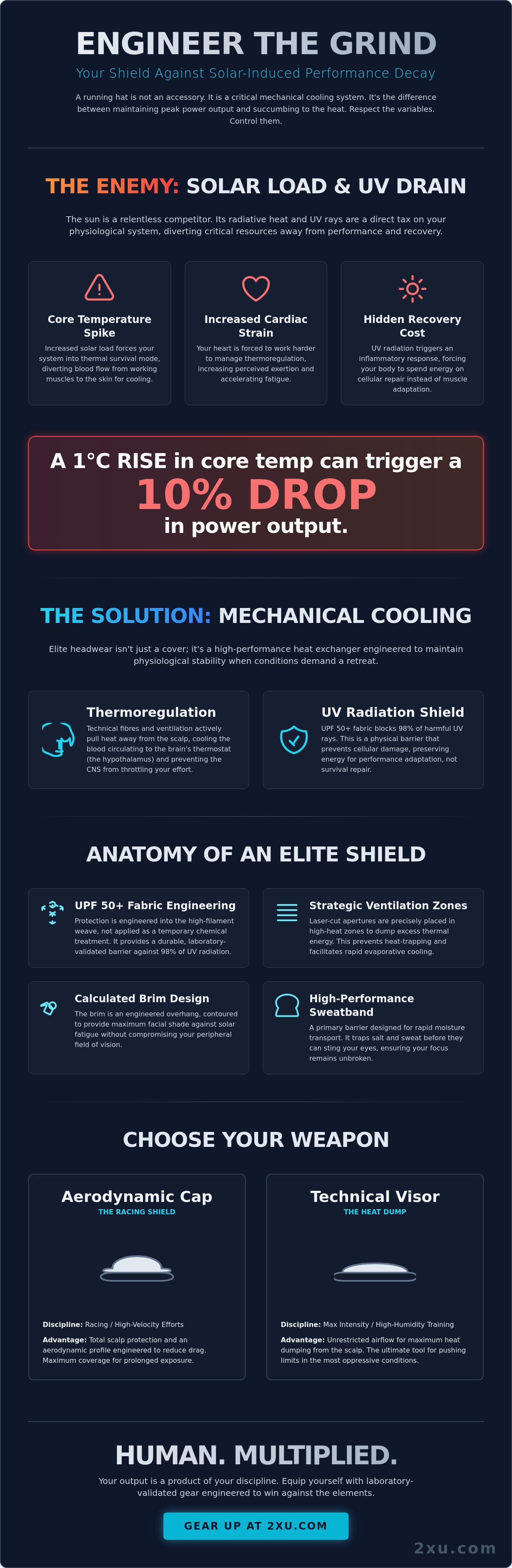
The hypothalamus acts as your internal thermostat, constantly monitoring cranial temperature with uncompromising precision. If this region overheats, the brain initiates a survival protocol to protect itself. Data-driven research suggests that a 1-degree rise in core temperature can lead to a 10% drop in power output as your central nervous system throttles your effort to prevent thermal injury. The best running hats for sun protection function as high-performance heat exchangers. They don't just block the sun; they use technical fibres to facilitate rapid evaporative cooling. This allows you to dump heat fast, keeping your brain cool and your output steady during high-intensity intervals.
UV Radiation vs. Endurance
UV exposure is an often-ignored drain on your biological recovery. Every minute your skin is unprotected, UV radiation triggers a systemic inflammatory response. Your body is forced to divert energy and nutrients away from muscle repair to fix cellular damage on your scalp and face. This is a hidden energy cost that can compromise your entire training programme. The scalp is particularly vulnerable because it's positioned directly toward the solar peak, yet it's the most overlooked area for endurance athletes. Protecting it ensures your resources stay focused on performance and adaptation. This is how human potential is multiplied. You aren't just running; you're managing a biological system under stress. UPF is the mechanical measurement of UV transmittance through fabric.
Maximising your output requires a commitment to every variable. Respect the sun as a competitor that never tires. When you deploy technical headwear, you are choosing to stabilise your core temperature and shield your biology from unnecessary damage. This is the discipline required to win. Stay focused. Keep the grind alive by equipping yourself with gear that has been laboratory-validated to perform when the heat becomes a weapon. Your endurance depends on it.
Technical Anatomy of Elite Running Hats: Engineering the Ultimate Shield
Elite performance is the result of meticulous engineering. When you select the best running hats for sun protection, you are evaluating a mechanical assembly designed to manage thermal load and ocular clarity. The brim is not just a piece of plastic; it is a calculated overhang. It must be rigid enough to withstand high-velocity headwinds yet contoured to provide maximum facial shade without obstructing your peripheral field of vision. Every millimetre of coverage is a win against solar fatigue during the peak of the grind.
Strategic ventilation zones are critical for heat dissipation. These are not random perforations. They are laser-cut apertures placed at high-thermal output zones where heat naturally accumulates. This airflow prevents the heat-trap effect common in standard headwear. Internally, a high-performance sweatband serves as a primary barrier. It traps salt and moisture before they reach your eyes, ensuring your focus remains on the split times rather than the sting of exertion. This is gear designed to survive the most intense training cycles.
UPF 50+ Fabric Engineering
Superior sun protection relies on the physical density of the weave rather than temporary chemical treatments that wash out over time. While SPF measures chemical protection on the skin, UPF measures the actual amount of UV radiation that penetrates the fabric. According to The Skin Cancer Foundation's guide to sun-protective clothing, a UPF 50 rating blocks 98 percent of the sun's rays. Technical headwear must maintain this integrity even when saturated. We use high-filament technical fibres that do not lose their protective structure when wet, shielding you from both UVA and UVB rays throughout the duration of your longest efforts.
Moisture Management Systems
Effective cooling is driven by capillary action. This process pulls sweat from the skin surface through the fibre matrix to the outer face of the fabric for rapid evaporation. This rapid-dry technology ensures the hat remains lightweight rather than becoming a heavy, waterlogged heat trap. Just as compression shirts provide a scientific foundation for core thermoregulation, your headwear completes the cooling ecosystem. When these systems work in unison, your biological output is exponentially increased. You can find these advanced technologies integrated into our range of athletic accessories designed for the uncompromising athlete who respects the discipline of the long run.
Beyond the Brim: Choosing Your Shield Based on Intensity and Terrain
Your gear selection must align with your mission profile. A recovery run in urban shade requires different engineering than a high-altitude mountain effort. The best running hats for sun protection are not universal tools; they are specialised instruments designed for specific thermal and aerodynamic demands. Every gram matters when you are 30km into the grind; excess weight creates mechanical drag and increases the energy cost of every stride. You must select the shield that matches the intensity of your output.
The Performance Cap is the standard for tempo runs and race day. Its streamlined profile prioritises aerodynamic efficiency, reducing wind resistance as you push toward peak velocity. In contrast, the Technical Visor is engineered for athletes with high thermal sensitivity. By leaving the crown exposed, it allows for maximum heat dumping, ensuring that metabolic heat does not accumulate around the cranium. For desert ultras or high-altitude exposure, where UV intensity increases by 6% to 10% for every 1,000 metres of elevation gain, the Legionnaire style provides a total UV shield for the neck and ears. This is essential for preventing solar-induced inflammation during multi-hour efforts.
Terrain-Specific Headwear Selection
Road running demands high-visibility reflective elements for safety in urban environments. These features ensure you remain visible to traffic during low-light transitions. Trail and mountain efforts require packable brims that can be stowed during steep vertical gain and secure fit systems that prevent mechanical bounce on technical descents. To achieve total body efficiency, pair your technical headwear with the right lower-body gear; see our ultimate guide to running shorts for total lower body performance. Discipline in gear selection translates to discipline on the trail.
The Visor vs. Hat Debate
The decision between a hat and a visor depends on hair density and scalp vulnerability. If you have thinning hair, a full-coverage hat is non-negotiable to prevent radiation damage to the scalp. However, if heat dissipation is your primary bottleneck, the visor offers superior ventilation by allowing the head to dump heat directly into the atmosphere. Ensure your shield is sunglasses-compatible to maintain zero-distraction performance. The arms of your eyewear must sit flush against your temples without interference from the hat's frame, maintaining mechanical stability throughout the grind. Respect the variables of your environment and choose the tool that multiplies your potential.
Performance Maintenance: Integrating Sun Protection into Your Training Protocol
Maintaining your equipment is as critical as the training itself. When you invest in the best running hats for sun protection, you are securing a tool for biological efficiency. Neglecting that tool leads to mechanical failure. Before every session, perform a mechanical fit check to ensure your gear is ready for the grind. A hat that shifts is a parasite on your focus. Follow this pre-run checklist to ensure zero mechanical bounce during high-velocity intervals:
- Adjust the rear tensioner for a zero-oscillation fit.
- Align the brim to provide maximum shade without obstructing the horizon.
- Verify that eyewear arms sit flush against the temples for mechanical stability.
Rinsing your headwear after every session is non-negotiable. High-intensity sweat cycles deposit heavy concentrations of sodium and minerals into the fabric matrix. If left to dry, these deposits compromise both breathability and comfort. Store your gear in a flat, dry environment to preserve the structural integrity of the brim. A warped brim distorts your field of vision and reduces the effectiveness of your solar shield. Armouring up is a psychological signal. It tells your brain that the casual movement has ended and the elite training programme has begun.
Preserving Technical Fibre Integrity
Technical fibres are engineered for specific moisture-transport properties. Fabric softeners are the enemy of these moisture-wicking polymers; they leave a waxy residue that clogs the capillary channels and renders the cooling system useless. Always use cold water washing as your standard protocol for performance longevity. Aggressive heat destroys the elasticity and UV-blocking density of the weave. Sharp salt crystals can physically abrade technical fibres if they are not rinsed away after every high-intensity session.
The Ritual of Preparation
Gear selection signals the transition from casual movement to elite training. It is a commitment to discipline. This ritual ensures your headwear works in tandem with your triathlon suit for total multi-sport efficiency. Whether you are transitioning from the bike or starting a pure running block, your sun protection must be absolute. Discipline does not take a day off. Even on overcast training days, UV penetration remains a threat to your biological recovery. Finding the best running hats for sun protection is only the first step; maintaining them is how you prove your respect for the grind. Secure your performance by exploring our full range of athletic sportswear and commit to the standard of excellence your training demands.
The 2XU Performance Collection: Engineered for the Elements
2XU does not engineer lifestyle accessories. We build technical tools for athletes who respect the discipline of the grind. Our commitment to laboratory-validated headwear ensures that every feature serves a specific mechanical purpose. When you demand the best running hats for sun protection, you're seeking gear that maintains its structural integrity under the most extreme solar loads. We utilise proprietary fabric technologies designed to maximise moisture transport, pulling sweat away from the cranium to facilitate rapid evaporative cooling. This is the physical manifestation of our 'Human Multiplied' promise; it's gear that works as hard as you do to sustain peak output when the environment is trying to throttle your power.
Our customisable fit systems are engineered for zero distraction at peak output. Whether you're pushing through high-velocity headwinds or technical trail descents, the gear remains mechanically stable. This fixed positioning prevents the friction and bounce that lead to performance decay. We've replaced average standards with precision engineering, ensuring that your focus stays on the split times rather than your equipment. It's about securing a performance shield that allows you to outwork the conditions.
Engineered for Endurance
We utilise advanced polymers to achieve a balance of lightweight durability and maximum UV blockage without the weight of traditional materials. This headwear is a core component of our tripartite athletic framework: Prepare, Perform, Recover. By shielding your biology during the performance phase, you accelerate the recovery cycle by reducing the systemic inflammatory response caused by UV radiation. We test our gear in extreme conditions to ensure it survives the repeated, high-intensity sweat cycles that define elite training programmes. There are no compromises in our manufacturing process because there are no compromises in your training.
The 2XU Advantage
Elite coaches recommend 2XU for total thermal management because we prioritise data and tangible results over aesthetics. From marathon majors to gruelling Ironman finishes, our technical apparel has been proven in the field under the harshest conditions. We understand that every variable matters, from the density of the weave to the angle of the brim. Don't let solar load dictate your results. Respect the work you've put in by choosing gear that protects your potential. Equip yourself with 2XU Performance Accessories and secure your mechanical advantage today.
Secure Your Mechanical Advantage
Mastering the science of solar load is a requirement for any athlete serious about maintaining peak power output during the heat of competition. You've identified how technical headwear serves as a mechanical cooling system; it stabilises core temperature and prevents the central nervous system from throttling your effort. By selecting the best running hats for sun protection, you ensure that your biological resources remain focused on forward motion rather than thermal repair. Discipline in gear maintenance and terrain-specific selection creates the foundation for consistent, elite-level results.
Our gear is built on a foundation of laboratory-validated moisture transport and UPF 50+ mechanical sun protection. These are the same precision tools used by elite Ironman athletes worldwide to survive the most punishing environments on the planet. Don't let environmental variables compromise your training blocks or race-day execution. It's time to armour up and respect the grind with equipment designed to exceed average standards.
Multiply your performance with 2XU technical headwear and prove that your potential has no limits. The road ahead is yours to own.
Frequently Asked Questions
What is the difference between UPF and SPF in running hats?
UPF measures the amount of UV radiation that penetrates fabric, while SPF primarily measures chemical protection on the skin surface. A UPF 50+ rating indicates the material blocks 98 percent of both UVA and UVB rays. Technical headwear achieves this through a dense physical weave rather than temporary coatings. This ensures your protection remains constant even when you are deep into a high-intensity training block.
Can I wear a normal baseball cap for long-distance running?
Standard cotton baseball caps are unsuitable because they lack the moisture-transport engineering required for elite performance. They absorb sweat and become heavy heat traps that increase your core temperature and perceived exertion. The best running hats for sun protection use high-filament technical fibres to pull moisture away from the scalp. This facilitates rapid evaporative cooling and prevents the mechanical drag of waterlogged gear during the grind.
How do I prevent my running hat from smelling like sweat?
Rinse your headwear with cold water immediately after every high-output session to remove salt and mineral deposits. This prevents bacteria from embedding in the technical fibres and causing persistent odours. You must avoid fabric softeners; they leave a waxy residue that clogs the moisture-wicking polymers and destroys the cooling mechanism. Discipline in maintenance ensures your gear survives repeated high-intensity sweat cycles without losing its structural integrity.
Is a white running hat better for sun protection than a black one?
White headwear reflects more visible light and radiant heat, which helps lower the surface temperature of the hat during peak solar exposure. While sun protection is determined by the physical density of the weave, white is often preferred for its thermal reflection properties. This is particularly effective during desert ultras or high-altitude efforts where solar load is extreme. Choose a shield that prioritises both UV blockage and heat dissipation.
How should a running hat fit to prevent distraction during the grind?
Your hat should provide a zero-oscillation mechanical seal that remains secure without causing cranial pressure points. Adjust the rear tensioner so the frame sits flush against your temples, ensuring it won't shift during high-velocity headwinds. A proper fit ensures the brim provides a consistent solar shield without obstructing your peripheral field of vision. This stability allows you to maintain focus on your split times rather than your equipment.
Will a running hat help with sweat management in high humidity?
Technical headwear is essential in high humidity because it uses capillary action to redirect liquid sweat away from your eyes. When evaporation slows down due to ambient moisture, having a dedicated transport system prevents salt from stinging your eyes and compromising your vision. High-performance internal sweatbands act as a primary barrier. They trap moisture and move it to the outer fabric surface where it can eventually dissipate.
Are visors better than hats for heat dissipation?
Visors provide superior heat dumping by leaving the crown of the head exposed to the atmosphere for maximum ventilation. This is a critical advantage for athletes with high thermal sensitivity or dense hair who struggle with heat accumulation. However, if you have thinning hair or are training in high-altitude environments, a full hat is necessary. It provides the essential UV shield your scalp needs to prevent radiation-induced inflammation.
How often should I replace my technical running hat?
Replace your equipment when the technical fibres lose their mechanical stability or the moisture-transport system becomes inefficient. Salt buildup and improper washing protocols can eventually degrade the wicking polymers and compromise the cooling effect. If the fit becomes loose or the fabric shows signs of physical abrasion, it's time to upgrade. Investing in the best running hats for sun protection ensures you always have a laboratory-validated shield for your most demanding sessions.