
Best Triathlon Suit for Long Distance: Engineering Endurance for 2026
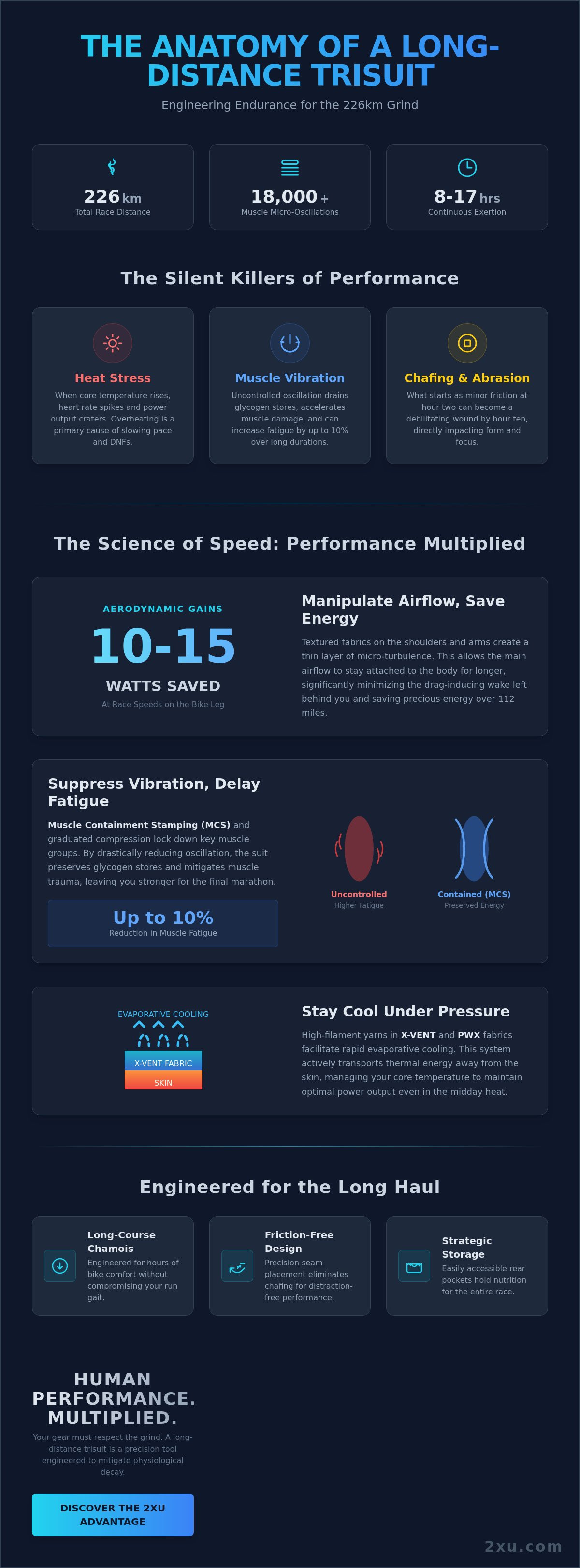
Over 226 kilometres, your quadriceps and calves experience more than 18,000 micro-oscillations, each one a tiny vibration that drains your glycogen stores and accelerates muscle damage. You've done the work, you've respected the grind, and you understand that at the 12-hour mark, the best triathlon suit for long distance is the difference between a podium and a DNF. Chafing and overheating aren't just discomforts; they're performance killers that cost you minutes on the road.
Mastering your gear is about more than aesthetics; it's about engineering endurance. This article explores the science behind multiplying your power output through graduated compression and aerodynamic efficiency, ensuring you finish with less physiological trauma. We'll examine the 2026 technical requirements for moisture management, internal storage, and the Muscle Containment Stamping technology required to dominate the course and prove that human performance is multiplied through discipline and data.
Key Takeaways
- Understand why selecting the best triathlon suit for long distance is critical for managing heat stress and muscle vibration during an 8-to-17-hour race.
- Learn how technical fabrics utilise airflow manipulation and evaporative cooling to prevent core temperature spikes and maintain optimal power output.
- Discover how Muscle Containment Stamping (MCS) and graduated compression reduce muscle oscillation to delay the onset of fatigue during the marathon.
- Identify the engineering markers that eliminate chafing and ensure the long-course chamois provides bike comfort without compromising your run gait.
- Explore how the Light Speed and Aero series leverage PWX fabric and specialised materials to multiply your performance over 226 kilometres.
The Long-Distance Challenge: Why Your Suit Matters After Hour Five
The 226km journey isn't just a race; it's a physiological siege. When you cross the five-hour mark, your gear stops being apparel and becomes life support. Finding the best triathlon suit for long distance requires looking past the graphics to the raw data of endurance. A long-distance trisuit is a specialised garment engineered for 8 to 17 hours of continuous exertion. It's designed to combat the three silent killers of performance: heat stress, muscle vibration, and skin abrasion. While sprint-distance suits prioritise raw speed and minimal drag for sixty minutes of effort, long-course engineering focuses on protection and efficiency. At 2XU, we operate under the philosophy of Human Performance. Multiplied. This framework dictates that every stitch must serve a purpose, ensuring your gear is as disciplined as your training schedule.
The 226km Grind: A Brutal Testing Ground
The three-phase demand of long-course racing is unforgiving. You need a garment that is hydrodynamic in the water, aerodynamic on the bike, and breathable during the marathon. Mediocrity in your Triathlon equipment choice leads to catastrophic failure during the final 42.2km. Every millimetre of friction at hour two becomes a debilitating wound by hour ten. Choosing a triathlon suit designed for the long haul is the difference between a podium and a DNF. Data from elite testing shows that uncontrolled muscle oscillation can increase fatigue by up to 10 percent over long durations. Our engineering suppresses that vibration, preserving your glycogen stores for when the real race begins on the run.
Beyond Aesthetics: The Engineering of Endurance
Visual design is secondary to technical fibre performance and seam placement. We don't care how the suit looks if it fails to manage your core temperature at midday. The best triathlon suit for long distance respects the grind by using graduated compression to facilitate blood flow and advanced cooling technologies to repel UV rays. Your gear must respect the effort you've put into your preparation. It's about maintaining power output when your central nervous system is screaming for you to stop. A long-distance trisuit is a precision tool engineered to mitigate physiological decay by managing thermoregulation and muscle stability over extended durations.
The Science of Speed: Aerodynamics and Thermoregulation
Success in long-course racing is a calculation of energy in versus energy out. The best triathlon suit for long distance acts as a performance multiplier by addressing the two greatest physical limiters: aerodynamic drag and thermal load. We engineer our garments to manipulate airflow through surface tension management, ensuring that every watt you produce translates into forward momentum. This is not about aesthetics; it is about the rigorous application of fluid dynamics to human movement. By reducing the energy cost of every kilometre, we allow you to maintain higher intensities for longer durations.
Aerodynamic Gains on the Bike Leg
The bike leg accounts for roughly 50 percent of your total race time. Reducing your drag coefficient is the most efficient way to buy speed without increasing your metabolic cost. We utilise textured fabrics on the shoulders and upper arms to break the boundary layer of air. This process creates a thin layer of micro-turbulence that allows the main airflow to track closer to the body, minimising the drag-inducing wake left behind the athlete. Data confirms that a precision-fit sleeved suit can save an athlete between 10 and 15 watts at race speeds compared to a sleeveless alternative. 2XU proprietary fabric blends are engineered to maintain these aerodynamic profiles even when wet, preventing the material from sagging or losing its textured structure under the weight of sweat or hydration spray.
Thermoregulation: Staying Cool Under Pressure
Heat is the silent performance killer. When your core temperature rises, your heart rate spikes and your power output craters. Our X-VENT technology approach focuses on active moisture management and continuous airflow. By using high-filament yarns, we facilitate rapid evaporative cooling, which is the primary method the body uses to shed heat. This process is more than just drying fast; it is a system of active heat transport that pulls thermal energy away from the skin surface. Recent research on aerodynamics and thermoregulation highlights the critical balance required to maintain speed without inducing thermal stress. Every millimetre of fabric must contribute to this cooling cycle.
To further combat solar radiation, we incorporate advanced cooling prints like Graphene and UV-reflective yarns. These materials reflect infrared rays, keeping the skin surface temperature significantly lower during exposed run segments. While sleeved suits provide essential sun protection, they require strategic mesh placement to ensure heat dissipation is not compromised. Choosing the best triathlon suit for long distance means selecting a garment that manages this trade-off with scientific precision. If you are ready to upgrade your race-day kit, explore our range of high-performance trisuits designed to withstand the grind.
Compression Technology: Mitigating Muscle Fatigue in the Marathon
Long-distance racing isn't just a test of aerobic capacity; it's an endurance challenge for your muscular framework. To find the best triathlon suit for long distance, you must look at how the garment manages muscle oscillation. Every foot strike during the marathon sends a shockwave through your legs, causing muscles to vibrate. This vibration leads to micro-tears and accelerates fatigue. 2XU uses proprietary Muscle Containment Stamping (MCS) to provide a structural advantage. This technology traces the primary muscle fibres to provide a targeted layer of support that generic compression cannot match. It isn't about restriction; it's about containment.
Graduated compression profiles are engineered to improve blood flow by applying the highest pressure at the extremities. This pressure gradient assists the veins in returning deoxygenated blood to the heart, which helps clear metabolic waste and delays the onset of lactic acid buildup. We use the Salzmann pressure measurement device to ensure every garment meets these rigorous standards. Beyond the physiological benefits, compression enhances proprioception. This is your body's internal GPS. When fatigue sets in during the final 15 kilometres, your form naturally degrades. Enhanced sensory feedback from the fabric helps you maintain a stable gait and efficient knee drive when your mind wants to quit.
Athletes often worry that high-level compression is too tight for an event lasting eight to seventeen hours. This is a misconception. Elite compression is engineered to act as a second skin that moves with you. It provides a firm, supportive feel that reduces the perception of effort by stabilising the core and limbs. You aren't just wearing a suit; you're wearing a piece of performance equipment designed to keep your biomechanics intact.
Reducing Muscle Damage and Vibration
The constant vibration from the bike and the repetitive impact of the run cause significant micro-tears in the quadriceps and calves. 2XU’s PWX fabric utilises high-filament yarns to deliver powerful, lightweight support to these key muscle groups. This containment reduces muscle damage and allows for a faster transition into the run. You can explore the science of compression shirts to see how upper-body support is equally critical for maintaining an open chest and efficient breathing patterns during the final stages of the race.
Enhancing Recovery During the Race
The best triathlon suit for long distance facilitates active recovery while you are still in motion. By assisting blood circulation, the suit helps transport oxygen to the muscles that need it most. Targeted support in the glutes and hamstrings is vital for maintaining run posture as the body fatigues. This structural reinforcement prevents the "hips dropping" effect common in the final hour of an Ironman. Compression isn't just for post-race; it is a tactical race-day advantage that protects your power output from start to finish.
Functional Design: Nutrition, Chafing, and Transition Efficiency
Endurance racing is a war of attrition. Chafing ruins more podium ambitions than poor fitness ever will. The best triathlon suit for long distance must eliminate friction entirely to protect the athlete over eight to seventeen hours of continuous movement. 2XU engineers garments with seamless construction and flatlock stitching to ensure the fabric moves as a secondary skin. By reducing seam height by 50% compared to standard athletic wear, we eliminate the primary cause of skin abrasion during the high-repetition mechanics of the run.
The Chamois Challenge: Bike vs. Run
A long-course chamois is a precise piece of engineering. It must provide support for 180km in the aero position without creating a "nappy" feel during the marathon. 2XU utilises high-density foam that maintains its structural integrity under 70kg of constant pressure while remaining low-profile enough for a full, unhindered stride. Moisture management is the critical variable here. Our proprietary foam technology retains 40% less water than traditional padding, preventing the heavy, soggy sensation after the 3.8km swim. This ensures you stay dry and light from the moment you exit the water until you cross the finish line.
Storage and Accessibility for the Long Haul
Nutrition is your fuel; if you can't access it, you will bonk. We have analysed pocket placement to maximise reach while minimising aero-drag in the wind tunnel. Rear and side pockets are positioned to keep up to six gels or salt tablets flush against the body, preventing the vertical bounce that disrupts your rhythm during high-impact running. Your suit must also integrate perfectly with your gear. It is designed to sit flat and compressed underneath your triathlon wetsuit, ensuring zero bunching or restriction during the swim leg. This streamlined fit is essential for maintaining a 1.25 drag coefficient in the water.
Mechanical reliability extends to the hardware. A high-quality, locking YKK zipper is non-negotiable for 2026 performance standards. It allows for immediate mid-race ventilation when core temperatures rise and facilitates efficient nature breaks in the transition area. Every second saved in T1 and T2 is earned through discipline and superior equipment design. Respect the grind by choosing gear that works as hard as you do.
Maximise your endurance potential. Shop the 2XU Long Distance Tri Collection
The 2XU Advantage: Engineering the Ultimate Long-Distance Trisuit
Mediocrity has no place on a long-course start line. When you are staring down 226 kilometres of self-inflicted discipline, your gear must be an extension of your intent. The 2XU Light Speed and Aero series represent the absolute peak of endurance engineering, designed specifically for the 2026 athlete who refuses to compromise. We don't just make apparel; we build technical systems that manage fatigue and optimise power output.
The foundation of our dominance lies in PWX fabric and our proprietary Muscle Containment Stamping (MCS) technology. While others focus on aesthetics, we focus on muscle oscillation. Every time your foot hits the pavement during a marathon, your muscles vibrate, causing micro-trauma and accelerating fatigue. Our MCS technology provides a targeted tracing system over key muscle groups, significantly reducing this movement. Combined with premium Italian-engineered materials, these suits provide the cooling and aerodynamic profile required to sustain elite performance for eight, ten, or twelve hours.
Light Speed vs. Aero: Which Suit for Your Distance?
Choosing the best triathlon suit for long distance depends on your specific race-day objectives. The Light Speed series is our ultimate compression tool. It is engineered for the athlete whose primary goal is stability and endurance. If your focus is on maintaining structural integrity through the "Grind" of the final 15km, Light Speed provides the muscle containment you need to stay upright and moving.
The Aero series is built for the podium. It prioritises maximum velocity through advanced wind-tunnel-tested fabrics that reduce drag on the bike leg. Use this framework to decide:
- Choose Light Speed if you struggle with muscle fatigue or cramping during the run.
- Choose Aero if you are hunting for personal bests and every saved watt on the bike is critical.
Precision is not negotiable. Every 2XU garment is assessed using the Salzmann pressure measurement device. This ensures the graduated compression profile is medically accurate, promoting blood flow and reducing recovery time while you are still in the heat of competition.
The Final Verdict on Long-Distance Gear
The race doesn't actually begin until the final 10km of the run. That is when the best triathlon suit for long distance proves its worth. It isn't about how you feel at the swim start; it's about how much of your muscle function remains when your mind wants to quit. We want you to respect the distance by arriving prepared. Gear is only one part of the equation, but it is the part that ensures your hard work isn't wasted by equipment failure.
Adopt a holistic "Prepare, Perform, Recover" strategy. Your suit handles the performance and recovery phases, but your preparation starts with understanding the physics of every leg. Before you hit the water, study our neoprene wetsuit science guide to ensure your swim is as efficient as your run. You provide the discipline. We provide the science.
Master the 226-Kilometre Grind
Success during an endurance event lasting over eight hours isn't about luck; it's about the clinical precision of your equipment. You've seen how advanced thermoregulation and aerodynamics dictate your power output once you cross into the fifth hour of effort. To maintain a rhythmic pace during the marathon, you require the best triathlon suit for long distance engineered to mitigate muscle fatigue. 2XU doesn't guess at performance. Every garment is meticulously assessed using Salzmann pressure measurement devices to ensure a graduated profile that actually works. Our proprietary PWX fabrics and Muscle Containment Stamping (MCS) provide the targeted support required to reduce muscle oscillation. This is the same technology relied upon by IRONMAN World Champions to secure podium finishes. We've optimised every stitch to ensure your output remains constant when others begin to fade. Respect the discipline you've shown in training by choosing gear that's as unyielding as your ambition. It's time to prepare, perform, and recover with the intensity your goals demand. Multiply your capacity and leave nothing to chance on race day.
Shop the 2XU Performance Triathlon Collection
Your breakthrough performance is waiting. Go out and earn it.
Frequently Asked Questions
Is a sleeved or sleeveless triathlon suit better for long distance?
Sleeved suits are superior for long distance because they offer critical aerodynamic advantages and UV protection. Data from wind tunnel testing shows a sleeved suit can save you 12 to 15 watts of power at 40km/h. This efficiency is vital when hunting for the best triathlon suit for long distance. The sleeves also protect your skin from 98% of harmful UV rays during an 8 hour exposure.
How tight should a long-distance triathlon suit fit?
Your suit must fit like a second skin with zero wrinkles to ensure maximum aerodynamic efficiency. Any fabric bunching as small as 0.5cm can increase drag by approximately 2% on the bike leg. When selecting the best triathlon suit for long distance, ensure the leg grippers stay secure without restricting blood flow. It should feel tight but allow for full lung expansion during the swim.
Can I wear my triathlon suit under a wetsuit?
You should always wear your trisuit under your wetsuit to ensure a rapid transition. This protocol is standard for 100% of elite competitors because it eliminates the need for a full wardrobe change in T1. Modern trisuits use hydrophobic coatings that repel water; this ensures the fabric doesn't gain weight or hold moisture once you exit the water and peel off your neoprene layer.
Do I need to wear underwear under my trisuit?
Never wear underwear under your trisuit. The internal chamois is engineered to sit directly against your skin to manage moisture and prevent friction. Adding a layer of cotton or other materials will lead to severe saddle sores and skin irritation within the first 40km of the ride. Trust the antimicrobial liners to maintain hygiene and comfort over the entire 226km journey.
How do I prevent chafing in a triathlon suit over 8+ hours?
Prevent chafing by applying a high-quality lubricant to high-friction zones like the neck, underarms, and inner thighs before the race starts. Studies show that reapplying lubricant during T2 can reduce skin irritation by 60% for the marathon leg. Choose a suit with flatlock stitching and bonded seams to minimise mechanical rub against the skin during 10 or more hours of continuous movement.
What is the difference between a one-piece and two-piece trisuit for Ironman?
One-piece suits offer superior aerodynamics while two-piece suits provide better versatility for mid-race pit stops. A one-piece design reduces drag by 3% over a 180km bike course compared to a separate top and bottom. However, 45% of age-group athletes prefer two-piece kits for the ease of bathroom breaks during a Full Ironman. Your choice depends on whether you prioritise raw speed or mechanical convenience.
How should I wash and care for my high-performance trisuit?
Rinse your trisuit in cold, fresh water immediately after every session to remove salt and chlorine. Research indicates that leaving chlorine in the fabric for more than 30 minutes can degrade elasticity by 25% over a single season. Always air dry your gear in the shade; never use a tumble dryer. High heat destroys the technical fibres and ruins the graduated compression profiles within the garment.
Is compression really necessary for a 70.3 or Full Ironman?
Compression is essential for 70.3 and Full Ironman distances to stabilise muscles and delay fatigue. 2XU laboratory testing proves that graduated compression reduces muscle oscillation by 33%, which prevents micro-tears during the repetitive impact of the run. This support allows you to maintain power output in the final 10km of the race. It's about ensuring you can perform at your peak until the finish line.