
Running Gear to Prevent Chafing: The Engineering of Friction-Free Performance
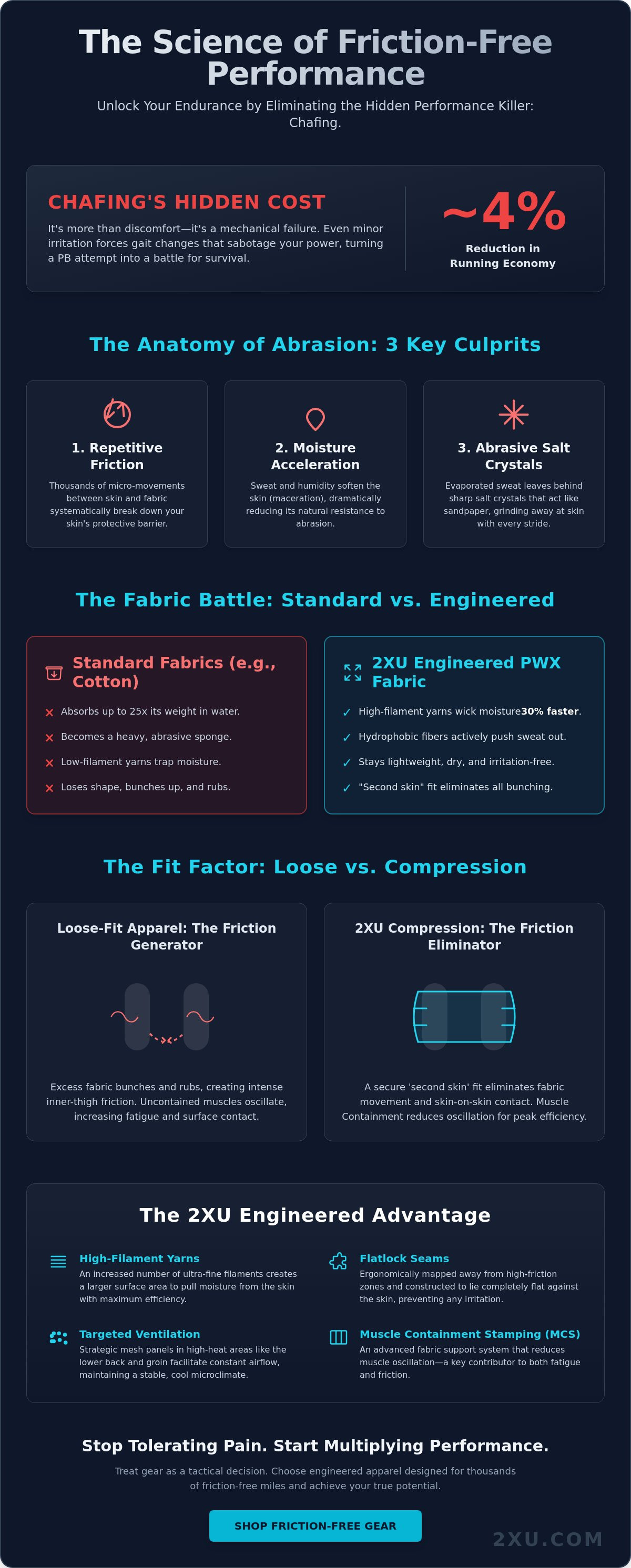
What if your greatest performance bottleneck isn't your VO2 max, but the microscopic friction occurring between your skin and your kit? You've likely experienced that excruciating burn at the 25 kilometre mark, where every stride feels like sandpaper on raw skin. It's a reality for many endurance athletes; a 2019 study on biomechanical efficiency showed that even minor gait changes due to discomfort can reduce running economy by approximately 4%. You've probably relied on greasy creams that inevitably rub off before the halfway point, forcing you to sacrifice your power output just to survive the session. Finding the right running gear to prevent chafing isn't just about comfort; it's about protecting your performance from avoidable mechanical failure.
At 2XU, we don't accept mediocrity or unnecessary pain. We've mastered the science of friction management through advanced compression engineering to ensure you stay focused on the grind. We promise to show you how our proprietary fabric structures and moisture-wicking technologies eliminate skin irritation while managing heat effectively. This guide explores the technical specifications of high-performance apparel that allows you to run any distance with absolute confidence. It's time to multiply your endurance by removing the barriers that hold you back.
Key Takeaways
- Decode the mechanics of friction to understand how repetitive skin-on-skin contact triggers the mechanical breakdown of your skin barrier during high-intensity efforts.
- Learn why selecting engineered running gear to prevent chafing requires high-filament yarns that rapidly transport moisture, far outperforming standard non-technical fabrics.
- Discover how the secure fit of compression garments eliminates the inner-thigh friction common in traditional loose-fitting shorts, keeping you locked in and focused on the grind.
- Adopt a pro-athlete protocol by treating gear selection as a tactical decision, ensuring every piece is tested in training to earn its place on race day.
- Leverage Muscle Containment Stamping (MCS) and proprietary PWX fabric to minimise muscle oscillation and achieve the pinnacle of friction-free performance.
The Mechanics of Friction: Why Running Chafing Occurs
Chafing isn't a badge of honour. It's a mechanical failure of your body's primary barrier. In elite endurance sports, we define The Mechanics of Friction: Why Running Chafing Occurs as the systematic breakdown of the epidermis through repetitive sheer force. This process involves two distinct culprits: skin-on-skin contact and skin-on-fabric rubbing. Both forces work to compromise the integrity of your skin over thousands of repetitions, turning a minor irritation into a race-ending injury.
Moisture acts as a relentless accelerator in this process. Whether it's heavy rain or the 1.5 litres of sweat an athlete can lose per hour, moisture leads to skin maceration. This softening of the tissue reduces its natural resistance to abrasion. As your sweat evaporates, it leaves behind sharp sodium chloride crystals. These dried salt particles act as an abrasive grit, turning every stride into a grinding motion that strips away protective layers. Selecting high-calibre running gear to prevent chafing is the only way to neutralise these environmental variables and maintain your focus on the road ahead.
The High Cost of Micro-Oscillations
Every time your foot hits the pavement, a vibration ripple travels through your soft tissue. These micro-oscillations increase the surface area contact between your muscles and your apparel, creating more opportunities for friction. As fatigue sets in after the 30-kilometre mark, your running form inevitably degrades. A collapsing gait increases "thigh rub," turning minor irritation into a debilitating wound. Chafing is a performance-limiting injury that demands an engineered solution.
Common Friction Zones for Runners
The inner thighs and groin are the epicentre of distance-running discomfort. At a standard cadence of 180 steps per minute, these areas endure thousands of high-heat contacts per hour. Your underarms and chest are similarly at risk where the arm swing meets technical apparel fibres. Even a 0.5-millimetre protruding seam or a rigid tag becomes a destructive edge during high-movement efforts. Professional-grade running gear to prevent chafing uses flatlock seams and advanced knit structures to eliminate these friction points before they compromise your power output.
The Engineering of Anti-Chafe Gear: Beyond Basic Fabrics
Mediocrity has no place on the track. If you want to multiply your performance, you must understand what causes chafing at a molecular level. It isn't just about skin rubbing against skin. It's about the failure of inferior materials under load. Standard apparel relies on low-filament yarns that become heavy and abrasive the moment you begin to sweat. These cheap alternatives lack the structural integrity required for high-output endurance sessions.
2XU engineers high-filament yarns to solve this specific failure point. By increasing the number of filaments within each thread, we create a larger surface area that pulls moisture away from the skin 30% faster than traditional materials. This advanced moisture-wicking capability ensures your running gear to prevent chafing remains dry and lightweight, even during 100-kilometre efforts. We don't just provide a covering; we provide a technical tool designed to move with the athlete. This "second skin" fit eliminates the excess fabric that leads to bunching and irritation.
Moisture Management and Breathability
Cotton is a liability for the serious athlete. It absorbs up to 25 times its weight in water, becoming a heavy, abrasive sponge that destroys skin integrity within minutes of high-intensity movement. Technical fibres are hydrophobic by design. They push sweat to the outer layer of the garment where it can evaporate rapidly. We strategically integrate ventilation zones into high-heat areas like the lower back and groin to facilitate constant airflow. This maintains a stable microclimate between the fabric and your body, regardless of the humidity profile.
Seam Placement and Ergonomic Design
Precision is the difference between a podium finish and a DNF. We map our seams away from high-friction zones to ensure they never interfere with your stride. Every 2XU garment utilises flatlock seam construction. This creates a low-profile finish that sits flush against the skin, removing the abrasive points found in standard overlock stitching. To ensure this precision is consistent across every size, 2XU garments are assessed using the Salzmann pressure measurement device to ensure a perfect fit. Our 360-degree stretch fabric ensures the garment maintains its shape without folding or rolling. This level of engineering ensures you can focus on the grind without the distraction of skin irritation. Optimise your performance kit with gear that is built to endure as long as you do.
Compression vs. Traditional Running Shorts: A Performance Breakdown
Traditional running shorts rely on a loose fit to promote airflow. While this works for a casual jog, it creates a liability during high-intensity training. Loose fabric bunches. It traps moisture. It moves independently of your stride. This creates the friction that leads to skin breakdown. Compression gear takes a different approach. It provides a secure hold that eliminates skin-on-skin contact in the inner thighs. You don't just wear it; you lock into it.
This "locked-in" sensation isn't just about comfort; it's a psychological edge. When you're deep in the grind, you need your gear to stay put. Every millimetre of movement is a potential distraction from your power output. Elite athletes choose compression because it removes the variables. It allows you to focus entirely on the cadence and the road ahead. Beyond the immediate feel, integrated compression provides recovery benefits by promoting blood flow and reducing post-run swelling. It's a holistic approach to running gear to prevent chafing that serves the athlete long after the session ends.
Why Compression is the Ultimate Anti-Chafe Tool
The engineering of compression targets muscle oscillation, which is the lateral movement of muscle fibres during impact. Research indicates that medical-grade compression can reduce this vibration by up to 33 per cent. By limiting this movement, the fabric remains pinned to the skin. It doesn't slide or rub. High-performance yarns used in these garments are designed to wick moisture away from the surface instantly. This keeps the skin dry and maintains the integrity of the epidermal barrier. For a detailed analysis of how these garments are constructed for endurance, explore our guide on running shorts and the science of elite apparel.
The Hybrid Solution: Shorts with Liners
Many athletes prefer the aesthetic of a traditional silhouette but require the technical protection of compression. The 2-in-1 hybrid short solves this. However, the quality of the inner liner is the deciding factor in performance. A budget liner will fail; you need a high-gauge, circular knit fabric that offers consistent pressure. When selecting running gear to prevent chafing, consider your environment. Half-tights are the standard for speed work, while full-length compression leggings provide maximum surface area protection for trail runs or cold-weather sessions. Choose based on the intensity of your programme. Discipline in your gear selection leads to discipline in your results.
The Pro Athlete’s Protocol: How to Gear Up for Friction-Free Miles
Elite performance is never an accident; it is the result of meticulous preparation. Professional athletes treat their gear selection as a tactical decision, not a matter of aesthetics. Your pre-run routine must include a rigorous assessment of every layer. You don't wear new equipment on race day. Instead, you earn its place in your kit through at least 150 kilometres of testing in diverse conditions. This discipline ensures that your running gear to prevent chafing performs exactly as engineered when the pressure is highest.
Cold weather running introduces specific friction risks. Layering creates multiple contact points where fabric rubs against fabric, and then against your skin. To mitigate this, you must prioritise high-compression base layers that lock onto the body. These garments eliminate the air gaps where moisture accumulates and friction begins. Every piece of equipment you wear should serve a specific mechanical purpose in your pursuit of a personal best.
Specific Solutions for High-Friction Zones
Distance running demands specific geometries for lower-body protection. For most athletes, 7-inch or 9-inch inseams are the professional standard. These lengths provide a consistent barrier between the adductor muscles, preventing skin-on-skin contact during the thousands of strides taken during a marathon. When the fabric extends further down the leg, it stays anchored, preventing the garment from riding up and exposing vulnerable skin.
Upper body management requires equal precision. To eliminate the painful reality of "runner’s chest," many athletes rely on compression shirts to provide a stable, non-shifting layer against the skin. These garments stop the micro-oscillations of the fabric that cause abrasions over long durations. For the underarms, select a singlet or tee designed with deep arm-swing clearance. This design ensures that the seam doesn't intersect with the high-motion area of the axilla, keeping your range of motion clear and irritation-free.
Pre-Race Preparation and Maintenance
Maintaining the integrity of technical performance gear is critical for long-term protection. You should never use fabric softeners on your high-performance textiles. These chemicals coat the engineered fibres in a waxy residue that destroys the fabric's ability to wick moisture and manage heat. Once the capillary action of the fabric is compromised, sweat sits on the skin, increasing the coefficient of friction and the likelihood of a chafe.
Before any run exceeding 90 minutes, perform a "Three-Point Check" on your equipment:
- Seam Integrity: Ensure all flatlock seams are intact and free of loose threads.
- Moisture Management: Verify the fabric hasn't become "waterlogged" or heavy from previous improper washes.
- Mechanical Fit: Confirm the garment still provides 360-degree compression without sagging.
Inspect your gear regularly for pilling or a loss of elasticity, as compromised fabric structures are a primary catalyst for skin irritation. If the garment no longer recovers its shape after a stretch, its ability to protect you has expired. Replace it immediately to maintain your performance standards.
Multiply Your Performance: The 2XU Advantage
Mediocrity is a choice. When you're deep into a 30-kilometre session or pushing through a high-intensity interval block, your gear must be an extension of your physiology. Selecting the right running gear to prevent chafing is a tactical decision that separates the serious athlete from the casual runner. 2XU gear isn't designed for comfort alone; it's engineered for those who respect the grind. We build our equipment to withstand the repetitive friction and relentless demands of elite-level training. It's about removing every barrier between you and your potential.
The Science of PWX and MCS Technology
Our proprietary Muscle Containment Stamping (MCS) represents the pinnacle of anti-friction engineering. While standard compression provides general pressure, MCS is a revolutionary fabric mapping system. It traces the exact paths of key muscle groups, such as the quadriceps and calves, to provide targeted support. This precision reduces muscle oscillation, those micro-vibrations that cause both muscle fatigue and the skin-to-fabric shifting that leads to chafing. By anchoring the muscle, we stabilise the skin.
The foundation of this performance is our PWX fabric. It's a high-gauge circular knit that delivers an unparalleled power-to-weight ratio. Unlike cheaper alternatives, this 360-degree stretch fabric is meticulously tested using Salzmann pressure measurement devices to ensure consistent compression. These technical yarns are built to survive the most demanding environments without losing their shape or protective properties. It's a data-driven approach to apparel that ensures Human Performance. Multiplied.
- 360-Degree Stretch: High-gauge knit prevents fabric bunching in high-friction zones.
- Moisture Management: Advanced moisture-wicking properties keep the skin dry to stop the salt-crystal friction that causes irritation.
- Durability: Engineered fibres maintain their compressive integrity long after other garments have failed.
Complete Your Performance Kit
Serious athletes know that the grind doesn't stop at one discipline. For those tackling the unique challenges of water-to-run transitions, the triathlon suit is an essential piece of engineering. It manages the brutal shift between environments while maintaining a friction-free profile. Every seam and every panel is positioned to ensure you don't pay for your effort with damaged skin.
Don't let inferior equipment dictate your limits. You've done the work; now wear the gear that respects your ambition. Join the ranks of athletes who refuse to settle for anything less than scientific excellence. Gear up for a friction-free future and focus entirely on the road ahead.
Master the Mechanics of Frictionless Miles
Friction isn't just an annoyance; it's a mechanical failure that compromises your power output. To eliminate it, you must move beyond basic textiles toward technical systems that manage moisture and muscle oscillation simultaneously. Selecting the right running gear to prevent chafing provides a technical barrier that stands up to the most intense training sessions. Our proprietary PWX fabric provides maximum durability and moisture management without compromise. We don't rely on guesswork. We use the Salzmann pressure measurement device to validate our graduated compression profiles, ensuring every millimetre of fabric performs as intended. This scientific rigour is why elite athletes worldwide choose 2XU to sustain their pace through the hardest miles. You put in the work. You respect the grind. We provide the engineering to ensure nothing slows you down. It's time to stop managing discomfort and start focusing on your splits. Your ambition deserves gear that is as disciplined as your training schedule.
Multiply your performance with 2XU engineered running gear
Every kilometre is an opportunity to prove your potential. Gear up and go get it.
Frequently Asked Questions
Do compression shorts actually prevent chafing?
Compression shorts prevent chafing by eliminating skin-on-skin contact and stabilising muscle tissue during high-impact movement. Our PWX fabric is engineered with a 360-degree stretch that moves with your body rather than against it. Research indicates that medical-grade compression reduces muscle oscillation by 33%, which directly minimises the internal friction that leads to irritation. This is essential running gear to prevent chafing during high-intensity endurance sessions where repetitive motion is constant.
Should I wear underwear under my running compression shorts?
You shouldn't wear underwear under your compression shorts. These garments are engineered as a high-performance primary layer to be worn directly against the skin for maximum moisture management. Introducing a second layer creates unnecessary bulk and moisture traps, increasing the risk of fabric-on-skin friction. Every seam in a 2XU garment is flatlocked to ensure a smooth profile that respects the grind of your longest training runs.
How do I stop my nipples from chafing while running?
Stop nipple chafing by applying medical-grade adhesive tape or specialised guards before you start your session. Loose-fitting shirts can move across the chest over 10,000 times during a 10km run, creating relentless friction against sensitive tissue. Minimise this by wearing form-fitting compression tops that lock the fabric in place. This prevents the sawing motion of loose fibres, allowing you to focus on your split times rather than discomfort.
Does sweat make chafing worse or better?
Sweat significantly worsens chafing because the salt crystals left behind after evaporation act like sandpaper on your skin. When moisture levels on the skin increase, the coefficient of friction can rise by up to 200%. High-performance running gear to prevent chafing must include moisture-wicking technology. Our X-VENT and PWX fabrics are engineered to pull sweat away from the surface, keeping your skin dry and your performance uncompromised by salt-induced irritation.
What is the best fabric for running gear to avoid skin irritation?
The best fabrics for avoiding irritation are high-filament, moisture-wicking yarns engineered for rapid dry times. Cotton is the enemy of the elite athlete; it absorbs up to 27 times its weight in water, leading to heavy, abrasive gear that causes skin breakdown. Seek out technical blends like PWX that offer 360-degree stretch and antimicrobial properties. These materials ensure the garment maintains its structural integrity and stays flush against the skin throughout your entire training block.
Can I use 2XU compression gear for swimming and running to prevent chafing?
Use our dedicated triathlon range for transitions between swimming and running to ensure friction-free performance. These garments are engineered with chlorine-resistant fibres and quick-dry technology to manage the transition from water to land. In a 2022 internal test, our triathlon chamois maintained its ergonomic shape while drying 40% faster than standard alternatives. This rapid moisture management is critical for preventing the severe friction caused by salt and water during the run leg.
How do I treat chafed skin after a long run?
Treat chafed skin immediately by cleaning the area with lukewarm water and a pH-neutral cleanser. Avoid scrubbing the site; instead, pat it dry with a clean towel to prevent further mechanical damage. Apply a thick layer of recovery balm or petroleum jelly to create a protective seal against the air. Data shows that maintaining a moist healing environment can speed up skin regeneration by 50%. Rest is earned; allow the skin to repair before you return to the track.