
What to Wear for Your First Triathlon Swim: The Performance Blueprint
Your swim gear is not a costume; it is the first stage of a specialised three-part mechanical system designed to multiply your physical output. Most novices approach the water with anxiety about looking like an amateur or struggling through a clumsy transition. You realise that every second lost to drag or thermal mismanagement is energy you cannot recover. Deciding what to wear for your first triathlon swim is your first tactical decision in a high-stakes environment where hydrodynamics dictate your success.
You likely feel the weight of the transition ahead, fearing the drag of an ill-fitting suit or the friction of a clumsy shift from water to land. This performance blueprint eliminates that uncertainty by providing a scientific breakdown of hydrodynamic efficiency and gear mechanics. We promise to help you master the equipment required to eliminate drag, manage thermoregulation, and ensure your gear functions as a force multiplier from the first stroke.
We will analyse the 2026 regulations regarding wetsuit thickness, the physics of buoyancy, and the strategic selection of trisuits that maintain stability across all three disciplines. Prepare to move from water to land with the precision of an elite athlete and the technical knowledge to back it up.
Key Takeaways
- Establish race-day momentum by treating your gear as a force multiplier, leveraging elite engineering to gain a psychological and mechanical edge.
- Decide what to wear for your first triathlon swim by selecting a trisuit, an integrated garment designed to eliminate the drag and inefficiency of traditional swimwear.
- Utilise the hydrodynamic advantage of a wetsuit to keep your hips high and minimise drag while protecting your core from energy-sapping temperature drops.
- Equip yourself with precision accessories, particularly goggles engineered for open-water sighting, to maintain navigational accuracy during the swim segment.
- Master the mechanics of the transition by applying lubricants to high-friction zones, ensuring a rapid and seamless shift from the water to the bike.
Establishing the Baseline: Why Your Swim Gear Choice Defines the Race
The swim is the foundation of your race-day momentum. It is not an obstacle to survive; it is a discipline to master. When athletes consider what to wear for your first triathlon swim, they often default to comfort or aesthetics. This is a tactical error. Your gear is a mechanical extension of your body. It is the first stage of a specialised system designed to maximise output while minimising energy leakage. High-performance Triathlon equipment is engineered to multiply your effort through technical precision. You are not just a swimmer; you are a biological system interacting with fluid dynamics. Entering the water in gear engineered for the elite provides a critical psychological advantage. It shifts your mindset from participation to performance. This is the "human multiplied" philosophy in action. We use science to extend the limits of your physical output, ensuring that every stroke translates into maximum forward velocity. A "pool-first" mindset will fail you in the open water. The pool is a controlled environment; the ocean is a chaotic system that demands respect and superior preparation.
The Science of Hydrodynamics in Your First Swim
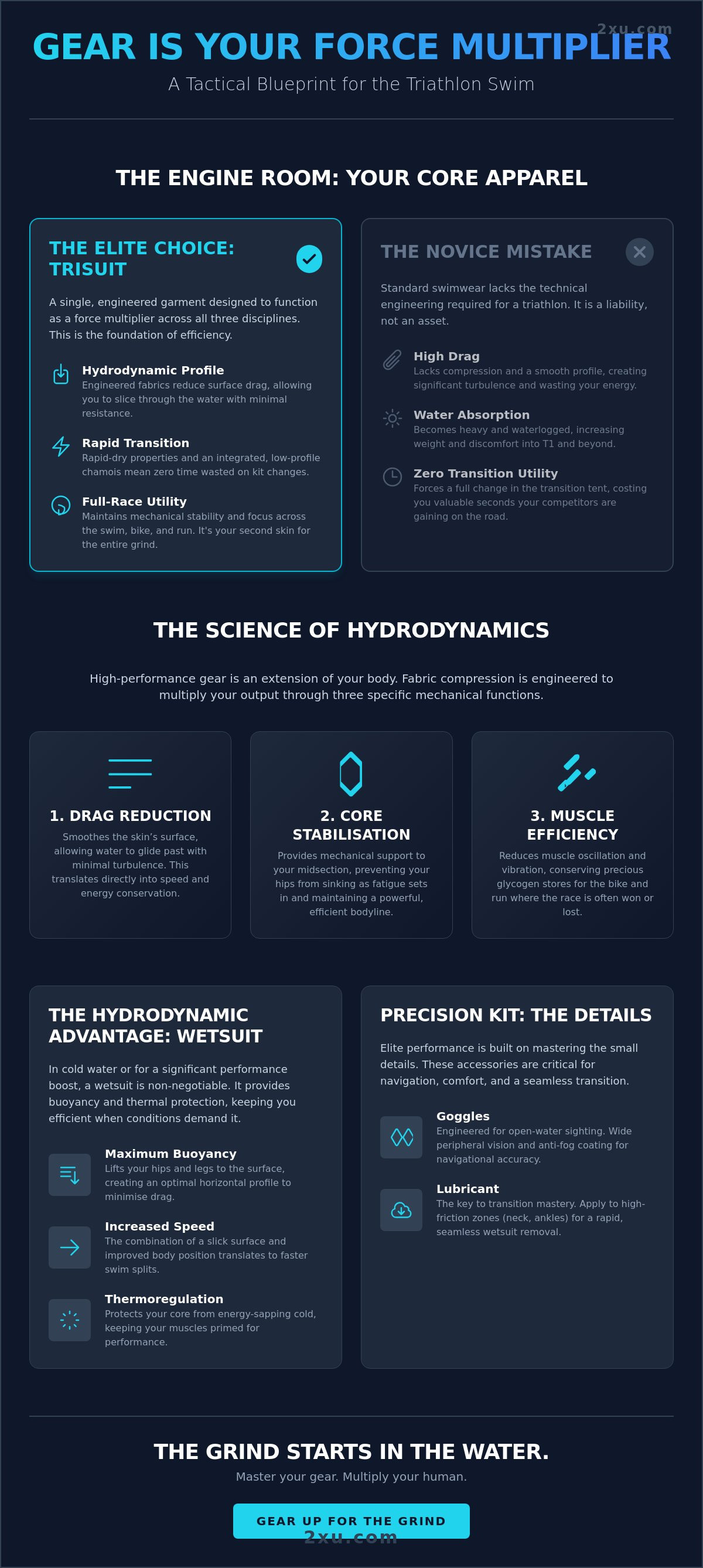
Surface drag is the primary adversary of the endurance swimmer. Over a 750m or 1500m course, even minor resistance results in significant cumulative energy loss. Technical fabrics are engineered to reduce this friction by smoothing the body's profile. Fabric compression plays a vital role here. It serves three specific functions:
- Drag Reduction: Smoothing the skin's surface to allow water to glide past with minimal turbulence.
- Core Stabilisation: Providing mechanical support to the midsection to prevent the hips from sinking.
- Muscle Efficiency: Reducing vibration in the muscle tissue to conserve glycogen stores for the bike and run.
Standard swimwear lacks this mechanical stability. It often absorbs water, becomes heavy, and fails to provide the structural support needed to keep your hips high in the water as fatigue sets in. Professional gear is designed to keep you buoyant and efficient through the final metre.
The Grind Starts in the Water
The grind begins the moment you hit the water. It is the first test of your discipline and your willingness to endure. Wearing professional-grade gear is a signal of your commitment to the sport. It shows you have done the work and respected the requirements of the discipline. Proper preparation is a form of respect for the environment you are about to enter. The water does not care about your intentions; it only responds to your mechanics and your gear. By choosing gear that is optimised for the grind, you sharpen your focus and prepare your body for the transition to land. You earn your place on the course through rigorous preparation and the refusal to settle for average standards.
The Engine Room: Choosing Between a Trisuit and Traditional Swimwear
Your choice of apparel dictates your efficiency across the entire tripartite framework of the race. When determining what to wear for your first triathlon swim, you must decide between a specialised trisuit or traditional swimwear. Traditional swimwear is a rookie mistake. It lacks the hydrodynamic profile required for open water and offers zero utility once you exit the water. A trisuit is a single, engineered garment designed to function as a force multiplier across all three disciplines. It eliminates the need for costume changes, ensuring your momentum remains unbroken from the moment you leave the water. Efficiency is found in the "no-change" rule. Every second spent in the transition tent is a second your competitors are gaining on the road. Professional athletes stay in the same kit to maintain mechanical stability and focus.
Why a Triathlon Suit is the Ultimate Multiplier
A high-performance trisuit uses advanced fabric technology to manage moisture and drag. These materials are engineered with rapid-dry properties that prevent the heavy, waterlogged sensation common with standard athletic gear. The integration of a low-profile chamois is a critical engineering feat. It provides the necessary protection for the cycling leg without the "nappy" feel that hinders your gait during the run. For a deeper analysis of fabric engineering, consult The Ultimate Triathlon Suit Guide. This level of technical integration ensures that your gear supports your physical output rather than detracting from it. You can't afford to let inferior materials dictate your pace.
Anatomy of a High-Performance Trisuit
The construction of a trisuit is as meticulous as your training schedule. Seam placement is strategically mapped to follow the natural contours of the body, preventing the friction and chafing that occur during repetitive swimming strokes. Beyond the water, the garment provides vital UV protection and high-level breathability, which are essential as body temperatures rise on the bike. Compression technology is often woven into the leg panels to support muscle oscillation. This reduces micro-trauma to the tissues and delays the onset of fatigue. Investing in professional trisuits allows you to maintain a streamlined profile while protecting your physiological reserves for the final push. It's about respecting the grind and equipping yourself to survive it.
Comparing the aerodynamic and hydrodynamic profiles of these options reveals a clear winner. A trisuit offers a slicker surface than bare skin or loose-fitting swim trunks. It compresses the muscles, reduces surface area, and keeps you moving forward with minimal resistance. This is how you multiply your potential from the first stroke.
The Hydrodynamic Advantage: When and Why You Need a Wetsuit
A wetsuit is a technical tool designed to solve two primary biological problems: energy leakage through heat loss and mechanical drag caused by poor body position. When considering what to wear for your first triathlon swim, do not view the wetsuit as a safety blanket. It is a hydrodynamic shell. By providing targeted buoyancy, a wetsuit forces your hips into a high, streamlined position. This reduces the surface area exposed to resistance, allowing you to slice through the water with lower oxygen consumption. This is a mechanical aid that compensates for technical fatigue as the race progresses.
Thermoregulation is equally critical for the serious athlete. Cold water triggers a physiological response that redirects blood flow to the core, which can lead to premature muscle fatigue in the extremities. A high-performance suit maintains your core temperature, protecting your energy stores for the bike and run stages. You must also respect the technical regulations of the sport. Governing bodies like World Triathlon and USA Triathlon mandate that wetsuits must not exceed 5mm in thickness for the 2026 season. For age-group athletes, the standard cutoff for "wetsuit legal" status is typically below 24.5°C (76.1°F) for Ironman events and 25.5°C (78°F) for USAT-sanctioned races. For a comprehensive breakdown of these regulations, refer to this Triathlon Wetsuit Guide.
Neoprene Science and Performance Multiplication
The efficacy of a wetsuit depends on the cellular structure of its neoprene. High-grade neoprene contains a high density of nitrogen-filled cells, which provide maximum buoyancy without sacrificing flexibility. This is where performance multiplication happens. By using varying thicknesses, such as 5mm in the legs and 1.5mm in the shoulders, manufacturers provide targeted lift where you need it while allowing an unhindered stroke. Inferior suits restrict shoulder rotation, forcing you to work against the material itself. To understand the physics behind these advanced materials, explore the Neoprene Wetsuit Science.
Selecting Your First Performance Wetsuit
Never substitute a surfing or diving suit for a triathlon-specific model. Surfing suits are designed for durability and warmth while sitting on a board; they are bulky and create unnecessary drag. Triathlon wetsuits are engineered for horizontal speed. They often feature SCS (Super Composite Skin) coatings. This technology reduces the coefficient of friction on the suit's surface, allowing it to move through the water faster than human skin alone. Achieving a "second-skin" fit is vital for success. If the suit is too loose, water will flush through the neck and arm openings, increasing weight and destroying your thermal barrier. The suit must be tight enough to restrict water entry but flexible enough to allow full lung expansion. This is the precision required for the grind.
Precision Accessories: Goggles, Caps, and the Mechanics of Sight
Accessories are the precision instruments that calibrate your performance. They are not optional extras. They are the components that ensure your mechanical system operates at peak efficiency. When you determine what to wear for your first triathlon swim, your optics and thermal protection must be as rigorously selected as your wetsuit. Navigation is the silent killer of race times. If you cannot see the buoy, you are adding unnecessary distance to your race, effectively wasting the energy you've worked so hard to preserve. You aren't just swimming; you're navigating a dynamic, fluid environment.
Goggles are your primary tool for sighting. In 2026, high-performance goggles feature advanced anti-fog technologies that maintain clarity even in high-humidity environments. Lens tinting is a tactical requirement. Polarised lenses are essential for bright, morning starts to reduce glare from the water surface, while clear or amber lenses are superior for low-light or overcast conditions. Ear plugs and nose clips may seem like minor additions, but they prevent major physiological distractions. Water entering the ear canal can disrupt equilibrium; a nose clip prevents the sinus irritation that can compromise your breathing rhythm on the bike.
Mastering the Art of Sighting
Clear vision is a force multiplier. Every metre you swim off-course is a metre of wasted output. To prevent zig-zagging, you must choose goggles with an expanded peripheral field. Low-profile pool goggles are designed for a black line on a concrete floor. They fail in the chaos of an open-water mass start. You need a wide-angle view to track the field and locate navigational markers without breaking your stroke rhythm. The discipline of prepping your lenses starts before the gun. Ensure your goggles are clean and the seals are tested for pressure. A leak at the 200-metre mark is a failure in preparation that you cannot afford to rectify mid-race.
Thermal and Hydrodynamic Caps
The swim cap is a critical component of your hydrodynamic profile. Most races provide an official silicone cap that is mandatory to wear on the outside. Silicone is preferred over latex for its durability and superior drag reduction. In cold water entries, double-capping is a proven strategy to protect the brain from temperature-induced shock. Wear your own silicone cap underneath the official race cap to trap a layer of warm water against your scalp. You must also decide on your goggle strap placement. Securing the straps under the outer cap prevents them from being knocked off during the physical contact of the swim start. Excellence is found in these minor details.
Sharpen your race-day toolkit with professional-grade Athletic Accessories to ensure your focus remains on the grind, not your gear.
Transition Mastery: Preparing Your Kit for the Grind
Transition 1 (T1) is the bridge between fluid dynamics and mechanical power. It represents the shift from horizontal buoyancy to vertical output. If you have followed this blueprint, you already know what to wear for your first triathlon swim to maximise efficiency. However, the gear only functions if your transition mechanics are equally optimised. T1 is not a rest period. It is a high-speed technical manoeuvre. You must visualise the entire process before you hit the sand. This mental rehearsal ensures that your body moves with autonomous precision when the heart rate is high and the adrenaline is surging.
The "Body Glide" factor is a non-negotiable tactical requirement. Apply a high-quality lubricant to your wrists, ankles, and the back of your neck before you enter the water. This reduces the friction between your skin and the neoprene, allowing the suit to slide off in seconds rather than minutes. Focus on the areas where the suit is tightest. A fast exit from the water is wasted if you struggle with a stuck sleeve at your bike rack. Your final kit check must confirm that every piece of equipment is positioned for a rapid departure. Your helmet must be unclipped, your sunglasses open, and your shoes ready for the first pedal stroke.
The 30-Second Wetsuit Exit
Mastering the suit removal is a matter of discipline and repetitive training. The process begins the moment your hands touch the shore. Follow this mechanical sequence to maintain momentum:
- Strip to the Waist: Reach for your rear zip and pull it down as you exit the water. Peel the suit down to your waist while you are still running toward the transition area.
- Use Your Heels: Once at your bike, peel the suit to your ankles. Step on the excess neoprene with one heel to pull your foot out, then repeat with the other. This keeps your hands free to secure your helmet.
- Time Your Sessions: Do not let race day be the first time you attempt a high-speed exit. Integrate transition drills into your training to shave off vital seconds.
Post-Swim Recovery and Compression
The compression technology in your trisuit serves a dual purpose. While it reduces muscle oscillation during the swim, it also initiates the recovery process as you move to the bike. Graduated compression supports venous return, ensuring that oxygenated blood continues to reach your primary movers even as the demands on your cardiovascular system shift. This is the "human multiplied" effect in action. You are preparing for the bike leg while still finishing the swim. For a deeper understanding of the science behind these fabrics, refer to our Compression Shirts Guide. Respect the effort you have invested in your training. Your gear choice is your first win of the day. It is the evidence of your discipline and your commitment to the grind. Sharpen your kit, master your transition, and prove that your potential is exponential.
Weaponise Your Performance: The Final Calibration
Your preparation is the foundation of your success. By integrating technical apparel and specialised wetsuits, you eliminate the mechanical drag that compromises lesser athletes. Deciding what to wear for your first triathlon swim is more than a choice of clothing; it is the first step in a broader strategy of physiological conservation and energy multiplication. You now possess the blueprint for hydrodynamic efficiency and transition speed. Precision in your gear selection ensures that your output remains high while your energy leakage is minimised. Respect the water, master your mechanics, and maintain the discipline required to excel.
We believe in the science of human multiplication. Our gear is the result of rigorous collaborations with elite academic research teams and features proprietary fabric technology engineered specifically for T1 speed. This is why our apparel is the choice of world-champion triathletes globally. Do not settle for average standards when you can access elite-level engineering. Gear up with 2XU and multiply your performance on race day. You've earned your place on the start line through the grind. Now, equip yourself to dominate it.
Frequently Asked Questions
Do I have to wear a wetsuit for my first triathlon?
A wetsuit is not mandatory unless the water temperature drops below 16°C for elite athletes or specific safety thresholds for age-groupers. While you can compete without one in warmer conditions, you will sacrifice the significant buoyancy and hydrodynamic advantages discussed in this blueprint. Most novices find that the mechanical lift provided by neoprene reduces anxiety and conserves energy for the bike leg.
Should I wear anything under my trisuit or swimsuit?
You should not wear undergarments beneath your trisuit or specialised swimwear. These garments are engineered for direct skin contact to minimise friction and manage moisture effectively. Adding a layer of cotton or other non-performance fabrics will lead to severe chafing and water absorption. This creates unnecessary drag and weight, which actively works against your physical output during the grind.
What is the difference between a swimming wetsuit and a triathlon wetsuit?
Triathlon wetsuits are engineered specifically for horizontal velocity and rapid removal in transition. Unlike surfing or diving suits, they feature specialised coatings to reduce surface friction and varying neoprene thicknesses to optimise body position. They also utilise a long rear zipper with an extended lanyard, allowing you to begin the stripping process while running toward your bike to maintain momentum.
Can I wear a two-piece swimsuit for the swim leg?
You can wear a two-piece swimsuit, but it is a suboptimal choice for competitive performance. These garments often shift during the swim start or catch water, increasing drag and requiring mid-race adjustments. A one-piece trisuit provides superior mechanical stability and remains secure throughout the entire tripartite framework. Performance is multiplied when you eliminate the distractions of ill-fitting apparel.
How tight should my triathlon swim gear feel?
Your gear must function as a second skin with no loose fabric to catch water. It should feel uncomfortably tight on land but allow for full lung expansion and unrestricted shoulder rotation. When deciding what to wear for your first triathlon swim, ensure there are no gaps at the neck or armholes. Gaps allow water to flush through the suit, which destroys your thermal barrier and increases weight.
Will a wetsuit make me swim faster even if I am a beginner?
A wetsuit will definitely increase your speed by elevating your hips and legs into a more streamlined position. This reduction in drag is especially beneficial for beginners who may struggle with "heavy legs" in the water. By providing artificial buoyancy, the suit allows you to focus on forward propulsion rather than fighting to stay afloat. It is a proven force multiplier for every level of athlete.
How do I prevent my goggles from fogging up in open water?
Prevent fogging by applying a specialised anti-fog solution or a small amount of diluted baby shampoo to the lenses before the start. Avoid touching the inside of the lenses with your fingers, as oils can damage the factory coatings. Temperature differentials between your face and the water cause condensation; rinsing your face with lake or ocean water before putting on your goggles can help equalise the temperature.
What should I do if the race is declared 'non-wetsuit legal'?
If the water temperature exceeds the legal limit, you must be prepared to swim in your trisuit or a specialised swim skin. These garments are designed to provide many of the hydrodynamic benefits of a wetsuit without the thermal insulation. Training in your trisuit without a wetsuit is essential during your preparation. This ensures you are comfortable with the reduced buoyancy and can maintain your discipline regardless of the conditions.