
What Do Professional Triathletes Wear? The Science of Elite Performance Gear
A single second in transition or a fraction of a watt lost to drag is the difference between a $125,000 winner's cheque at the 2026 IRONMAN World Championship and finishing out of the money. Understanding what do professional triathletes wear is not about aesthetics; it is about deploying a technical system engineered to survive three distinct environments without compromise. You have felt the sting of salt-water chafing and the leaden fatigue that follows high-oscillation bike legs. You know that standard apparel fails when the intensity peaks.
This article provides the blueprint to help you utilise the same engineered gear elites use to dominate the course and multiply your physical output. We will examine the "one-suit" philosophy found in the $349.95 Light Speed React Tri Suit, the hydrodynamics of the 5mm-thick Propel Pro wetsuit, and the mechanics of Muscle Containment Stamping. You will learn to optimise your aerodynamics within the new 20-metre draft zones and use graduated compression to reduce muscle oscillation, ensuring you run stronger for longer.
Key Takeaways
- Master the "one-suit" philosophy to eliminate transition waste and maintain a consistent aerodynamic profile across all three disciplines.
- Discover what do professional triathletes wear to achieve hydrodynamic superiority, balancing the 5mm buoyancy limit with maximum shoulder flexibility.
- Utilise advanced compression technology and Muscle Containment Stamping to stabilise muscle oscillation and reduce fatigue during the bike and run.
- Optimise your race-day kit with specialised accessories and eyewear designed to protect your vision and sharpen your focus under pressure.
- Implement the "Prepare, Perform, Recover" framework to ensure your engineered gear supports every stage of the athletic lifecycle.
The Trisuit: Engineering a Single Skin for Triple Disciplines
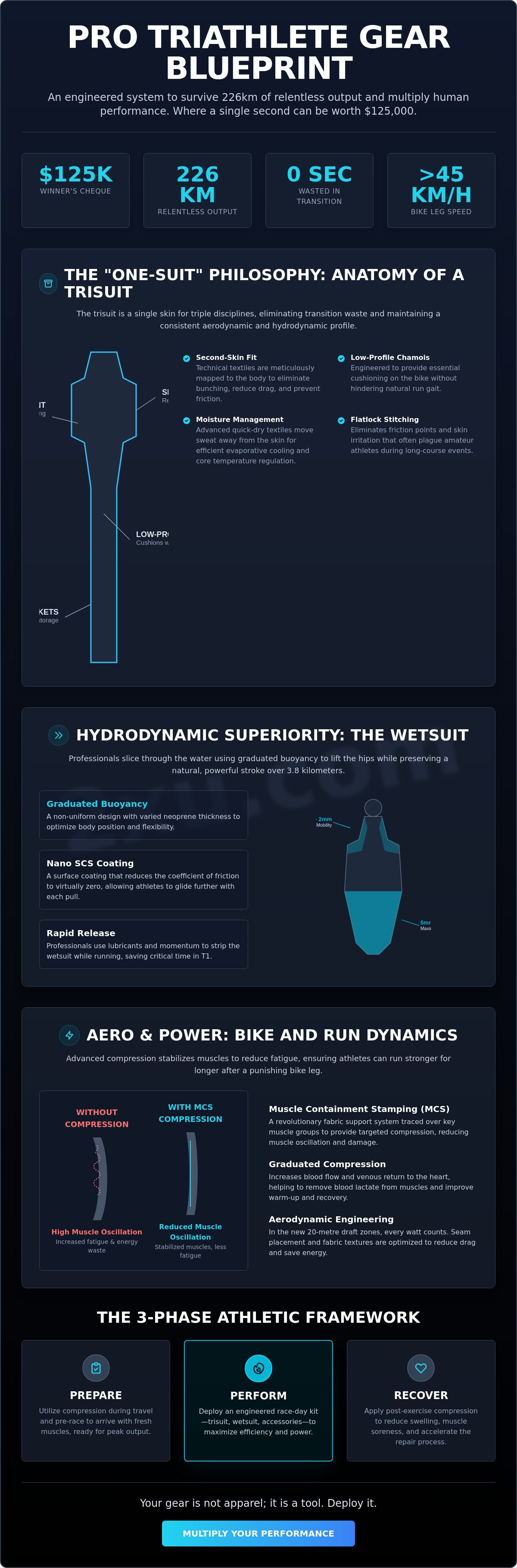
The trisuit is the definitive piece of triathlon equipment. It is the foundation of a professional's kit. When asking what do professional triathletes wear, the answer begins with a garment engineered to survive 226 kilometres of relentless output. Elites follow a "one-suit" philosophy. They don't waste time changing between legs. Every second spent in transition is a second lost on the course. A trisuit must perform as a hydrodynamic skin in the water and an aerodynamic shield on the bike; it is the primary tool used to ensure human performance is multiplied across all three disciplines.
Professional trisuits are designed with a "second-skin" fit. This is not about vanity; it is about survival during the grind. A loose garment creates drag and causes devastating friction. Technical textiles are meticulously mapped to the body to eliminate bunching. This precision engineering prevents the chafing that can end a race before the run even begins. By reducing drag and skin irritation, these suits ensure your energy is directed solely toward forward propulsion. You don't just wear it. You deploy it.
The Anatomy of a Professional Trisuit
Every element of the suit is scrutinised for performance. The low-profile chamois is a prime example of this obsession. Unlike bulky cycling pads, it is engineered to provide essential cushioning on the bike without hindering your natural run gait; this ensures you maintain peak efficiency during the final leg. Flatlock stitching is used throughout to reduce friction points. This eliminates the skin irritation that often plagues amateur athletes. Integrated pockets are strategically placed on the lower back or thighs. These are designed to hold essential nutrition while remaining flush against the body to minimise aerodynamic drag.
Fabric Breathability and Moisture Management
Core temperature regulation is vital for sustained power output. When you consider what do professional triathletes wear, you are looking at advanced moisture-management systems. These technical textiles move sweat away from the skin rapidly, allowing for efficient evaporative cooling. Quick-dry technology is essential during the transition from the swim to the bike. You cannot afford to carry water weight or suffer the chill of damp fabric at 45 kilometres per hour. For a deeper dive into the mechanics of these garments, consult the ultimate triathlon suit guide to understand how to choose the right kit for your specific race distance.
Hydrodynamic Superiority: Professional Wetsuits and Swim Skins
Professional swimmers don't just move through the water; they slice through it. When evaluating what do professional triathletes wear in the water, the choice is binary: a wetsuit or a swim skin. This decision is dictated by water temperature and the USA Triathlon competitive rules, which enforce strict cut-offs for buoyancy aids. A wetsuit is a performance tool designed for lift and warmth. A swim skin is a tactical garment used when wetsuits are prohibited. Elites prioritise shoulder mobility above all else. A suit that restricts your reach by even 2% will cost you minutes over 3.8 kilometres. You must earn your lead in the water through discipline and the right kit.
The transition from water to land is where races are often lost. Professionals treat stripping their wetsuit as a high-stakes drill. They use body lubricants on the wrists and ankles to ensure the neoprene slides off in one fluid motion. They don't sit down. They strip the torso while running toward the bike, using the momentum of the race to shed the layer. This efficiency is what separates the podium from the pack. If you want to dominate the first leg, you must optimise your swim kit with the same rigour as your training plan.
Neoprene Science and Buoyancy
The 5mm thickness limit is the gold standard for buoyancy in professional racing. However, a uniform 5mm suit is a cage. Professionals demand "graduated buoyancy." This means 5mm neoprene in the lower body to lift the hips and 1.5mm to 2mm in the shoulders to preserve a natural stroke. Surface coatings, such as Nano SCS, reduce the coefficient of friction to virtually zero. This allows the athlete to glide further with each pull, multiplying their power output. For a technical breakdown of how these materials interact with your stroke, read our triathlon wetsuit performance guide.
When the Pros Reach for a Swim Skin
In warm-water events like the IRONMAN World Championship in Kona, wetsuits are banned. Understanding what do professional triathletes wear in these non-wetsuit legal temperatures is the key to maintaining speed in the heat. Here, the kit shifts to the swim skin. A swim skin is a non-buoyant, hydrophobic outer layer used in warm water races. These garments use high-density textiles that compress the body, creating a smaller frontal area in the water. This compression stabilises the core and prevents the "parachute effect" common in standard trisuits. It is a tool for the relentless athlete who refuses to let warm water slow them down.
Aerodynamics and Muscle Containment: The Bike and Run Kit
The bike leg is a battle against fluid dynamics. When you emerge from the water, your focus shifts to defeating wind resistance. Understanding what do professional triathletes wear on the bike reveals a total shift toward sleeved trisuits. These garments use textured fabrics on the shoulders and arms to break up airflow, reducing the low-pressure wake behind the athlete. With the 2026 IRONMAN rule change increasing the professional bike draft zone to 20 metres, the ability to maintain an aerodynamic profile in clean air is more critical than ever. Every wrinkle in your kit is a penalty. A precision, wrinkle-free fit ensures that airflow remains laminar, preserving watts for the final 42.2 kilometres.
Transitioning to the run requires a kit that manages the violent impact of every stride. This is where muscle containment becomes the priority. High-velocity running causes muscle oscillation, which is the lateral movement of muscle fibres upon impact. This movement wastes energy and accelerates fatigue. Professional-grade compression, specifically Muscle Containment Stamping (MCS), provides a structural map over key muscle groups like the quadriceps and calves. This technology anchors the muscles in place, reducing micro-tears and allowing for more efficient power transfer. You don't just run; you maintain structural integrity under pressure.
Compression Technology: Multiplying Power Output
Graduated compression is not a lifestyle choice; it is a physiological advantage. By applying the highest pressure at the extremities and decreasing it toward the heart, these garments enhance venous return. This process speeds up the removal of metabolic waste and increases the delivery of oxygenated blood to the working muscles. For a deeper technical breakdown of how these mechanisms support your physiology, consult our compression shirts scientific guide. This is the science of recovery in motion, ensuring you have the strength to finish the grind.
Aerodynamic Optimisation on the Bike
Sleeved trisuits have become the professional standard for long-distance events because exposed skin is less aerodynamic than engineered fabric. By covering the shoulders and upper arms with specialised dimpled textiles, athletes achieve significant drag reduction compared to sleeveless alternatives. When considering what do professional triathletes wear, look for kits that incorporate cooling technologies like X-VENT. These fabrics use high-filament yarns to block UV rays and facilitate rapid heat dissipation. This ensures your core temperature remains stable even as the intensity peaks during the marathon, proving that every thread serves a performance purpose.
The Professional Transition: Layering and Accessories
Transitioning from the bike to the run is the final test of your discipline. Elites don't just put on shoes; they execute a pre-determined gear system designed to eliminate friction and cognitive load. When you ask what do professional triathletes wear during this phase, you are looking at a system where nothing is left to chance. Specialised eyewear is non-negotiable. At 45 kilometres per hour on the bike, wind and debris cause eye fatigue that manifests as physical tension in the neck and shoulders. On the run, high-contrast lenses allow for immediate terrain recognition, preserving your focus for the grind. This is the science of being "Race Ready."
The footwear transition is a masterclass in efficiency. Professionals use elastic lace systems to shave 10 to 15 seconds off their T2 time. This isn't just about speed; it's about maintaining a low heart rate and avoiding the fumble of fine motor skills under pressure. A disciplined gear setup provides a psychological edge. When your equipment is laid out with surgical precision, you enter the final leg with a sense of total control. You can shop professional athletic accessories to ensure your setup is as unyielding as your ambition.
Headwear and Sun Protection
Heat management is the primary goal of professional headwear. Technical visors are often preferred by elites because they allow heat to escape directly from the crown while the brim protects the eyes. However, in extreme heat, caps made from UPF-rated, technical textiles are used to prevent sun-induced fatigue and protect the scalp from radiation. Professional headwear balances sweat management with UV protection through high-filament yarns that pull moisture away from the skin and facilitate rapid evaporation.
The Sock Debate: To Wear or Not to Wear?
The decision to wear socks is a calculation of distance versus risk. In short-course racing, professionals often go sockless to save time, relying on the seamless interiors of their footwear to prevent irritation. For long-course events, technical socks are essential for blister prevention and structural stability. Specialised compression socks aid in mid-race recovery by stabilising the calf muscles and reducing the impact of muscle oscillation during the marathon. This choice reflects a commitment to finishing the grind without the distraction of avoidable pain. By choosing the right technical sock, you ensure your feet are as prepared for the distance as your mind.
Human Performance Multiplied: The 2XU Professional Standard
The choice of what do professional triathletes wear is ultimately a statement of intent. It is the final layer of a disciplined preparation phase that separates the committed from the casual. At 2XU, we don't settle for mediocrity because it doesn't enter our minds. We position ourselves as the pinnacle of triathlon engineering because our garments are designed to function as a physiological extension of the athlete. By adopting the "Prepare, Perform, Recover" framework, elite athletes ensure that their bodies are supported through the entire lifecycle of a race. This is not just apparel; it is a technical system designed to multiply your output when your willpower is tested by the grind.
Every piece of kit in a professional's arsenal must earn its place. When you see the world's best on the start line, they are wearing gear that has been scrutinised under laboratory conditions. This level of precision is why what do professional triathletes wear often begins and ends with 2XU. We respect the effort you put into your training by providing gear that matches that intensity. If you are willing to endure the hours of solitary swimming, the relentless bike intervals, and the high-impact run sessions, you deserve a kit that translates that hard work into tangible speed. We don't believe in limits. We believe in results.
Scientifically Proven Performance
Our commitment to excellence is grounded in rigorous data and scientific validation. Every piece of approved compression fabric is meticulously transformed into garments and assessed using the Salzmann pressure measurement device. This ensures the correct graduated pressure profile is achieved to optimise venous return and muscle stabilisation. We maintain active partnerships with elite research teams to validate our performance claims, ensuring that terms like "Muscle Containment Stamping" are backed by tangible physiological benefits. Professional athletes rely on 2XU for their most demanding races because they trust the numbers. They know that our proprietary PWX fabrics have been tested to survive the most punishing environments on Earth.
Earning Your Place on the Start Line
High-performance gear is not exclusive; it is aspirational. It is engineered for every athlete who is willing to respect the grind and push beyond their perceived limits. When you invest in professional-grade trisuits and compression, you are acknowledging that your effort is worth the best possible support. You have done the work. Now, you must sharpen your edge. We invite you to explore the 2XU triathlon collection and select the tools that will help you achieve your breakthrough. This is your journey toward becoming the absolute best version of yourself. Human Performance. Multiplied.
Master the Course with Engineered Precision
Professional racing is a game of marginal gains and relentless discipline. You've seen how the one-suit philosophy eliminates transition friction and how graduated buoyancy corrects your position in the water. Understanding what do professional triathletes wear is about recognising that every thread must serve a performance purpose; whether it is breaking up airflow on the bike or stabilising muscle oscillation during the marathon.
Our technology is used by World Champions who refuse to compromise on their kit. Every 2XU garment is meticulously assessed using Salzmann pressure measurement devices to ensure our proprietary PWX compression fabric delivers the exact profile needed to multiply your power output. You've put in the hours. You've respected the grind. Now, it's time to equip yourself with the engineering required to finish what you started.
Shop the 2XU Triathlon Collection and Multiply Your Performance
The start line is waiting. Earn your place and prove that your performance has no limits.
Frequently Asked Questions
Do professional triathletes wear underwear under their trisuits?
No. Trisuits are engineered with an integrated, low-profile chamois and technical linings designed to be worn directly against the skin. Adding extra layers creates friction points that lead to severe chafing and moisture retention. The proprietary fabrics used in professional kits are designed to wick sweat and dry rapidly, ensuring comfort throughout the grind without the need for additional garments.
How do professional triathletes pee during a long race?
Athletes either utilise portable toilets located at aid stations or, more commonly in long-distance events, relieve themselves while moving on the bike or run. Stopping costs valuable seconds that can ruin a race plan. Professionals often rinse themselves with water from their hydration bottles immediately after to maintain hygiene and prevent salt crystals from irritating the skin or damaging the technical fabric.
Why do professional triathletes wear long-sleeved suits on the bike?
Aerodynamics is the primary driver for the shift toward sleeved suits. Engineered fabric is faster than human skin; dimpled textiles on the shoulders and upper arms break the airflow and reduce the low-pressure wake behind the athlete. In non-drafting events where the gap is now 20 metres, these marginal gains are essential for preserving power output and maintaining high speeds over 180 kilometres.
Do professional triathletes change clothes during transitions?
No. They adhere to a strict one-suit philosophy to minimise transition times and maintain a consistent aerodynamic profile. When considering what do professional triathletes wear, the trisuit remains the constant foundation from the swim start to the run finish. They may add or shed a wetsuit or swim skin, but the core garment is never changed, as every second in transition is a second lost.
What is the difference between a wetsuit and a swim skin?
A wetsuit provides buoyancy and thermal protection using neoprene up to 5mm thick to lift the hips and improve body position. A swim skin is a non-buoyant, hydrophobic textile worn over a trisuit in warm water. It reduces drag through high-density compression and specialised surface coatings rather than lift, ensuring you remain fast and streamlined in non-wetsuit legal conditions where temperatures exceed 24.5 degrees Celsius.
Why is compression gear so important for professional triathletes?
Compression reduces muscle oscillation, which is the lateral movement of muscle fibres that occurs upon impact. This lateral movement causes micro-tears and accelerates fatigue during the run. By anchoring the muscles with technology like Muscle Containment Stamping, athletes preserve energy and enhance venous return. This ensures that human performance is multiplied, allowing the athlete to maintain structural integrity and pace during the final stages of the race.
Do professional triathletes always wear socks during the run?
Not always. In short-course ITU races, many athletes go sockless to save time during the transition. However, for long-course events like the 2026 IRONMAN World Championship, approximately 95% of professionals wear technical socks to prevent blisters and provide additional lower-leg compression. It is a calculated trade-off where the protection of the feet and the reduction of muscle fatigue outweigh the few seconds spent in transition.
How tight should a professional-grade trisuit be?
It must feel like a second skin with zero visible wrinkles. If the suit is loose, it creates significant drag in the water and air, functioning like a parachute. When determining what do professional triathletes wear, the fit is so precise that it may feel slightly restrictive while standing upright but becomes perfect once the athlete settles into the aero position on the bike. Accuracy in sizing is non-negotiable for performance.