
Compression Tights for Running Recovery: The Scientific Blueprint to Faster Gains
Recovery is not a passive state of rest; it is an engineered phase of the athletic lifecycle that requires precision to yield results. If you treat the hours between sessions as downtime, you are leaving performance on the table and settling for mediocrity. You have felt the leaden weight of heavy legs during high-volume blocks and the sharp bite of DOMS that delays your next interval set. It is a common barrier, but it is one that data-driven athletes have already solved.
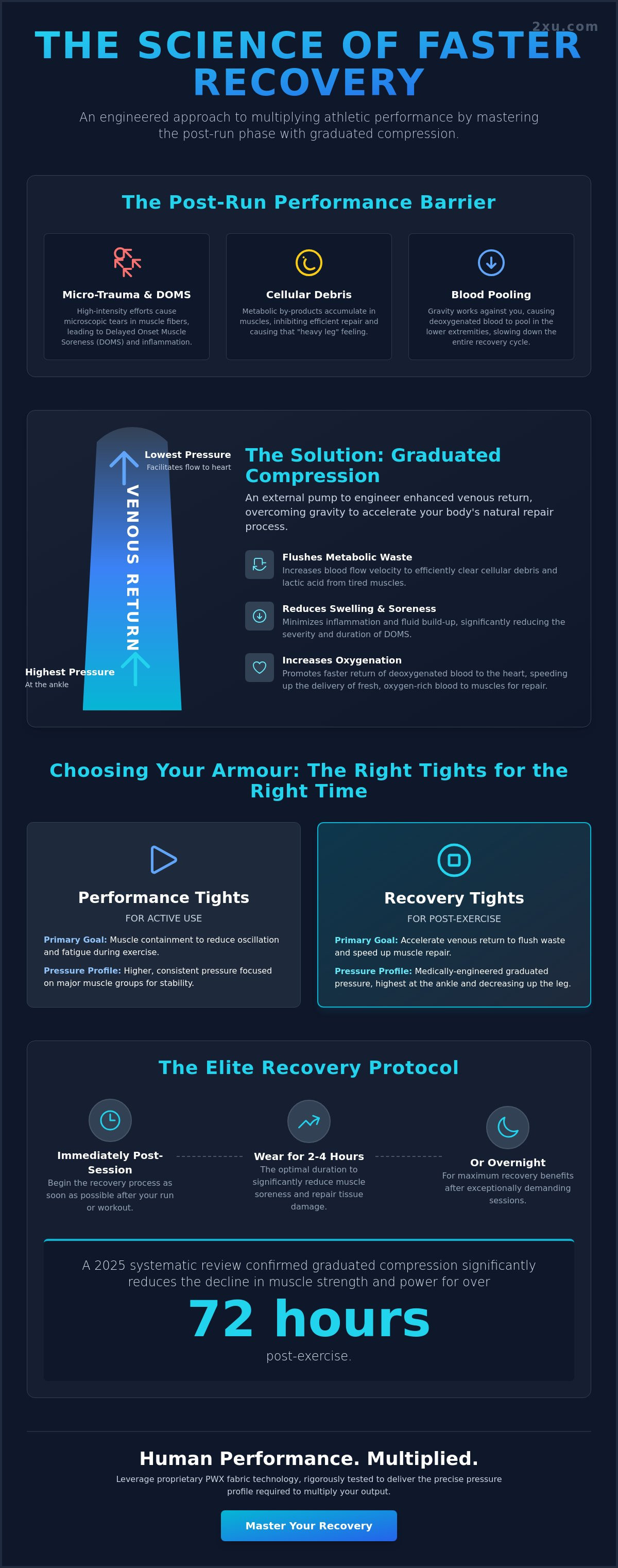
Utilising compression tights for running recovery is the scientifically proven method to accelerate muscle repair and reduce downtime. A 2025 systematic review confirmed that graduated compression significantly reduces the decline in muscle strength and power for over 72 hours post-exercise. By applying specific pressure profiles, often measured against Class I or II medical standards, you can flush metabolic waste and increase oxygenation. This article provides the scientific blueprint to mastering active recovery, explaining the mechanical triggers that multiply your gains and ensure you return to the track stronger than your previous self.
Key Takeaways
- Redefine the finish line by treating recovery as an elite discipline that requires engineered solutions rather than passive rest.
- Accelerate venous return and metabolic clearance through graduated pressure that is meticulously designed to overcome gravity and move deoxygenated blood.
- Optimise your downtime by wearing compression tights for running recovery for 2-4 hours post-session or overnight to reduce muscle soreness and repair tissue.
- Distinguish between the high-impact muscle containment of performance gear and the specific physiological requirements of a muscle at rest.
- Leverage proprietary technology that has been rigorously tested in independent laboratories to confirm it delivers the precise pressure profile required to multiply your output.
Beyond the Finish Line: Why Recovery is a Performance Metric
The race doesn't end when you cross the timing mat. For the elite athlete, the finish line is simply the trigger for the next phase of the athletic lifecycle. Recovery is not a passive state of rest; it is an active, engineered process of physiological repair. If you view the hours between your sessions as mere downtime, you're failing to respect the mechanics of growth. At 2XU, we operate under a singular framework: Prepare, Perform, Recover. Each stage is vital. Skipping the recovery phase is a compromise that leads directly to mediocrity.
Respecting "the Grind" means more than just enduring the miles. It requires the discipline to manage the micro-trauma and muscle oscillation that occur during high-intensity efforts. Every strike on the pavement sends vibrations through your soft tissue, causing microscopic tears and structural fatigue. By utilising compression tights for running recovery, you provide your muscles with the external stability they need to begin the reconstruction process immediately. This isn't about comfort; it's about sharpening your physical edge so you can load your system again sooner.
Our philosophy is grounded in the belief that human performance can be multiplied through rigorous science. When you prioritise recovery as a performance metric, you turn a period of vulnerability into a period of gain. You don't just wait for the soreness to fade. You use technical apparel to force the pace of repair, ensuring that your next "Perform" phase starts from a higher baseline of power and readiness.
The Physiology of Post-Run Fatigue
Delayed Onset Muscle Soreness (DOMS) is a primary inhibitor of training consistency. It's the result of inflammatory responses to muscle fibre damage and the accumulation of metabolic waste products in the lower extremities. Gravity works against you, causing blood to pool in the calves and ankles after a hard effort. The recovery window is the most critical 24 hours post-exercise, where intervention determines whether you'll be ready for tomorrow's session or sidelined by heavy, unresponsive legs.
Active vs. Passive Recovery
Static rest is the default for the amateur, but it's an inefficient way to clear cellular debris. A specialised Compression garment acts as an external pump for the lymphatic system, facilitating the return of deoxygenated blood to the heart. While compression tights for running recovery focus on the high-impact zones of the legs, a total-body approach is often required for complete restoration. Integrating tools like those found in our Compression Shirts: The Scientific Guide to Performance & Recovery ensures that your entire circulatory system is optimised for rapid repair.
Graduated Compression: Engineering Enhanced Venous Return
The effectiveness of graduated compression isn't a matter of opinion; it's a matter of physics. To understand how compression tights for running recovery function, you must understand the pressure gradient. Unlike standard athletic leggings that apply uniform pressure, engineered recovery gear uses a specific differential. The highest pressure is applied at the ankle, gradually decreasing as the garment moves up the leg. This is not a random design choice. It's a calculated mechanical intervention designed to overcome the limitations of human circulation under fatigue.
Gravity is the enemy of efficient recovery. After high-intensity efforts, deoxygenated blood and metabolic by-products pool in your lower extremities. Graduated pressure acts as an external pump, narrowing the diameter of the veins and increasing the velocity of blood flow back to the heart. At 2XU, we don't guess at these levels. Every garment is assessed using the Salzmann pressure measurement device, the gold standard for medical-grade testing, to confirm the exact graduated profile. This ensures that the pressure is powerful enough to facilitate venous return without restricting arterial flow. By utilizing high-filament yarns, we maintain this precise pressure for the life of the garment, ensuring your engineered recovery tights perform as well in year two as they did on day one.
The PWX Fabric Advantage
Our proprietary PWX (Power-Weight-Flex) fabric technology is the foundation of our recovery range. This isn't a basic knit; it's a circular knit structure that provides 360-degree stretch and consistent power. By using high-denier elastane and high-filament yarns, the fabric remains incredibly lightweight while delivering superior strength. These engineered fibres are built to withstand the rigours of daily use, maintaining their tensile strength and compression profile through hundreds of wash cycles. It's a technical solution for athletes who demand gear as resilient as their training programme.
Muscle Containment Stamping (MCS)
Muscle Containment Stamping (MCS) is an advanced technology that provides targeted support to the specific muscle groups most impacted by the running gait. By applying a proprietary stamping pattern to the internal fabric, we reinforce the quads and calves, the primary drivers of power and stability. This targeted approach reduces muscle oscillation and micro-tears, which are the root causes of post-run fatigue. MCS doesn't just support the muscle; it maps it, ensuring that the repair process is accelerated exactly where the damage is most severe. This is how you multiply your performance: by providing the exact mechanical support your body needs to rebuild faster.
Choosing Your Armour: Recovery Tights vs. Performance Tights
Precision is the difference between a podium finish and a plateau. Many athletes mistakenly believe that any tight-fitting garment provides the same benefit, but the physiological requirements of a muscle in motion are fundamentally different from those of a muscle at rest. Performance tights are engineered for the "Perform" phase. They focus on muscle containment and reducing muscle oscillation during high-impact activity. This mechanical support minimises the energy wasted on vibration, allowing you to run stronger for longer. A 2023 meta-analysis of 42 studies confirmed that compression sportswear provides statistically significant improvements in endurance and functional motor performance by managing these internal mechanics.
In contrast, compression tights for running recovery are engineered for the "Recover" phase. At rest, your muscles no longer face the impact of the pavement, but they do face the accumulation of metabolic waste. Recovery-specific gear prioritises maximum venous return through a more aggressive graduated pressure profile. Using the wrong profile limits your results. Wearing a performance-grade tight for recovery may not provide the specific gradient needed to flush the system, while wearing a high-pressure recovery garment during a run can restrict the arterial blood flow required for peak output. You must choose the right tool for the specific objective.
When to Wear Performance Tights
Deploy performance compression during high-intensity intervals and long endurance blocks. These garments are designed to stabilise the quads and calves, reducing the micro-trauma that leads to DOMS. For those who prefer a layered approach or specific heat management, integrating these with technical Running Shorts: The Ultimate Guide to Engineering Your Performance allows for a customised setup that doesn't compromise on muscle containment. The goal during this phase is to mitigate fatigue before it takes hold.
When to Transition to Recovery Tights
The transition should occur immediately post-session. Elite protocols suggest wearing recovery compression for at least 2 to 4 hours after a race to jumpstart metabolic clearance. This is especially critical during travel. Research from March 2025 indicates that compression is effective at reducing strength loss when worn for up to 72 hours post-exercise. If your training schedule involves post-race transit, use these tights or Flight Pressure Socks to combat swelling and the risk of DVT. This discipline ensures you return to the track with fresh legs, ready to multiply your next performance.
The Elite Recovery Protocol: How to Wear Compression for Maximum Results
Discipline doesn't stop at the end of your run. Your recovery protocol is a structured extension of your training programme. If you don't execute it with the same precision as your track intervals, you are sabotaging your gains. Recovery is an active choice, not a passive consequence of sitting down. To multiply your output, you must treat the post-run window as a high-stakes performance metric.
For immediate intervention, wear compression tights for running recovery for a minimum of 2 to 4 hours post-session. This specific duration jumpstarts metabolic clearance by facilitating the removal of lactate and other cellular debris. Research from March 2025 confirms that physiological benefits are most pronounced when compression is applied during this initial window, providing a statistically significant reduction in muscle swelling. By applying external pressure immediately, you prevent the fluid buildup that leads to the "heavy legs" sensation during high-volume training blocks.
Long-haul travel represents a high-risk period for the serious athlete. Away-races often involve prolonged periods of physical inactivity that cause blood pooling and increased risk of DVT. Compression is non-negotiable in these scenarios. It maintains the pressure gradient required to keep blood moving against gravity, ensuring you arrive at your destination ready to perform rather than fighting unresponsive, fluid-filled limbs. You have worked too hard to let a flight or a long drive compromise your power output.
Duration and Timing
For high-intensity events like marathons or ultra-marathons, the protocol must be extended. Elite athletes often wear graduated compression overnight to maintain enhanced circulation during the deep repair phases of sleep. Scientific data indicates that noticeable effects on muscle strength recovery occur after just two hours of consistent wear, but the most significant gains in tissue repair are seen when the garment is worn for up to 72 hours post-event. Consistency is the metric that separates the elite from the amateur. You don't recover "sometimes." You recover every time you load the system.
Sizing for Precision
A tight fit is not a compression fit. To ensure the graduated profile is effective, you must measure your height and weight against specialised size charts rather than relying on standard clothing sizes. The effectiveness of the Salzmann-tested gradient relies on the specific ankle-to-calf ratio. If the garment is too loose at the ankle or too tight at the knee, the mechanical pump mechanism fails. Secure your competitive advantage by selecting the correct specialised recovery gear and applying it with unyielding discipline.
2XU Recovery Technology: Human Performance, Multiplied
Mediocrity has no place in our engineering process. At 2XU, our mission is to provide the technical equipment that allows every athlete to multiply their physiological output. We don't just manufacture apparel; we engineer performance-enhancing systems. By choosing compression tights for running recovery developed through rigorous scientific inquiry, you are investing in a blueprint designed to push your limits. We believe that with the right discipline and the right gear, you can become "Two Times You."
Every garment we produce undergoes exhaustive assessment to ensure it meets the unyielding standards of elite sport. Our fabrics are meticulously transformed into high-performance tools and validated using the Salzmann pressure measurement device. This ensures the graduated pressure profile is accurate to the millimetre, providing the mechanical advantage required for rapid muscle repair. We don't rely on vague claims. We rely on data-driven results that have been proven in independent laboratories and through partnerships with the world's leading sports institutes.
The technical superiority of our recovery range is found in the details. We utilise high-filament, moisture-wicking yarns to ensure optimal thermoregulation while you recover. Our garments feature flatlock seams to eliminate chafing and an antibacterial treatment to maintain freshness during extended wear. These features are not for comfort; they are for performance. They allow you to focus entirely on the "Recover" phase of the athletic lifecycle without distraction or compromise.
The Science of Superiority
Our commitment to excellence is reinforced by ongoing partnerships with elite research teams. These collaborations allow us to validate our performance claims and refine our proprietary PWX fabric technology. 2XU gear is engineered to withstand the rigours of professional training blocks and high-frequency loading. When we talk about "Two Times You," we are referring to the measurable increase in power output and endurance that comes from a perfectly executed recovery protocol. This is the science of superiority in action.
Join the Elite
Stop settling for a passive approach to your training. If you respect the grind, you must respect the science of recovery. Every session you perform is only as good as the repair process that follows it. Earning your place among the elite requires more than just hard work; it requires the intelligence to use the best tools available. Don't leave your gains to chance. Take control of your physiological repair and multiply your performance. It is time to Shop 2XU Recovery Compression Tights and dominate your next block.
Secure Your Competitive Edge
Respecting the grind means acknowledging that your training doesn't end at the finish line. You've seen how graduated pressure facilitates venous return and how the specific 2-4 hour protocol jumpstarts the removal of cellular debris. Choosing the correct compression tights for running recovery is a strategic decision to eliminate the heavy legs and muscle soreness that stall your progress. A 2025 systematic review confirms these garments reduce the decline in muscle strength for over 72 hours post-exercise. Every 2XU garment is tested with Salzmann pressure devices to ensure precise graduation, providing the same technical advantage used by elite athletes worldwide.
Don't leave your performance to chance. Settling for passive rest only yields mediocre results. By applying scientific precision to your post-run window, you ensure your body is ready for the next block. It's time to sharpen your discipline and treat your downtime as a period of active gain. Your next breakthrough starts with the choices you make today.
Engineered for Recovery: Shop 2XU Compression Tights
Earn your place through smarter recovery. Your next breakthrough starts now.
Frequently Asked Questions
How long should I wear compression tights for recovery after running?
Wear them for a minimum of 2 to 4 hours immediately following your session to jumpstart metabolic clearance. Research from March 2025 indicates that physiological repair is most effective when graduated pressure is applied while cellular debris is at its peak. For high-intensity events like marathons, extending this wear time up to 72 hours ensures you maintain a higher baseline of power for your next load.
Can I sleep in my recovery compression tights?
You can and should sleep in them during high-volume training phases. Overnight wear is an elite protocol that facilitates continuous venous return while your body is in its most critical repair state. This ensures you wake up with fresh, responsive legs rather than the stiffness associated with fluid pooling. It is a simple discipline that multiplies your recovery efficiency without extra effort.
What is the difference between active compression and recovery compression?
Active compression is for the "Perform" phase, focusing on muscle containment and reducing oscillation during impact. Recovery compression is for the "Recover" phase, using a more aggressive graduated pressure profile to flush metabolic by-products. 2XU recovery gear is specifically Salzmann-tested to ensure the pressure gradient is highest at the ankle, which is a requirement that active-phase gear doesn't always prioritise.
Do compression tights really help with muscle soreness (DOMS)?
Scientific data confirms they are highly effective. A 2025 systematic review found that compression tights for running recovery significantly reduce the decline in muscle strength and perceived soreness after strenuous exercise. By mitigating the inflammatory response and reducing swelling, you shorten the downtime between your hardest sessions and return to the track sooner.
How tight should recovery compression tights be to be effective?
They must be firm enough to apply graduated pressure but not so tight that they restrict arterial flow. You must use specialised height and weight charts to ensure the garment matches your specific physiology. A correct fit ensures the engineered gradient remains highest at the ankle and decreases up the leg, which is the mechanical trigger for enhanced circulation.
Can I wear compression tights for recovery while flying to a race?
Wearing compression tights for running recovery during travel is a non-negotiable requirement for serious athletes. Prolonged inactivity in a cabin or car causes blood to pool in the lower extremities, increasing the risk of DVT and heavy legs. Graduated pressure maintains circulation against gravity, ensuring you arrive at the start line ready to perform rather than fighting travel fatigue.
How do I wash my compression tights to maintain the pressure gradient?
Use cold water and a gentle cycle, then always air dry your gear. High temperatures from tumble dryers damage the high-filament yarns and elastane, which compromises the garment's ability to maintain its proprietary pressure profile. Treat your technical apparel with the same respect you give your training plan to ensure it continues to multiply your performance.
Should I wear underwear under my compression recovery tights?
You shouldn't wear underwear under your recovery tights. Our garments are engineered for direct skin contact to allow the moisture-wicking yarns and antibacterial treatments to function at peak efficiency. This also ensures the graduated pressure profile is applied precisely to the muscle groups without any interference or bulk that could compromise the gradient.