
Best Wetsuit for Cold Water Swimming 2026: The Performance Engineering Guide
Cold water isn't an obstacle to be avoided; it's a physiological laboratory where elite endurance is engineered. You've likely felt the bite of a 16°C alpine lake or the relentless surge of a winter ocean. When the mercury drops, the search for the best wetsuit for cold water swimming becomes a quest for specialised armour that protects your core without compromising your mechanics. Most swimmers accept a loss of mobility as the price of warmth, but we don't believe in compromise.
You know the frustration of a session ending early because your core temperature plummeted or a poorly fitted suit allowed cold water to flush your system. We're here to sharpen your approach to the elements and help you earn your place in the water through discipline. This guide will help you master the science of thermal protection so you can maintain core warmth for 60 plus minutes while enjoying zero restriction in your shoulder rotation. We'll preview the latest 2026 technical advancements, from infrared-reflective linings to the $700.00 Propel Pro, to ensure your performance is multiplied even in the harshest conditions.
Key Takeaways
- Master the science of Yamamoto neoprene and nitrogen-injected foam to ensure maximum thermal insulation without the bulk of traditional materials.
- Learn to calculate the performance trade-off between neoprene thickness and joint mobility to maintain an uninhibited stroke during the grind of long-distance sessions.
- Identify your specific "Critical Temperature" threshold to select the best wetsuit for cold water swimming that prevents core temperature drops and mid-session flushing.
- Discover how engineered buoyancy distribution and Muscle Containment Stamping (MCS) technology multiply your power output and horizontal trim in freezing conditions.
The Cold Water Challenge: Why Standard Wetsuits Fail the Grind
Cold water swimming isn't a casual hobby; it's a calculated assault on your physical limits. We define this environment as any body of water dipping below 15°C. At these temperatures, the margin for error vanishes. Standard wetsuits designed for summer conditions are fundamentally incapable of sustaining the thermal integrity needed for high-output training. They lack the specialised internal linings and precision seals required to stop "flushing." This occurs when cold water surges through the neck or zipper, instantly resetting your internal clock and forcing an early exit. Mastering this environment requires the best wetsuit for cold water swimming, a piece of equipment that acts as a technical barrier between your ambition and the elements.
Winter training is the ultimate forge for discipline. While others retreat to the heated pool, the elite athlete understands that the open water provides a psychological edge that cannot be replicated. However, you cannot build grit if your physiology is failing. Respecting the grind means acknowledging that your body has hard limits. Without the correct thermal protection, your session becomes a battle for survival rather than a pursuit of performance. Your gear must be as unyielding as your mindset.
The Science of Thermoregulation in Open Water
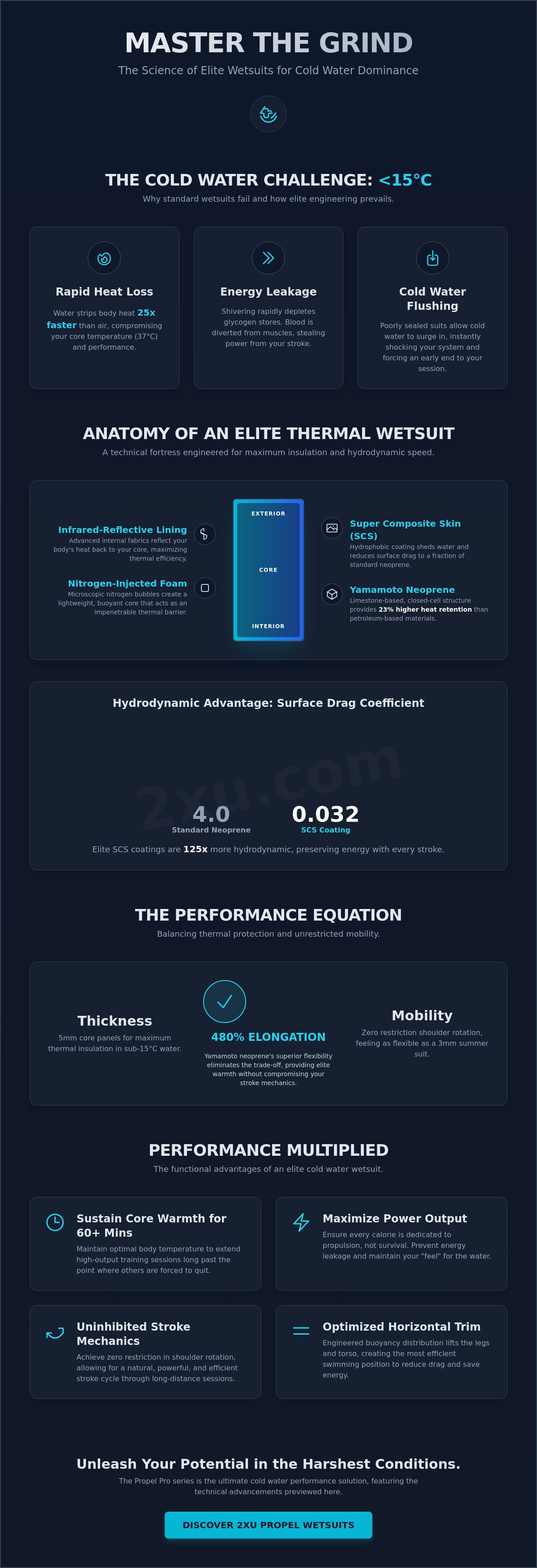
Water is a brutal conductor, stripping heat from your body 25 times faster than air. To perform, your suit must trap a microscopic film of water against your skin. This thermal layer is heated by your body and acts as a buffer. Thermoregulation is the body’s ability to maintain a core temperature of 37°C against external stressors. If your gear fails to maintain this layer, your heart rate spikes and your focus shatters. Understanding the Anatomy of an Elite Thermal Wetsuit is the first step in defending your core against the thermal drain of the open ocean.
Energy Leakage: How Being Cold Saps Your Power Output
Every calorie spent shivering is a calorie stolen from your stroke. When your core temperature drops, the body initiates a survival response, diverting blood from your prime movers to your internal organs. This peripheral vasoconstriction leads to a loss of proprioceptive feedback in the extremities, where your hands lose their "feel" for the water and your catch becomes inefficient. Shivering rapidly depletes your glycogen stores, leaving you empty long before your planned distance is complete. A high-performance suit is an investment in your training volume. It ensures that your energy is dedicated to propulsion rather than survival. The best wetsuit for cold water swimming doesn't just keep you warm; it preserves your power output so you can dominate the grind.
Engineering the Shield: The Anatomy of an Elite Thermal Wetsuit
Engineering is the definitive factor between a 15-minute survival dip and a 60-minute threshold session. To survive and thrive in the grind, the best wetsuit for cold water swimming must utilise Yamamoto neoprene. This limestone-based material represents the pinnacle of aquatic insulation. Unlike standard petroleum-based rubbers, Yamamoto neoprene features a closed-cell structure with a 23% higher heat retention rate. It consists of 99.7% calcium carbonate, making it significantly more impermeable and durable over multiple seasons of intense use. When you're facing The Cold Water Challenge, your equipment must be a technical fortress.
The core of this thermal shield is nitrogen-injected foam. By injecting nitrogen gas into the limestone structure, engineers create millions of microscopic bubbles that act as independent thermal barriers. This cellular density provides the buoyancy needed for a horizontal trim while preventing the material from compressing under water pressure. On the exterior, Super Composite Skin (SCS) technology reduces the surface drag coefficient to 0.032, compared to 4.0 for standard neoprene. This specialised coating doesn't just make you faster; it sheds water instantly upon exit to prevent evaporative cooling. If you're serious about your winter volume, explore the latest 2XU triathlon wetsuits to see this material science in action.
Neoprene Cell Structure and Heat Retention
Closed-cell structures are non-negotiable for sub-15°C environments. They're engineered to ensure the suit doesn't absorb water, which would otherwise sap your energy through increased weight and heat loss. High-grade limestone materials maintain 480% elongation, allowing a 5mm torso panel to feel as flexible as a 3mm summer suit. This ensures your shoulder rotation remains uninhibited during high-cadence sets. The durability of these materials is proven; they resist the "crushing" effect of depth and repeated use far better than low-grade alternatives.
Seam Construction: Keeping the Cold Out
Seams are the primary failure point in standard gear. Elite thermal suits use Glued and Blind Stitched (GBS) construction, where the needle never fully penetrates the neoprene. We then apply liquid taping to the exterior and internal pressure-bonded tape to create a 100% waterproof seal. This prevents the "flushing" effect that resets your internal temperature. Seamless underarm panels are also critical. By removing seams from high-motion areas, we eliminate friction and ensure your stroke mechanics remain pure despite the increased thickness of your cold-water armour.
Thickness vs. Mobility: Calculating the Performance Trade-off
Mediocrity in the water often stems from a misunderstanding of material physics. You don't need a thicker suit; you need a smarter one. The debate between 4/3mm and 5/4mm configurations isn't about warmth alone; it's about the metabolic cost of movement. A suit that is too restrictive in the shoulders will force your heart rate higher as you fight against the neoprene, leading to premature fatigue. However, a suit that is too thin will allow your core temperature to drop, causing the energy leakage discussed in our earlier analysis of Engineering the Shield. The best wetsuit for cold water swimming is one that places thickness exactly where the body needs insulation while stripping it away where it hinders mechanics.
Buoyancy distribution is a tactical advantage often overlooked by amateur swimmers. For triathletes, placing 5mm panels in the lower limbs isn't just about heat; it's about horizontal trim. Thicker legs lift your lower body into a more hydrodynamic position, reducing the frontal surface area that creates drag. This is where 2XU technology excels. By understanding the neoprene wetsuit science behind graduated thickness, we ensure that your power output is converted into forward velocity rather than being wasted on maintaining body position. We engineer for the elite who respect the grind and refuse to let the elements dictate their pace.
The 3-2-1 Rule of Performance Wetsuits
Elite engineering follows a specific distribution pattern. We typically utilise 5mm or 4mm panels across the torso to protect vital organs and maintain core heat. We then transition to 3mm in the lower legs for buoyancy and 1.5mm to 2mm in the shoulders and underarms. This variable thickness mimics natural human biomechanics. Uniform thickness is a hallmark of low-tier gear that ignores the reality of the swim stroke. Your armour should move with you, not against you.
Hydrodynamics and Drag in Cold Water
The myth that a thicker suit makes you slower is debunked by the physics of buoyancy. While a 5mm suit has a larger physical profile, the increased lift often results in a faster swim split by reducing "sink" in the hips. Water saturation is the true enemy of speed. High-quality limestone neoprene absorbs significantly less water than cheaper alternatives, ensuring the suit remains light and fast throughout a 60-minute session. In sub-12°C conditions, the best wetsuit for cold water swimming provides the lift you need to stay on top of the water, multiplying your efficiency when the conditions are at their most demanding.
Selection Framework: Choosing Your Cold Water Armour
Selecting the best wetsuit for cold water swimming is a tactical decision that determines whether you dominate the session or succumb to the elements. Casual advice found on public forums often suggests buying a size larger for "comfort." This is a dangerous error. A loose suit allows cold water to flush the torso, instantly siphoning core heat and risking hypothermia. You need a second skin that eliminates dead space while allowing for full biomechanical extension. Respect the science of the fit; it is the foundation of your thermal defense.
Your selection must follow a rigorous four-step framework. First, identify your critical temperature threshold. If you are training in water consistently below 12°C, you require a 5/4mm configuration with a thermal lining. Second, assess your stroke style. High-cadence swimmers require thinner, 1.5mm panels in the underarms to prevent friction and fatigue. Third, demand precise sizing to prevent flushing. Finally, evaluate the entry system. While back zips are easier to put on, chest zip systems provide a superior thermal seal by removing the long zipper track from the spine, where water entry is most common. To ensure you are fully race-ready, explore our performance triathlon wetsuits engineered for these exact conditions.
The 2XU Fit System: Precision Over Everything
Precision is our baseline. To achieve a performance fit, you must record your chest circumference, height, and weight with meticulous accuracy. A suit that bunches at the back of the knees or leaves a gap in the small of the back is a failure of engineering for your specific body type. These gaps become reservoirs for cold water. When testing a new suit, perform a "dry run" with extreme care. Use a plastic bag over your hands and feet to slide through the limbs without snagging the neoprene with your fingernails. If the suit feels tight on land, it is likely correct; neoprene expands slightly and settles once you enter the water.
Essential Accessories for Sub-10°C Sessions
When the mercury drops below 10°C, your periphery becomes the primary point of energy leakage. A thermal hood is mandatory to prevent "brain freeze" and maintain cognitive focus during the grind. Similarly, specialised neoprene gloves and booties are required to maintain dexterity and kick power. Without these, blood flow is diverted from your prime movers to protect your extremities, siphoning the power from your stroke. Consult our Triathlon Wetsuit Guide for a deeper dive into how to integrate these accessories into your winter training programme. Discipline in your preparation ensures that your human performance is multiplied, regardless of the temperature.
2XU Propel: The Ultimate Cold Water Performance Solution
The Propel series is the scientific culmination of our obsession with human potential. When you are searching for the best wetsuit for cold water swimming, you aren't just looking for a garment; you are selecting a performance multiplier. Engineered for the elite, the Propel series integrates proprietary Muscle Containment Stamping (MCS) technology. This internal mapping reduces muscle oscillation and fatigue by providing targeted support to the major muscle groups used during the swim stroke. By containing the muscle, we ensure that your power output is directed entirely into propulsion, even when the cold attempts to sap your strength.
Buoyancy is the foundation of speed in open water. The Propel features a 39 Cell front buoyancy panel, designed to provide maximum lift and keep your body in an optimal horizontal position. This is critical in cold water where muscle density increases and natural buoyancy can shift. We don't settle for mediocrity. Our athletes respect the grind because they know that every technical advantage, from the limestone neoprene to the precision buoyancy panels, is earned through rigorous testing and scientific validation. This is the gear that allows you to maintain your edge when the temperature drops.
Propel P:2 vs. Propel P:1: Which Suit for Your Race?
Choosing between the Propel P:2 and P:1 depends on your specific performance requirements. The P:2 is our versatile all-rounder, offering a balanced mix of flexibility and buoyancy for the serious competitor. In contrast, the Propel Pro features advanced Rollbar technology. This proprietary feature enhances body rotation and core stability, allowing for a more efficient stroke and faster splits. For a comprehensive breakdown of our full range, consult The Ultimate Triathlon Suit Guide. Whether you are a high-cadence specialist or a long-glide powerhouse, our engineering ensures your fastest race day is ahead of you.
Maintenance: Protecting Your Investment
A technical shield requires meticulous care to maintain its performance profile. After every session, rinse your suit thoroughly with fresh water to remove salt and minerals that cause degradation. Never use soaps or harsh chemicals. Dry the suit inside out in the shade; direct UV exposure destroys neoprene elasticity and compromises the cellular structure. Storage is equally vital. Never hang a heavy, wet suit by the shoulders, as this causes permanent stretching and ruins the precision fit. Instead, fold it over a wide, padded hanger at the waist once dry. Respect your gear as much as you respect your training, and it will continue to multiply your performance for seasons to come.
Master the Elements and Multiply Your Performance
Cold water swimming is a tactical choice that separates the elite from the average. You now understand that thermal protection is a matter of precision engineering, not just thickness. By leveraging Yamamoto 39 Cell Neoprene and proprietary Rollbar Technology, you ensure that your body remains in the optimal hydrodynamic position even as the temperatures plummet. This is the same gear used by World Champion Triathletes who refuse to let the seasons dictate their training volume.
Selecting the best wetsuit for cold water swimming is an investment in your endurance and discipline. You have the framework to choose your armour based on critical temperature thresholds and stroke mechanics. Don't settle for gear that fails the grind or restricts your power output. It's time to step into the water with confidence, knowing your equipment is as unyielding as your mindset. The open water is a laboratory for your potential; go out and prove what you're capable of achieving.
Shop 2XU Performance Wetsuits and prepare to dominate your next session.
Frequently Asked Questions
What is the best wetsuit thickness for 10-15°C water?
A 5/4mm configuration is the standard for 10-15°C water to maintain core integrity. While a 4/3mm suit offers more flexibility, it often fails to prevent core temperature drops in sessions exceeding 45 minutes. The 5mm torso panels provide the necessary thermal barrier, while 3mm or 2mm limbs ensure your stroke mechanics remain uninhibited and efficient throughout the grind.
Can I use a surfing wetsuit for open water swimming?
Surfing wetsuits are engineered for different biomechanical requirements and will hinder your swim performance. They lack the specific buoyancy panels needed for a horizontal trim and often feature high-friction seams that cause severe chafing during repetitive stroke cycles. A dedicated triathlon suit uses limestone-based neoprene designed specifically for constant shoulder rotation and reduced drag in the water.
How do I stop my wetsuit from chafing in cold water?
Apply a silicone-based anti-chafe lubricant to the neck, underarms, and ankles before every session. Cold water can cause the skin to become more sensitive, making the "second skin" fit of the best wetsuit for cold water swimming even more critical. Ensure your suit is pulled up correctly into the crotch and armpits to eliminate friction points caused by sagging material.
Do I need a thermal base layer under my wetsuit?
A high-performance thermal wetsuit with an integrated fleece lining usually eliminates the need for a base layer. Adding internal layers can actually compromise the precision fit, allowing more water to flush through the suit and increasing the metabolic cost of your movement. If you require more warmth, prioritise accessories like neoprene hoods or booties before adding internal bulk that restricts your range of motion.
How long does a high-performance wetsuit usually last?
A premium limestone neoprene suit typically maintains its performance properties for 2 to 3 seasons of regular use. Salt degradation and UV exposure are the primary enemies of cellular integrity and elasticity. By rinsing with fresh water and drying in the shade, you preserve the 480% elongation capacity of the material, ensuring the suit doesn't become brittle or lose its thermal efficiency over time.
What happens if my wetsuit is too loose in cold water?
A loose fit allows cold water to circulate freely between your skin and the neoprene, a process known as flushing. This prevents the body from heating the thin thermal layer of water, leading to rapid core temperature drops and shivering. In sub-15°C conditions, a suit that doesn't provide a compressed, second-skin seal will likely end your session in under 20 minutes.
Is a chest zip or back zip better for cold water swimming?
Chest zip systems are superior for cold water because they minimise water entry through the zipper track. By removing the long zipper from the spine, the suit maintains better flexibility and a more reliable seal around the neck. This configuration is essential for athletes who respect the grind and need to maintain thermal integrity during high-intensity training blocks in winter conditions.
How do I repair a small fingernail tear in my neoprene?
Repair small nicks immediately using a specialised neoprene cement to prevent the tear from expanding. Apply a thin layer of adhesive to both sides of the nail nick, wait 5 minutes for it to become tacky, and then press the edges together firmly. This simple maintenance task protects the structural integrity of your best wetsuit for cold water swimming and extends its operational lifespan.