
How to Avoid Chafing on Inner Thighs When Running: The Tactical Guide
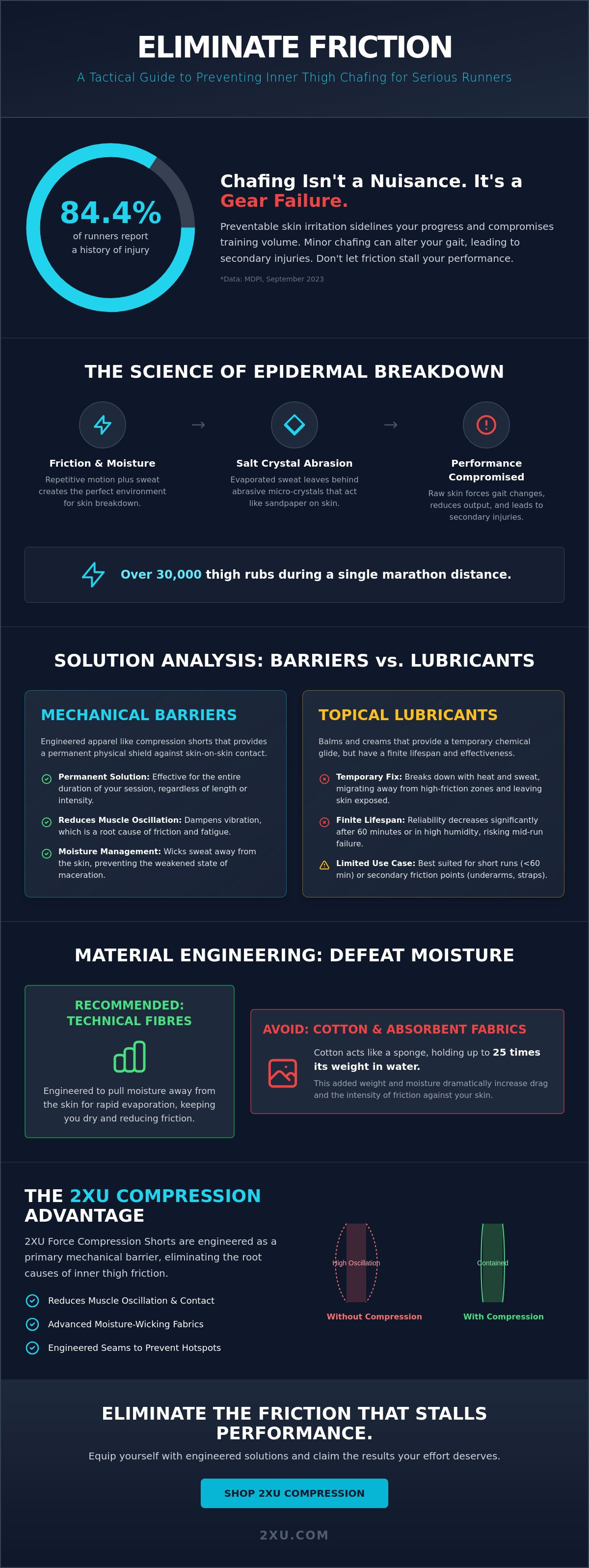
Inner thigh chafing is not a badge of honour; it's a mechanical gear failure that compromises your training volume. Every serious athlete has felt that excruciating sting when salt crystals meet raw skin at the 15 kilometre mark. Learning how to avoid chafing on inner thighs when running is critical for maintaining your discipline and respecting the grind. With 84.4% of recreational runners reporting a history of injury according to MDPI data from September 2023, you cannot afford to let preventable skin irritation sideline your progress or steal your next session.
You know that mediocre preparation leads to mediocre results. This tactical guide provides the scientific protocol required to ensure friction-free long-distance sessions. We'll examine the technical benefits of advanced textiles and compression barriers like the 2XU Force Compression Shorts, which are engineered to reduce muscle oscillation and skin contact. You will gain a reliable pre-run prevention protocol and an understanding of how to use performance-engineered lubricants to multiply your endurance. Prepare to eliminate the friction that stalls your performance and claim the results your effort deserves. Human performance, multiplied.
Key Takeaways
- Master the science of epidermal breakdown and how abrasive salt crystals from evaporated sweat compromise your performance.
- Discover how to avoid chafing on inner thighs when running by prioritising permanent mechanical barriers over short-lived topical lubricants.
- Optimise your gear selection with technical fibres engineered to manage moisture and prevent the high-friction environment caused by absorbent materials like cotton.
- Execute a rigorous pre-run protocol that includes kit inspection and skin preparation to ensure you stay in the grind without distraction.
- Understand how reducing muscle oscillation through advanced compression technology eliminates the root cause of inner thigh friction.
Understanding the Friction: The Science of Inner Thigh Chafing
Chafing is the mechanical breakdown of the epidermis. It's caused by repetitive friction and moisture. It's not a minor nuisance; it's a gear failure. The Science of Inner Thigh Chafing involves a complex interaction between skin hydration and mechanical stress. Understanding how to avoid chafing on inner thighs when running starts with acknowledging that your skin is being compromised by a relentless cycle of abrasion. This is a performance barrier that demands an engineered solution.
When you push through high-intensity sessions, your sweat does more than cool you down. As moisture evaporates, it leaves behind abrasive micro-crystals of sodium and minerals. These crystals act like high-grit sandpaper against the sensitive skin of your thighs. This salt-crystal effect accelerates the tearing of the skin's surface, turning a slight rub into a raw wound that halts your progress. Mediocrity accepts this as part of the sport. We don't.
The inner thighs are the primary hot spot for endurance athletes because of high stride frequency. Over a marathon distance, your legs may rub together over 30,000 times. This constant contact isn't just painful; it has a physiological cost. Research suggests that minor skin irritation increases your perceived exertion and forces you to alter your running mechanics to avoid the pain. This shift in gait leads to secondary injuries in the knees and ankles. The 12-month prevalence of running-related injuries among trail runners reached 69.2% in September 2024, often stemming from these mechanical compensations.
The Role of Moisture and Humidity
High humidity is the enemy of the elite athlete. Wet skin is more permeable and significantly more prone to tearing than dry or properly lubricated skin. Maceration is the process where skin becomes weakened by prolonged moisture exposure. In humid environments, sweat cannot evaporate effectively, leaving your skin in a vulnerable, softened state that is easily shredded by repetitive motion. You must control the microclimate between your skin and your gear.
Why Your Current Gear is Failing You
Your current kit might be the culprit. Loose-fitting apparel allows for excessive skin-on-skin contact, which is the root cause of friction. Low-quality seams create high-pressure friction points that dig into the epidermis during every gait cycle. Avoid the heavy fabric trap. Water-absorbent materials like cotton can hold up to 25 times their weight in water. This extra weight increases the drag and the intensity of the friction against your skin, stalling your performance. To master how to avoid chafing on inner thighs when running, you must choose technical fibres designed for rapid moisture transfer.
Mechanical Barriers vs. Topical Lubricants: A Tactical Comparison
Mastering how to avoid chafing on inner thighs when running requires moving beyond temporary fixes. Topical lubricants provide a chemical glide, but they possess a finite lifespan. Petroleum-based products often break down under high thermal stress; silicone-based formulas offer superior longevity but eventually migrate away from the high-friction zone as sweat volume increases. For the endurance athlete, relying solely on a balm is a tactical risk. You need a permanent solution that doesn't wash away at the 20 kilometre mark.
Mechanical barriers represent the professional standard for friction management. Unlike balms that cost between $9.99 and $22.00 per unit and require constant reapplication, compression gear provides a physical shield that remains effective for the duration of your session. Elite athletes often employ a hybrid approach for marathons and triathlons. They utilise a primary mechanical barrier to eliminate skin-on-skin contact and apply a targeted lubricant layer only at specific high-pressure seam points. This multi-layered strategy ensures that even if one system is compromised, your performance is not.
When to Rely on Anti-Chafe Balms
Balms have a place in your kit, but their utility is limited. Use them for short recovery runs under 60 minutes or for secondary friction points like underarms and heart rate monitor straps. It is critical to choose non-staining, water-resistant formulas that can withstand heavy perspiration. The primary limitation remains heat. As your core temperature rises, lubricants liquefy and move. When the product migrates, your skin is left exposed to the salt-crystal abrasion mentioned in the previous section. If you want to multiply your output, you cannot rely on a barrier that disappears when the grind intensifies.
The Superiority of Compression as a Mechanical Barrier
Compression is the superior choice for serious training. It provides a physical second-skin layer that eliminates skin-on-skin contact entirely. High-performance running shorts with engineered liners provide a permanent barrier that cannot wear off. This is a scientific approach to protection. Graduated pressure also plays a critical role by reducing muscle oscillation. By stabilising the thigh muscles, you decrease the lateral movement that drives friction in the first place. This reduction in vibration means less heat, less irritation, and more power output. Invest in advanced compression gear to ensure your focus remains on the finish line, not your skin.
Material Engineering: Choosing Fabrics That Defeat Moisture
Cotton is a liability for the endurance athlete. It absorbs 25 times its weight in water; this transforms your kit into a heavy, abrasive sponge that clings to your skin. When you are determining how to avoid chafing on inner thighs when running, your first step is to purge non-technical materials from your wardrobe. High-performance gear relies on the engineering of moisture-wicking. These technical fibres use capillary action to pull sweat from the skin's surface to the outer layer of the garment where it can evaporate. This process keeps the epidermis dry and maintains the structural integrity of the fabric during the most intense sessions.
Proprietary fabrics go beyond simple wicking. They incorporate antibacterial treatments to prevent the microbial growth that exacerbates skin irritation. When bacteria mix with moisture and friction, the risk of infection and intensified rawness increases. Technical garments engineered with silver-ion technology or similar antimicrobial properties ensure that your gear remains a sterile environment, even during high-humidity ultra-marathons. This is the difference between gear that merely covers you and gear that multiplies your performance.
High-Performance Fibre Architecture
2XU avoids basic materials in favour of proprietary, high-filament yarns. These engineered filaments maintain their shape and compressive power even when saturated with sweat. The choice between circular knit and warp knit fabrics is critical for durability. While circular knit is common in entry-level sportswear, warp knit provides a superior 360-degree stretch and resists running or pilling. This high-level architecture ensures the fabric remains smooth against your inner thighs, eliminating the micro-abrasions caused by pilling fabric.
Seam Placement and Ergonomic Design
Anatomical mapping is the professional standard for high-performance apparel. This process ensures that seams are moved away from high-friction inner thigh zones to prevent irritation. Seamless technology in key movement areas provides an uninterrupted glide, allowing your legs to move through the gait cycle without resistance. Flatlock stitching creates a flush finish that prevents the fabric from digging into the skin; this ensures that every internal connection point of the garment is as smooth as the face of the fabric itself. By reducing the profile of the garment, you eliminate edge friction and focus entirely on the grind.
The Pre-Run Protocol: A 5-Step Checklist to Prevent Irritation
Elite performance is the result of meticulous preparation. Skin failure mid-run is not an inevitability; it's a failure of process. If you want to know how to avoid chafing on inner thighs when running, you must adopt a disciplined, scientific protocol before you even lace up. Respecting the grind means respecting your body's largest organ. Follow this five-step checklist to ensure your focus remains on your power output, not your skin's breakdown.
- Cleanse the skin: Remove residual salts and bacteria from previous sessions. These micro-contaminants increase the abrasiveness of the skin surface, accelerating the salt-crystal effect discussed in earlier sections.
- Inspect your kit: Examine the inner thigh area of your shorts for pilling. Worn-out technical fibres create a rough surface that increases friction. If the fabric is pilled, it's compromised. Replace it.
- Apply a silicone barrier: Use a high-quality lubricant even when wearing compression. This dual-layer protection creates a chemical glide between the skin and the fabric, ensuring zero friction points.
- Secure the fit: Ensure your compression shirts and shorts are positioned correctly. Proper alignment prevents fabric from bunching in high-movement zones.
- Post-run hygiene: Immediately rinse salt crystals from the skin. Delayed-onset irritation occurs when sweat dries and leaves abrasive minerals on raw epidermis.
Addressing the 'Hot Spot' Mid-Run
Identify the early sting before it becomes a raw wound. If you feel a hot spot develop during sessions exceeding 90 minutes, stop immediately. Carry a travel-sized lubricant in your belt to reapply to the affected area. Adjust your kit position mid-run to ensure the fabric liner hasn't shifted or bunched. A five-second adjustment can save your training volume for the following day.
Post-Run Recovery and Skin Repair
When irritation occurs, use the rinse and repair method. Use lukewarm water and soap-free cleansers to avoid further dehydrating the tissue. For raw areas, apply topical treatments like zinc oxide or petroleum-based salves to facilitate rapid healing. Respect the skin's recovery time. Chronic inflammation from repeated chafing will force a rest period you didn't plan for. Upgrade your running kit to prevent the need for recovery in the first place.
Beyond the Surface: How 2XU Compression Multiplies Comfort
Determining how to avoid chafing on inner thighs when running isn't just about what you put on your skin; it's about how you contain the muscle beneath it. While basic apparel allows the thigh muscles to move independently of the garment, 2XU technology anchors the tissue. Muscle Containment Stamping (MCS) provides a targeted layer of support that traces key muscle groups, tendons, and fascia. By providing this internal structure, MCS significantly reduces lateral muscle movement during high-impact sessions. When your muscles aren't oscillating wildly, the skin surface remains stable. This stability is the ultimate solution to friction because it eliminates the repetitive rubbing that leads to epidermal breakdown.
The link between reduced muscle oscillation and decreased skin-on-skin friction is scientifically grounded. Every time your foot strikes the pavement, a vibration wave travels through your leg. In loose kit, this wave causes the inner thighs to collide and grind. 2XU compression shorts act as a mechanical stabilizer. They dampen these vibrations and ensure your stride remains efficient and linear. This is how we multiply your endurance. You aren't just protecting your skin; you're preserving the energy that would otherwise be wasted on muscle vibration and pain management.
The Architecture of PWX Fabrics
Our proprietary PWX fabric technology is engineered for the rigours of elite training. We utilize high-filament technical yarns that provide a smooth, low-friction surface against your skin. This isn't a basic moisture-wicking material. PWX is a high-power fabric that maintains its compressive profile even when saturated with sweat. The 360-degree stretch ensures a consistent, secure fit throughout the entire gait cycle, preventing the fabric from shifting or bunching. To guarantee precision, every 2XU garment is assessed using the Salzmann pressure measurement device. This confirms the correct graduated pressure profile, ensuring your gear delivers the exact performance benefits promised on the label.
Earning Your Place: Gear for the Disciplined Athlete
Elite performance is the result of meticulous preparation and the refusal to accept mediocrity. You respect the grind by showing up every day and pushing your limits. Your gear must work as hard as you do. Chafing is an amateur distraction that has no place in a professional training programme. By choosing equipment engineered with scientific rigour, you eliminate the friction that stalls your progress. You've earned your place on the track through hard work; don't let a gear failure take it away. Take control of your training environment and ensure every session counts. Explore 2XU Performance Running Gear and experience human performance, multiplied.
Dominate Every Kilometre Without Distraction
Skin breakdown is a mechanical failure, not a badge of honour. You now have the tactical knowledge to implement a rigorous pre-run protocol and choose permanent mechanical barriers over temporary lubricants to protect your training volume. Understanding how to avoid chafing on inner thighs when running is the critical difference between a stalled session and a breakthrough performance. Mediocrity accepts friction; elite athletes engineer it out of the equation entirely.
2XU gear is meticulously engineered for the entire athletic lifecycle: prepare, perform, and recover. Our scientifically proven PWX fabric technology is endorsed by elite coaches and world-class athletes who refuse to let skin irritation compromise their power output. Every piece of kit is designed to withstand the intensity of your most demanding sessions. Respect the grind and equip yourself with the technology required to push past your previous limits. It's time to stop managing pain and start multiplying results.
Multiply your performance with 2XU technical running gear.
Stay focused on the finish line. Your next personal best is earned through discipline, hard work, and the right equipment.
Frequently Asked Questions
Is it better to wear loose shorts or tight leggings to prevent chafing?
Tight leggings or compression shorts are the superior choice for mastering how to avoid chafing on inner thighs when running. Loose-fitting apparel allows for repetitive skin-on-skin contact, which is the primary driver of friction. Technical compression provides a second-skin layer that eliminates this contact while reducing muscle oscillation. This stability ensures that the fabric remains in a fixed position throughout your entire gait cycle.
Can I use Vaseline to stop my thighs from rubbing when I run?
Vaseline provides a temporary chemical glide but often fails during high-intensity endurance sessions. Petroleum-based products liquefy as your core temperature rises, causing the lubricant to migrate away from the friction zone. For sessions exceeding 60 minutes, silicone-based anti-chafe sticks are more effective. These formulas are more water-resistant and withstand heavy perspiration without staining your technical apparel.
How do I treat inner thigh chafing if it has already started?
Treat existing chafing by immediately cleansing the area with lukewarm water and a soap-free cleanser. Avoid abrasive scrubbing which can further damage the compromised epidermis. Once dry, apply a thick layer of zinc oxide or a protective salve to create a barrier against further moisture. Respect the recovery process and allow the skin to heal before attempting another high-volume session.
Does body weight or muscle size affect how much I chafe?
Increased muscle volume or higher body fat percentages heighten the frequency of thigh contact during your stride. This increased surface area makes it vital to master how to avoid chafing on inner thighs when running through mechanical barriers. Athletes with significant quad development require high-power compression to contain muscle mass and minimise the lateral shift that drives skin breakdown.
Are there specific fabrics I should avoid for long-distance running?
Cotton is the most dangerous fabric for any endurance athlete and must be avoided. It retains up to 25 times its weight in moisture, which increases the weight of the garment and creates an abrasive, sandpaper-like texture against the skin. You should only utilise technical fabrics engineered with high-filament yarns that facilitate rapid moisture transfer and maintain structural integrity when wet.
How often should I replace my running shorts to avoid friction issues?
Replace your running apparel every 500 to 800 kilometres to ensure the fabric's surface remains smooth. Mechanical fatigue eventually causes technical fibres to pill, creating micro-abrasions that increase skin irritation. Conduct a kit inspection every 100 kilometres. If you detect pilling or a loss of compressive tension, the garment is compromised and will no longer provide an effective friction barrier.
Should I wear underwear under my compression shorts?
Do not wear underwear under your compression shorts. Compression gear is engineered to be worn directly against the skin to maximise moisture management and muscle stabilisation. Adding a layer of underwear introduces unnecessary seams and cotton-based moisture traps. This creates high-pressure friction points that lead to the very chafing you are trying to prevent.
Does humidity make inner thigh chafing worse?
Humidity significantly worsens skin irritation by accelerating the process of maceration. In environments where the humidity exceeds 60 percent, sweat cannot evaporate effectively, leaving the skin in a softened and vulnerable state. Softened skin has a much lower threshold for mechanical tearing. In these conditions, you must prioritise high-filament technical fabrics that pull moisture away from the skin surface instantly.