
Choosing Between Trisuit and Two-Piece: The Performance-Driven Guide
Every second surrendered to aerodynamic drag is a second gifted to your rival. You've put in the work, but without the right equipment, you're leaving power on the course. Data shows that 60% of serious athletes now demand gear that offers measurable performance gains. However, the critical decision of choosing between trisuit and two-piece configurations often comes down to a tactical calculation of speed versus physiological heat management.
We're here to sharpen that calculation. This guide ensures you master the technical differences between one-piece and two-piece gear to optimise your aerodynamics and race-day efficiency. You'll learn how to eliminate the complexity of transitions and reduce muscle oscillation through engineered compression. We provide the data-driven insights needed to achieve a faster swim-to-bike split and maximum cooling during the run. Prepare to multiply your results.
Key Takeaways
- Identify the architectural advantages of the one-piece for maximum hydrodynamic efficiency versus the versatile ventilation of a two-piece design.
- Learn how Muscle Containment Stamping (MCS) and advanced compression reduce muscle oscillation to delay fatigue over high-mileage legs.
- Master the tactical trade-offs when choosing between trisuit and two-piece gear based on race distance and your specific aerodynamic requirements.
- Optimise your race-day logistics by balancing the "toilet factor" and nutrition storage with technical fabrics like X-VENT for superior cooling.
Defining the Architecture: One-Piece vs. Two-Piece Design
Success in a triathlon isn't just about your VO2 max; it's about the technical integrity of your gear. When you're deep in the grind, every millimetre of fabric matters. The architecture of your kit dictates how you interface with the elements. Broadly, Triathlon equipment is categorised into two distinct silhouettes. Choosing between trisuit and two-piece configurations is a tactical decision that impacts your hydrodynamic profile in the water and your aerodynamic efficiency on the bike.
The One-Piece Trisuit Profile
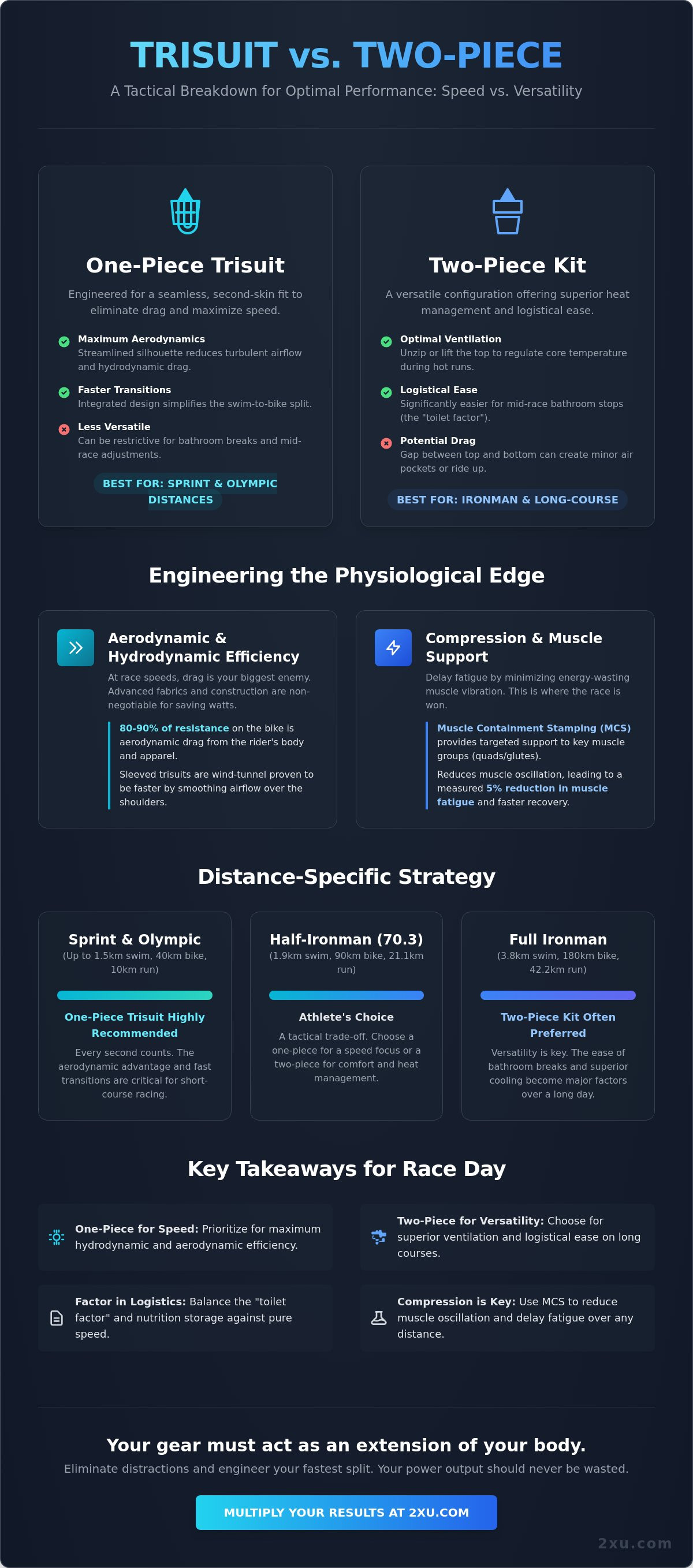
Engineered for a "second-skin" fit, the one-piece trisuit is the definitive choice for athletes prioritising speed. By eliminating the gap between top and bottom, this design removes the risk of the top riding up. This protects the lower back from friction and sun exposure. It creates a professional, streamlined silhouette that reduces turbulent airflow. Data suggests that 80% of resistance on the bike leg is caused by the rider's body and apparel; a singular, tensioned garment offers a measurable edge in reducing that drag.
The Two-Piece Configuration
The two-piece setup consists of separate tri shorts and a tri top. This configuration provides essential flexibility for athletes with asymmetrical sizing needs. It's often the superior choice for long-distance events where mid-race adjustments or bathroom stops are a physiological reality. Ventilation is more easily managed. You can unfasten or lift the top to regulate core temperature during the run, ensuring heat management doesn't compromise your pace. This versatility is a primary factor when choosing between trisuit and two-piece options for high-mileage events.
Beyond the silhouette, the internal architecture varies significantly. One-piece suits typically feature thinner, high-density chamois designed to remain unobtrusive during the run while providing critical support on the saddle. Two-piece shorts may offer slightly more versatility in pad thickness. Seam placement is equally vital. Advanced garments use flatlock stitching moved away from high-friction zones to prevent the chafing that leads to performance degradation. These technical details are what separate elite gear from standard apparel.
Respect the grind by selecting gear that eliminates distractions like shifting waistbands or loose fabric. These minor annoyances compound over 180 kilometres. When you're pushing for a personal best, your gear must act as an extension of your body. Your choice isn't just about aesthetics. It's about engineering your environment to ensure your power output is never wasted on adjusting your kit. Every piece of equipment must serve the goal of multiplying your performance.
The Aerodynamic and Physiological Edge
Performance is a game of marginal gains. When you're redlining on the bike, the interaction between your apparel and the air determines your power efficiency. Aerodynamic drag accounts for nearly 90% of the total resistance a cyclist faces at speeds over 30 km/h. A one-piece suit is engineered to minimise air pockets and turbulences by providing a continuous, tensioned surface. This structural integrity is a primary consideration when choosing between trisuit and two-piece options for competitive racing.
Reducing Drag and Fluid Dynamics
Advanced fabric technology uses dimpled textures to break the boundary layer of air, allowing it to flow more smoothly over the body. Flatlock stitching is strategically placed to avoid creating ridges that catch the wind. While sleeveless designs offer freedom, sleeved trisuits have been shown in wind-tunnel testing to reduce drag significantly by covering the porous skin of the shoulders with aerodynamic fibres. Hydrodynamic efficiency in non-wetsuit legal swims is defined by a garment's ability to repel water and maintain a compressed, low-drag profile throughout the stroke. Referencing a Triathlon gear guide can provide additional context on how equipment affects your overall race-day logistics.
Compression and Muscle Oscillation
Most athletes overlook the physiological impact of fabric tension. 2XU uses proprietary PWX fabric to provide graduated compression, which actively supports blood flow and enhances oxygen delivery to working muscles. This isn't just about comfort; it's about power output. Muscle Containment Stamping (MCS) takes this further by providing targeted support to the quads and glutes, mapping the muscle structure to reduce oscillation. Reducing muscle vibration saves precious energy that would otherwise be wasted during the high-impact grind of the run. Scientific testing has linked this level of support to a 5% reduction in muscle fatigue and faster post-race recovery times. This technical support is a decisive factor for athletes choosing between trisuit and two-piece kits for long-course endurance. When selecting high-performance compression, ensure the fabric provides the necessary tension to stabilise your core and limbs.
Thermoregulation is the final pillar of the physiological edge. Technical fibres are engineered to wick moisture rapidly and reflect UV rays, keeping your core temperature stable. In a two-piece, the overlap can sometimes create heat traps. In contrast, the one-piece offers a unified cooling system. Every watt saved through better aerodynamics and every joule of energy preserved by reduced muscle oscillation brings you closer to your breakthrough. Don't settle for mediocrity. Choose gear that multiplies your potential.
Distance-Specific Strategy: Sprint to IRONMAN
Your race duration dictates your physiological demands. A 60-minute sprint requires a different tactical approach than an 11-hour IRONMAN. When choosing between trisuit and two-piece gear, you must consider how the time spent in the "pain cave" changes your requirements for comfort and accessibility. Short-course racing is a sprint for every millisecond; long-course racing is an exercise in managing the grind while maintaining technical integrity. Your gear must be a silent partner in your discipline.
Short Course Intensity
In Sprint and Olympic distances, the one-piece is the undisputed king. Transitions (T1 and T2) are where races are won or lost. A singular garment eliminates the possibility of the top catching on your bike or bunching under a triathlon wetsuit during the swim. For draft-legal events, a tight, aerodynamic fit is critical to maintaining your position in the pack. Sleeveless options are often preferred here to ensure maximum shoulder mobility, allowing for a more efficient stroke without fabric resistance. Every second shaved in transition is free speed you've earned through preparation.
Long Course Endurance
As the mileage increases to 70.3 and full IRONMAN distances, the trade-off between speed and long-term comfort shifts. The necessity of nutrition storage becomes paramount. You need pockets that are engineered to hold gels and salt tabs securely without flapping or creating drag. While a one-piece provides a sleek profile, a two-piece configuration offers easier access for mid-race logistics. However, comfort is performance. Seam placement becomes the difference between a personal best and a DNF. A suit that chafes at kilometre 10 of the bike will be unbearable by kilometre 30 of the run. Moisture management is the primary variable during the long-course grind. Technical fabrics must wick sweat and reflect heat for over five hours to prevent core temperature spikes that lead to physiological shutdown.
Data from 2026 indicates that over 60% of triathletes prefer specialised gear for its performance efficiency, yet many struggle with the logistical reality of long-course racing. In events lasting over four hours, the "toilet factor" is a realistic consideration. A two-piece can save minutes in the porta-loo, which can be the difference between a podium finish and falling back. Choosing between trisuit and two-piece setups requires you to be honest about your physiological needs. Choose the architecture that aligns with your specific distance and your ability to endure the grind. Human performance is multiplied when the gear supports the athlete's discipline without compromise.
Overcoming the Grind: Practical Race-Day Logistics
Logistics don't just happen; they're engineered. When you're deep in the grind, your ability to manage physiological needs and equipment determines your finishing time. Choosing between trisuit and two-piece gear is a decision that dictates your efficiency during the most vulnerable moments of the race. Every transition and every nutrition stop is an opportunity to gain or lose time. You must be prepared to handle the mechanical realities of the course.
The "toilet factor" is a tactical reality in long-course events. In a 70.3 or full IRONMAN, a bathroom stop is often unavoidable. A one-piece suit requires unzipping and peeling the garment down to the waist, which is a slow process when skin is wet and salt-crusted. In contrast, a two-piece setup allows for rapid, independent removal of the shorts. If you're chasing a podium, calculate the 60 to 90 seconds lost in a one-piece versus the marginal aerodynamic gain. Explore our ultimate triathlon suit guide for more gear insights.
Sun protection is another critical logistical variable, especially in harsh Australian conditions. Sleeved technical fibres provide a mechanical barrier against UV rays while actively promoting evaporative cooling. This is why elite athletes often choose sleeved one-piece suits even in extreme heat. The fabric acts as a second skin, reflecting radiation and keeping core temperatures stable for over 180 kilometres of cycling.
Transition Speed and Efficiency
T1 is a test of discipline. If you're wearing a two-piece, ensure the top is tucked firmly into the waistband of the shorts before the swim. This prevents the fabric from bunching under your wetsuit. When peeling the wetsuit, use a smooth, downward motion to avoid pulling the tri top up with it. For one-piece users, ensure the zipper lanyard is easily reachable. Never debut new kit on race day. You must test every element in training "brick" sessions to identify potential friction points before they become race-ending blisters.
Nutrition and Storage Solutions
Aero is everything, but fuel is the engine. Rear pockets are the industry standard, but access can be restricted by limited shoulder flexibility. Side-thigh pockets are now the preferred choice for gel storage because they're easier to reach without breaking your aero tuck. 2XU pockets are engineered to stay flush against the body when empty. This maintains a low drag coefficient. Strategic placement of gels prevents bouncing during the run leg, which can cause gastric distress. Every gram of fuel must be secured. Shop our high-performance triathlon range to find the storage configuration that matches your race-day strategy.
Engineering Your Fastest Split with 2XU Technology
Tactical decisions are only as effective as the technology supporting them. Once you've finished choosing between trisuit and two-piece configurations based on your race distance, the focus shifts to the mechanical properties of the fabric. At 2XU, we don't build apparel for casual fitness. We engineer equipment for athletes who respect the grind and refuse to settle for mediocrity. Our garments are scientifically validated to ensure your power output is preserved, not wasted.
The heat of the course is a physiological barrier that can derail months of discipline. Our X-VENT fabric uses high-filament cooling technology to manage this heat through rapid moisture displacement. By pulling sweat away from the skin's surface, it facilitates more efficient evaporative cooling. This is paired with SBR Power technology, which provides essential support to the lower body. It's engineered to be lightweight and flexible, ensuring that while your muscles are contained, your range of motion remains uninhibited during the transition from the bike to the run.
Saddle comfort is a non-negotiable requirement for long-course performance. Our pro-level chamois engineering provides critical protection on the saddle without the restrictive "nappy" feel during the run leg. Using high-density, low-profile foam, we've created a pad that disappears when you're off the bike. This allows you to maintain a natural gait and high cadence without the distraction of bulk or chafing. Human performance is multiplied when the gear removes the physical limitations of the environment.
Advanced Fabric Engineering
Our proprietary blends are meticulously transformed into garments that act as a barrier against the elements. These technical fibres reflect UV rays to keep skin temperature lower during exposed bike legs. Unlike standard materials, our fabrics are tested for durability against chlorine and salt water, ensuring the compression profile remains consistent from the first swim stroke to the final kilometre. We use the Salzmann pressure measurement device to confirm that our graduated compression provides the exact profile needed to enhance blood flow and reduce muscle oscillation.
Choosing Your Elite Performance Kit
Your gear is an investment in your performance, not just a race-day expense. When selecting your kit, use this final checklist to align with our specific ranges:
- Core: Ideal for entry-level competitors seeking reliable moisture management and durability.
- Aero: Engineered with dimpled fabric technology for maximum speed on the bike leg.
- Light Speed: Our most advanced range, featuring Muscle Containment Stamping (MCS) for elite-level muscle support.
Success is earned through hard work and the refusal to compromise on your equipment. Shop the 2XU Triathlon Collection and multiply your performance today.
Master Your Race-Day Strategy
Success on the course is the result of meticulous preparation and the refusal to accept compromise. Choosing between trisuit and two-piece configurations isn't just about comfort; it's a tactical decision that impacts your aerodynamic drag and physiological efficiency. You now understand the trade-offs between the streamlined profile of a one-piece and the logistical versatility of a two-piece setup. Both architectures serve a specific purpose in the pursuit of your personal best.
2XU gear is the choice of IRONMAN World Champions because our engineering is grounded in data. We utilise proprietary PWX compression technology that is scientifically proven to reduce muscle fatigue by 5% during high-intensity efforts. By dampening muscle oscillation and supporting blood flow, our equipment ensures you arrive at the run leg with more power in reserve. Respect the grind by investing in technology that works as hard as you do.
Engineered for the elite. Shop the 2XU Triathlon Range.
The course doesn't care about your excuses. It only respects the work you've done and the gear you've chosen to carry you to the finish. Go out and earn your place.
Frequently Asked Questions
Is a one-piece or two-piece trisuit faster for a beginner?
A one-piece trisuit is objectively faster due to its streamlined profile, but a two-piece is often more practical for those new to the sport. Choosing between trisuit and two-piece options for a beginner involves weighing the aerodynamic advantage against the ease of mid-race adjustments. Focus on the gear that allows you to execute your race plan without unnecessary technical distractions.
Can I wear a two-piece triathlon suit under a wetsuit?
You can wear a two-piece suit under a wetsuit, but you must ensure the top is tucked into the shorts to prevent bunching. Bunching creates drag and can lead to chafing during the swim leg. For non-wetsuit legal swims, a one-piece is superior. It prevents water from entering the waistband, which increases hydrodynamic drag and slows your split.
How should a triathlon suit fit to ensure maximum performance?
Your triathlon suit must provide a second-skin fit with zero loose fabric to ensure maximum performance. Any excess material creates aerodynamic drag on the bike and hydrodynamic drag in the water. It should be tight enough to provide compression but allow for full lung expansion. If you see fabric flapping, you're losing watts that you've worked hard to earn.
Do one-piece trisuits have pockets for nutrition?
Yes, modern one-piece trisuits are engineered with internal or external pockets specifically for nutrition management. These pockets are designed to sit flush against the body when empty to maintain a low drag coefficient. Strategic placement on the rear or side thighs allows for rapid access to gels and salt tabs without breaking your aero tuck on the bike leg.
What happens if I need to use the bathroom in a one-piece trisuit?
Managing a bathroom stop in a one-piece requires unzipping the front and peeling the garment down to the waist. This process is slower than a two-piece setup, which is why many long-course athletes factor this into their gear selection. Practice this movement in training to ensure you can execute it quickly under race-day pressure without losing your focus.
Is a sleeved or sleeveless trisuit better for sun protection?
A sleeved trisuit is the superior choice for sun protection, especially in harsh environments where UV exposure is high. Sleeved designs use technical fibres to provide a mechanical barrier that reflects radiation and promotes evaporative cooling. This reduces the risk of skin temperature spikes and sun damage during the 180 kilometre bike leg or the marathon run.
Can I use a two-piece suit for an IRONMAN event?
You can absolutely use a two-piece suit for an IRONMAN event; many age-group athletes choose this for its logistical advantages. The separate top and bottom allow for easier ventilation and simpler bathroom breaks over a race lasting 10 hours or more. Choosing between trisuit and two-piece for long-course endurance is a balance of marginal aerodynamic gains versus the necessity of physiological comfort.
How do 2XU compression fabrics help during a triathlon?
2XU compression fabrics use proprietary PWX technology to enhance blood flow and reduce muscle oscillation. This is scientifically proven to reduce muscle fatigue by 5% and accelerate recovery times. By stabilising the quads and glutes, our garments preserve energy during the high-impact grind of the run. This helps you maintain your power output when your rivals begin to fade.