
Triathlon Clothing Rules: The Performance-Driven Guide to Race Day Compliance
A single technical oversight at the transition rack can render 500 hours of disciplined training worthless. You didn't wake up at 4:00 am for 24 consecutive weeks to be sidelined by a technicality. You know that every watt matters and every second in transition is earned through sweat and repetition; however, the complexity of triathlon clothing rules often creates a barrier between elite preparation and race-day execution. Whether it is the 5-millimetre thickness limit on wetsuits or the specific ban on calf sleeves during non-wetsuit swims, technical compliance is the foundation of your performance.
We understand that you demand equipment that works as hard as you do. This guide will master the technical regulations of race-day apparel to ensure your gear is legal while multiplying your performance potential. We will provide a definitive breakdown of 2024 World Triathlon and IRONMAN standards, clarify wetsuit temperature cut-offs, and confirm the legality of advanced compression wear to ensure you approach the start line with absolute certainty. Prepare to optimise your transition strategy and focus entirely on the grind ahead.
Key Takeaways
- Navigate the technical framework established by World Triathlon and IRONMAN to ensure your gear maintains a level playing field.
- Master the physics of buoyancy through strict adherence to the 5mm neoprene rule and temperature-specific wetsuit regulations.
- Optimise your race-day efficiency by mastering triathlon clothing rules concerning torso coverage, zipper lengths, and mandatory closure protocols.
- Sharpen your transition discipline with a clear understanding of helmet safety mandates and the non-negotiable "no nudity" regulations.
- Leverage the 2XU compliance checklist to confirm your engineered apparel is race-legal and ready to multiply your performance potential.
The Triathlon Rulebook: A Framework for Fair Performance
Triathlon isn't just a test of raw grit; it's a disciplined execution of technical standards. The governing bodies, World Triathlon and IRONMAN, establish the Triathlon Equipment Overview and clothing regulations to ensure every athlete competes on a level playing field. These triathlon clothing rules are designed to prevent unfair aerodynamic or hydrodynamic advantages while maintaining strict safety protocols across the swim, bike, and run disciplines. Every 2XU garment is engineered with this regulatory framework in mind. We use proprietary fabric technologies like PWX FLEX and X-VENT to ensure your gear meets the rigorous standards of the transition area without sacrificing an ounce of power output. Human performance, multiplied, starts with gear that respects the law of the course.
Governing Bodies: Who Sets the Standard?
World Triathlon sets the global benchmark for Olympic-distance events, while the IRONMAN Group dictates the rules for long-course racing. Within our borders, Triathlon Australia aligns these international standards with local requirements to ensure consistency. Local race directors may apply specific variations based on environmental factors, such as a 22-degree water temperature cut-off for wetsuit use or specific torso coverage requirements in extreme heat. Don't leave your compliance to chance. Every event issues a specific Athlete Information Guide approximately 14 days before the starting gun. Read it. This document is the definitive blueprint for your race day kit and ensures your preparation is scientifically sound.
The Consequences of Non-Compliance
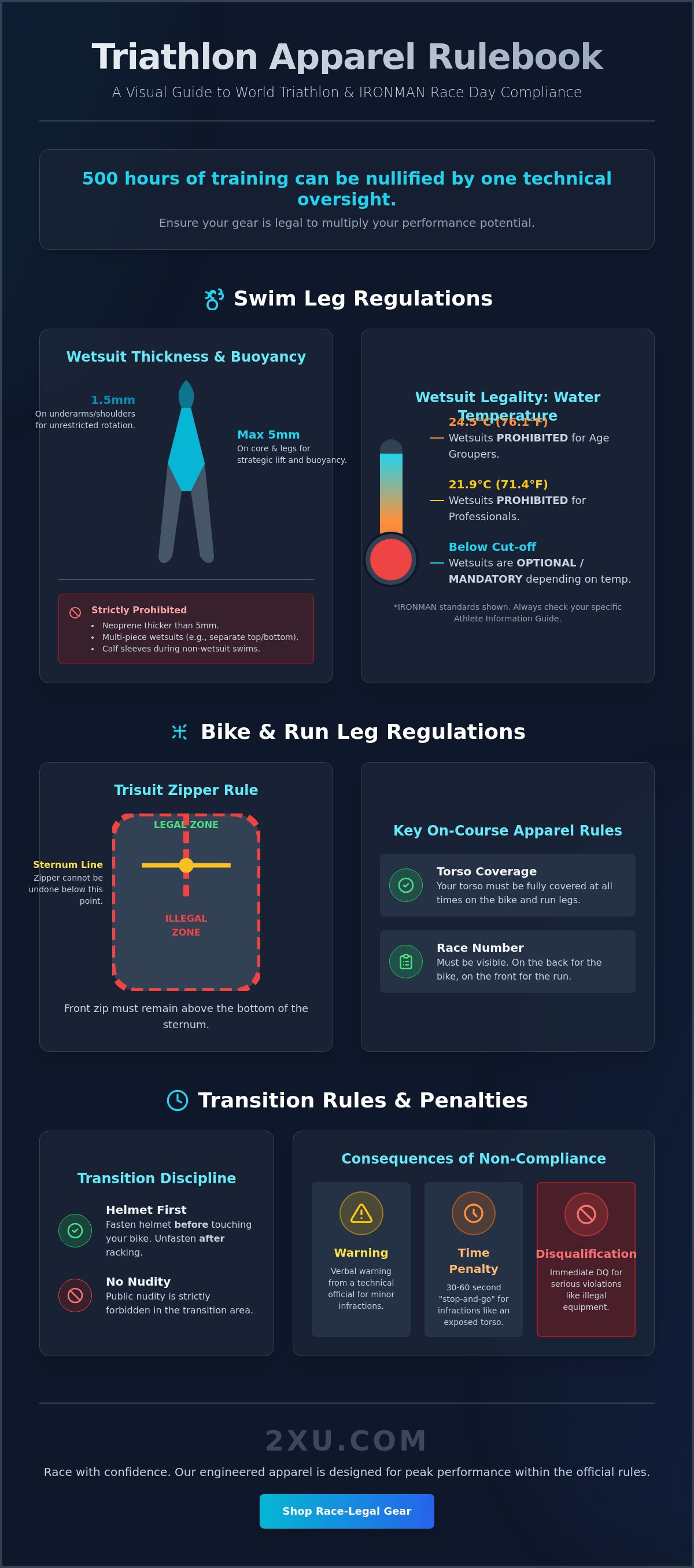
Technical officials don't just watch the course; they monitor the transition racks with meticulous precision during check-in. Non-compliance with triathlon clothing rules leads to immediate repercussions that can derail months of training. Penalties range from verbal warnings to "stop-and-go" time penalties, often costing an athlete 30 to 60 seconds for minor kit infractions like exposed torsos on the bike leg. Serious violations, such as front zips being pulled below the sternum or illegal neoprene thickness, result in a Disqualification (DQ). Discipline in your gear preparation is just as vital as the discipline you bring to the grind of training. Prepare. Perform. Recover. Your kit must be as ready as your muscles.
Swim Leg Regulations: Wetsuits and Neoprene Science
Victory in the water is a matter of hydrodynamics and discipline. To ensure athletic integrity, global governing bodies enforce strict triathlon clothing rules that dictate exactly what you can wear when the gun goes off. These regulations aren't suggestions; they're the boundary between a podium finish and a disqualification. Every millimetre of your gear must be engineered to comply with the USA Triathlon Rulebook and World Triathlon standards. At 2XU, we don't just follow these rules. We use them as a framework to build the fastest legal equipment on the planet.
Wetsuit Thickness and Buoyancy Limits
The 5mm maximum thickness rule is the standard for a reason. Any neoprene thicker than 5mm provides an excessive mechanical advantage by artificially elevating the hips, which compromises the spirit of the sport. We respect the grind of the swim by staying within this limit while maximising performance through intelligent design. Our neoprene wetsuit technology uses varied thickness to optimise your body position. We place 5mm panels in the core and upper legs for lift, but we taper down to 1.5mm in the underarms to ensure unrestricted rotation. This isn't about adding bulk; it's about strategic buoyancy.
Understand that "decapitated" wetsuits or multi-piece neoprene solutions are frequently banned in sanctioned races. You must wear a single-piece suit that covers the torso. This ensures no athlete gains an unfair advantage through overlapping layers that could increase buoyancy beyond the 5mm limit. If your gear isn't a single, cohesive unit, you're risking your race before you even hit the first buoy.
Temperature Cut-offs and Athlete Safety
Thermal protection is vital, but safety and fairness dictate the cut-off points. For Age Groupers in IRONMAN events, the standard threshold is 24.5°C (76.1°F). If the water exceeds this temperature, the race becomes "wetsuit prohibited" to prevent athlete hyperthermia. Professional athletes operate under even more demanding constraints, with thresholds often dropping to 21.9°C (71.4°F). You must be prepared for both scenarios. When the water is too warm for neoprene, you need a legal triathlon suit or a textile swim-skin.
Swim-skins are designed for speed in non-wetsuit races. These garments must be 100% textile material, meaning no neoprene or rubberised coatings are allowed. They rely on proprietary hydrophobic treatments to reduce surface drag. We test our fabrics to ensure they provide zero added buoyancy while still compressing the muscles to reduce oscillation.
- 24.5°C: The standard Age Group cut-off for wetsuit legality.
- 5mm: The maximum allowable neoprene thickness for any race panel.
- Textile Only: The requirement for swim-skins in non-wetsuit events.
The Trisuit: Zippers, Coverage, and Compression Legality
Mastering the grind requires more than just physical grit; it demands technical precision. If you don't respect the triathlon clothing rules, your performance data won't matter because you'll be facing a disqualification. Most major federations mandate that the torso remains covered throughout the bike and run legs. Bare chests are a violation of the code. This rule ensures a professional standard and provides a consistent baseline for aerodynamic competition. 2XU engineers every garment to meet these rigorous standards, utilising advanced technical fabrics that provide a second-skin fit without compromising on official regulations.
Zipper Placement and Length
World Triathlon and the USA Triathlon Multisport Competition Rules are clear on hardware. Front zippers must not exceed 40cm in length. During the race, these zippers must remain done up at all times. An unzipped suit is a common cause for a time penalty. 2XU triathlon suits solve this through meticulous engineering. We utilise semi-auto lock zip technology and internal zipper housings to prevent skin irritation and accidental sliding during high-intensity efforts. Many elite athletes prefer rear-zip suits. This design eliminates the temptation to unzip and provides a smoother aerodynamic surface for the wind to pass over.
Sleeved vs. Sleeveless Trisuits
Sleeved suits have become the weapon of choice for long-course athletes seeking aerodynamic gains and UV protection. However, you must follow the elbow rule. Sleeves must not extend beyond the elbow joint. If they do, you are non-compliant. In specific non-wetsuit swim formats, sleeved suits may be prohibited to ensure no athlete gains an unfair hydrodynamic advantage. You must check your specific race briefing 24 hours before the start. 2XU sleeved suits use high-velocity technical yarns that optimise airflow on the bike while remaining flexible enough for a powerful swim stroke.
Compression Wear in the Water
Compression is vital for muscle containment, but the water has its own laws. Calf sleeves are strictly prohibited in non-wetsuit swims. Officials categorise them as buoyancy aids, and wearing them will result in an immediate penalty. Conversely, wearing compression shirts under a wetsuit is a legal strategy for temperature regulation and reducing muscle oscillation. Ensure your recovery gear stays in your transition bag. The goal is to arrive at the finish line having maximised every legal advantage. Human performance, multiplied, is only possible when you play by the rules. Push the limits of your body, not the limits of the rulebook.
Transition and Beyond: Helmets, Numbers, and Nudity
Transition is the fourth discipline of triathlon. It's where the prepared athlete separates themselves from the pack through discipline and technical precision. Adhering to triathlon clothing rules during this phase is as critical as your power output on the bike. Failure to follow protocol results in time penalties that negate your hard-earned gains on the course. Respect the grind by respecting the rules.
The mandate against nudity is absolute. World Triathlon Rule 10.1 states that public nudity or indecent exposure is a violation that carries a minimum two-minute penalty or potential disqualification. You must use designated changing tents or ensure you're covered by a towel if changing gear. For those wearing two-piece kits, your torso must remain covered at all times; a gap between your top and shorts is permitted, but full exposure is not.
Race number placement is a frequent source of official intervention. You must display your number on your back during the cycle leg and rotate it to the front for the run. Using a high-quality race belt is the only professional solution. It eliminates the need for safety pins that damage advanced fabrics and allows for a seamless transition. Secure the belt tightly to prevent the number from flapping, which creates unnecessary drag and risks obscuring your identification from race officials.
The Transition Flow: Speed Within the Rules
Efficiency in T2 starts with how you organise your gear. Position your running shorts and shoes to allow for immediate entry. World Triathlon Rule 7.1.f prohibits 'marking' your spot with bright towels or large markers. Any athlete found doing so will be penalised. Every piece of equipment, from your goggles to your helmet, must be placed inside your designated box or within your tight transition footprint. Discarded gear left in the flow of traffic is a safety hazard and a rule violation.
Helmets and Technical Safety
Safety equipment is non-negotiable and governed by strict triathlon clothing rules. Your helmet must meet ANSI Z90.4, SNELL B90, or CE EN1078 standards to be legal for competition. Officials will check for these certification stickers during bike check-in. The most common error for eager athletes is the 'buckle first' rule. You must fasten your chin strap before you touch your bike at the rack. Conversely, you cannot unbuckle your helmet until the bike is fully racked after the cycle leg. Breaking this sequence results in an immediate stop-and-go penalty.
Never attempt to modify your safety gear. Drilling ventilation holes into a helmet or trimming straps to save weight compromises structural integrity. Such modifications lead to an immediate disqualification. True performance is found in engineering, not shortcuts. Trust the technology that has been rigorously tested to protect your head at high velocities.
Engineering Your Race Day: The 2XU Compliance Checklist
Preparation is the foundation of every breakthrough. You've logged the kilometres, refined your nutrition, and mastered your transitions. Don't let a technicality at the start line dismantle months of discipline. Mastering triathlon clothing rules is about more than avoiding a penalty; it's about respecting the grind and ensuring your focus remains entirely on the course ahead. Every detail matters when you're chasing a personal best.
Pre-Race Gear Inspection
Meticulous athletes leave nothing to chance. Start by inspecting your trisuit for fabric integrity. Over time, exposure to salt water and chlorine can degrade technical fibres, leading to transparency that violates decency regulations. If your kit shows signs of thinning, it's time to replace it. For elite and professional athletes, branding compliance is a frequent pitfall. World Triathlon rules specify that primary sponsor logos must not exceed 30cm² in size. Measure your logos before you arrive at the venue to avoid last-minute tape fixes that compromise aerodynamics.
Test your race belt under load. A belt that bounces or shifts during a 4:00 min/km run pace is a distraction you can't afford. Ensure your number attachment points are secure and positioned to keep the bib visible as required by Ironman and local federation officials. This isn't just about rules; it's about professional execution. Prepare your kit with the same intensity you bring to your track sessions.
Multiply Your Performance Legally
2XU technology is engineered to exist at the absolute limit of legal performance. Our design team monitors updates from World Triathlon and Ironman to ensure every garment complies with current standards. We don't guess; we validate. Our proprietary Muscle Containment Stamping (MCS) provides targeted support to key muscle groups, reducing oscillation and fatigue without violating thickness or buoyancy regulations. This is legal mechanical support designed for the serious competitor.
We verify our compression profiles using the Salzmann pressure measurement device. This ensures that every piece of PWX fabric delivers the exact graduated pressure required to enhance blood flow and accelerate recovery. When you step onto the pontoon, you should do so with the confidence that your gear is lab-tested and federation-approved. Human performance, multiplied by science, gives you the edge you've earned through hard work.
Respect the sport by being the most prepared athlete on the field. Optimise your kit for the upcoming season and ensure your gear is as ready for the podium as you are. Prepare, perform, and recover with the gear built for the elite. Get race ready now.
Master the Standard and Multiply Your Output
Compliance isn't just about avoiding a penalty. It's about eliminating the variables that stand between you and your personal best. Mastering the triathlon clothing rules ensures your focus remains on the grind, not the technical official's clipboard. Every 2XU garment undergoes rigorous assessment using the Salzmann pressure measurement device to validate our proprietary PWX compression technology. This scientific rigour ensures you meet the strict 2024 World Triathlon and IRONMAN standards without sacrificing a single watt of power output.
You've put in the hours and embraced the discipline. Don't let a zipper length or fabric buoyancy violation derail months of preparation. Our designs are engineered to be a seamless extension of your ambition, providing the legal edge required at the highest levels of elite competition. We've standardised every stitch so you can focus on the threshold. Respect the rules, trust the data, and prepare to outperform your previous self. There's no room for mediocrity when the clock is running.
Shop the 2XU Triathlon Collection: Engineered for Compliance and Speed
The finish line doesn't care about your excuses, only your results. Earn your place.
Frequently Asked Questions
Are front-zip trisuits legal in IRONMAN races?
Yes, front-zip trisuits are legal in IRONMAN races, provided you follow specific closure protocols within the triathlon clothing rules. Under Section 5.01(i) of the 2024 IRONMAN Competition Rules, your zip cannot be lowered below the end of the sternum. If you breach this, you face a time penalty or disqualification. Focus on your power output, not your wardrobe malfunctions. Ensure your gear is engineered to stay secure while you push for your personal best.
Can I wear compression calf sleeves during the swim?
You can only wear compression calf sleeves during the swim if the water temperature requires a wetsuit. When a race is non-wetsuit legal, World Triathlon Rule 4.11 prohibits any clothing covering the arms below the elbows or legs below the knees. Don't let a gear violation derail your preparation. Our compression is designed to maximise recovery post-race, so keep the sleeves in transition until the bike leg begins.
What is the maximum thickness allowed for a triathlon wetsuit?
The maximum thickness allowed for any part of a triathlon wetsuit is 5 millimetres. This limit is strictly enforced by IRONMAN Rule 4.02 and World Triathlon Rule 4.11 to ensure fair buoyancy levels across the field. We meticulously engineer our suits to hit this 5 millimetre mark where it matters most for lift. Every millimetre is a calculated advantage in your pursuit to multiply your performance and dominate the water.
Do I have to wear a shirt during the run leg of a triathlon?
Yes, you must keep your torso covered during the run leg to comply with triathlon clothing rules. IRONMAN Rule 6.01(e) mandates that chests remain covered for the entire 42.2 kilometre duration. Failure to comply leads to immediate disqualification. Respect the grind and the rules of the road. Choose a high-performance trisuit that offers maximum breathability through advanced ventilation technology so you stay cool without breaking protocol.
Can I use headphones or a phone while racing if they are under my clothing?
No, you cannot use headphones or phones during the race, even if they're hidden under your kit. IRONMAN Rule 3.01(i) explicitly bans all personal electronic devices to ensure athlete safety and focus. This is about you versus the course. Elite performance requires 100 per cent concentration on your muscle oscillation and pacing. Leave the distractions behind and listen to your body as you push through the pain barrier.
Is it legal to change my clothes in the transition area?
Changing clothes in the open transition area is illegal and will result in a disqualification for public nudity. IRONMAN Rule 3.01(a) requires athletes to use the provided changing tents for any full kit swaps. Efficiency in transition is a discipline you must master. Minimise your time in the tent by using versatile, advanced garments designed to perform across all three disciplines without needing a change.
What happens if my race number falls off during the bike leg?
If your race number falls off, you must report it to a race official immediately to avoid a penalty under IRONMAN Rule 3.01(k). While your bike frame stickers and helmet numbers provide secondary identification, the bib is a primary requirement for the run. Secure your number with a high-quality race belt. Don't let a simple mechanical failure compromise months of disciplined training and preparation for the finish line.
Are there specific rules for the length of trisuit sleeves?
Sleeve length is strictly regulated; they must not extend past the elbow. World Triathlon Rule 4.11 states that for any event, sleeves that reach the forearm are prohibited during the swim and land legs. We engineer our trisuits to sit precisely above the joint to ensure full range of motion. This technical precision ensures you remain compliant while our proprietary fabrics work to reduce drag and optimise your speed.