
What to Wear for a 5k Run: Engineered Gear for Peak Performance
Your 5k PB isn't just a reflection of your aerobic capacity; it's a direct result of how effectively you manage mechanical waste. When you step onto the start line, deciding what to wear for a 5k run becomes a technical calculation rather than a stylistic choice. You've likely felt that sudden surge in core temperature after the first 1,600 metres or the debilitating muscle oscillation that sets in during the final two kilometres. We agree that every watt of energy should propel you forward, not be lost to friction or inefficient heat dissipation.
This guide will show you how to master the science of race-day apparel to optimise thermoregulation, reduce muscle fatigue, and multiply your 5k performance. We'll provide a definitive kit list for every climate and explain how graduated compression technology stabilises muscles to prevent the late-race fade. You'll gain the technical knowledge required to stand on the start line with absolute confidence in your equipment, knowing your gear is engineered to handle the grind as well as you do.
Key Takeaways
- Master the "10-degree rule" to ensure your kit is engineered for the physiological heat of the second mile rather than the chill of the start line.
- Minimise muscle oscillation and fatigue by utilising compression gear designed to stabilise high-impact zones during maximal race-day efforts.
- Learn exactly what to wear for a 5k run to facilitate rapid sweat evaporation and maintain core thermoregulation at high thresholds.
- Adapt your kit to the elements by prioritising moisture management and heat dissipation to ensure your performance never falters in rain or heat.
- Multiply your output by understanding how Muscle Containment Stamping (MCS) targets specific muscle groups to drive peak power and endurance.
The 5k Blueprint: Elite Rules for Race Day Apparel
The 5k is a tactical assault on your anaerobic threshold. It's 3.1 miles of sustained intensity where metabolic heat production can increase by 10 to 15 times your resting rate. Deciding what to wear for a 5k run requires a scientific approach to thermoregulation. If your gear fails to manage moisture or restricts your range of motion, you're not just uncomfortable; you're slower. Peak performance demands zero distractions. This means prioritising engineered gear that functions as a second skin, allowing you to focus entirely on your split times and the grind of the final kilometre.
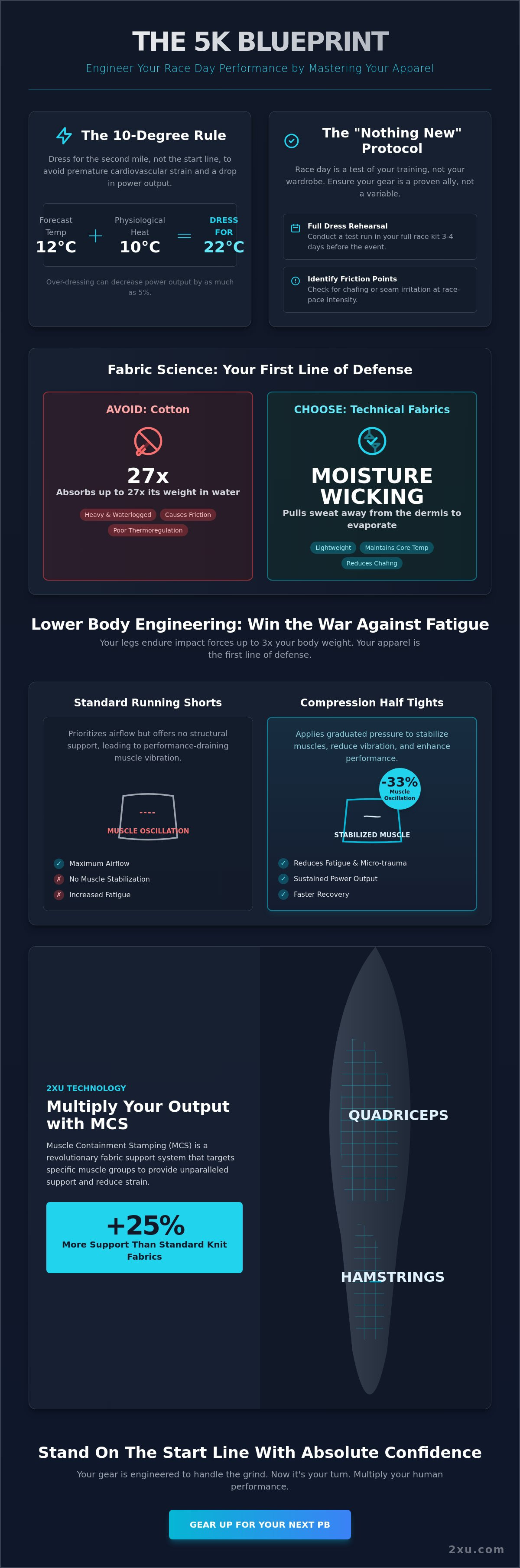
Cotton is the enemy of the serious runner. It absorbs up to 27 times its weight in water, leading to heavy, moisture-logged garments that cause friction and rapid cooling once you cross the finish line. Elite athletes rely on performance sportswear fabrics designed to pull sweat away from the dermis. These advanced moisture-wicking polymers ensure your core temperature remains stable even as your effort levels redline. Human performance, multiplied, starts with the right technical foundation.
The 10-Degree Celsius Rule
Dress for the second mile, not the start line. A common amateur error is over-dressing based on the ambient temperature at the race village. To calculate your "running temperature," add 10 degrees Celsius to the current forecast. If the mercury sits at 12°C, you must dress as if it's 22°C. Over-dressing triggers premature cardiovascular strain as your body diverts oxygen-rich blood away from the working muscles to the skin's surface for cooling. This thermoregulatory struggle can decrease power output by as much as 5 per cent, sabotaging your PB before you hit the midway point.
The "Nothing New" Protocol
Race day is a test of your training, not your wardrobe. The "Nothing New" mandate is non-negotiable for anyone serious about their results. Friction points that are undetectable during a casual jog become agonising at race-pace intensity. Salt crystals from dried sweat act like sandpaper against unvetted seams. Conduct a full dress rehearsal run 3 to 4 days before the event. This ensures your running shorts are tested for internal liner comfort and that your singlets don't cause underarm chafing during high-frequency arm drives. When you step to the line, your gear should be a proven ally, not a variable. Respect the process. Earn the result.
Lower Body Engineering: Optimising Stride and Support
During a 5k, your legs endure impact forces up to 3 times your body weight with every foot strike. This kinetic energy causes muscle oscillation, the lateral movement of muscle fibres that leads to micro-trauma and premature fatigue. When deciding what to wear for a 5k run, your choice of lower body gear must be a deliberate engineering decision to stabilise these tissues. Each stride creates a shockwave; your apparel is the first line of defence in maintaining structural integrity and power output.
Compression Half Tights vs. Standard Running Shorts
Compression garments provide a mechanical advantage by applying graduated pressure to the quadriceps and hamstrings. This pressure profile increases venous return and reduces the vibration that drains your energy. While split shorts offer a "free" feel and maximum ventilation, they lack the structural support needed to protect against soft tissue strain. For athletes prone to adductor or hamstring issues, compression half tights provide a "secure" fit that physically limits muscle displacement. 2XU's proprietary Muscle Containment Stamping (MCS) technology targets specific muscle groups to provide 25% more support than standard knit fabrics. If you are dressing for running in all weather, consider how your gear manages both external climate and internal mechanical stress.
- Split Shorts: Best for high-heat environments where maximum airflow is the priority for thermoregulation.
- Half Tights: Superior for muscle stabilisation and reducing the risk of repetitive strain injuries.
- Mechanical Benefit: Compression reduces muscle oscillation by up to 33%, allowing for faster recovery and sustained power.
Technical Socks: The Anti-Blister Barrier
Cotton is the enemy of the serious runner. It retains up to 27% of its weight in moisture, leading to friction and debilitating blisters. Technical socks utilise engineered yarns to ensure an anatomical fit that eliminates internal shoe slippage. High-impact zones require targeted cushioning to absorb shock without adding bulk that compromises your proprioception. The wicking process involves the capillary action of hydrophobic technical fibres that actively pull moisture away from the dermis to the outer surface for rapid evaporation. Every millimetre of your gear should serve a purpose. Secure your performance by choosing engineered compression shorts that move with your anatomy, not against it. Human Performance. Multiplied.
Core Thermoregulation: Managing Heat and Moisture
Your torso serves as your body's primary radiator. During a high-intensity 5k, core temperatures can rise rapidly within the first 800 metres; failure to manage this thermal load leads to premature physiological shutdown. When deciding what to wear for a 5k run, your choice of top must facilitate immediate sweat evaporation to maintain a stable internal environment. The kit you select is a tool for climate control. Singlets provide the ultimate solution for shoulder mobility and airflow, while technical tees offer essential protection against UV radiation during midday sessions. Both must be engineered to work with your body, not against it.
Friction is the enemy of the high-cadence athlete. At a standard running cadence of 180 steps per minute, your arms will swing over 3,000 times during a 25-minute race. Standard raised seams act as sandpaper against the skin under these conditions. We utilise flatlock seams to eliminate abrasion, ensuring your focus remains on the finish line rather than skin irritation. For those getting started with running, investing in seamless or flat-seamed apparel is a non-negotiable requirement for injury prevention and comfort. Performance is often found in these small, meticulous details.
As you enter the final kilometre, fatigue compromises your biomechanics. Your shoulders slump and your lung capacity diminishes. High-performance compression shirts are designed to improve postural awareness by providing constant sensory feedback to the brain. This "proprioception" encourages you to keep your chest open and your breathing efficient when the grind becomes most intense. It's about multiplying your natural capacity through scientific intervention.
Singlets: Maximising Ventilation
In humid or high-heat environments, maximising airflow is the only way to prevent overheating. Singlets are the preferred choice for elite competition because they expose more skin surface area for evaporative cooling. Beyond the physics, there is a psychological edge to donning a racing kit. It shifts your mindset from training to execution. Ensure your singlet features an engineered armhole depth; it must be deep enough for full range of motion but structured to prevent latissimus dorsi chafing during the arm drive.
Advanced Moisture Management
Effective moisture management relies on capillary action. Technical yarns are engineered to pull sweat away from the skin surface and disperse it across the outer layer of the fabric for rapid drying. We integrate targeted mesh panelling in high-heat zones, specifically the centre back and underarms, to accelerate heat dump. Avoid garments with heavy dyes or thick rubberised prints. These elements clog the fabric's breathability and add unnecessary weight once they become saturated. Every gram of water weight held in your shirt is energy wasted. Respect the science of the fabric to respect the effort of your run.
Environmental Adaptability: Dressing for Rain, Wind, and Heat
The grind doesn't stop for a forecast. Your kit must adapt to the elements or it becomes a liability. When deciding what to wear for a 5k run, view weather as a performance variable to be engineered, not an obstacle to be avoided. Elite performance requires a strategic approach to moisture, wind, and thermal regulation. Mediocrity accepts the conditions; the serious athlete out-engineers them.
Wind management is a game of core temperature and aerodynamics. A lightweight gilet is often superior to a full jacket for the 5k distance. It shields your vital organs from the wind chill while allowing heat to escape through the arms and underarms. This prevents the "boil-in-the-bag" effect common with standard jackets. Technical headwear and UPF 50+ rated fabrics are equally critical. Sun exposure increases your core temperature and induces fatigue faster than almost any other factor. Engineered headwear acts as a cooling system, wicking sweat away from the brow to ensure your vision remains clear during the final 1,000 metres.
Tactical Layers for Cold Starts
Muscles perform at their peak when maintained at a specific thermal baseline. Using arm sleeves provides a modular solution that adapts to your output. They provide essential warmth during the 15-minute wait in the starting corral but can be rolled down to the wrists once your core temperature rises after the first kilometre. Many athletes employ a "throwaway" layer, such as an old cotton jumper, to maintain muscle warmth until seconds before the gun. Don't neglect your extremities. Lightweight gloves prevent the upper body tension that often occurs when hands are cold, which can waste up to 3 percent of your energy through inefficient running form.
Wet Weather Performance
Rain strategy is about moisture management, not staying dry. Attempting to stay dry with waterproof layers during a high-intensity 5k is a mistake; these fabrics lack the breathability required for 90 percent max heart rate efforts. Focus on form-fitting gear made from engineered technical fibres. These materials don't sag or become heavy when saturated. A standard shirt can increase in weight by 40 percent when wet, creating significant drag. Apply anti-chafe balm to every high-friction zone before you dress. In wet conditions, the friction between skin and fabric accelerates, and skin damage can occur in less than 20 minutes of running.
Prepare for any forecast and ensure your body is primed to perform. Human Performance. Multiplied.
Shop Engineered Running GearMultiply Your Output: Why 2XU Compression Wins the 5k
2XU gear isn't just apparel. It's engineered equipment designed for the athlete who refuses to settle for average. When you're deciding what to wear for a 5k run, you aren't just looking for comfort; you're looking for a competitive edge. Our "Human Performance. Multiplied." philosophy means every stitch serves a specific physiological purpose. A 5k demands explosive power and sustained speed. Your gear must provide both. We don't build clothes; we build tools that allow you to demand more from your body.
The Science of MCS Technology
Muscle Containment Stamping (MCS) provides a revolutionary layer of support that standard tights cannot match. By mapping the vasoneurotic structure of the key muscle groups used in running, MCS provides targeted compression to the quadriceps and calves. This system specifically reduces muscle oscillation, which is the wasted vibration that causes micro-tears and energy loss. Research indicates that by stabilising the muscle, you preserve glycogen stores and delay the onset of fatigue during high-intensity efforts. Every garment is meticulously assessed using the Salzmann pressure measurement device to confirm the correct graduated pressure profile, ensuring blood is efficiently directed back to the heart. This isn't guesswork. It's laboratory-validated performance enhancement.
Post-Race Recovery: Respecting the Grind
The work doesn't stop when you cross the finish line. The 30 minutes following your 5k are critical for long-term progress and injury prevention. During this window, your body requires assistance with lymphatic drainage and the repair of muscle tissue. Choosing what to wear for a 5k run should include a plan for what you wear after it. Switching to recovery-specific tights after your cool-down accelerates the removal of metabolic waste and reduces swelling. This disciplined approach to the post-race phase ensures your muscles return to a peak state faster.
- Immediate Compression: Reduces post-exercise oedema and muscle soreness.
- Optimised Circulation: Increases oxygen delivery to tired tissues for faster repair.
- Graduated Fit: Maximum pressure at the ankle tapering upwards to drive blood flow.
Performance is a 24-hour cycle. 2XU ensures you're prepared for the start line and protected after the finish. You earned the finish; now earn the recovery. Don't let your effort go to waste by neglecting the science of repair. Respect the grind. Multiply your output.
Engineer Your Next Personal Best
Success on race day is the result of disciplined preparation and superior engineering. Deciding what to wear for a 5k run requires a focus on core thermoregulation and mechanical support rather than just aesthetic appeal. You need gear that manages moisture under high-intensity loads and stabilises your muscles against the repetitive impact of every high-velocity stride. 2XU apparel is built for this exact purpose; it's designed to withstand the rigours of the grind while ensuring your body operates at its physiological peak.
Our gear isn't just clothing; it's a performance tool. Every garment features scientifically proven graduated compression that has been meticulously tested by elite athletes and global research teams. We use the Salzmann pressure measurement device to ensure our compression profiles are precise, helping you reduce muscle oscillation and accelerate recovery. There's no room for mediocrity when you're chasing a new personal record. You've done the work in training; now ensure your equipment matches your ambition.
Don't leave your performance to chance. Equip yourself with 2XU high-performance running gear to experience the power of human performance multiplied. Step onto the starting line with the confidence that your gear is engineered for maximum durability and elite-level output. The road is waiting for you to prove what's possible.
Frequently Asked Questions
Is it okay to wear a cotton t-shirt for a 5k run?
You should never wear a cotton t-shirt because it absorbs up to 27 times its weight in moisture. Cotton traps sweat against your skin, causing your core temperature to fluctuate and increasing the weight you carry. Instead, choose engineered fabrics that provide 40% better moisture management than standard knits. This ensures you stay dry and light while you push through the grind of race day.
Should I wear compression socks or sleeves for a 5k?
Wear compression socks or sleeves to reduce muscle oscillation by up to 33% during your run. Our proprietary Muscle Containment Stamping (MCS) technology provides targeted support to the calf and Achilles, which helps mitigate the risk of micro-tears. By increasing venous return, these garments ensure your power output remains consistent across the full 5,000 metres. It's a scientifically proven method to protect your limbs from repetitive impact.
What should I wear for a 5k if it is raining?
When deciding what to wear for a 5k run in the rain, prioritise a lightweight, water-resistant shell with a 10,000mm waterproof rating. Avoid heavy layers that soak up water; focus on moisture-wicking base layers that keep your skin dry. A brimmed hat is also essential for maintaining 100% visibility by keeping water out of your eyes. Choose gear that maintains its structural integrity even when saturated to ensure peak performance.
How do I choose the right running shoes for my first 5k?
Choose your running shoes based on a professional gait analysis that uses force-plate technology to assess your biomechanics. You require a shoe with a 20mm to 30mm stack height to provide a balance of energy return and stability. Never experiment with new footwear on race day. Ensure you have logged at least 50 kilometres in your chosen pair to avoid mechanical failure or blisters during the event.
Do I need to wear a hat or visor during a 5k race?
You should wear a hat or visor to manage sweat and block UV radiation, which can increase your perceived exertion by 12%. A visor is often superior for heat dissipation because it allows 100% of heat to escape from the crown of your head. For cold mornings, a technical beanie preserves up to 10% of body heat that would otherwise be lost. Every piece of gear must serve a specific performance purpose.
What is the best way to prevent chafing during a 5k?
The best way to prevent chafing is to wear high-performance compression shorts with flatlock seams to eliminate friction points. Data from sports science research indicates that skin-to-skin friction causes abrasions in 65% of runners. Apply a medical-grade anti-chafe balm to high-friction areas like the inner thighs and underarms before you start. Respect your effort by ensuring your gear does not become a distraction from your goals.
Should I wear a jacket if the temperature is below 5 degrees Celsius?
Wear a lightweight, windproof jacket if the temperature is below 5 degrees Celsius to protect against wind chill. At these temperatures, your body expends significant energy to maintain a core temperature of 37 degrees. Use a three-layer system consisting of a moisture-wicking base, an insulating mid-layer, and a protective outer shell. This setup allows you to regulate your temperature as your heart rate climbs, keeping you in the optimal performance zone.
How tight should my 5k running clothes be?
Your running clothes should be snug to provide muscle support and reduce aerodynamic drag. When considering what to wear for a 5k run, ensure your compression garments apply a pressure of 15 to 25 mmHg to be effective. If the fabric bunches, it's too loose; if it restricts your range of motion by 5%, it's too tight. A proper fit ensures that the fabric moves with your body, multiplying your natural power output.