
How Much Faster Is a Triathlon Wetsuit? Quantifying the Performance Multiplier
Did you know that a high-performance wetsuit can reduce passive drag by up to 14% while increasing buoyancy by as much as 30%? To understand how much faster is a triathlon wetsuit, you must look at the physics of displacement and surface friction. You've logged the kilometres in the pool and mastered your catch, yet that "sinky leg" feeling in open water still haunts your split times. It's frustrating to watch your hard-earned aerobic fitness dissipate because your body position isn't optimal.
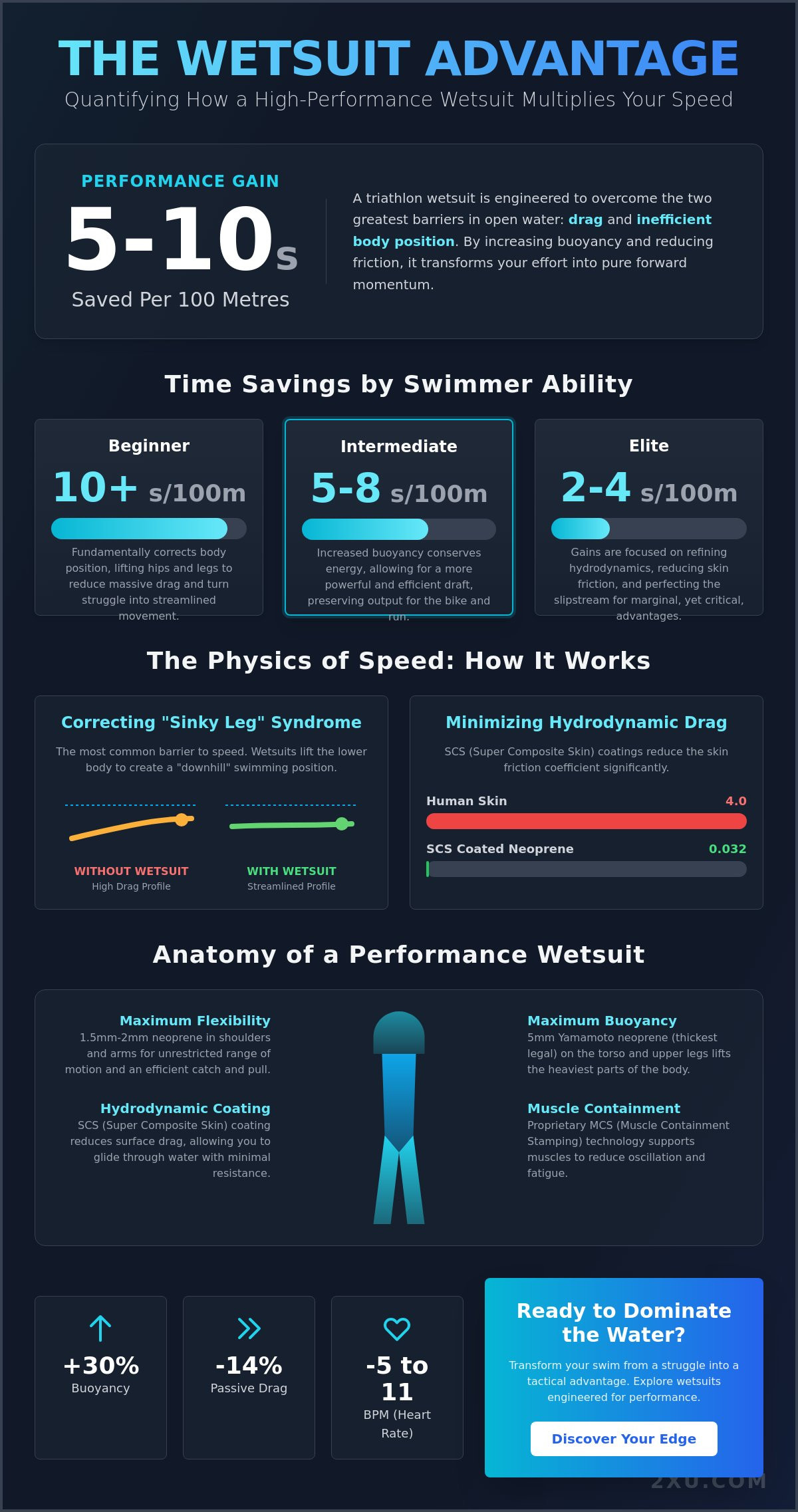
We're going to break down the data behind hydrodynamic lift and Yamamoto neoprene efficiency. You'll see how elite engineering can shave between 5 and 10 seconds off every 100 metres, effectively multiplying your effort into podium-level results. This guide examines the specific time savings across various distances and explains why premium buoyancy profiles are the ultimate ROI for your race day. Prepare to transform your swim from a struggle into a tactical advantage. Human performance, multiplied.
Key Takeaways
- Quantify the precise performance gain of 5 to 10 seconds per 100 metres and understand exactly how much faster is a triathlon wetsuit when elite engineering is applied to your baseline.
- Master the physics of hydrodynamics by leveraging 40-cell neoprene to neutralise pressure, skin friction, and wave drag for an optimised buoyancy-to-weight ratio.
- Select your performance weapon by weighing the maximum buoyancy and reduced drag of sleeved suits against the unrestricted shoulder mobility required for rapid transitions.
- Eliminate performance-sapping drag through precision fit and technical execution, using the "high catch" to fully engage proprietary forearm buoyancy panels.
- Discover how 2XU utilises graduated buoyancy and Muscle Containment Stamping (MCS) to support muscle oscillation and deliver a podium-ready swim split.
The Baseline: Quantifying the Wetsuit Advantage
Swimming is a relentless battle against drag. For the serious athlete, the data behind how much faster is a triathlon wetsuit isn't just a curiosity; it's a critical component of race strategy. On average, most athletes see a performance multiplier that translates to a saving of 5 to 10 seconds per 100 metres. This isn't a marginal gain. In a standard 1500m Olympic distance swim, that equates to a 2 to 3 minute advantage. This shift in race position ensures you exit the water fresher and ready to attack the bike leg.
While pool-based tests provide a controlled baseline, they rarely reflect the chaotic reality of open water. Triathlon wetsuits are engineered to provide the buoyancy required to maintain technical integrity when the "Grind" of the race begins. You aren't just wearing a suit; you're deploying a piece of advanced technology designed to stabilise your core and maximise every stroke. This is where human performance is multiplied by scientific precision.
Time Gains by Swimmer Ability
- Elite Swimmers: 2-4 seconds per 100m. At this level, gains are focused on hydrodynamics and the reduction of skin friction. These athletes already possess an optimal body position, so the suit works to refine their slipstream.
- Intermediate Swimmers: 5-8 seconds per 100m. These athletes benefit from increased buoyancy which allows them to hold a drafting position with less effort, preserving power output for later stages.
- Beginner Swimmers: 10+ seconds per 100m. The most significant gains occur here. The suit fundamentally corrects technical flaws in body position, turning an inefficient struggle into a streamlined movement.
The "Sinky Leg" Syndrome Correction
The most common barrier to speed is "sinky leg" syndrome. When your hips and legs drop, your frontal surface area increases, creating massive drag. Advanced neoprene placement lifts the lower body, creating a "downhill" swimming sensation. This correction is far more efficient than trying to increase kick power. By elevating the legs, the suit reduces the energy required to stay level. You stop fighting the water and start moving through it. Understanding how much faster is a triathlon wetsuit requires acknowledging that it does the heavy lifting for your form, allowing your muscles to focus entirely on propulsion. Prepare. Perform. Recover. This is how you dominate the water.
The Physics of Speed: Buoyancy, Hydrodynamics, and Drag
Swimming is a relentless battle against fluid resistance. Because water is roughly 800 times denser than air, every technical flaw in your stroke is magnified by drag. To understand how much faster is a triathlon wetsuit, you must first quantify the three forces working against your momentum. Pressure drag is the resistance caused by your body's frontal area displacing water. Skin friction is the "tugging" effect of water moving across your surface. Wave drag represents the energy lost as you create surface turbulence. High-performance suits are engineered to neutralise these forces through advanced material science.
Top-tier suits utilise 39-cell and 40-cell neoprene to maximise buoyancy-to-weight ratios. These materials are packed with nitrogen cells that provide immense lift without adding unnecessary mass. To further sharpen your profile, we apply Super Composite Skin (SCS) coatings. This hydrodynamic technology reduces the skin friction coefficient of the suit to 0.032, compared to 4.0 for standard skin. This allows you to glide through the water with significantly less resistance. You can explore the neoprene wetsuit science for a more technical breakdown of these material properties.
Neoprene Thickness and Buoyancy Profiles
World Triathlon regulations mandate a maximum neoprene thickness of 5mm. We don't use this limit uniformly; we apply it where it matters most. A buoyancy profile is the strategic distribution of neoprene across the suit to optimise your centre of buoyancy and horizontal alignment. We place 5mm panels in the core and upper legs to lift the hips, which are the heaviest part of the body. This is countered by thinner 1.5mm to 2mm panels in the shoulders. This specific thickness gradient ensures you achieve maximum lift without sacrificing the flexibility required for an efficient catch and pull.
Reducing the Energy Cost of Swimming
Performance isn't just about speed; it's about metabolic efficiency. Data shows that wearing a suit can reduce an athlete's heart rate by 5 to 11 beats per minute at a fixed pace. When the suit handles the "work" of keeping you buoyant, your oxygen demand drops. This allows for a lower stroke rate while achieving a higher distance per stroke. Additionally, the suit provides essential thermal protection. Cold water triggers muscle shivering and reduces blood flow to the extremities, which can tank your power output by up to 15%. By maintaining core temperature, you ensure your muscles are primed for the transition. Equip yourself with high-performance triathlon gear to ensure your energy is spent on propulsion, not survival.
Sleeved vs. Sleeveless: Choosing Your Performance Weapon
Choosing between a sleeved and sleeveless suit isn't just a matter of personal comfort. It's a calculated decision involving drag coefficients and physiological efficiency. Sleeved suits are objectively faster for the majority of athletes. By covering the arms in specialised neoprene, you reduce surface friction far below what bare skin allows. This full-body coverage also increases total buoyancy, lifting the arms higher in the water column to maintain a more hydrodynamic profile. If you're questioning how much faster is a triathlon wetsuit, the answer often lies in the surface area of the neoprene itself.
Sleeveless suits have their place for specific conditions. They offer total shoulder mobility and allow for a faster transition in T1. In water temperatures exceeding 22 degrees Celsius, a sleeveless suit prevents overheating. However, you sacrifice the speed multiplier of arm buoyancy. At 2XU, we believe engineering should solve the mobility issue rather than avoiding it. Our focus remains on creating sleeves that move with the athlete, not against them. When the temperature drops below 16 degrees Celsius, sleeves become a performance necessity to protect core temperature and maintain muscle firing rates.
The Flexibility Factor in Sleeved Suits
The "heavy shoulder" feeling is a symptom of poor engineering, not a flaw of sleeved suits. We eliminate this resistance by using 1.5mm underarm panels that provide near-zero restriction during the recovery phase of your stroke. These are paired with intermediate zone stretch panels that allow the suit to expand and contract with your natural mechanics. This ensures your power output goes into propulsion, not fighting the neoprene. To optimise your entire setup, consult our guide on the triathlon suit for effective race-day layering.
Price vs. Performance: Is the Investment Earned?
Entry-level suits are built for the grind, focusing on basic buoyancy and durability to help athletes finish the swim. Elite-level suits are built for velocity. Premium suits utilise variable buoyancy profiles, placing thicker neoprene in the lower core and thinner sections in the chest to prevent "corking." Data from pool testing indicates that a premium suit can be 2 to 3 seconds faster per 100 metres than a budget alternative. Over a 3.8km Ironman swim, that translates to a massive 76 to 114-second advantage. You don't just buy a suit; you buy time. Every second saved in the water is energy preserved for the bike and run.
Maximising Your Gains: Technique and Transition
You have seen the data. You understand how much faster is a triathlon wetsuit when the neoprene is engineered for elite output. However, raw technology is only half the equation. You have to earn the advantage through discipline and technical precision. First, master the fit. A suit that is even slightly loose will trap water, creating a heavy internal anchor that increases drag by up to 15%. It should feel like a second skin, compressed but not restrictive. Refer to our triathlon wetsuit guide for fitment tips to ensure you aren't fighting your gear.
Leverage the buoyancy for technical precision. High-performance suits use specific forearm panels to increase sensory feedback during the "high catch." This helps you grip the water and generate more propulsion per stroke. You must train in the suit to adapt. Your body position sits significantly higher in the water column, which shifts your centre of mass and alters your stroke mechanics. If you don't log the hours in the neoprene before race day, you will fight your own buoyancy rather than using it to multiply your power output.
Energy Conservation for the Bike and Run
A wetsuit does not just cut time; it preserves your engine for the long haul. By providing up to 30% more lift to your hips and legs, it reduces the demand on your lower body. This saves your primary muscle groups for the 40km or 180km bike leg. Research shows elite athletes can exit the water with a Rated Perceived Exertion (RPE) two points lower than in a non-wetsuit swim. The fastest swim is not the one that leaves you gasping. It is the one that delivers you to T1 with a stable heart rate and the metabolic capacity to dominate the next discipline.
The Art of the Fast Transition
Speed in the water is wasted if you spend 60 seconds fumbling in the transition area. You need a surgical T1. Apply lubricant to your wrists and ankles to ensure the neoprene slides over your joints without resistance. Master the "half-off" strategy; strip the top half of the suit to your waist the moment you exit the water. Do this while running. Efficiency is earned through repetition. When calculating how much faster is a triathlon wetsuit, factor in the transition time. A fast suit combined with a disciplined exit can shave 90 seconds off your total race time compared to a standard setup.
The 2XU Edge: Engineering the Fastest Swim Split
2XU engineers garments for the 1 per cent of athletes who refuse to accept mediocrity. We don't rely on anecdotes; we rely on the Salzmann pressure measurement device and rigorous flume testing to validate every millimetre of our gear. When asking how much faster is a triathlon wetsuit, the answer lies in our proprietary 39 Cell and 40 Cell neoprene blends. These materials provide up to 30 per cent more buoyancy than standard industry alternatives, lifting your hips into the optimal hydrodynamic position to reduce frontal drag.
Our scientific testing confirms that graduated buoyancy is the key to speed. By placing 5mm buoyancy panels in the lower core and legs, we correct the "sinking leg" syndrome common in fatigued swimmers. This keeps your body horizontal, even when your stroke starts to fail. Beyond buoyancy, we integrate Muscle Containment Stamping (MCS) into our trisuits. This technology provides a structural map for your power. By tracing key muscle groups, MCS reduces muscle oscillation and fatigue, ensuring you exit the water with the energy reserves needed for the bike leg.
Respect the grind. Gear is the multiplier, but your effort is the foundation. A 2XU suit won't swim for you; however, it will ensure every watt of energy you generate moves you forward with maximum efficiency. You earn your place on the podium through discipline. We provide the technology to ensure your hard work isn't wasted against water resistance.
Proprietary Technology: From PWX to SCS
Quantifying how much faster is a triathlon wetsuit requires looking at the drag reduction provided by our Super Composite Skin (SCS) coating. This hydrodynamic silicone layer reduces water resistance to a near-zero coefficient. It's the difference between fighting the water and cutting through it. Inside the suit, our internal lining promotes extreme flexibility without sacrificing durability, allowing for a natural shoulder rotation. The 2XU promise is simple: gear designed to help you become "Two Times You" by removing the mechanical barriers to performance.
Prepare, Perform, Recover: The 2XU Ecosystem
Performance doesn't end at the finish line. Integrating compression shirts into your post-race protocol accelerates lactate clearance and reduces muscle swelling. The 2XU ecosystem supports you through every phase of the triathlon lifecycle, from the pre-race taper to the final recovery session. We've spent decades perfecting the chemistry of our fabrics so you can focus on your splits. Stop guessing your speed; engineer it through data and the right equipment.
Master the Water: Quantifying Your Competitive Edge
Understanding how much faster is a triathlon wetsuit requires looking at the raw data of buoyancy and hydrodynamic efficiency. Independent testing indicates that a high-performance suit can reduce swim times by 5% to 10%, largely by decreasing drag by up to 15% through improved body positioning. By lifting the hips and legs into a streamlined plane, you conserve vital energy for the bike and run legs. This isn't just about floating; it's about engineering a faster version of yourself.
We don't accept compromise in our pursuit of speed. Our gear is engineered with Yamamoto 39 and 40-cell neoprene, materials scientifically proven to reduce hydrodynamic drag and maximise power output. This is the same technology trusted by elite IRONMAN champions to secure their lead from the first stroke. When you choose 2XU, you're choosing a suit that's been meticulously tested to ensure your human performance is multiplied. Respect the grind, trust the data, and prepare to dominate your next race.
Shop 2XU High-Performance Triathlon Wetsuits
The work you've put in deserves the best equipment. Go out there and claim your new personal best.
Frequently Asked Questions
Is a more expensive wetsuit actually faster?
Premium wetsuits deliver superior velocity through advanced material engineering and hydrodynamic coatings. While entry-level suits provide basic buoyancy, elite models use Yamamoto 39 or 40 cell neoprene to maximise flexibility and reduce the drag coefficient to 0.032. You're investing in the science that allows your body to cut through the water with minimal resistance; this translates to faster stroke turnover and reduced energy expenditure over long distances.
How much time does a wetsuit save in a 1500m swim?
A triathlon wetsuit typically saves an athlete between 5 and 10 seconds per 100 metres. For a standard 1500m Olympic distance swim, this results in a total time saving of 75 to 150 seconds. If you're wondering how much faster is a triathlon wetsuit, data from a 2021 performance study showed that even mid-pack swimmers improved their pace by 7% due to the increased buoyancy and improved horizontal body position.
Are sleeveless wetsuits faster than sleeved ones?
Full-sleeved wetsuits are objectively faster than sleeveless designs for the majority of athletes. The inclusion of neoprene on the arms increases total surface area buoyancy and reduces drag across the shoulders. Laboratory testing indicates that sleeved suits provide a 2% to 3% speed advantage over sleeveless alternatives. Unless you have a specific biomechanical restriction, the extra coverage is essential for multiplying your power output in the water.
Can I use a surfing wetsuit for a triathlon?
You shouldn't use a surfing wetsuit if you're serious about performance. Surfing suits are engineered for thermal insulation and abrasion resistance, utilising thicker materials that restrict the swim stroke. Triathlon-specific suits use varied neoprene thicknesses, often 5mm in the core and 1.5mm in the shoulders, to optimise your swimming mechanics. A surfing suit will likely increase your drag and lead to premature shoulder fatigue during the first 400 metres.
Does a wetsuit make you faster if you are already a good swimmer?
Even elite swimmers see significant performance gains from wearing a wetsuit. While a novice might save 10 seconds per 100 metres, a collegiate-level swimmer still gains approximately 2 to 4 seconds per 100 metres. The suit minimises the micro-oscillations of the muscles and maintains a perfect horizontal plane even as fatigue sets in. It ensures your technique remains disciplined throughout the entire duration of the swim leg.
What happens if the water is too warm for a wetsuit?
Swimming in a wetsuit when water temperatures exceed 24.5 degrees Celsius creates a high risk of hyperthermia. World Triathlon and IRONMAN regulations strictly prohibit wetsuits above this threshold to protect athlete safety. Excessive heat buildup forces your heart rate to spike, which compromises your power output for the bike and run segments. Respect the limits and train for non-wetsuit conditions to ensure you're ready for any race-day environment.
How do I test my own speed in a wetsuit?
Conduct a 400-metre time trial in a pool to quantify your personal performance multiplier. Swim the distance at race intensity without the suit, rest completely, then repeat the effort with the suit on. Record your heart rate and stroke count for both sets. Most athletes find their stroke count drops by 10% while their speed increases, proving that the suit is doing the heavy lifting for your buoyancy and alignment.
Does a wetsuit help with salt water buoyancy?
A wetsuit provides a cumulative buoyancy effect when combined with high-salinity water. Salt water is already more dense than fresh water, and the neoprene adds another layer of lift to your hips and legs. This combination allows you to maintain a high body position with almost zero kicking effort. It's a technical advantage that preserves your glycogen stores for the grind of the bike and run segments ahead.