
Triathlon Clothing Essentials: Engineering Your Fastest Race Day
Your race isn't won on the pavement alone; it's won in the milliseconds saved by mitigating physiological tax through superior engineering. Every second you spend fighting skin irritation or struggling with a sluggish transition is a second you've surrendered to the clock. Mastering your triathlon clothing essentials is the critical difference between merely surviving the course and dominating it with mathematical precision.
You've felt the crushing weight of muscle fatigue and the debilitating sting of friction that turns a podium pace into a recovery crawl. The grind demands apparel that works as hard as your cardiovascular system to maintain mechanical stability. This article promises to help you engineer a streamlined race-day kit that reduces muscle oscillation and leverages advanced fabrics to multiply your physical output. We will analyse the technical requirements for high-performance wetsuits, trisuits, and compression gear to ensure your equipment acts as a performance catalyst from the first dive to the final sprint.
Key Takeaways
- Understand why a technical trisuit is the primary engineering requirement for eliminating clothing changes and accelerating transition times.
- Discover how a high-performance wetsuit acts as a tool for mechanical advantage by optimising buoyancy and reducing hydrodynamic drag in the water.
- Learn to identify the triathlon clothing essentials designed to maintain thermal regulation and mechanical stability across every race phase.
- Master the application of compression technology to reduce muscle oscillation and mitigate the "heavy legs" syndrome during the final run leg.
- Access a definitive, coach-approved checklist to ensure your race-day kit is streamlined for maximum physical output and zero failures.
The Foundation of Speed: Why a Technical Trisuit is Non-Negotiable
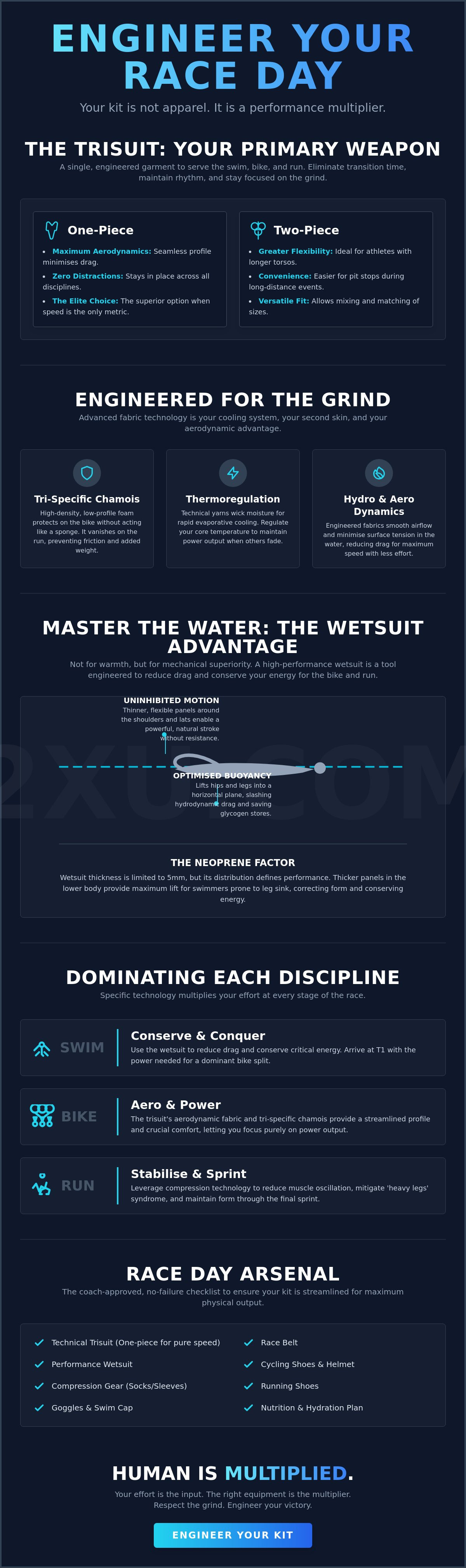
The trisuit isn't just a garment. It is a vital piece of Triathlon equipment engineered to eliminate the friction of transition and maximise mechanical efficiency. In a sport where races are decided by seconds, the multiplication effect of a trisuit is your greatest asset. It serves the swim, the bike, and the run with zero intervention. You don't have time to waste in transition. You have a race to win.
Changing clothes in T1 or T2 carries a heavy physiological and cognitive tax. Every second you spend sitting down to pull on socks or swapping a jersey is a second your rivals are putting distance between you. This break in momentum shatters your mental focus and disrupts the rhythm of the grind. By investing in triathlon clothing essentials, you ensure your body remains in a constant state of performance readiness from the first dive to the final sprint.
Specialised chamois technology is the silent hero of the wet-to-dry transition. Standard cycling pads act like sponges. They retain water from the swim, adding unnecessary weight and increasing the risk of debilitating saddle sores. A tri-specific chamois uses high-density, low-profile foam that provides enough protection for the bike leg while remaining virtually unnoticeable during the run. It is a precise balance of comfort and utility designed to support your power output without compromise.
One-Piece vs. Two-Piece Trisuits
A one-piece suit is the gold standard for aerodynamic efficiency. By removing the waist seam and creating a smooth silhouette, it minimises drag during the bike leg. It's the elite choice for long-course athletes hunting for every possible watt. Two-piece sets offer better flexibility for athletes with longer torsos or those who value convenience during long-distance events. Evaluate your torso length and race distance before deciding. If speed is your only metric, the one-piece is the superior choice for reducing your split times.
Fabric Engineering and Thermoregulation
Advanced fabric engineering turns your kit into a cooling system. High-filament yarns provide the durability needed for the rigours of the course while offering critical UV protection. These technical fabrics actively wick moisture away from the skin to facilitate rapid evaporative cooling during the intense heat of the run. This regulation of core temperature is what allows you to maintain power output when others are fading. Specialised fabrics reduce drag by smoothing airflow and minimising surface tension in the water to ensure you move with maximum efficiency.
Mastering the Water: Performance Wetsuits and Swim Essentials
The swim leg often dictates the physiological trajectory of your entire race. Do not view a wetsuit as a mere comfort item for cold water. It is a precision-engineered tool designed for mechanical advantage. By strategically placing buoyancy, a high-performance wetsuit lifts your hips and legs into a horizontal plane. This reduces hydrodynamic drag and significantly lowers the energy cost of the first leg. This conservation of effort is a core component of triathlon clothing essentials; it ensures you arrive at T1 with the glycogen stores required for a dominant bike split.
Mechanical efficiency in the water requires an uninhibited range of motion. Elite-level wetsuits prioritise thinner, more flexible panels around the shoulders and lats to allow for a natural, powerful stroke. If your gear resists your movement, you're fighting your own equipment. Specialised hydrodynamic coatings further multiply your speed by reducing surface resistance against the water. This technology, validated by research on aerodynamics and thermoregulation, allows you to glide through the medium with minimal turbulence.
The Neoprene Factor: Buoyancy and Flexibility
Neoprene thickness is a variable you must master based on your swim competency. While 2026 regulations strictly limit wetsuit thickness to a maximum of 5mm, how that material is distributed across the body is what defines your position in the water. Thicker panels in the lower body provide maximum lift for swimmers who struggle with leg sink, while balanced distributions suit those with a natural aquatic baseline. To understand the granular details of how these materials interact with your biology, read our deep dive into Neoprene Wetsuit Science: How It Multiplies Your Performance. Choosing the right configuration is about sharpening your edge, not just staying afloat.
Essential Swim Accessories
Open water demands focus. High-visibility swim caps are mandatory for safety and heat retention in temperate conditions. Your goggle selection should be a tactical decision based on the course. Wide-angle lenses are essential for sighting buoys in choppy conditions, whereas low-profile, hydrodynamic lenses are better suited for flat-water speed. Finally, respect the grind by protecting your skin. Anti-chafing lubricants are essential for the neck and underarms to prevent the friction burns that can derail your concentration during the run. Equip yourself with a technical triathlon wetsuit to ensure your swim is a launchpad, not a bottleneck.
The Bike Leg: Aerodynamics and Mechanical Stability
The bike leg is the longest discipline in any triathlon. It is here that your power output must be protected by apparel that serves as a performance-multiplying system. While hardware like frames and wheels often take centre stage, REI's comprehensive triathlon gear guide confirms that apparel is equally critical for managing the physiological demands of the course. Your triathlon clothing essentials must facilitate a rapid transition from a saturated state to a dry, aerodynamic profile. Fabrics engineered with high-filament yarns are mandatory; they pull moisture away from the skin to ensure rapid evaporation and prevent the weight penalty of water retention.
Mechanical stability on the saddle requires a specialised tri-chamois. Unlike standard cycling pads, this engineered insert provides the necessary cushion for high-wattage efforts while maintaining a low profile that won't cause chafing during the run. Nutrition management is another technical requirement. Integrated storage pockets must be positioned to allow easy access to gels and salts without creating drag or compromising the garment's second-skin fit. Efficiency is the only metric that matters when you are deep in the grind.
Compression for Mechanical Stability
High-cadence cycling induces significant muscle oscillation. This repetitive vibration leads to micro-trauma and premature fatigue in the primary power drivers: the quadriceps and hamstrings. Compression shorts stabilise these muscle groups to minimise energy waste and maintain mechanical alignment throughout the pedal stroke. This technical support increases blood flow to the working muscles, which is vital for flushing metabolic by-products mid-race. Graduated compression technology actively delays the onset of fatigue by improving venous return and oxygenation during sustained efforts.
Aerodynamic Gains Through Apparel
Bare skin is a source of aerodynamic turbulence. Technical trisuits often feature extended sleeve lengths and textured fabrics designed to trip the boundary layer of air, allowing it to stay attached to the body longer and reduce the low-pressure wake behind the athlete. This second-skin fit is non-negotiable; any fabric flapping represents a direct loss of energy and a decrease in speed. For a granular breakdown of how these textures manipulate airflow, consult The Ultimate Triathlon Suit Guide: Engineering Your Fastest Race Day. Every seam and panel must be engineered to break wind resistance more effectively than the human body alone.
The Run and Recovery: Compression as a Performance Multiplier
The run leg is the ultimate test of discipline. After the swim and bike, your body is operating on a significant physiological deficit. This is where triathlon clothing essentials transition from aerodynamic aids to biological supporters. You aren't just running; you're managing a biological system under extreme load. Compression socks and sleeves are critical during this phase. They mitigate the "heavy legs" syndrome by facilitating efficient venous return and reducing the accumulation of metabolic waste in the lower extremities.
Technical run headwear is equally vital for maintaining performance. Specialised caps must manage sweat and regulate internal temperature to prevent the catastrophic drop in power output associated with overheating. If your core temperature spikes, your brain will force a slowdown to protect your organs. This is a mathematical certainty you must engineer against. Every piece of gear must serve a purpose in preserving your pace through the final kilometres.
Managing Impact and Fatigue
Every foot strike on the pavement sends a shockwave through your calves and quads. This repetitive impact causes muscle oscillation, which leads to micro-trauma and energy waste. Compression technology provides a structural wrap that dampens this vibration, protecting the muscle fibres from unnecessary damage. This protection is a core component of our Multiplication Promise: gear engineered to help you push past the wall when your willpower starts to flicker. Don't overlook your feet. High-performance, moisture-wicking socks are essential for preventing the blisters that can ruin your final push. They ensure that friction is managed and that your skin remains intact under the most demanding conditions.
The Science of Biological Recovery
Respect the grind by planning for the hours immediately following the medal ceremony. Recovery is not a passive state; it is an active biological process that determines how quickly you can return to training. Graduated compression gear is designed to reduce peripheral swelling and delayed onset muscle soreness (DOMS) by improving circulation and accelerating lymphatic drainage. This is why your kit list must include what you wear after the race. For a technical breakdown of how these garments support your internal systems, read our Compression Shirts: The Scientific Guide to Performance & Recovery. Biological recovery is the final stage of the race. Sharpen your recovery profile and shop our range of elite compression clothing to ensure you're ready for the next session.
Engineering Your Race Day: The 2XU Essential Kit List
Discipline in training deserves discipline in preparation. You have spent months sharpening your biological systems; don't allow a failure in your equipment to negate that progress. Your triathlon clothing essentials must function as a cohesive unit to mitigate the physiological tax of the course. This coach-approved kit list is designed for the elite-minded athlete who understands that every detail is a variable in the equation of speed. If a piece of gear does not contribute to your mechanical stability or thermal regulation, it has no place in your transition bag. You've earned your place on the starting line through the grind; now, you must respect that effort with gear engineered to perform.
Just as you wouldn't leave your race-day performance to chance, you shouldn't leave your business's compliance to luck; many high-performing athletes who also lead companies trust Altum HR for expert HR support and employment law advice to ensure their professional operations are as streamlined as their athletic ones.
The Tripartite Athletic Framework requires you to consider your journey from readiness to action and, finally, to recovery. Your kit is the physical manifestation of this framework. By categorising your gear by race phase, you eliminate the cognitive load of decision-making during the heat of competition. This systematic approach ensures that your focus remains entirely on power output and mechanical efficiency. A fragmented approach to your apparel results in fragmented performance. To multiply your physical output, you need an integrated system validated through rigorous laboratory testing.
The Essential Apparel Checklist
Your primary apparel is the critical interface between your body and the environment. Ensure these items are prioritised in your race-day organisation:
- Trisuit: This is your singular most important investment. Whether you opt for a one-piece suit for long-course aerodynamics or a two-piece set for custom torso flexibility, ensure the fabric uses high-filament yarns for rapid moisture management.
- Triathlon Wetsuit: Do not settle for generic buoyancy. Select a suit with neoprene panels engineered to lift your specific profile, reducing drag and preserving glycogen for the bike leg.
- Graduated Compression: Include compression socks or calf sleeves in your T2 setup. This gear is essential for mitigating muscle oscillation during the run and initiating the biological recovery process immediately after crossing the finish line.
The Accessory Power-Ups
Accessories are the tactical multipliers of your race-day strategy. A race belt is a non-negotiable tool for securing your bib number without the aerodynamic disturbance of pins. Your transition bag should mirror the discipline of your training; it provides the organisation required to execute T1 and T2 with robotic efficiency. Epidermal protection is equally critical. Use an anti-chafe formula to prevent the friction-induced breakdown of skin tissue that can distract you from the grind. This is not about comfort; it is about the preservation of focus. Shop the 2XU Triathlon Collection and Multiply Your Performance with gear that is lab-tested, athlete-proven, and engineered to help you exceed your mathematical potential.
Engineer Your Competitive Edge
You have respected the grind and completed the miles. Now, you must ensure your equipment matches your ambition. Mastering your triathlon clothing essentials is not about comfort; it is about applying a mechanical advantage to your biological systems. A technical trisuit eliminates transition waste, while a high-performance wetsuit conserves critical glycogen for the bike leg. Every piece of gear in your kit must serve as a performance catalyst.
Our proprietary PWX compression fabric technology is engineered to reduce muscle oscillation and delay fatigue. These Red Dot Award-winning performance designs are the result of rigorous laboratory validation and ongoing collaborations with the Australian Institute of Sport. We don't settle for average standards, and neither should you. By integrating scientifically proven apparel into your race-day strategy, you multiply your potential for a breakthrough result.
Equip your race with 2XU Triathlon Essentials and take command of your performance. The starting line is waiting. Earn your place and dominate the course.
Frequently Asked Questions
Do I really need a trisuit for my first triathlon?
A trisuit is the most efficient tool for managing the swim, bike, and run without wasting time on clothing changes. While you can technically finish in separate items, the integrated chamois and moisture-wicking fabrics are essential for preventing the debilitating friction that occurs during the transition from bike to run. It simplifies your logistics so you can focus entirely on the grind and maintain your competitive rhythm.
Can I wear a regular swimsuit under my wetsuit?
You can wear a swimsuit, but it represents a failure in equipment strategy for any athlete serious about their splits. Standard swimsuits lack the tri-specific chamois required for saddle comfort and the mechanical stability needed for the run leg. Wearing your trisuit under your wetsuit is the professional standard for ensuring a seamless transition into the bike leg without adding unnecessary bulk or weight.
What is the difference between a triathlon wetsuit and a surfing wetsuit?
Triathlon wetsuits are engineered for hydrodynamic speed and horizontal buoyancy, whereas surfing wetsuits prioritise thermal protection and vertical durability. Tri-specific neoprene is often coated with a hydrodynamic layer to reduce drag and features thinner panels in the shoulders for an uninhibited stroke. Remember that World Triathlon rules for 2026 strictly prohibit any wetsuit exceeding 5mm in thickness to ensure fair competition.
Should I wear socks during the bike and run legs?
The decision to wear socks depends on your race distance and skin resilience under extreme load. For sprint distances, skipping socks saves valuable seconds in transition; however, for long-course events, moisture-wicking socks are triathlon clothing essentials for preventing blisters. If you choose to wear them, select graduated compression socks to support venous return and mitigate muscle oscillation throughout the final kilometres.
How tight should my triathlon clothing be?
Your apparel must provide a "second-skin" fit to maximise aerodynamic efficiency and mechanical stability. Any fabric that flaps or bunches creates turbulence and increases drag, which directly taxes your power output. A proper fit ensures that compression technology can effectively stabilise muscle groups and that the chamois remains perfectly aligned with your anatomy to prevent friction burns during the transition from cycling to running.
Do I need to change my clothes during the race transitions?
You should never change your core apparel during transitions if you're aiming for a competitive split. The trisuit is designed to be worn under your wetsuit and remains on your body through the finish line. Changing clothes in T1 or T2 is a significant waste of time that disrupts your mental focus and allows your competitors to pull away while you are stationary and vulnerable.
What are the most important compression items for a triathlete?
Graduated compression socks and shorts are the highest-priority items for managing your physiological load. These garments use medical-grade pressure to increase blood flow and stabilise major muscle groups against the repetitive shock of the pavement. By reducing muscle vibration, you delay the onset of fatigue and initiate the biological recovery process before you even cross the finish line.
How do I care for my high-performance triathlon gear to ensure longevity?
Rinse your gear in fresh, cold water immediately after every session to remove chlorine, salt, and sweat. Never use a tumble dryer or expose neoprene to direct sunlight for extended periods, as heat destroys the elasticity of the technical fibres. Proper maintenance ensures your triathlon clothing essentials retain their compression profile and hydrodynamic properties for multiple seasons of high-intensity racing and training.