
How to Find a Wetsuit that Fits Perfectly: The Athlete’s Guide to Hydrodynamic Precision
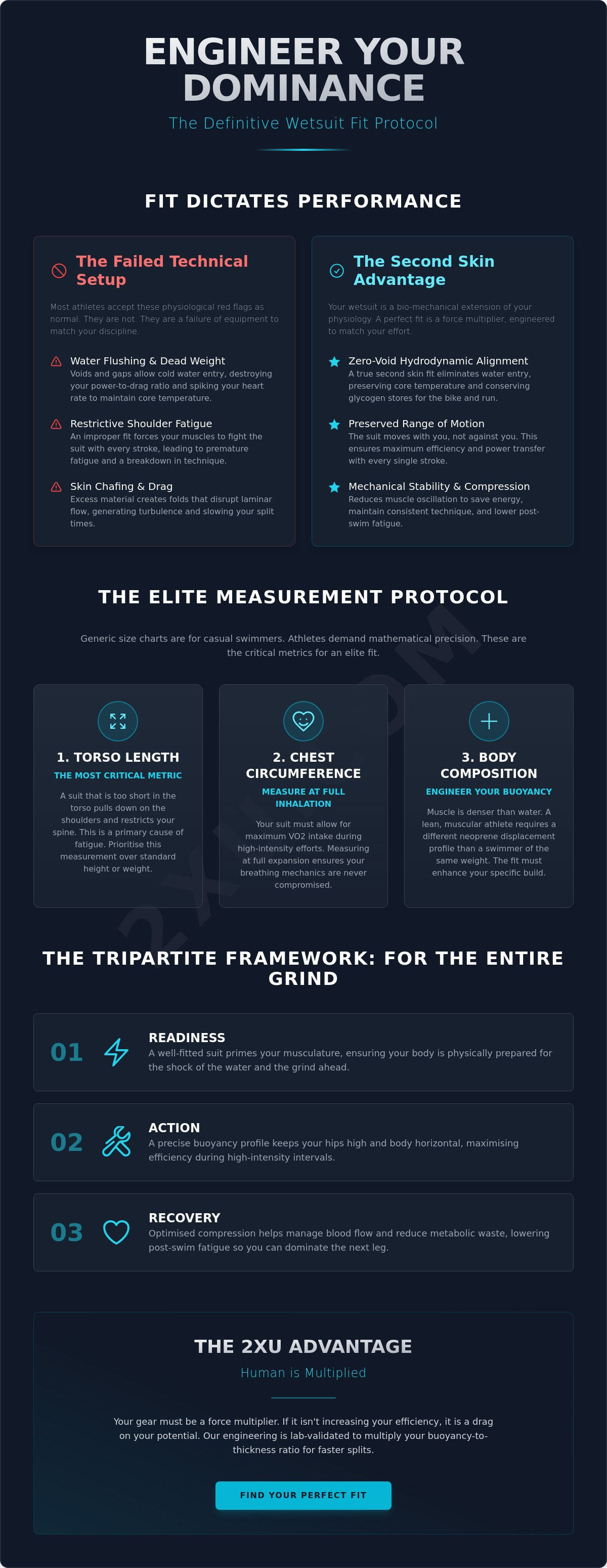
Your wetsuit is not a piece of clothing; it is a bio-mechanical extension of your physiology that determines whether you dominate the swim or fight against it. Most athletes accept skin chafing and restrictive shoulder fatigue as necessary evils of the sport, but these are actually physiological red flags of a failed technical setup. You understand that water entry, or flushing, doesn't just feel cold; it adds dead weight that destroys your power-to-drag ratio and slows your split times. Precision is the only variable that separates an elite performance from a mediocre one.
This guide provides the definitive methodology on how to find a wetsuit that fits perfectly by treating your gear as a hydrodynamic tool rather than an accessory. We will show you how to achieve a second skin fit that multiplies your natural buoyancy and preserves your range of motion for a more efficient stroke. You're about to master the science of suit selection to ensure your equipment works as hard as your discipline. We will analyse the mechanical stability of different cuts and the specific tactile markers of an elite fit so you can transition faster and swim with unyielding confidence.
Key Takeaways
- Eliminate the biological cost of water flushing by achieving a zero-void hydrodynamic alignment that acts as a true second skin.
- Prioritise torso length and chest expansion over standard sizing to maintain optimal swim posture and unhindered VO2 intake.
- Learn how to find a wetsuit that fits perfectly by executing a five-step movement protocol that accounts for the transition from dry fit to wet performance.
- Identify and correct the most common fit errors, such as improper neoprene placement, to eliminate drag and ensure a watertight neck seal.
- Understand how lab-validated seam placement and advanced material engineering multiply your buoyancy-to-thickness ratio for faster splits.
The Science of the Second Skin: Why Fit Dictates Your Swim Split
Precision in the water is non-negotiable. When you investigate how to find a wetsuit that fits perfectly, you are looking for a state of zero-void hydrodynamic alignment. This concept, often referred to as The Science of the Second Skin, ensures that no space exists for water to pool against your body. Voids lead to flushing, where cold water enters and circulates through the suit. This isn't just a comfort issue. It is a biological disaster. Cold water entry forces your heart to work harder to maintain core temperature, which spikes your heart rate and burns through glycogen stores that should be reserved for the bike and run legs.
Mechanical stability is equally critical. High-performance triathlon wetsuits provide compression that reduces muscle oscillation. This is the involuntary vibration of muscle tissue that occurs with every movement. By dampening this vibration, you save energy and maintain a more consistent stroke technique. At 2XU, we believe your gear must be a force multiplier. If it isn't increasing your efficiency, it is a drag on your potential. You aren't training to accommodate your equipment; your equipment must be engineered to match your effort.
Hydrodynamics vs. Thermoregulation
A perfect fit manages the delicate balance between keeping you warm and keeping you fast. While thermoregulation preserves your metabolic resources, hydrodynamics ensures those resources translate into forward motion. Any excess material creates folds that disrupt laminar flow and generate turbulence. Hydrodynamic drag is the resistive force generated as water interacts with the suit's surface area, where even a slight increase in material thickness or a loose fold can break your streamlined profile. Eliminating these folds through a precision fit is the simplest way to lower your drag coefficient and increase your velocity.
The Tripartite Framework: Readiness, Action, Recovery
Our approach to fit follows a specific three-part chronological structure designed to support the athlete's entire journey:
- Readiness: A well-fitted suit primes your musculature for the grind, ensuring your body is physically prepared for the shock of the water.
- Action: Maintaining a precise buoyancy profile keeps your hips high and your body in a horizontal plane during high-intensity intervals.
- Recovery: Optimised compression assists in managing blood flow and reducing the accumulation of metabolic waste, which lowers post-swim fatigue.
This holistic framework ensures you don't just swim faster, but you exit the water ready to dominate the next phase of the race. Respect the grind by choosing gear that respects your physiology.
The 2XU Measurement Protocol: Engineering Your Buoyancy Profile
Generic height and weight charts are designed for casual swimmers; they are insufficient for athletes who demand mathematical precision. To master how to find a wetsuit that fits perfectly, you must move beyond the standard S/M/L mentality. Torso length is the most critical metric for maintaining an elite swim posture. If the suit is too short in the torso, it will pull down on the shoulders and create a restrictive curve in the spine. This mechanical failure forces your muscles to fight against the neoprene with every stroke, leading to premature fatigue and a breakdown in technique. We engineer our suits for specific athletic frames, including "Tall" and "Short" variations, to ensure the neoprene aligns with your biological pivot points.
Your body composition also dictates your buoyancy requirements. Muscle is denser than water and provides significantly less natural lift than adipose tissue. A lean, muscular triathlete requires a different neoprene displacement profile than a recreational swimmer of the same weight. When Troubleshooting the Fit, research confirms that pressure points at the joints often result from a suit failing to account for these specific limb-to-torso ratios. You aren't just looking for a suit that goes on; you're looking for a suit that enhances your specific displacement profile.
The Critical Metrics for Elite Swimmers
Precision measurement requires more than a bathroom scale. You must measure your chest circumference at full inhalation. This ensures the suit allows for maximum VO2 intake during high-intensity efforts. The torso loop measurement, taken from the top of the shoulder, through the crotch, and back to the same shoulder, is the only way to validate vertical fit. Finally, check wrist and ankle diameters. These must be tight enough to create a hydrodynamic seal that prevents water ingress while remaining flexible enough for rapid transitions.
Buoyancy Mapping for Your Body Type
A precision fit is designed to align your hips with the surface of the water. Many athletes suffer from "sinky legs," a common postural flaw that creates massive amounts of drag. Our engineering uses targeted compression and strategically placed buoyancy panels to correct this. By lifting the lower body into a horizontal plane, we reduce the energy cost of maintaining a streamlined position. Explore our range of triathlon wetsuits to find the specific buoyancy mapping required to multiply your performance in the water. This is not about comfort. It is about technical superiority through posture correction.
The Range of Motion (ROM) Test: Validating Your Suit’s Performance
Static measurements are merely the baseline. To truly understand how to find a wetsuit that fits perfectly, you must subject the garment to a dynamic validation protocol that mimics the specific mechanical demands of the swim stroke. A suit that feels restrictive in a standing position will become an exhausting anchor after two kilometres of high-intensity output. You are looking for a fit that facilitates, rather than fights, your natural biomechanics. This requires a systematic assessment of the neoprene’s elasticity across your primary pivot points, specifically the shoulders, lats, and lower back.
Identifying technical failures like armpit bunching or lower back pooling before you enter the water is essential for hydrodynamic precision. Armpit bunching indicates excess material that will chafe during the recovery phase of your stroke. Conversely, a gap in the small of your back creates a reservoir for water to pool, destroying your buoyancy profile and adding dead weight. The neck seal must be secure enough to prevent water ingress during the catch phase, yet flexible enough to allow for unrestricted breathing during the grind of a race start. Discipline in the fitting room translates to speed in the open water.
The 5-Step Athlete ROM Protocol
Executing this protocol ensures your suit is ready for the technical rigours of elite competition:
- Step 1: The Overhead Reach: Extend both arms fully above your head as if reaching for the wall. You should feel tension, but your shoulders must not be forced into a shrugged position.
- Step 2: The Torso Twist: Rotate your upper body while keeping your hips forward. This validates the lateral flexibility of the suit, which is critical for the body roll required in an efficient freestyle stroke.
- Step 3: The Catch Phase Simulation: Mimic the high-elbow catch of your stroke. Ensure there is no significant restriction at the wrist or forearm that could lead to muscle pump or cramping.
- Step 4: The Deep Squat: Drop into a full squat to test the neoprene stretch across the lower back and glutes. This ensures the suit won't pull down on your shoulders when you are in a horizontal swimming position.
- Step 5: The Neck Flexion: Move your head through its full range of motion. The seal should remain flush against your skin without restricting your airway or causing immediate friction.
Dry Fit vs. Wet Fit: The Reality
A dry trial is an imperfect simulation of performance. Neoprene is a cellular structure that settles only when water acts as a lubricant between the material and your skin. Once wet, the suit undergoes a "vacuum seal" effect, where the thin layer of trapped water allows the suit to shift into its final, optimised position. This reduces the perceived tightness and increases your actual range of motion. Athletes must never judge the ultimate performance of a suit solely on a dry trial because neoprene requires water to achieve its final, lubricated alignment against the skin. Trust the engineering and the protocol; the suit is designed to multiply your capability once you hit the water.
Troubleshooting the Fit: Eliminating Drag and Preventing Flushing
Finding the right size is only the first phase of the grind. Even if you understand how to find a wetsuit that fits perfectly, improper application will result in mechanical failure in the water. The most common error athletes make is failing to seat the neoprene correctly into the crotch and armpits. If a gap exists between the suit and your underarms, the material will pull against your shoulders during the recovery phase, causing early fatigue. Similarly, if the crotch of the suit is not hiked high enough, the entire torso length is compromised, leading to a restrictive downward pull on your upper body.
Eliminating dead air pockets is the priority for maintaining a hydrodynamic profile. These voids allow water to pool, creating a ballooning effect that increases surface area and drag. You must also distinguish between performance compression and respiratory restriction. A high-performance suit will feel tight on the chest; this is necessary to prevent water ingress. This compression should never prevent a full diaphragmatic breath. If you cannot expand your lungs fully during the readiness phase, the suit is either too small or improperly seated.
Mastering the Entry: Seating the Neoprene
Application requires discipline. You must inch the material up your limbs incrementally, starting from the ankles and moving toward the hips. Ensure the neoprene is pulled as high as possible into the crotch before attempting to close the zipper. The zipper pull should create a flush-proof spinal seal that prevents water from entering the suit's rear channel. If the suit doesn't feel significantly higher than you think it should be, you haven't seated it properly. This meticulous process ensures that the maximum amount of material is available for shoulder rotation during the action phase.
Signs Your Wetsuit is Too Large (The Performance Killers)
A suit that feels easy to put on is often a suit that will fail you. Easy shoulder movement in the fitting room usually signals excess material that will trap water and destroy your split times. Look for water pooling behind the knees or in the small of the back; these are clear indicators of a sizing mismatch. A neck gap is another critical failure point. If the seal doesn't remain flush against your skin during head rotation, cold water will flush the suit, spiking your heart rate and lowering your efficiency. Don't settle for average standards. Check our collection of Triathlon Wetsuits to find a technical tool that actually multiplies your output.
The 2XU Advantage: Why Our Engineering Multiplies Your Potential
The 2XU advantage is built on a refusal to accept average standards. We don't just manufacture gear; we engineer technical solutions that multiply your biological output. This starts with our lab-validated neoprene, which achieves a superior buoyancy-to-thickness ratio. By reducing the physical mass of the suit while increasing its lift, we minimise the surface area susceptible to drag. Our specialised seam placement is not a stylistic choice. It is a hydrodynamic requirement designed to guide water flow along the body's natural contours. This prevents the turbulence that destroys your split times. You've learned how to find a wetsuit that fits perfectly; now you must understand why the materials within that fit determine your ultimate velocity.
Athletes who respect the grind choose our gear because they know that every second earned in the water is a second saved for the run. We've mastered the science of neoprene wetsuit construction to ensure that your equipment remains an asset, not a liability, through every phase of the race. Discipline in your selection process ensures that the suit acts as a mechanical extension of your own power.
Proprietary Technology: Beyond Standard Neoprene
We utilise premium Yamamoto neoprene to provide maximum flexibility and thermoregulation. This material is derived from limestone, offering a closed-cell structure that is significantly more durable and warmer than petroleum-based alternatives. Our commitment to scientific validation means every panel is tested for its mechanical stability and response to high-intensity movement. We don't guess. We measure. This data-driven approach ensures our suits provide the specific compression needed to reduce muscle oscillation without restricting your stroke.
Engineered for the Transition
Speed doesn't stop at the water's edge. A perfect fit aids in rapid T1 removal to shave critical seconds off your race time. We've integrated specialised buoyancy panels that work with your body's rotation, not against it. This ensures you maintain a high horizontal plane throughout the swim while allowing for a seamless exit. Refer to our triathlon wetsuit guide for specific race-day strategies to sharpen your performance. Your suit should be the last thing you think about during the action phase because it has been engineered to perform instinctively.
Final Checklist for the Perfect 2XU Fit:
- Seating: Neoprene is pulled high into the crotch and armpits with zero gaps.
- Seal: The neck and wrist cuffs are flush against the skin to prevent flushing.
- Posture: The buoyancy panels lift your hips into a horizontal alignment.
- Rotation: Full range of motion is achieved in the overhead reach without resistance.
- Breathing: The chest compression allows for maximum diaphragmatic expansion.
Dominate the Water with Mathematical Precision
Precision in the water is the direct result of discipline in your preparation. You now understand that a technical fit is not about comfort; it is about eliminating the biological cost of drag and maximising your power-to-buoyancy ratio. By prioritising torso length over generic sizing and executing a rigorous range of motion protocol, you've mastered how to find a wetsuit that fits perfectly. This second skin alignment ensures that every stroke translates into forward velocity rather than wasted effort against the neoprene.
2XU gear is engineered for those who refuse to settle for average standards. Our suits are the choice of world-champion triathletes because they utilise advanced Yamamoto neoprene technology to provide an unmatched buoyancy-to-thickness ratio. Every panel and seam is engineered for maximum hydrodynamic efficiency to ensure your equipment multiplies your potential from the first stroke to the final transition. Respect the grind, trust the science, and earn your place at the front of the pack.
Optimise your swim with 2XU Triathlon Wetsuits
Frequently Asked Questions
How tight should a triathlon wetsuit actually feel?
A triathlon wetsuit should feel like a firm, compressive second skin with zero voids or air pockets between the material and your body. While it may feel uncomfortably snug on land, this level of compression is necessary to prevent water from pooling inside once you submerge. You are looking for a technical fit that provides mechanical stability without compromising your stroke mechanics or lung expansion.
Should I size up if I am between two wetsuit sizes?
You should generally choose the smaller size if you are between sizes, provided your range of motion remains unrestricted. Excess material is a performance killer that leads to ballooning and increased hydrodynamic drag. Elite athletes prioritising speed will choose the tighter fit to ensure a zero-void alignment and maximum buoyancy throughout the grind.
Is it normal to have restricted breathing when I first put on my wetsuit?
A compressive sensation on the chest is normal during the readiness phase, but it should never prevent a full diaphragmatic breath. High-performance suits are engineered to allow for maximum VO2 intake while maintaining a watertight seal across the torso. If you cannot take a deep breath after seating the neoprene, the suit is likely too small in the torso loop or improperly adjusted.
How do I know if the arm and leg lengths are correct?
Correct arm and leg lengths should finish approximately two to five centimetres above the wrists and ankles. This gap is intentional; it ensures a hydrodynamic seal at the extremities and facilitates rapid removal during T1. If the neoprene covers your watch or overlaps your feet, the suit is too long and will likely flush water during high-intensity action.
Can I use a surfing wetsuit for a triathlon if it fits well?
You cannot use a surfing suit for competitive triathlon performance because they are engineered for entirely different mechanical demands. Surfing suits focus on abrasion resistance and warmth, whereas triathlon-specific gear prioritises buoyancy profiles and reduced surface friction. Using the wrong tool for the grind will significantly increase your drag and slow your split times.
What is the "flushing" effect and how do I prevent it?
Flushing is the continuous entry and exit of cold water through the suit, which spikes your heart rate and burns glycogen stores. You prevent this by mastering how to find a wetsuit that fits perfectly around the neck, wrists, and ankles. A precision fit creates a vacuum seal that keeps a thin, stable layer of water against your skin for optimal thermoregulation.
How much should I account for neoprene stretch over time?
Account for a slight increase in flexibility once the neoprene is wet, but do not expect a high-quality suit to stretch out significantly over time. Elite Yamamoto neoprene is engineered for dimensional stability to ensure your buoyancy profile remains consistent over hundreds of kilometres. If a suit feels loose on the first day, it will remain a performance liability throughout its lifespan.
Does the thickness of the neoprene affect how the suit should fit?
Neoprene thickness dictates the suit’s buoyancy mapping, and thicker 5mm panels require a more precise fit to ensure they align with your centre of mass. Thicker material is inherently less flexible, so the fit must be exact at the joints to prevent mechanical restriction. A suit with varying thickness requires meticulous seating to maintain your horizontal posture and multiply your efficiency in the water.