
Best Compression Socks for Running: The 2026 Performance Engineering Guide
Every stride you take sends a kinetic shockwave through your soft tissue, wasting critical energy on muscle oscillation rather than forward propulsion. Identifying the best compression socks for running is not a matter of aesthetics; it's a requirement for any athlete serious about minimising the calf fatigue and lower leg soreness that interrupts training consistency. You know the "Grind" requires resilience, but your gear must be engineered to support that ambition, not hinder it.
This 2026 performance engineering guide will teach you to master the science of graduated compression to accelerate venous return and multiply your endurance on the road or trail. We've analysed the technical data to help you achieve a blister-free, locked-in fit that provides reduced muscle vibration and faster recovery times. We will deconstruct the 20-30mmHg pressure profiles and technical fabric constructions that separate elite equipment from average sportswear, proving that when the right mechanics meet discipline, the human is multiplied.
Key Takeaways
- Master the mechanics of graduated compression to optimise venous return and accelerate the removal of metabolic waste during high-intensity efforts.
- Learn how mechanical containment reduces muscle oscillation and micro-trauma, allowing you to maintain structural integrity across punishing long-distance kilometres.
- Identify the best compression socks for running by matching specific sock lengths and cushioning profiles to your individual race-day requirements and terrain variables.
- Implement the Tripartite Athletic Framework—Readiness, Action, and Recuperation—to ensure your physiological systems are primed before the starting gun and repaired after the finish.
- Discover how advanced engineering in the Performance Tall and Vectr Light Cushion series provides a scaffold for the Achilles to stabilise the lower limb and eliminate friction.
Why Compression Socks Are Critical for High-Performance Running
Gravity is the enemy of the endurance athlete. It forces blood to pool in the lower limbs, slowing the removal of metabolic byproducts and increasing the physiological tax of every kilometre. To secure the best compression socks for running, you need a garment that functions as an external vascular pump. Standard socks are passive barriers that lack the structural integrity to manage the mechanical load of the calf during high-velocity impact. If you aren't managing your circulation, you are leaving speed on the pavement. Respect the Grind by giving your vascular system the mechanical advantage it requires to sustain elite output.
The Science of Graduated Pressure
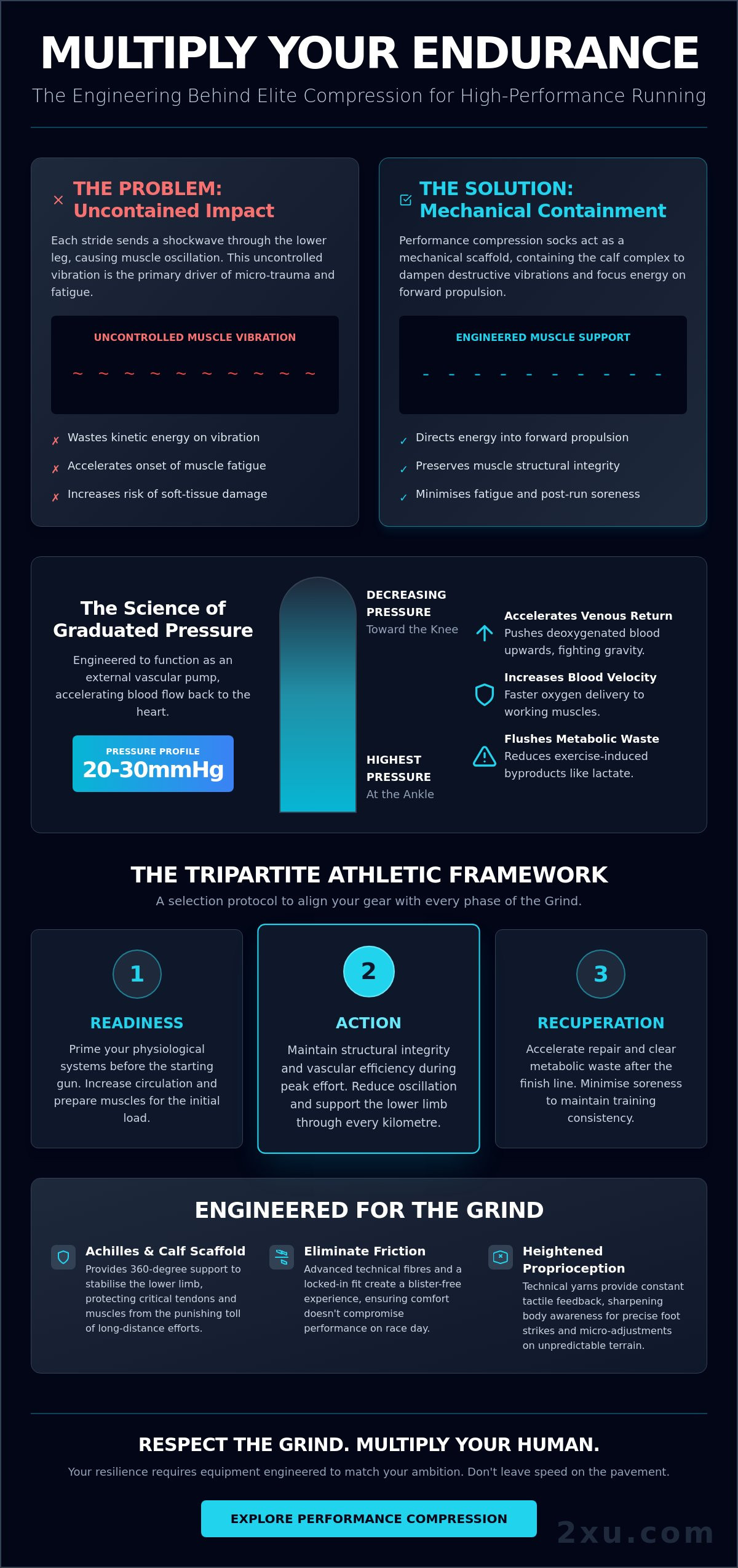
Graduated compression is a mechanical pump for the vascular system. This engineering principle applies the highest pressure at the ankle, which systematically decreases as the garment moves toward the knee. This gradient is essential for assisting the heart in moving deoxygenated blood through the "venous return" mechanism. While compression therapy originated in clinical settings, its role in 2026 performance is about maximising output. We engineer 20-30 mmHg ratings specifically for active use to ensure blood does not pool in the extremities during the most intense training blocks. By compressing the vein walls, the velocity of blood flow increases, which ensures that oxygenated blood reaches your working muscles faster.
Beyond Blood Flow: Proprioceptive Feedback
Your performance depends on more than just oxygen; it requires total body awareness. Technical yarns in high-performance socks provide constant tactile feedback, sharpening your proprioceptive response during technical trail runs or fatigued road efforts. This mechanical scaffold stabilises the joint architecture around the ankle, which is critical when the terrain becomes unpredictable. It improves foot strike precision and reduces the likelihood of structural failure under load. You gain a competitive edge by sharpening the communication between your central nervous system and your lower limbs. This heightened awareness allows for micro-adjustments in real time, preventing the ankle rolls that often end a season. Every yarn is placed with meticulous intent to ensure you remain locked in, regardless of the distance or the difficulty of the trail.
The Mechanical Advantage: Muscle Containment and Oscillation
Every time your foot strikes the ground, a shockwave travels through your lower limb. This phenomenon, known as muscle oscillation, is the primary driver of micro-trauma and soft-tissue damage during endurance efforts. Without external stabilisation, your muscles vibrate uncontrollably upon impact. This vibration wastes kinetic energy and accelerates the onset of fatigue. Identifying the best compression socks for running requires looking beyond simple comfort; you need a garment engineered to function as a mechanical scaffold. By containing the muscle mass and dampening these destructive vibrations, you preserve the structural integrity of the calf and Achilles. This ensures more kinetic energy is directed toward forward propulsion rather than being lost to internal friction.
Laboratory validation confirms that high-performance compression significantly reduces markers of muscle damage, such as creatine kinase levels, following intensive training blocks. This is not merely a subjective feeling of "tightness." It is biological preservation. When you minimise the physical toll of the Grind, you recover faster and maintain the ability to execute back-to-back high-intensity sessions. Explore our full range of performance-engineered compression garments to see how this technical scaffolding integrates into your existing kit.
Protecting the Achilles and Calf Complex
The lower leg is a complex architecture of tendons and muscles that must endure thousands of repetitions per session. We utilise advanced technical fibres to provide 360-degree support without restricting your natural range of motion. This containment strategy is critical for minimising the "pump" effect that often leads to increased compartment pressure and shin splints. By maintaining consistent external pressure, the garment prevents the excessive swelling that compromises vascular efficiency and nerve function during long-distance efforts. You are essentially wrapping your muscles in a secondary layer of protection that absorbs the brunt of the road's impact.
Multiplied Endurance through Mechanical Stability
Mechanical stability is the foundation of running economy. When muscles are contained, the body expends less metabolic energy on internal stabilisation. This allows you to maintain your form even as you enter the final kilometres of a marathon or ultra-trail race. Discipline in training is wasted if your gear allows your mechanics to break down under duress. Muscle containment is the secret to maintaining mechanical efficiency when your central nervous system begins to fatigue.
- Reduces the metabolic cost of movement by dampening vibration.
- Delays the onset of muscle fatigue through superior containment.
- Protects against structural failure by supporting the Achilles tendon.
- Optimises energy return by keeping the muscle in its most efficient alignment.
Evaluating the Collection: Which Compression Profile Suits Your Goal?
Selecting the best compression socks for running is a precision exercise that requires matching the garment's architecture to your session's physiological demands. You don't bring a knife to a gunfight; similarly, you don't wear a recovery-grade sock for a high-intensity interval session. The primary differentiator between elite equipment and average apparel lies in the yarn's ability to manage thermal and moisture variables. Technical yarns are engineered to transport sweat away from the skin surface far more efficiently than natural fibres, which tend to saturate and lose their structural integrity. When skin remains dry, it remains resilient. This moisture management is the first line of defence against the friction that causes blisters during the Grind.
Anatomical left and right fit is a non-negotiable requirement for the serious athlete. Generic, symmetrical socks lead to fabric bunching in the toe box and arch, creating high-pressure zones that compromise circulation and comfort. By engineering a specific fit for each foot, we ensure the compression gradient is applied precisely where the vascular and muscular systems require it most. This eliminates excess material and provides a sleek, second-skin feel that remains stable regardless of your pace or foot strike pattern.
Tall Compression Socks: The Maximum Support Standard
Over-the-calf coverage is the gold standard for athletes seeking maximum venous return and total calf stabilisation. By enveloping the entire lower limb, these socks maximise the surface area under pressure, which is critical for clearing metabolic waste during long-distance road efforts. This height is also the optimal choice for recovery blocks and long-haul travel. If you are serious about your post-race protocol, using flight pressure socks ensures that blood flow remains consistent even during periods of enforced stasis. For the athlete, every hour spent in transit is an opportunity to accelerate the repair process rather than allowing fluid to pool in the ankles.
Vectr Socks and the X-LOCK Architecture
The Vectr series introduces our proprietary X-LOCK architecture, a mechanical system designed to lock the foot in place within the shoe. This system provides targeted arch support, which is vital for preventing plantar fascia strain when your mechanics begin to degrade under duress. By stabilising the foot's internal structure, X-LOCK eliminates the micro-movements that lead to friction and heat buildup. While tall socks dominate the road, the "crew" height has emerged as the weapon of choice for technical trail athletes. It offers the perfect balance of ankle protection and breathable comfort for navigating off-road terrain where agility is paramount. Discipline dictates that you choose the profile that serves your objective, ensuring your gear never becomes a point of failure.
- Tall: Maximum containment for marathons and recovery.
- Crew: Versatile stability for technical trails and daily training.
- No-Show: Minimalist profile for track sessions and speed work.
- Padded Zones: Strategically placed for impact protection in high-wear areas.
- Lightweight Zones: Optimised for maximal ventilation in high-heat conditions.
The 2XU Selection Protocol: Readiness, Action, and Recuperation
High-performance output is not a isolated event; it is a continuous cycle of physiological preparation, execution, and repair. To identify the best compression socks for running, you must look beyond the duration of the race itself and adopt our Tripartite Athletic Framework. This system ensures your physiology is primed before the starting gun, protected during peak output, and repaired immediately after you cross the finish line. Discipline in your gear selection across all three phases is what separates the elite from the average. If you only focus on the "Action" phase, you are neglecting the critical windows where the most significant gains in training consistency are made.
Action: Engineering the Run
The Action phase requires maximum mechanical containment to manage the loads described in previous sections. Selecting the correct weight is a tactical decision based on your specific objective. Ultra-lightweight technical yarns are the standard for race day to minimise mass and maximise breathability, while cushioned profiles provide the structural durability required for the daily Grind of high-mileage training. You must ensure the graduated profile is correctly positioned; the highest pressure zone must sit flush against the ankle to effectively drive the vascular gradient upward. For athletes demanding total systemic stability, pairing these socks with compression shirts ensures the upper body maintains postural integrity while the lower limbs focus on propulsion.
Recuperation: Winning the Recovery
Recovery is the most critical part of the training cycle. Your ability to back up a high-intensity effort depends entirely on how quickly you can flush metabolic toxins and reduce inflammation. The window of opportunity opens the moment your heart rate begins to drop. Wearing graduated compression for a minimum of 2-4 hours post-run provides the sustained venous support necessary to prevent blood pooling and minimise the heavy-leg sensation associated with Delayed Onset Muscle Soreness (DOMS). This protocol accelerates the removal of lactate and reduces peripheral swelling, ensuring your tissues are repaired and ready for the next session. By honouring the Recuperation phase, you ensure that every kilometre of effort results in a mathematical improvement in performance rather than structural decay.
Don't leave your progress to chance. Optimise your full training cycle with targeted compression to ensure you are always ready for the next challenge.
- Readiness: Use light compression to prime the vascular system and increase muscle temperature before activity.
- Action: Deploy high-power containment to dampen oscillation and preserve energy during the effort.
- Recuperation: Maintain graduated pressure post-run to accelerate blood flow and eliminate metabolic byproducts.
Engineered for the Grind: Standout Performance Socks for 2026
You have deconstructed the vascular science and mastered the mechanical framework of muscle containment. Now, you must select the specific hardware required to execute your training strategy. The best compression socks for running are not found on the shelves of casual retailers; they are developed in laboratories to meet the uncompromising standards of elite human output. Our 2026 collection represents the pinnacle of this engineering, providing a range of pressure profiles designed to match every phase of the Tripartite Athletic Framework. Whether you are attacking a personal best or navigating a punishing recovery block, your choice of equipment dictates the speed of your progress.
Choosing Your Weapon: Product Highlights
The Performance Tall Compression Socks are the definitive choice for marathoners and ultra-endurance athletes who require maximalist calf containment. This garment provides the structural scaffold necessary to dampen the oscillation that leads to structural decay over 42.2 kilometres. For those focused on the high-velocity demands of race day, the Vectr Light Cushion Full Length Sock is the ultimate weapon. It integrates our proprietary X-LOCK architecture to secure the foot, eliminating the micro-movements that cause heat and friction. Pair these with our technically superior running shorts to ensure your entire lower kinetic chain is primed for efficiency.
Training consistency is built on the days between the big efforts. The Vectr Crew Socks offer the versatility required for daily training and gym conditioning, providing targeted arch support and joint stabilisation without the full height of a tall sock. When the work is done, transition immediately to our Recovery Compression Socks. These are engineered with a specific pressure profile optimised for stagnant blood flow, ensuring that even when you are at rest, your vascular system is working to flush toxins and repair tissue. Discipline in selection ensures that no part of your cycle is left to chance.
Earning Your Place: The 2XU Promise
We explicitly reject average standards. This is why we never use the term "synthetic" to describe our materials. We utilise technical performance fibres engineered for specific mechanical properties, from moisture-wicking efficiency to elastic recovery. Our commitment is to lab-validated results rather than fleeting fashion trends. Every stitch and every gradient is the result of rigorous testing with academic research teams and industrial instrumentation. You earn your place on the podium through hard work; we earn our place in your kit through proven mathematical improvements in your physical output. It's time to stop guessing and start engineering your results. Shop the full 2XU Compression Sock collection and multiply your performance today.
- Performance Tall: Maximalist support for long-distance containment.
- Vectr Light Cushion: Race-day precision with anti-blister X-LOCK technology.
- Recovery Series: Optimised gradients for passive repair and inflammation control.
- Vectr Crew: Versatile stabilisation for daily training and conditioning.
Master the Mechanics of Your Next Breakthrough
The Grind doesn't negotiate. Neither should your equipment. You now understand that the best compression socks for running are precision-engineered tools designed to optimise blood flow and stabilise muscle architecture. By implementing lab-validated graduated compression, you've moved beyond passive apparel to a mechanical system that actively supports your vascular health. This technology, combined with X-LOCK anti-blister support and a precise anatomical left/right fit, ensures your focus remains entirely on the road or trail.
Discipline in your selection across the Readiness, Action, and Recuperation phases allows you to back up your efforts with relentless consistency. When you dampen muscle oscillation and accelerate venous return, you protect your structural integrity against the impact of every stride. Apply these scientific principles to your next training block to ensure no energy is wasted. It's time to earn your results through superior engineering.
Shop the 2XU Compression and Running Sock Collection and prove that your potential is limitless.
Every kilometre earned is a testament to your commitment. Stay focused, respect the work, and continue to multiply what you thought was possible.
Performance Engineering: Frequently Asked Questions
How tight should compression socks for running actually be?
Identifying the best compression socks for running requires a fit that is firm and snug but never restrictive. A medical-grade 20-30mmHg rating should feel like a supportive scaffold around your calf, providing a clear graduated profile. It must feel like a second skin without causing numbness or deep indentations. If the garment causes tingling in your toes, the pressure is excessive for active performance and will hinder rather than help your output.
Can I wear compression socks for every run, or just long ones?
You can wear compression for every session, although the benefits are most pronounced during high-intensity blocks and long-distance efforts. Short recovery runs benefit from proprioceptive feedback that sharpens your foot strike precision. For the long-distance Grind, the mechanical containment of the calf becomes your primary defence against the structural fatigue that leads to injury. Discipline in your gear selection ensures every kilometre contributes to your progress.
Is it better to wear compression socks during or after a run?
Utilise them for both phases to maximise your physiological potential. During the run, the focus is on reducing muscle oscillation and preserving kinetic energy. Post-run, the focus shifts to the Recuperation phase of our framework. Wearing graduated compression for several hours after a session accelerates venous return and flushes metabolic byproducts. This protocol ensures your tissues are repaired and ready for the next day's work.
Do compression socks really help with shin splints?
Compression provides a mechanical advantage by dampening the vibration of the soft tissue against the tibia. This reduction in muscle oscillation prevents the micro-trauma that leads to inflammatory responses in the periosteum. While they are not a substitute for proper discipline in your training load, they are an essential tool for managing the physical impact of the road. Stabilising the calf complex reduces the strain on your lower leg architecture.
How do I choose the right size to ensure the graduated pressure works?
Measure the widest part of your calf circumference with a tape measure to ensure the graduated pressure works as engineered. Shoe size is an unreliable metric for vascular engineering because it doesn't account for the volume of the muscle mass. A precise fit is required to ensure the 20-30mmHg gradient is applied correctly. This drives deoxygenated blood back toward the heart with maximum efficiency.
What is the difference between running compression socks and medical ones?
Running compression socks are specifically engineered to handle the mechanical loads of high-impact movement and thermal regulation. Medical garments are often designed for passive recovery and lack the technical yarns required for moisture management and blister prevention. Our garments use high-performance technical fibres that maintain their structural integrity under the extreme duress of an endurance race. They provide the 360-degree support that a serious athlete demands.
How long do compression socks last before they lose their elasticity?
High-performance compression garments typically maintain their structural integrity for 6 to 12 months of regular use. After approximately 50 wash cycles, the technical fibres may begin to lose their elastic memory, which compromises the graduated pressure profile. Once the 20-30mmHg rating degrades, the mechanical advantage is lost. You must replace your gear to maintain elite performance standards and ensure your training remains effective.
Can compression socks prevent blisters on long runs?
Technical compression prevents blisters by eliminating the movement between the sock and your skin. Our X-LOCK architecture and anatomical fit ensure the fabric remains locked in place, even during the final kilometres of a marathon. By using technical yarns instead of natural fibres that saturate with sweat, the skin remains dry and resilient. This manages the friction that usually causes structural breakdown during the toughest parts of the Grind.