
Compression Shorts vs Regular Underwear for Running: The Science of Performance
Your standard cotton underwear is a biological failure point that actively sabotages your physical output. You understand the grind, yet you likely tolerate the searing heat of inner-thigh chafing or the persistent muscle oscillation that drains your energy reserves. When evaluating compression shorts vs regular underwear for running, most athletes mistake the choice for a mere comfort preference. It is not. It is a fundamental decision between accepting physical degradation or implementing a specialised, engineered advancement for your kinetic chain.
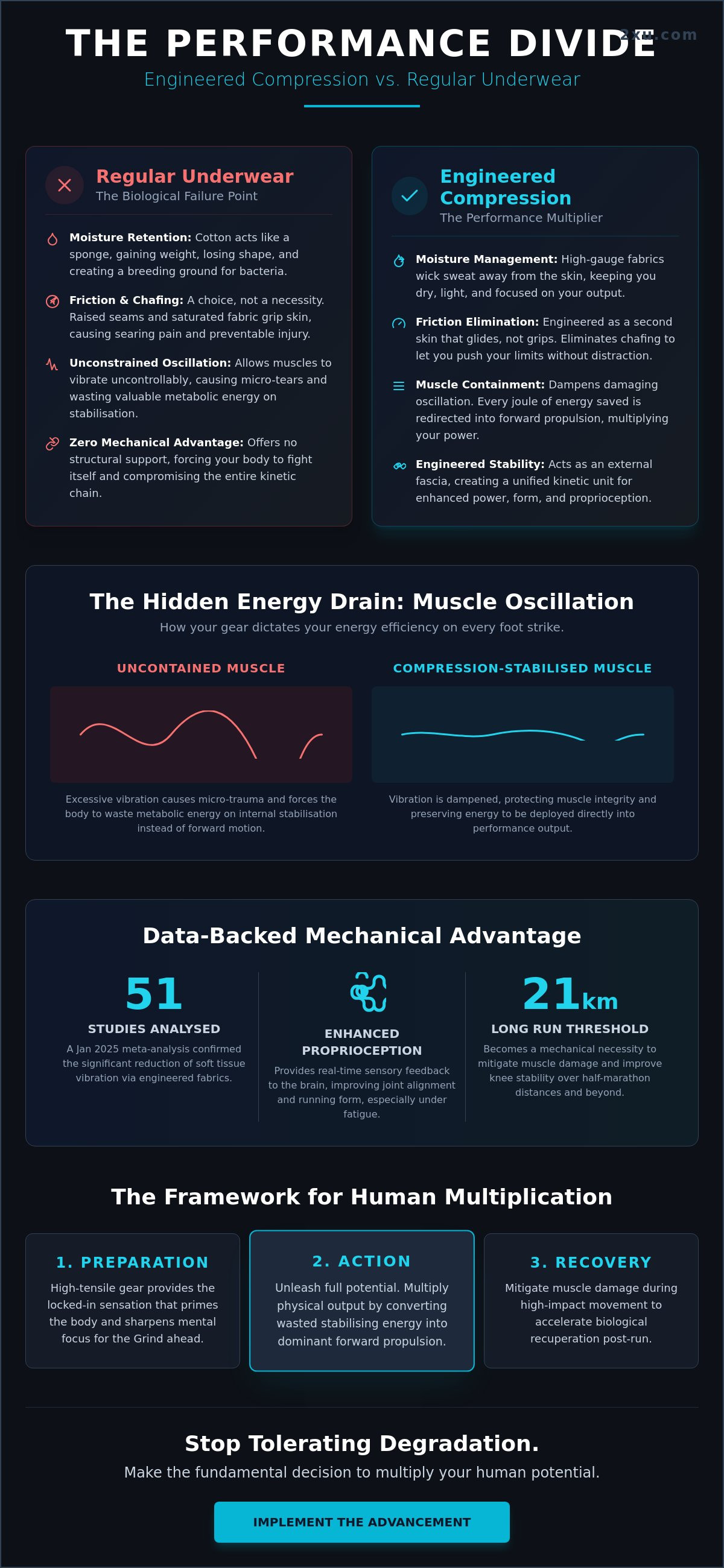
Swapping regular briefs for high-performance compression is the critical mechanical adjustment required to multiply your running output and accelerate biological recovery. We'll examine the rigorous data, including the January 2025 meta-analysis of 51 studies, to prove how engineered fabrics significantly reduce soft tissue vibration and improve knee proprioception over distances of 21km. You will learn exactly how to eliminate friction-based injuries, dampen muscle damage during high-impact movement, and leverage laboratory-validated technology to sharpen your post-run recuperation. This is the science of human multiplication.
Key Takeaways
- Identify how standard cotton layers act as a biological failure point by creating energy leaks through unconstrained muscle oscillation and moisture retention.
- Discover the mechanical role of high-gauge engineered fabrics in enhancing proprioception to maintain elite running form during high-impact movement.
- Analyse the technical disparity in compression shorts vs regular underwear for running by comparing knit density and graduated power ratings (mmHg).
- Determine the specific training thresholds where swapping to compression becomes a mechanical necessity to mitigate muscle damage during the long run.
- Implement a tripartite athletic framework—Preparation, Action, and Recovery—to multiply your physical potential and accelerate post-run recuperation.
The Biological Failure of Regular Underwear in High-Impact Running
Standard underwear is a non-technical layer that actively degrades your performance. While you focus on your splits and heart rate, a silent energy leak occurs at the most fundamental level of your kit. Regular underwear is designed for sedentary lifestyles, not the repetitive, high-velocity load of a distance run. It is a moisture-absorbing trap that increases friction and compromises your kinetic chain. In the context of compression shorts vs regular underwear for running, the latter represents a biological failure point that serious athletes must eliminate to maintain peak output.
Cotton is your primary liability. It is a hydrophilic fibre that retains significant weight in moisture, meaning your gear gets heavier as the Grind intensifies. Beyond the weight penalty, cotton loses its structural shape when wet, leading to sagging and a complete loss of support. It also creates an environment that promotes bacterial growth, leading to odour and skin irritation. Unlike professionally engineered Compression garments, regular underwear offers zero mechanical advantage. It allows for unconstrained muscle movement, which forces your body to expend metabolic energy simply to stabilise your soft tissue during the gait cycle.
The Friction Problem: Why Chafing is a Choice
Chafing is not an inevitable part of running; it is a sign of equipment failure. Regular underwear features raised seams and thick waistbands that create micro-abrasions under repetitive load. When sweat saturates these fibres, it creates a hydro-mechanical effect where the fabric grips the skin rather than gliding over it. This leads to searing pain and preventable skin damage that can halt your progress for days. Elite athletes do not tolerate these distractions. You cannot push your limits when your gear is actively tearing your skin apart.
Muscle Oscillation: The Hidden Cause of Fatigue
Every foot strike sends a shockwave through your lower limbs, causing muscle oscillation. This is the lateral vibration of muscle fibres that occurs upon ground impact. This vibration is not benign. It causes micro-tears in the muscle tissue and wastes significant metabolic energy as your body attempts to damp the movement manually. Regular underwear provides no containment for this oscillation. High-tensile compression creates a locked-in environment, providing the mechanical stability required to minimise this vibration. By reducing oscillation, you preserve energy for forward propulsion rather than internal stabilisation.
Engineering Stability: How Compression Multiplies Your Physical Output
Stability is the foundation of power. While regular underwear allows your muscle mass to move independently of your skeletal structure, engineered compression creates a unified kinetic unit. When analysing compression shorts vs regular underwear for running, the primary differentiator is mechanical integrity. High-gauge fabrics act as an external fascia, reinforcing your natural anatomy and providing the structural support necessary to maintain peak output during high-velocity movement. This is not about comfort; it is about the mathematical multiplication of your physical potential.
By applying a constant, calculated pressure to the quadriceps and hamstrings, these garments reduce muscle vibration and stabilise the soft tissue. This creates a multiplication effect: every joule of energy you save on internal stabilisation is a joule of energy you can redirect into forward propulsion. You stop fighting your own body and start dominating the pavement. Beyond the physics, there is a psychological edge. Stepping into high-tensile gear provides an immediate sensation of being primed for explosive movement, sharpening your mental focus for the Grind ahead.
Proprioceptive Feedback and Running Economy
Proprioception serves as a critical metric for endurance athletes because it dictates the precision of every foot strike and joint alignment under fatigue. Skin-tight compression stimulates cutaneous sensory receptors, providing your brain with real-time data on limb positioning. A 2026 study on compression running pants confirmed this effect, showing significant improvements in knee proprioception at distances of 14km and 21km. When your mechanics are precise, your oxygen cost per kilometre drops. You run more efficiently, stay taller in your gait, and resist the form collapse that typically occurs in the final stages of a race. Integrating advanced compression clothing into your kit ensures your mechanics remain sharp when it matters most.
Venous Return and Oxygen Delivery
The pressure gradient in technical compression is engineered to assist the circulatory system. By applying greater pressure at the extremities and tapering upwards, these garments facilitate venous return, pushing deoxygenated blood back to the heart more efficiently. This process reduces venous pooling and accelerates the removal of metabolic waste products like lactic acid. During high-intensity intervals, this enhanced oxygenation of the tissues allows you to maintain a higher work rate for longer. You delay the onset of muscle fatigue, allowing you to push through plateaus that would sideline an athlete wearing standard, non-technical gear.
Technical Breakdown: Compression Shorts vs Performance Running Underwear
Distinguish between technical running underwear and true, engineered compression. While moisture-wicking boxer briefs are a marginal upgrade from cotton, they lack the high-density knit required for physiological support. When weighing compression shorts vs regular underwear for running, you must evaluate the 'power' of the fabric, measured in millimetres of mercury (mmHg). Standard performance underwear typically falls below 10 mmHg, providing basic coverage but zero mechanical benefit to the underlying tissue. In contrast, elite compression garments provide 20 to 25 mmHg of targeted pressure to the major muscle groups. This density is achieved through specialised circular knitting machines that create a multi-directional stretch, ensuring the garment retains its compressive properties over hundreds of kilometres. Standard knitted fabrics fail the durability test; they lose elasticity under the repetitive strain of the Grind.
The 'Commando' protocol is a non-negotiable technical requirement for serious athletes. Many novice runners mistakenly believe that wearing a layer of briefs beneath their compression provides extra support or hygiene. This is a fundamental error. Compression is designed for direct skin contact to maximise the mechanical interface between the fabric and the muscle. Doubling up introduces unnecessary bulk and friction points, neutralising the very benefits you are paying for. Understanding The Science of Compression means respecting the engineering behind the garment; it is a standalone performance layer, not a cover-up.
The Layering Error: Why One is Better Than Two
A middle layer of underwear traps heat and moisture against the skin, creating a micro-climate that promotes friction. This additional layer neutralises the moisture-wicking properties of your high-performance Running Apparel, leading to rapid saturation. Extra seams from regular underwear increase the risk of 'saddle sores' and groin irritation under high-velocity movement. Trust the engineered liner or the compression fabric alone to manage the interface between your body and the environment.
Moisture Management and Thermal Regulation
Technical fibres are engineered to pull sweat away from the skin surface and disperse it across a larger surface area for rapid evaporation. This 'vapour' transport system is essential for maintaining core temperature during high-intensity intervals. Standard underwear, even technical versions, cannot match the evaporative cooling speed of high-gauge compression. Efficient thermal regulation prevents your heart rate from climbing due to heat stress, allowing you to maintain your work rate for longer durations without physiological degradation.
Optimising Your Kit: When to Deploy Compression
Deploying compression is a tactical decision based on physiological demand. For the 'Long Run', where repetitive impact leads to cumulative muscle damage, the stabilisation provided by high-gauge fabric is essential. In contrast, regular underwear fails to mitigate the micro-trauma associated with these high-mileage sessions. The tactical choice between compression shorts vs regular underwear for running depends entirely on the specific demands of your training block. Serious athletes require firm compression (23-25 mmHg) for peak competition and moderate levels (15-20 mmHg) for daily training or recovery phases. Choosing the right power level is about matching the garment's mmHg rating to your specific output goals.
Endurance vs. Intensity: Choosing Your Weapon
For explosive sprints and hill repeats, high-pressure compression is superior because it provides the maximum containment of muscle mass during rapid acceleration. This mechanical support reduces the risk of strain and ensures your energy is directed solely into propulsion. For recovery-paced efforts where thermal regulation is the priority, you might opt for specialised running shorts that prioritise airflow while maintaining basic stabilisation. Always match the fabric weight to your local environment. In humid conditions, lightweight meshes allow for evaporative cooling, while thicker, high-denier knits are reserved for cold-weather sessions where muscle temperature maintenance is critical.
Post-Run Recovery: The Work Continues
The Grind doesn't end when you cross the finish line. Keeping your compression on for 12 to 24 hours post-run is a scientifically validated method to reduce delayed onset muscle soreness (DOMS). Research has shown that graduated pressure stimulates lymphatic drainage, accelerating the removal of metabolic by-products and extracellular fluid that causes swelling. This process minimises the post-exercise delay in muscle fatigue, allowing you to return to high-intensity training sooner. Complementing your lower-body kit with compression shirts ensures total body recovery by supporting the upper kinetic chain and respiratory muscles. Regular underwear provides zero circulatory assistance, effectively leaving your muscles to stagnate in their own waste products. By choosing engineered garments, you are actively investing in your next session.
Sharpen your recovery protocol and shop the latest high-performance compression gear to multiply your output.
The 2XU Standard: Multiplying Human Capability through PWX Technology
2XU exists to eliminate the variables that hinder human potential. While the market is saturated with apparel that prioritises aesthetics, our engineering focus remains on laboratory-validated performance. At the core of this mission is PWX technology, representing Power, Weight, and Flex. This proprietary fabric is designed to provide high-power support while remaining lightweight and flexible enough for a total range of motion. The measurable difference between compression shorts vs regular underwear for running is found in the laboratory, where we use specialised instrumentation to ensure every garment meets our exacting standards for tensile strength and graduated pressure.
We operate within a tripartite athletic framework: Prep, Action, and Recovery. This holistic approach ensures that the athlete is supported at every stage of the training cycle. Our use of high-filament yarns ensures superior moisture control and durability, allowing the fabric to withstand the rigours of the Grind without degrading. These yarns are engineered to pull sweat away from the skin faster than standard knitted fabrics, maintaining your thermal equilibrium during high-intensity output. Regular gear cannot compete with this level of moisture management.
Laboratory-Tested Power
Consistency is the hallmark of elite gear. 2XU rejects average standards in favour of elite-level validation. We utilise industrial-grade testing machinery to validate the mmHg pressure of our garments, ensuring that a rating of 20 to 23 mmHg is consistent across every square centimetre of the fabric panel. Our circular knit technology provides 360-degree stretch, which is superior to standard warp-knit fabrics that often lose their compressive power after limited training cycles. This durability ensures your gear lasts as long as your ambition.
Join the Elite: Earn Your Place
High-level gear is a multiplier, not a substitute. You must bring the discipline, the sweat, and the unyielding commitment to the Grind; we provide the mechanical advantage. Stop settling for the biological failure of regular layers that hold you back. Demand a multiplied output. It is time to implement the technical adjustments required to push beyond your current limits and redefine what is physically possible. Upgrade your performance with 2XU Compression Shorts and secure your place among the elite.
Demand More From Your Kit
The choice between compression shorts vs regular underwear for running is a decision to stop accepting physical degradation. Regular cotton is a technical liability that increases friction and drains metabolic energy through unconstrained muscle oscillation. Engineered compression, validated through rigorous laboratory testing, provides the mechanical stability required to protect your tissue and sharpen your proprioception over long distances. It is a calculated upgrade that respects the Grind and ensures your physical output is multiplied.
2XU utilises proprietary high-filament yarns and laboratory-validated pressure ratings to deliver gear trusted by IRONMAN champions and elite athletes globally. This is about more than comfort; it is about implementing a tripartite framework of preparation, action, and recovery to ensure you can return to high-intensity training faster. Stop settling for average standards and start demanding equipment that matches your ambition.
Multiply your output. Shop 2XU Compression Shorts.
Every session is an opportunity to sharpen your edge. Earn your place through discipline and superior preparation.
Frequently Asked Questions
Should I wear underwear under my compression shorts for running?
No, you should not wear underwear under your compression shorts. These garments are engineered for direct skin contact to ensure the mechanical interface between the fabric and the muscle is optimised. Adding a middle layer creates a biological failure point by trapping heat, promoting friction, and neutralising the moisture-wicking properties of the technical fibres. For maximum performance, follow the commando protocol to prevent saddle sores and groin irritation.
Can compression shorts really prevent running-related injuries like shin splints?
Compression shorts mitigate the risk of injuries by significantly reducing soft tissue vibration and muscle oscillation upon ground impact. While they don't replace proper strength training, the stabilising effect protects against micro-tears in the quadriceps and hamstrings. By improving proprioception, they also help you maintain elite form when fatigue sets in, which is a critical factor in preventing the biomechanical collapses that lead to shin splints or joint strain.
How tight should my running compression shorts be to actually work?
Your gear should feel firm and locked-in without restricting your range of motion or cutting off circulation. Effective compression requires a specific pressure gradient, typically between 15 and 25 mmHg, to influence venous return and muscle stabilisation. If the fabric sags or bunches, the mechanical advantage is lost. Conversely, if you experience numbness or deep skin indentations, the fit is too aggressive and will hinder your physical output.
Do compression shorts cause overheating during summer runs?
Engineered compression garments actually assist with thermal regulation rather than causing overheating. High-filament yarns and technical mesh panels facilitate rapid evaporative cooling by dispersing sweat across a larger surface area. This process is far more efficient than wearing cotton, which retains heat and moisture. In the debate of compression shorts vs regular underwear for running, the superior vapour transport of compression keeps your core temperature stable during the most intense summer sessions.
How do I wash my compression gear to maintain its elasticity?
Maintain the elasticity of your gear by washing it in cold water on a gentle cycle. Avoid fabric softeners at all costs, as they clog the technical fibres and destroy the moisture-wicking vapour transport system. Use a mild detergent and always air dry your garments in the shade. High heat from tumble dryers or direct sunlight breaks down the Lycra and elastane components, leading to a permanent loss of compressive power.
Is there a difference between men's and women's compression for running?
The primary difference lies in anatomical tailoring and the distribution of power panels. Men's compression features a specialised pouch for support, while women's designs often include a wider, higher waistband for core stabilisation and different pelvic mapping. While both genders benefit from the same high-gauge engineered fabrics, the specific cut ensures the graduated pressure is applied to the correct muscle groups without compromising comfort or mechanical function.
Can I wear compression shorts for recovery even if I didn't run in them?
You can and should wear compression shorts for recovery even after non-running activities. The graduated pressure assists the circulatory system by facilitating venous return and stimulating lymphatic drainage, which reduces extracellular fluid buildup. This biological support helps clear metabolic waste products from your tissues. Whether you've been standing all day or finishing a heavy lifting session, the gear accelerates your return to a state of readiness for the next Grind.
What is the difference between compression shorts and half-tights?
The difference is defined by knit density and laboratory-validated pressure. While half-tights is a general term for any tight-fitting running apparel, true compression shorts must provide a specific mmHg rating to influence physiology. Many standard half-tights are made from basic knitted fabrics that offer aesthetics but zero mechanical stabilisation. True compression is a technical tool designed to dampen muscle vibration and multiply your physical potential through high-tensile, multi-directional stretch.