
Best Running Accessories for Long Distance: Engineering Your Endurance
Endurance is not a test of willpower; it is a mathematical calculation of energy conservation and biological management. When you hit the 30-kilometre mark, your mechanical efficiency begins to degrade as muscle oscillation increases and fatigue sets in. You respect the grind, but you shouldn't let it break your form. To maintain peak output, you must engineer your apparel to fight back against physiological decline.
We understand that every kilometre earned is a result of discipline and rigorous preparation. This article promises to help you master these requirements by identifying the gear designed to multiply your physical potential. By integrating high-performance compression gear for long distance running, you can effectively reduce recovery time and stabilise your mechanics. We will examine the technical specifications of elite accessories, from medical-grade graduated compression to moisture-wicking textiles, ensuring your focus remains on the finish line rather than the friction.
Key Takeaways
- Eliminate energy leakage by selecting gear that reinforces mechanical durability and maintains metabolic efficiency during high-mileage blocks.
- Leverage graduated compression gear for long distance running to accelerate venous return and suppress the muscle vibrations that trigger premature fatigue.
- Minimise metabolic cost through ergonomic carry systems and technical socks engineered for moisture expulsion and friction reduction.
- Stabilise your core physiological metrics with moisture-wicking fabrics that facilitate precise thermoregulation and heart rate control.
- Utilise laboratory-validated technology to multiply your physical output across the tripartite framework of preparation, action, and recuperation.
The Long-Distance Framework: Engineering Your Endurance
Long-distance running is a relentless test of mechanical durability and metabolic efficiency. It is the grind where every millimetre of movement is scrutinised by the laws of physics. Many runners suffer from energy leakage, a phenomenon where poor apparel choices allow for unnecessary muscle movement and heat retention. This inefficiency drains your power reserves long before you reach the final sector of your race. At 2XU, we reject the notion that gear is a mere secondary consideration. Our philosophy is rooted in the belief that human potential is multiplied through technical precision and unwavering discipline. There is a categorical divide between lifestyle clothing and performance-engineered gear; one is for aesthetics, the other is for maximal physical output.
The Biological Toll of High-Mileage Running
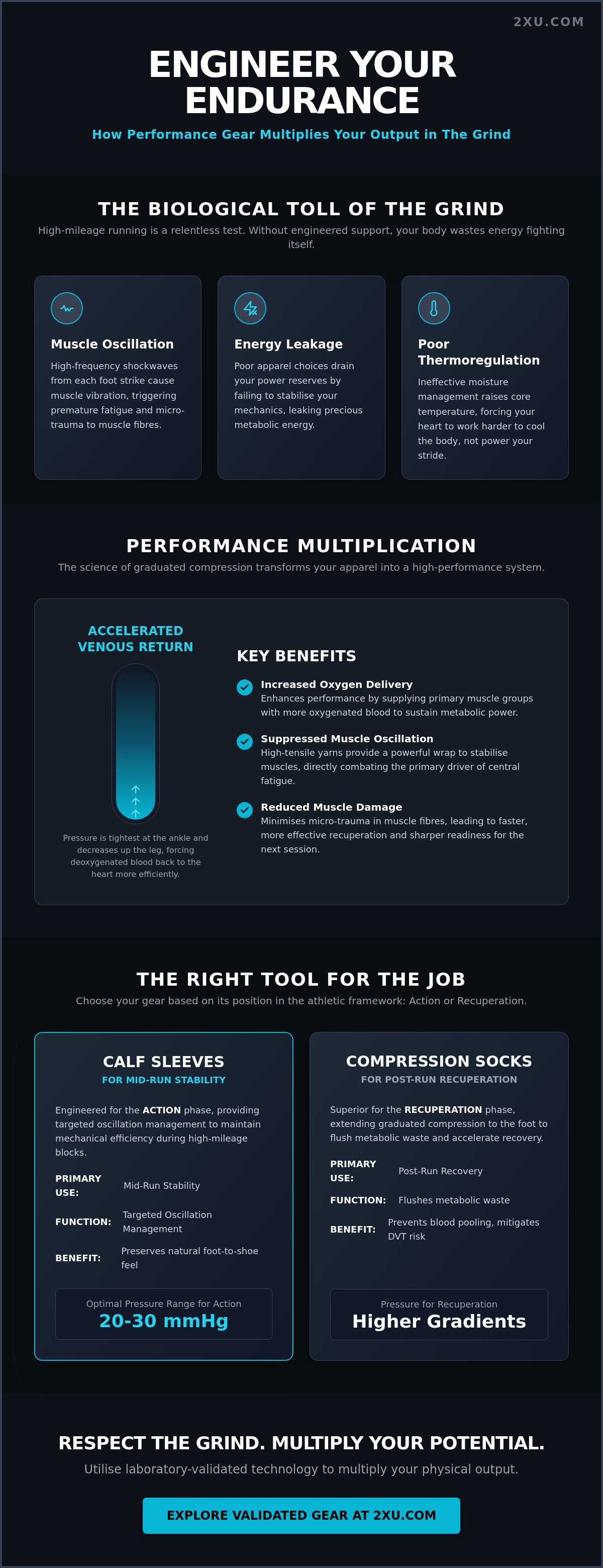
When your effort exceeds the 90-minute mark, the biological cost of each stride increases. Every foot strike sends a high-frequency shockwave through the lower extremities, triggering muscle oscillation. This lateral movement of the muscle tissue is the primary driver of central nervous system fatigue and leads to significant micro-trauma in muscle fibres over time. Without external stabilisation, your body wastes precious metabolic energy simply attempting to maintain structural integrity. Effective thermoregulation is also critical for heart rate stability. If your apparel fails to manage moisture and heat, your core temperature rises, forcing your heart to work harder to cool the body rather than powering your stride.
Defining High-Performance Running Accessories
Shift your mindset from carrying things to optimising physiological systems. An elite endurance kit is built on three distinct pillars: Stability, Hydration Management, and Recovery. High-performance accessories are tools designed specifically to mitigate physiological decline and preserve running economy. By integrating The Science of Graduated Compression, athletes can enhance venous return and maintain mechanical alignment under duress. Professional-grade compression gear for long distance running provides the external framework necessary to reduce muscle vibration and accelerate waste product removal. You must treat your gear as a component of your biological engine. Respect the grind by equipping yourself with technology that validates your effort and multiplies your results.
Performance Multiplication: The Science of Graduated Compression
High-performance output is a matter of fluid dynamics and mechanical stabilisation. Graduated compression is the engineering solution to a biological bottleneck. By applying precise pressure that is tightest at the ankle and decreases proximally, these garments accelerate the rate of venous return. This process forces deoxygenated blood back to the heart more efficiently, increasing oxygen delivery to the primary muscle groups. When you integrate compression gear for long distance running, you aren't just wearing apparel; you're deploying a system designed to sustain metabolic power. High-tensile, medical-grade yarns provide the necessary wrap to suppress muscle oscillation, which is the primary driver of central fatigue and tissue damage during high-mileage blocks. The technical construction of these fabrics ensures that the pressure remains constant even under extreme physical duress.
Postural integrity is equally critical for maintaining peak respiratory function during the grind. Compression shirts provide essential support to the upper body, pulling the shoulders back to maintain lung capacity and prevent the structural collapse associated with late-stage exhaustion. You can explore our full range of technical apparel to find the specific tools required for your next endurance milestone.
Calf Sleeves vs. Compression Socks
Choosing between sleeves and socks depends on your position in the tripartite athletic framework. Calf sleeves are engineered for mid-run stability, providing targeted oscillation management without affecting foot-to-shoe feel. Full compression socks are superior for the recovery phase, as they prevent blood pooling in the feet and mitigate the risk of Deep Vein Thrombosis (DVT) after extreme efforts. For active endurance, aim for a pressure rating between 20 and 30 mmHg. This range provides the optimal balance between mechanical support and circulatory enhancement. Recovery phases often require higher pressure gradients to flush metabolic waste from the system effectively and sharpen your readiness for the next session.
Mechanical Stability in Tights and Shorts
Form breakdown is the enemy of the long-distance athlete. As fatigue increases, the abductors, glutes, and quads lose their alignment, leading to inefficient gait patterns and potential injury. Performance tights provide a structural external framework that locks these muscle groups into place. This mechanical stability ensures that every watt of energy is directed toward forward propulsion rather than correcting lateral sway. Many elite runners prefer running shorts with integrated liners to achieve this stability while maintaining maximum ventilation. Utilising compression gear for long distance running in this way dampens the impact of every stride, protecting your muscle fibres from the micro-trauma that causes post-run soreness and prolonged downtime.
Ergonomic Carry Systems: Managing Nutrition Without Energy Waste
Efficiency in endurance running is determined by the elimination of mechanical distractions. Every gram of weight you carry must be stabilised to prevent energy leakage and postural decay. When a carry system is poorly engineered, it creates a "bounce" effect that forces your core muscles to work overtime to correct your centre of gravity. This unnecessary metabolic cost compounds over 42 kilometres, leading to premature exhaustion. You must view your hydration and nutrition storage as an extension of your body's own mechanical framework. While integrating compression gear for long distance running provides the structural foundation for your muscles, your carry systems must work in tandem to maintain your running economy.
Running Belts and Hydration Ergonomics
The primary criteria for any carry system is no-bounce technology. A belt that shifts during your stride disrupts your rhythm and causes friction that leads to skin irritation. High-performance belts distribute weight evenly across the iliac crest, ensuring that your centre of mass remains stable. Accessibility is non-negotiable. You shouldn't have to break your form or slow your cadence to reach for electrolytes or gels. Look for systems that prioritise anatomical fit and use technical fabrics that won't stretch or sag when fully loaded. Discipline in training requires gear that respects your posture and allows you to focus entirely on the grind.
Performance Socks: The Foundation of Every Mile
Blisters are not an inevitable part of long-distance running; they are a sign of technical failure. Performance socks are engineered with specific padded zones to protect the metatarsals and heels from repetitive impact. An anatomical left and right fitment ensures that the fabric contours perfectly to the foot, eliminating the bunching that causes friction. Technical yarns are essential for rapid moisture expulsion. Unlike non-technical materials that retain water and increase in weight, these textiles move sweat away from the skin to maintain a dry micro-climate. This moisture management is critical for preventing the skin softening that leads to painful lesions. If your socks are water-logged, your mechanical efficiency drops as your feet slide within your footwear.
Managing the micro-climate around your face and eyes is the final component of the endurance kit. Technical headwear serves a dual purpose: it prevents salt-heavy sweat from reaching your eyes and provides essential thermoregulation for the head. This gear must be as durable as your resolve. High-mileage training blocks will expose every weakness in your equipment. Choose accessories designed to survive the repetitive stress of the grind, ensuring that your focus remains on the mathematical challenge of the distance rather than the failure of your apparel.
Managing the Grind: Thermoregulation and Post-Run Recuperation
Success in the long-distance grind is predicated on your ability to maintain homeostatic balance. Thermoregulation is not a luxury; it is a critical driver of heart rate stability and overall performance. When your core temperature rises unchecked, your cardiovascular system diverts blood flow from the working muscles to the skin for cooling. This shift results in a measurable drop in power output. Technical fabrics engineered for moisture management are your first line of defence against this physiological drain. These textiles facilitate rapid evaporative cooling, preventing the heat-related fatigue and skin maceration that compromise your mechanical efficiency. By utilising specialised compression gear for long distance running, you ensure that your body remains a precision-tuned machine even under extreme thermal stress.
UV Protection and Moisture Management
Solar radiation is an often-overlooked metabolic tax. During endurance efforts exceeding three hours, sun exposure increases your thermal load and accelerates dehydration. Specialised headwear and arm protectors are essential tools for managing this solar impact. These accessories use advanced technical yarns to block UV rays while simultaneously moving sweat away from the dermis. By maintaining a stable micro-climate, you preserve your energy for propulsion rather than internal cooling. Efficiency is found in the details; don't let a lack of solar protection undermine your training block.
The Science of Repair and Recuperation
The elite athlete knows that the race doesn't end at the finish line; it ends when the repair phase is complete. High-performance compression technology is vital for accelerating the removal of blood lactate and metabolic waste products that accumulate during high-intensity efforts. This process involves:
- Increased Venous Return: Graduated pressure assists the valves in your veins, pushing deoxygenated blood back to the heart.
- Reduction of Oedema: Targeted compression limits the swelling and fluid retention caused by repetitive muscle trauma.
- Enhanced Oxygenation: Faster blood turnover means fresh, nutrient-rich blood reaches damaged tissues sooner.
Transitioning immediately from the grind to a recuperation protocol ensures that you can maintain consistency in your next training block. For those travelling to destination events, the risk of travel-induced fatigue and DVT is significant. You must utilise flight pressure socks to arrive at the start line in peak physiological condition. Discipline in recovery is what separates the amateur from the professional. Respect your effort by providing your body with the tools it needs to rebuild. Upgrade your kit with laboratory-validated compression today.
The 2XU Standard: Laboratory-Validated Endurance Gear
At 2XU, we don't guess; we measure. Our commitment to high-performance output is grounded in rigorous scientific validation and a refusal to accept average standards. This is the categorical difference between apparel that looks fast and compression gear for long distance running that is actually engineered to sustain your pace. We partner with elite academic research teams to ensure every seam and every textile serves a mathematical purpose. You earn your results through discipline, and we honour that effort by providing apparel that has been stress-tested in controlled laboratory environments. Every training block you complete is a step toward a better version of yourself. We ensure that your equipment is never the limiting factor in that progression.
Why Laboratory Validation Matters
We utilise specialised industrial testing machinery to guarantee that every garment delivers consistent graduated pressure across the entire production line. This precision is vital for maintaining the venous return and muscle stabilisation benefits required to combat biological fatigue. Our collaborations with leading sports scientists allow us to refine the performance of our technical fabrics, ensuring they provide the mechanical durability required for the most demanding endurance efforts. We reject the shallow standards of lifestyle fashion. Instead, we prioritise data-driven design and peer-reviewed proof points. This meticulous approach ensures that our gear effectively mitigates the micro-trauma and energy leakage that compromise your running economy over 42 kilometres and beyond.
Joining the Elite: Gear for the Disciplined Athlete
The Multiplication Promise is our guarantee that your physical potential can be exponentially increased through technical advancement. We provide the framework, but you must provide the willpower to endure the grind. 2XU gear is engineered for the disciplined athlete who understands that performance is not given; it is earned through sweat and repetition. While our standards are elite, our community is inclusive of every runner willing to put in the work. You don't need a professional contract to wear the best technology, but you do need the heart to respect the distance. It's time to sharpen your kit and master the physiological requirements of your sport. Shop the 2XU Running Collection to multiply your endurance potential and dominate your next high-mileage block.
Master the Mechanics of the Distance
Endurance is a mathematical challenge that requires absolute mechanical and metabolic precision. You've learned that gear is not a secondary consideration; it's a critical component of your biological engine. By eliminating energy leakage and suppressing muscle oscillation, you preserve the power needed for the final kilometres. Integrating laboratory-validated compression gear for long distance running ensures your effort isn't wasted on structural instability or poor thermoregulation.
We provide the high-performance technical fabrics designed for the ultimate grind. You provide the discipline. Our technology is trusted by elite athletes and sports scientists because it delivers tangible results in the most demanding environments. You've earned your place on the road through hard work and resilience. Now, equip yourself with the tools that respect your commitment and multiply your potential.
Engineered for Endurance: Shop 2XU Running Accessories
The road is demanding. Stay focused. Your next breakthrough is earned, not given.
Frequently Asked Questions
What are the most essential accessories for a first marathon?
The most essential accessories for your first 42 kilometre effort include graduated compression tights, an ergonomic hydration belt, and moisture-wicking technical socks. These tools are engineered to manage muscle oscillation and prevent the metabolic waste buildup that leads to premature fatigue. High-performance gear ensures your focus remains on the grind of the race rather than the failure of your apparel.
How does compression gear help with long-distance running performance?
Compression gear for long distance running enhances performance by increasing venous return and suppressing muscle oscillation. By applying a precise pressure gradient, these garments force deoxygenated blood back to the heart more efficiently to increase oxygen delivery to active tissues. This mechanical stabilisation reduces the lateral muscle movement that triggers central nervous system fatigue and tissue micro-trauma.
Do I really need specialised running socks for distances over 10km?
Specialised socks are non-negotiable for distances exceeding 10km because technical yarns facilitate rapid moisture expulsion and friction reduction. Standard materials often retain water weight and increase in volume when wet, leading to skin maceration and painful blisters. Technical socks feature anatomical left and right fitment to eliminate the bunching that causes mechanical inefficiency during your stride.
How should I carry water and gels during a long run without it bouncing?
Select a carry system featuring no-bounce technology that distributes weight evenly across your iliac crest to maintain a stable centre of gravity. Poorly designed belts create a pendulum effect that forces your core muscles to waste metabolic energy on postural corrections. Laboratory-validated systems ensure your nutrition and hydration remain accessible without compromising your running economy or structural alignment.
What is the difference between performance gear and standard athletic wear?
The difference lies in laboratory validation and mechanical precision. Performance gear is engineered using medical-grade yarns and specific pressure millimetres (mmHg) to provide tangible physiological benefits like increased blood flow and muscle support. Standard athletic wear is often designed for lifestyle aesthetics and lacks the technical construction required to survive the repetitive stress of high-mileage training blocks.
Can running accessories help prevent common injuries like shin splints?
Yes, accessories like compression sleeves provide the external framework necessary to dampen muscle vibration and reduce strain on the connective tissues. By stabilising the calf and tibialis anterior, this gear mitigates the repetitive impact trauma that leads to shin splints. Consistent use of technical apparel protects your muscle fibres from the micro-trauma associated with the grind of endurance running.
How do I choose the right size for compression sleeves to ensure effectiveness?
Size selection must be based on precise anatomical measurements of your calf circumference at its widest point rather than standard clothing sizes. Accuracy is paramount because the graduated pressure gradient relies on a specific fit to accelerate venous return. If the sleeve is too loose, the mechanical stabilisation benefits are lost; if too tight, it may restrict arterial flow.
Is it worth wearing compression gear for recovery after a long-distance run?
Wearing compression gear for long distance running after your effort is critical for accelerating metabolic waste removal and reducing post-run oedema. This technology initiates the repair phase immediately by increasing blood turnover and oxygenating damaged muscle tissues. A disciplined approach to recovery ensures that you maintain consistency in your training and multiply your long-term physical potential.