
The Elite Triathlon Race Day Checklist: Engineering Peak Performance in 2026
A podium finish isn't an accident of raw grit; it's the calculated result of a perfectly engineered logistics strategy. You've spent months sharpening your physical output, but a single forgotten item or a transition error can negate every watt of power you've gained. To dominate in 2026, you must treat your preparation with the same scientific rigour as your interval training. This comprehensive triathlon race day checklist is designed to eliminate the anxiety of gear failure and ensure your equipment's technical superiority is fully utilised from start to recovery.
We understand the grind. You respect the discipline required to push human limits, yet you know that fear of a mechanical oversight can compromise your focus. This guide promises to multiply your performance by refining your race day variables, from technical wetsuit selection to biological restoration. You'll gain a foolproof packing list and a clear roadmap for faster transitions and recovery. We're moving beyond basic preparation and focusing on elite execution, where every piece of compression clothing and every technical fabric choice serves a documented purpose in your success.
Key Takeaways
- Implement a 24-hour readiness protocol to synchronise mechanical systems with biological preparation before the grind begins.
- Optimise hydrodynamics by selecting triathlon wetsuits that balance thermal regulation with the flexibility required for maximum propulsion.
- Master every technical variable from aerodynamic trisuits to mechanical stability using an elite triathlon race day checklist.
- Reduce cognitive load by mapping the transition area to prioritise direct entry and exit paths during the fourth discipline.
- Accelerate recuperation by utilising compression clothing within the critical 30-minute post-race restoration window to facilitate lactate removal.
Pre-Race Readiness: Optimising the Logistics of the Grind
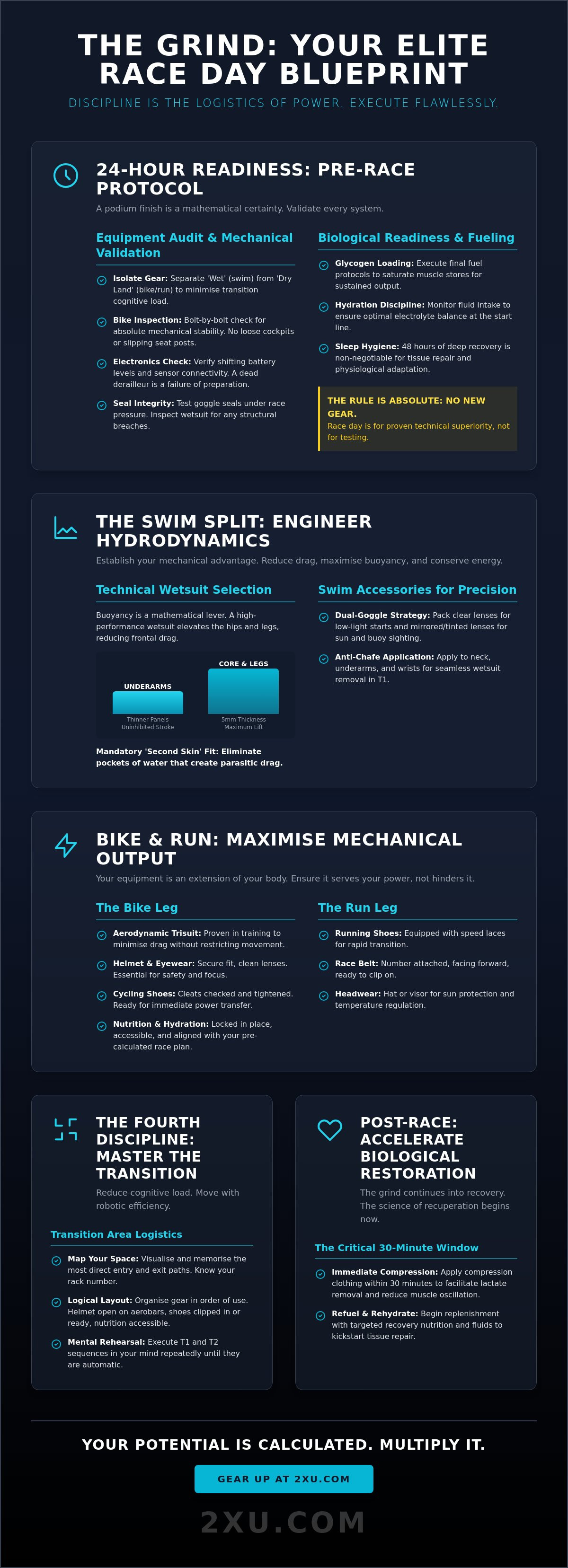
A podium finish is a mathematical certainty when your logistics match your physical output. The 24-hour window before the gun fires isn't for passive rest; it's for the final validation of every mechanical and biological system. You must execute a triathlon race day checklist that leaves zero room for oversight. This is where you separate your 'Wet' gear from your 'Dry Land' equipment. Your wetsuit and goggles belong in one sector; your running apparel and cycling kit in another. This separation strategy minimises cognitive load during high-intensity transitions, allowing you to move with robotic efficiency when the pressure peaks.
Respect the grind. Do not introduce unverified variables. The 'No New Gear' rule is absolute. Race day is the time for proven technical superiority, not for testing a new trisuit or unverified accessories. If a garment hasn't survived your peak training blocks, it has no place on the course. A comprehensive triathlon race day checklist serves as your blueprint for this final audit, ensuring every item from your training apparel to your athletic accessories is accounted for. Secure your timing chip and race licence immediately after the athlete briefing. Mental calibration requires aligning your ambition with the hard data of your power curves. You aren't guessing your pace; you're executing a pre-calculated plan in this endurance multisport race.
Equipment Audit and Mechanical Validation
Perform a meticulous, bolt-by-bolt bike inspection to ensure absolute mechanical stability. You can't afford a loose cockpit or a slipping seat post when pushing maximum watts during the cycle leg. Verify electronic shifting battery levels and sensor connectivity; a dead derailleur is a failure of preparation, not luck. Test your goggle seals under race-intensity pressure to prevent leaks. Inspect your triathlon wetsuits for any structural integrity breaches that could compromise hydrodynamic efficiency. Every component must be laboratory-ready to multiply your human potential and ensure your mechanical output remains uncompromised by preventable failure.
Biological Readiness: Tapering and Fueling
Biological restoration is as critical as mechanical maintenance. Execute final glycogen loading protocols to saturate your muscle stores for sustained physical output. This isn't about casual eating; it's about strategic fuel loading based on your body mass and expected intensity. Monitor your hydration levels to ensure an optimal electrolyte balance at the start line. Sleep hygiene in the 48 hours preceding the event is non-negotiable. Your body requires this deep recovery window to repair tissue and consolidate the physiological adaptations gained during your hardest training cycles. Discipline in bed is as vital as discipline on the road.
The Swim Split: Engineering Hydrodynamics and Buoyancy
The swim split is where you establish your mechanical advantage. It isn't just about survival; it's about engineering a hydrodynamic profile that conserves energy for the grind ahead. Your triathlon race day checklist must prioritise equipment that reduces drag and maximises buoyancy. Every second lost to water resistance is a second you have to claw back on the bike. We don't settle for average equipment. We demand gear that acts as a technical extension of the body. You've done the work in the pool. Now, ensure your equipment doesn't sabotage your output.
Technical Wetsuit Selection
Buoyancy is a mathematical lever. By elevating the hips and legs, a high-performance Triathlon Wetsuit reduces the frontal surface area exposed to water resistance. You need to evaluate neoprene thickness across specific zones. 5mm thickness in the core and upper legs provides maximum lift, while thinner panels in the underarms ensure your stroke remains uninhibited. A 'second skin' fit is mandatory. Any pocket of water trapped between the skin and the suit creates parasitic drag, slowing your split and wasting precious watts. The goal is to minimise water entry entirely, maintaining a thin thermal layer without compromising your range of motion during high-repetition strokes.
Swim Accessories for Precision
Light conditions in open water are volatile. Your triathlon race day checklist should include a dual-goggle strategy. Clear lenses are essential for low-light morning starts, while mirrored or tinted lenses provide the visual clarity needed to sight buoys against a rising sun. While some athletes rely on a comprehensive, printable checklist for basic gear, elite performers focus on the marginal gains. This includes brightly coloured towels for rapid transition identification and medical-grade skin lubricants to prevent the friction burns that can compromise your focus. Chafing is a failure of preparation. Apply lubricants generously to the neck, underarms, and ankles to ensure a rapid exit during T1.
Biological distractions like ear pressure or nasal irritation can be mitigated with nose clips and earplugs. These aren't luxuries; they're tools to maintain your cognitive focus on the rhythm of your stroke. Timing and heart rate monitoring in aquatic environments require sensors that maintain accuracy despite water interference. Use a chest strap with internal memory to capture the data you'll analyse post-race. Real-time pacing is difficult in the water, so trust your training and your technical gear to deliver the split you've earned. To multiply your aquatic efficiency, explore our range of Triathlon Wetsuits designed for the elite athlete.
Bike and Run: Maximising Mechanical Output and Stability
Moving from the water to the tarmac requires a shift in mechanical focus. Your triathlon race day checklist must now account for the transition from buoyancy to ground-based stability. On the bike, your objective is the total minimisation of drag. On the run, it's the mitigation of muscle oscillation. Every vibration through the pavement represents wasted energy that should be propelling you forward. By using technical apparel that provides targeted compression, you secure the muscle groups, reducing the biological fatigue that typically sets in during the final kilometres. This isn't just clothing; it's a performance engine designed to multiply your wattage.
The Trisuit: Your Performance Engine
Selecting a high-performance Triathlon Suit is a critical decision in your race day strategy. You need a garment that offers documented aerodynamic advantages on the bike while providing elite moisture management during the run split. The fabric must facilitate rapid evaporation to keep your core temperature stable. Ensure the chamois is specifically engineered for a triathlon position. It must provide enough cushioning for the bike leg without causing friction or bulk during the run. This single garment must perform across three distinct disciplines; any failure in its technical construction will be magnified over the hours of the grind.
Bike and Run Hardware Checklist
Efficiency is won through precision. When selecting your helmet, weigh the aerodynamic benefits of a closed aero-shield against the cooling requirements of a ventilated road helmet. If the temperature exceeds 28 degrees, the physiological cost of overheating might outweigh the marginal aero gains. For the run, transition speed is paramount. Use elastic laces to shave seconds off your T2 time. Your sunglasses should feature interchangeable lenses to adapt to shifting light conditions, ensuring you never lose sight of the road surface or your competitors. Your triathlon race day checklist should verify that all sensors are paired and calibrated before you leave the transition area.
Don't overlook the role of technical socks and sleeves. These tools enhance proprioception, providing your brain with better feedback on foot placement and mechanical alignment. This heightened awareness is vital when fatigue begins to compromise your form. Monitor your progress with unyielding rigour. Power meters and cadence sensors on the bike provide the objective truth of your effort. GPS tracking on the run ensures you're sticking to your pre-calculated pacing strategy. If the data shows a drop in output, you must have the discipline to adjust immediately. This is how you master the grind and ensure your physical potential is mathematically realised.
The Fourth Discipline: Transition and Nutrition Logistics
Transition is not a rest period. It is the fourth discipline of triathlon, requiring the same level of technical rigour as the swim, bike, or run. A cluttered transition area is a failure of organisation that leads to cognitive fatigue and wasted seconds. To multiply your efficiency, you must engineer a layout that minimises movement and reduces the complexity of your actions. Your triathlon race day checklist should include a mental 'Transition Map' that visualises exactly where you enter from the swim and exit for the bike. Every second spent searching for your rack is a second of lost momentum. Precision here is about reducing the variables that can go wrong under high-intensity stress.
Your nutrition delivery system must be as aerodynamic as your bike frame. Use integrated bento boxes and aero-bottles to ensure fuel is accessible without breaking your tuck. This is about maintaining your mechanical advantage while addressing your biological needs for sustained output. High-performance sun protection is another non-negotiable component of your logistics. Use an SPF that is specifically formulated to resist sweat and water for the duration of the event. Sunburn is more than a discomfort; it increases your skin temperature and heart rate, directly degrading your physical performance. Protect the engine to maintain the grind.
Transition Mastery Checklist
- Use a race belt with your number pre-attached. Safety pins are an inefficient relic that causes unnecessary delays when your heart rate is red-lining.
- Apply talcum powder or lubricants to your bike and run shoes. This facilitates rapid entry even when your feet are damp from the swim.
- Keep a small spray bottle at your station. Removing sand and grit from your feet prevents the abrasions that can ruin a run split and compromise your mechanical stability.
High-Performance Fuelling Strategy
Your fuelling strategy must be grounded in the data you've gathered during training. Calculate your required carbohydrate intake per hour and stick to the protocol with military discipline. Do not experiment with new products on the course. Electrolyte replacement salts are essential to maintain muscle function and prevent the cramping that halts progress. For the final 10km of the run split, utilise caffeine gels to sharpen your cognitive focus and provide a final surge in power. This is where your preparation pays off. Ensure you have the right Athletic Accessories to execute this plan with absolute precision.
Post-Race Protocol: The Science of Biological Restoration
Biological restoration is the final, non-negotiable phase of the tripartite athletic framework. The finish line is merely a transition point, and if you want to multiply your season's output, your triathlon race day checklist must extend into the recovery zone. Amateurs think the work is done at the tape. The elite know that restoration is the foundation for the next grind. You have a 30-minute metabolic window to initiate glycogen and protein restoration. Missing this window compromises muscle repair and delays your return to peak training. This phase is about accelerating blood flow and facilitating the rapid removal of metabolic waste like lactate. We don't just stop; we transition from action to restoration with the same rigour we applied to the swim split.
Immediate Recovery Essentials
Immediate mechanical support is vital for long-term health. Utilise Compression Shirts to support upper body postural recovery after hours of maintaining an aggressive aero-tuck on the bike. These garments reduce muscle oscillation even in a resting state, which is essential for mitigating delayed onset muscle soreness (DOMS). Your recovery-specific compression clothing should be applied as soon as you've cleared the finish chute. This isn't just about comfort; it's about using graduated pressure to force blood back to the heart, speeding up the repair of damaged tissue. Keep a hydration reservoir in your recovery bag to ensure fluid replacement begins the moment you stop moving.
Travel and Long-Term Recuperation
The journey home is often where recovery fails due to sedentary conditions. If you're flying or driving long distances, pack Flight Pressure Socks to combat travel fatigue and reduce the risk of deep vein thrombosis (DVT). These tools are engineered to maintain circulation when your limbs are inactive. Your triathlon race day checklist should also include soft-tissue tools like foam rollers or massage balls for targeted release of trigger points. Technical recovery apparel is necessary for thermal regulation, as your body's ability to maintain its core temperature is often compromised after extreme exertion. Respect the process. Discipline in recovery is what allows you to push harder in the next cycle.
Use data to validate your restoration rather than relying on feeling alone. Track your heart rate variability (HRV) in the 48 hours post-race to monitor your autonomic nervous system's response to the stress of the grind. A low HRV indicates you're still in a state of high physiological strain; don't return to high-intensity work until the numbers stabilise. This holistic approach proves that when you engineer every variable, the human potential is truly multiplied. You've earned your place through hard work. Now, ensure that effort isn't wasted by a failure of post-race logistics.
Execute with Absolute Precision
Race day is the ultimate validation of your discipline. You've synchronised your biological readiness with mechanical rigour; now you must execute. By internalising this triathlon race day checklist, you've eliminated the variables that cause average athletes to falter. You understand that peak performance is a tripartite process that doesn't end at the finish line. From the initial hydrodynamic advantage in the water to the final stage of biological restoration, every second is an opportunity to multiply your output through technical superiority.
Don't leave your results to chance. Our proprietary PWX compression technology is meticulously tested in elite sports laboratories to ensure it meets the unyielding standards of the world's best. World-champion triathletes trust this gear to manage muscle oscillation and accelerate recovery during the most intense grinds. It's time to equip yourself with the same level of scientific excellence. Shop the 2XU Triathlon Collection and Multiply Your Performance. You've done the work. Now, prove the concept that human is multiplied. Go out and earn your place.
Frequently Asked Questions
What is the most important item on a triathlon race day checklist?
Your timing chip and race licence are the most critical logistical items because their absence prevents you from entering the water entirely. While mechanical gear can often be sourced at the athlete village in an emergency, these credentials are non-negotiable for participation. Ensure they are the primary entries on your triathlon race day checklist to avoid disqualification before the grind even begins.
Should I wear a wetsuit if the water is warm but race-legal?
Yes, you should wear a wetsuit if it is race-legal because the hydrodynamic lift and buoyancy benefits mathematically outweigh minor thermal discomfort. A wetsuit elevates your hips, reducing frontal drag and allowing you to maintain an efficient horizontal profile. Unless you are at risk of immediate overheating, the mechanical speed advantage provided by high-performance neoprene is too significant to ignore.
How do I choose between a one-piece and two-piece triathlon suit?
Choose a one-piece trisuit for maximum aerodynamic efficiency and reduced parasitic drag during the bike and run splits. One-piece garments eliminate the risk of fabric bunching, providing superior mechanical stability and a streamlined profile. Two-piece suits are generally reserved for long-course events where physiological relief requires easier access; otherwise, the single garment is the elite choice for pure speed.
What nutrition should I pack for a 70.3 vs. a sprint triathlon?
Pack approximately 60 to 90 grams of carbohydrates per hour for a 70.3, whereas a sprint triathlon requires minimal fuelling beyond basic hydration. Sprints rely on existing glycogen stores, necessitating only a small volume of liquid electrolytes for the duration. A half-distance event demands a rigorous, data-driven nutrition plan to prevent the total depletion of muscle glycogen during the extended grind.
How can I speed up my transition times with specific gear?
Speed up your transitions by using elastic laces, race belts, and talcum powder to eliminate mechanical delays in T1 and T2. These accessories facilitate rapid shoe entry and instant number placement without the need for manual dexterity under high-stress conditions. Every second saved through efficient logistics is a second gained on the course without increasing your physical exertion or heart rate.
Is compression gear necessary for post-race recovery?
Compression clothing is a scientifically validated necessity for accelerating the removal of lactate and reducing muscle oscillation after the race. By applying graduated pressure, these garments facilitate venous return and oxygenate damaged tissue more efficiently than passive rest. This biological restoration is a cornerstone of the elite triathlon race day checklist, ensuring you return to peak training with minimal downtime.
What should I do if I forget a critical piece of equipment at home?
Head immediately to the race village or technical support tent to source a replacement if you discover a gear failure. Most sanctioned events have mechanical support and equipment vendors on-site to assist athletes in crisis. These mobile retailers often utilize advanced payment systems to ensure transactions are processed without delay; you can learn more about the latest professional standards for card payments in the UK. If a proprietary item is missing, reach out to the local triathlon community; the shared respect for the discipline often leads to support from fellow competitors.
How do I pack my transition bag for maximum efficiency?
Pack your transition bag in chronological order using a sector-based separation strategy to minimise cognitive load during the race. Place your run gear at the bottom, followed by bike equipment, with swim accessories positioned on top for immediate access. This ensures you move through your gear with robotic precision, allowing your focus to remain entirely on maintaining your physical output.