
Best Women's Running Shorts That Don't Ride Up: 2026 Performance Guide
Constant mid-run adjustments are a mechanical failure of your apparel, not your performance. You know the frustration of breaking rhythm to tug at fabric that refuses to stay put while inner-thigh chafing compromises your focus. It is time to demand more from your gear. Finding the best women's running shorts that don't ride up is about more than basic comfort; it's about maintaining the mechanical stability required for elite physical output. We agree that every millimetre of fabric movement is a distraction that drains your mental energy and degrades your power.
This 2026 performance guide provides the technical blueprint to eliminate these distractions and master the grind through apparel engineered for zero ride-up. You will learn how high-filament fibres and graduated compression reduce muscle fatigue by dampening oscillation during high-intensity efforts. We preview the latest advancements in elite gear, from integrated storage solutions to laboratory-validated moisture-wicking technology. Prepare to multiply your potential with equipment that survives the rigours of your most demanding training sessions and proves that your capacity is limitless when your gear performs.
Key Takeaways
- Identify the mechanical causes of ride-up, specifically how vertical displacement during your gait creates upward kinetic energy in standard textiles.
- Master the science of graduated compression and elastomeric yarns to maintain constant pressure and eliminate muscle oscillation for superior stability.
- Evaluate essential engineering features like flat-bond waistbands and multi-directional stretch polymers that ensure an unrestricted stride length.
- Utilise our decision matrix to select the best women's running shorts that don't ride up by matching specific inseam lengths to your training intensity.
- Discover how 2XU running apparel serves as a high-performance tool to multiply your effort and maintain absolute focus throughout the grind.
Why Your Running Shorts Ride Up: The Science of Mechanical Friction
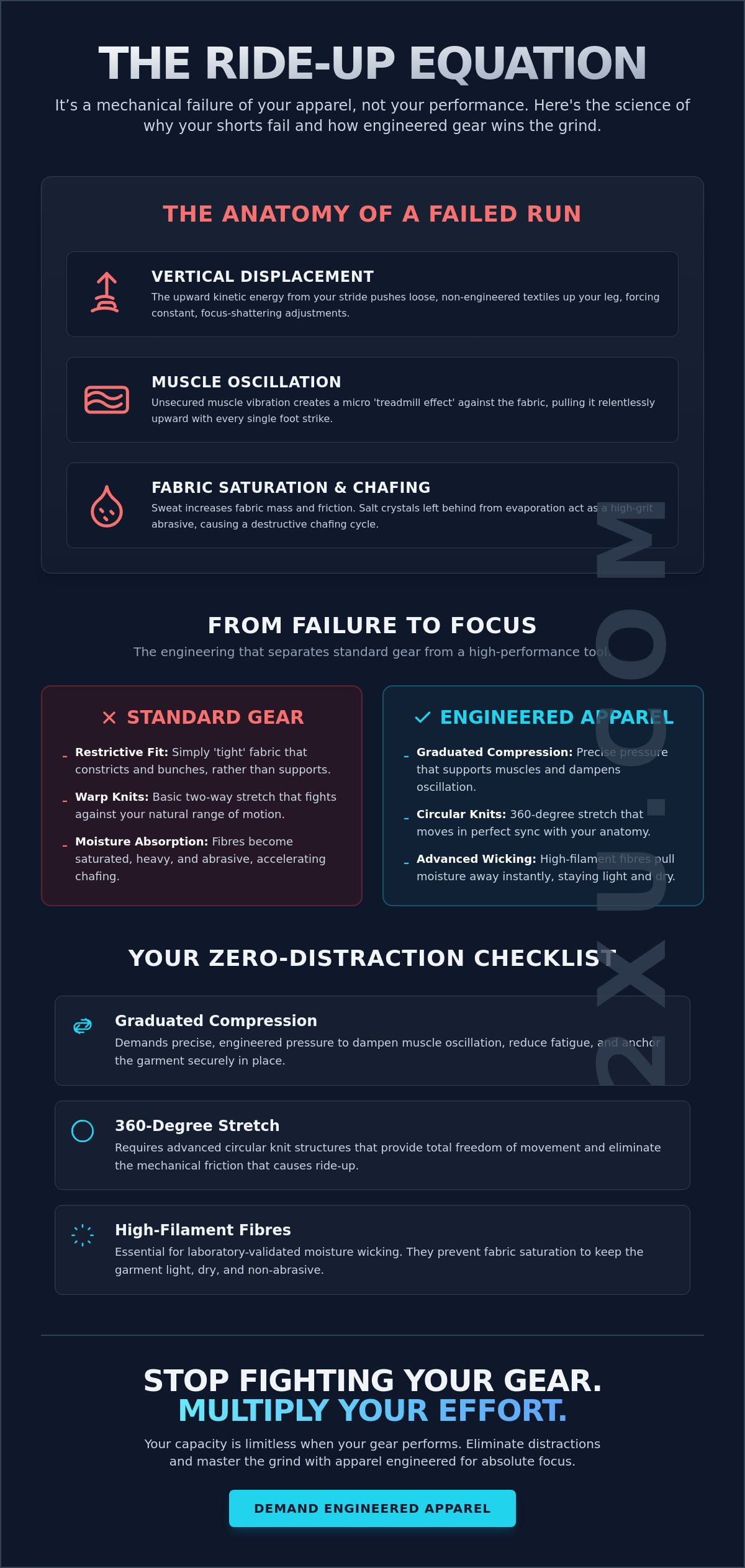
Ride-up is not a personal failing; it is a failure of textile engineering. When you run, your body experiences significant vertical displacement with every stride. This movement generates upward kinetic energy within loose textiles. If your gear lacks the necessary tension to anchor itself against your anatomy, that energy translates into fabric migration. Most athletes accept this as a necessary evil of the grind, but it is actually a solvable mechanical error. Understanding the physics of your apparel is the first step toward reclaiming your focus and improving your physical output.
Identifying the best women's running shorts that don't ride up requires an analytical look at three core factors: gait mechanics, fabric saturation, and muscle oscillation. Standard apparel often fails because it cannot handle the rigours of elite training. When fabric becomes saturated with sweat, its mass increases significantly. This additional weight, combined with the downward pull of gravity and the upward thrust of your stride, causes non-engineered materials to bunch and sag. It is a mathematical certainty that inferior gear will fail under these conditions. To maintain stability, your kit must utilise advanced Compression garment technology to create a secure, second-skin fit that resists these external forces.
The Impact of Muscle Oscillation on Fabric Stability
Muscle oscillation is the lateral movement and vibration of soft tissue that occurs every time your foot strikes the pavement. This constant "jiggle" creates a treadmill effect against the interior of your clothing, effectively pulling the fabric upward with every step. Most standard liners lack the structural integrity to counteract this force. Without the targeted stabilisation provided by high-power elastomeric yarns, your shorts will inevitably succumb to these micro-shifts. Engineered compression dampens this vibration, securing the muscle in place and providing a stable foundation for the fabric to grip.
Friction Points and the Chafing Cycle
When moisture management fails, fabric saturation increases the weight of the garment and heightens surface friction. Sweat contains salt. As moisture evaporates, these salt crystals remain on the skin and fibres, acting as a high-grit abrasive against your inner thighs. This creates a destructive cycle of chafing that erodes your mental discipline and breaks your concentration. The best women's running shorts that don't ride up solve this by using high-filament fibres that wick moisture away instantly. This prevents the buildup of abrasive residue and maintains a consistent friction coefficient throughout your run.
The psychological cost of gear failure is a critical factor in performance degradation. Every time you pause to adjust your waistband, you break your aerobic rhythm and deplete your cognitive reserves. Elite athletes understand that gear is a tool. If that tool requires constant maintenance during use, it is unfit for purpose. Mastering the grind requires a total elimination of these micro-distractions through superior mechanical design.
Engineering the 'No-Ride' Fit: Compression Technology Explained
To identify the best women's running shorts that don't ride up, you must distinguish between restrictive, tight apparel and engineered compression. Generic tight clothing merely compresses the surface of the skin, which often leads to fabric bunching and significant discomfort. True graduated compression is a precise mechanical application of pressure that facilitates blood flow and provides structural support to your muscle groups. This is achieved through high-power elastomeric yarns that maintain constant, uniform pressure throughout your entire range of motion. If your gear doesn't provide this level of tension, it will fail the moment your intensity increases.
Uniform tension is a non-negotiable requirement for gear that stays in place during high-output sessions. We achieve this through advanced circular knit structures. Unlike standard warp knits found in low-tier apparel, a circular knit provides a 360-degree stretch profile. This engineering ensures the fabric moves in total synchronisation with your anatomy. When the textile expands and contracts at the same rate as your muscles, the mechanical friction that usually causes ride-up is mathematically eliminated. This is not a matter of opinion; it is the result of rigorous laboratory validation and engineering discipline.
PWX Fabric: The 2XU Standard for Performance
Our proprietary PWX (Power, Weight, Flexibility) textiles represent the pinnacle of performance engineering. These fabrics utilise high-filament yarns to provide superior moisture-wicking properties without the need for chemical coatings that degrade over time. PWX is validated through industrial testing machinery to ensure it maintains its tensile strength and resists bagging out, even after hundreds of hours of elite training. This durability ensures your gear remains as effective on day 500 as it was on day one. If you are ready to upgrade your training kit, explore our range of performance compression clothing designed to survive the grind.
Muscle Containment Stamping (MCS) for Elite Stability
Section 1 established that muscle oscillation is a primary driver of fabric migration. Muscle Containment Stamping (MCS) is the direct response to this mechanical failure. By applying a targeted internal stamping to key muscle groups like the quads and glutes, we provide a secondary layer of stabilisation. This reduces the lateral movement of soft tissue upon impact, which in turn prevents the fabric from being pulled upward by the "jiggle" effect. When your muscles are contained, the best women's running shorts that don't ride up can perform their primary function: allowing you to focus entirely on your physical output. This level of stability is what separates elite gear from average sportswear.
Essential Features for Zero-Distraction Endurance Runs
The anchoring point of any elite garment is the waistband. While standard apparel focuses on aesthetics, the best women's running shorts that don't ride up utilise a flat-bond waistband to provide essential core support without compromising circulation. This structural element must resist the vertical displacement discussed in Section 1. If the waistband fails to maintain its position, the entire mechanical integrity of the short is lost. A wide, bonded construction distributes pressure evenly, ensuring the garment remains fixed despite the intensity of your movement.
Unrestricted stride length requires multi-directional stretch polymers. These materials allow for total range of motion while maintaining the tensile strength needed to snap back into place. Additionally, flatlock seams are a non-negotiable requirement for high-mileage athletes. Standard seams create internal friction points that contribute to fabric migration and skin irritation. Flatlock construction eliminates these ridges, preventing seam-failure ride-up and allowing you to maintain focus on your physical output. Discipline is built on the ability to ignore discomfort, but engineered gear ensures you don't have to fight your kit while you fight the clock.
Integrated Storage and Load Balancing
Physics dictates that an unbalanced load leads to instability. When you place a heavy device in a side pocket, you create an asymmetrical force that pulls the fabric downward and across the body. This destabilises the waistband and triggers the ride-up cycle. We advocate for rear-zip pockets or internal mesh panels that keep weight close to your centre of gravity. By centralising the load, you eliminate the bounce that typically forces mid-run adjustments. The best women's running shorts that don't ride up are designed to carry essentials without compromising the garment’s vertical alignment.
Breathability and Vapour Management
Fabric lightness is critical during the latter stages of the grind. As established in our analysis of fabric saturation, moisture buildup increases the weight and friction of your gear. High-performance moisture-wicking polymers pull sweat away from the skin instantly to maintain a dry friction coefficient. Laser-cut ventilation in high-heat zones further accelerates vapour management. This engineering ensures that your kit remains lightweight and functional from the first kilometre to the last. When your gear manages heat and moisture effectively, it proves that human is multiplied through meticulous technical preparation.
Selecting Your Performance Kit: Inseams, Pockets, and Compression Levels
Selecting the best women's running shorts that don't ride up requires a technical assessment of your gait mechanics and training intensity. You don't guess your interval splits; don't guess your gear requirements. Your choice of inseam and compression level must be a calculated decision based on anatomical friction points and the specific rigours of your discipline. Elite performance is the result of removing every possible variable that could impede your output.
- 3-Inch Inseam: Engineered for track work and high-velocity intervals. It offers maximum ventilation and minimal weight but requires high-power compression liners to prevent fabric migration.
- 5-Inch Inseam: The versatile standard for tempo runs and daily training. It provides a balanced ratio of coverage to mobility.
- 7-Inch Inseam: The definitive choice for ultra-endurance and high-friction environments.
The "Golden Rule" of inseams states that longer lengths are mathematically superior for preventing inner-thigh friction. A longer compression liner provides more surface area for the elastomeric yarns to anchor against the skin. This increased surface contact creates higher resistance to the upward kinetic energy generated during your stride. If you struggle with garment migration, increasing your inseam length is the most effective mechanical solution.
Before committing to your kit, perform a squat and stride test. If the leg opening migrates more than one centimetre during a deep squat, the fabric tension is insufficient for your muscle volume. Your gear must maintain its anatomical alignment under load. Match your compression levels to your specific goals: utilise high-power active compression for stabilisation during the grind, and graduated recovery compression to optimise biological repair post-session.
The 5-Inch vs. 7-Inch Inseam Debate
The 5-inch inseam is the versatile choice for athletes who require unrestricted movement during varied training intensities. It provides enough coverage to protect the upper thigh while allowing for maximum hip flexion. In contrast, the 7-inch inseam is paramount for ultra-endurance and trail running. These longer compression liners act as a second skin, totally eliminating ride-up by extending the anchor point closer to the knee. This ensures the garment remains fixed despite the unpredictable terrain and extended duration of your effort.
Waistband Height and Core Engagement
High-rise waistbands are not a stylistic preference; they are a functional tool for pelvic stability and proprioception. A secure, high-rise fit provides constant sensory feedback to your core, encouraging better posture throughout the latter stages of fatigue. Conversely, track sprinters may prefer a mid-rise fit to allow for the absolute maximum hip flexion required at peak velocity. For a deeper dive into engineering your fit, consult our comprehensive running shorts guide. Choosing the right best women's running shorts that don't ride up is about matching the architecture of the garment to the demands of your stride.
Shop our range of elite training apparel to secure the gear that survives the grind.
2XU Women's Running Shorts: Engineered to Multiply Your Effort
For the athlete who refuses to compromise on gear, 2XU is the only logical conclusion. We don't design apparel for casual fitness; we engineer tools for those who respect the grind. When you seek the best women's running shorts that don't ride up, you are looking for a mechanical advantage that allows you to push your physical limits without distraction. Our 'Human Multiplied' philosophy is grounded in the belief that your equipment should work as hard as your discipline allows. Every stitch and fibre is designed to ensure that your output is never limited by your kit.
Our engineering follows a rigorous tripartite framework to support the athlete through every phase of the journey. We address readiness by providing the muscular bracing required to prevent injury before you even start. During action, our shorts eliminate the mechanical failures of ride-up and fabric bunching through advanced tension management. Finally, our graduated compression technology facilitates biological recovery by enhancing blood flow and reducing post-exercise swelling. This holistic approach ensures that you are prepared to perform, day after day, with zero compromises.
The Active Performance Range
The Aero and Light Speed collections represent the pinnacle of speed and vapour management. These garments utilise high-filament yarns to accelerate moisture transfer, ensuring the fabric remains lightweight during high-intensity efforts. To create a complete performance system, many elite athletes pair these shorts with our compression shirts. This combination provides total body stabilisation and thermal regulation. We validate the durability of our engineered fibres through hundreds of wash cycles to ensure that the compression power remains constant, providing you with a reliable tool that survives the rigours of elite training.
Earn Your Place: The 2XU Commitment
We provide the most advanced technology on the market, but we don't offer shortcuts. Our gear is elite, yet it remains inclusive to anyone willing to put in the work. You must earn your place through sweat and persistence. 2XU apparel doesn't do the work for you; it multiplies the effort you already invest. It's time to stop settling for average standards and upgrade to gear that won't fail when the pressure is on. Respect the grind, trust the data, and demand the best from yourself and your equipment.
The best women's running shorts that don't ride up are a requirement for those who understand that every second counts. Don't let inferior gear break your focus or erode your mental discipline. Secure your mechanical advantage today and prove that your potential is limitless.
Shop the Women's Running Shorts Collection
Master Your Mechanics: Secure Your Performance Advantage
You now understand that garment migration is a technical error caused by insufficient fabric tension and muscle oscillation. By prioritising graduated compression and advanced circular knit structures, you eliminate the vertical displacement that breaks your rhythm. Finding the best women's running shorts that don't ride up is no longer a matter of trial and error; it is a matter of precision engineering. Your choice of inseam and load balancing architecture determines whether your gear supports your physical output or hinders it. Every element of your kit must serve the singular purpose of performance stability.
2XU gear is used by elite triathletes and marathoners worldwide because it is built for those who refuse to compromise. Our scientifically validated PWX fabric technology is engineered to withstand the rigours of the grind, ensuring your equipment performs as long as your discipline lasts. Don't let inferior apparel dictate the limits of your training. Maximise your output with 2XU Women's Running Shorts and reclaim your focus. You've done the work to understand the science; now do the work to master the road. Stay disciplined and keep pushing.
Frequently Asked Questions
Do compression shorts really stop riding up during long runs?
Yes, compression shorts engineered with graduated tension effectively neutralise the upward kinetic energy generated during your stride. This mechanical stability is achieved through high-power yarns that anchor the fabric against your anatomy. When searching for the best women's running shorts that don't ride up, look for circular knit structures that provide 360-degree stretch. This ensures the garment moves in synchronisation with your muscles rather than migrating upward under load.
What is the best inseam length for women's running shorts to prevent chafing?
A 5-inch to 7-inch inseam is the most effective length for preventing inner-thigh friction and garment migration. Longer liners provide an increased surface area for the fabric to grip, creating a more secure anchor point closer to the knee. This additional coverage physically separates the skin at high-friction points, mathematically reducing the risk of chafing. Shorter inseams often lack the necessary surface contact to remain fixed during high-intensity endurance efforts.
How tight should my running shorts be for maximum performance?
Your shorts should provide firm, consistent pressure that stabilises the soft tissue without compromising your range of motion. Use the squat and stride test to verify the fit; the fabric must remain in its original position when your muscles are under maximum load. If the waistband or leg openings shift significantly, the tension is insufficient to counteract muscle oscillation. Elite gear should feel like a second skin that enhances your proprioception and mechanical efficiency.
Can I wear compression shorts without underwear to prevent bunching?
Yes, wearing compression shorts without additional layers is a common strategy to eliminate the friction caused by fabric bunching. Performance liners are engineered with flatlock seams and moisture-wicking properties to handle direct skin contact safely. Removing the extra layer of standard underwear reduces the total mass of the kit and improves vapour management. This streamlined approach ensures that nothing interferes with the graduated compression profile of your training apparel.
How do I care for my performance running shorts to maintain their elasticity?
Maintain the mechanical integrity of your gear by washing in cold water and avoiding the use of fabric softeners or heat dryers. Softeners contain chemicals that coat the high-filament yarns, which degrades their ability to wick moisture and manage vapour. High heat from a dryer can damage the elastomeric fibres, leading to a permanent loss of tension and "bagging out." Air drying in the shade is the only way to preserve the lab-validated elasticity of your kit.
Are high-waisted running shorts better for preventing ride-up?
High-waisted designs provide a superior anchor point by securing the garment above the iliac crest. This positioning uses your natural pelvic structure to prevent the waistband from sliding down, which is often the first step in the ride-up cycle. Additionally, the increased coverage improves core engagement and provides consistent sensory feedback during the latter stages of the grind. For many athletes, this is a critical feature in the best women's running shorts that don't ride up.
What is the difference between active compression and recovery compression?
Active compression is designed to reduce muscle oscillation and provide mechanical stability during high-output movement. It focuses on dampening the vibrations that cause fatigue and fabric migration. Recovery compression utilises a specific graduated pressure profile to maximise blood flow and lymphatic drainage once the session is complete. While active gear keeps you stable during the action, recovery gear accelerates biological repair to ensure you are ready for the next session.