
How to Improve Running Form and Efficiency: The Science of Mechanical Output
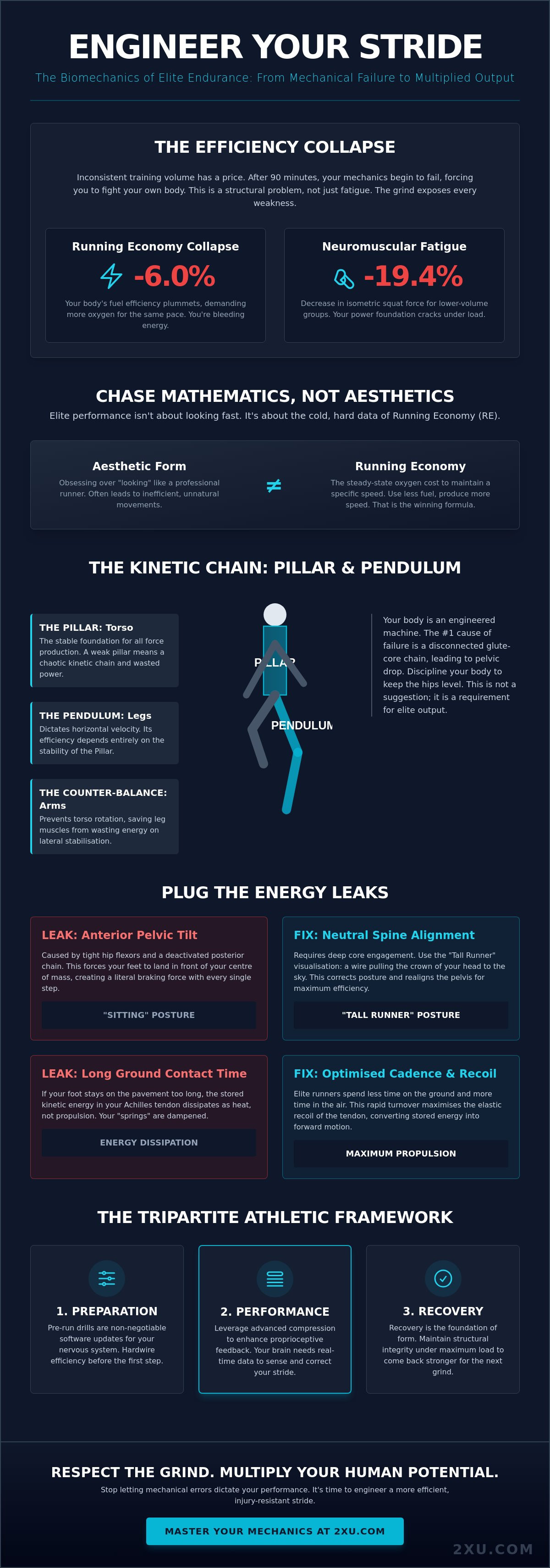
Recent 2026 research reveals that runners with inconsistent training volume suffer a 6.0% collapse in running economy after just 90 minutes of effort. You have likely felt this decline as a heavy sensation in your legs or seen your heart rate climb while your pace stagnates during late-race splits. It is frustrating to feel like you are fighting your own body instead of gliding over the pavement. Understanding how to improve running form and efficiency is not about mimicking the aesthetic of a professional athlete; it is a rigorous engineering project focused on mechanical stability and biological readiness.
This article promises to help you master the biomechanics of elite endurance so you can engineer a more efficient, injury-resistant stride. We will examine why lower-volume groups experience a 19.4% decrease in isometric squat force after long sessions and how to counteract this neuromuscular fatigue. You will learn to lower your heart rate at higher speeds and achieve a lighter feeling stride through data-backed drills and the strategic use of high-performance compression clothing. We are moving beyond guesswork to provide a laboratory-validated framework for multiplying your physical output and respecting the grind of elite performance.
Key Takeaways
- Differentiate between aesthetic form and Running Economy to focus your training on reducing the oxygen cost of maintaining elite speeds.
- Optimise your kinetic chain by stabilising the "Pillar" of your torso to support the high-velocity "Pendulum" of your leg drive.
- Leverage advanced compression clothing to enhance proprioceptive feedback, allowing your brain to sense and correct your stride in real-time.
- Discover how to improve running form and efficiency by implementing pre-run drills that serve as essential "software updates" for your nervous system.
- Integrate the Tripartite Athletic Framework of preparation, performance, and recovery to maintain structural integrity when your body is under maximum load.
Defining Running Economy: Efficiency vs. Form
Stop chasing the aesthetic of a professional runner and start chasing their mathematics. While many athletes obsess over "looking" fast, the elite focus on Running Economy (RE). This metric defines the steady-state oxygen cost required to maintain a specific submaximal velocity. If two runners have the same VO2 max, the one with superior economy wins every time because they use less fuel to produce the same speed. Understanding how to improve running form and efficiency requires you to stop viewing your stride as a movement and start viewing it as an engineering problem. Every movement that does not contribute to forward propulsion is an "energy leak."
Average runners often bleed watts through excessive vertical oscillation. If your head bobbles up and down by even an extra centimetre, you are fighting gravity rather than the clock. By eliminating these mechanical errors, we achieve the concept of "Human Multiplied." This is the point where your biological output is no longer hindered by structural waste, allowing you to sustain higher speeds for longer durations without hitting a metabolic wall.
The Mathematics of the Stride
Speed is the product of stride length and stride frequency, but the real secret lies in ground contact time. Elite runners spend less time on the pavement and more time in the air. This rapid turnover isn't just about leg strength; it's about the elastic recoil of the Achilles tendon. Think of your lower leg as a high-tension spring. When your foot strikes the ground, the tendon stores kinetic energy and releases it during toe-off. If your ground contact is too long, that energy dissipates as heat rather than propulsion. You might be the fittest athlete on the starting line, but if your "springs" are dampening your output, your VO2 max is irrelevant.
Why Natural isn't Always Optimal
The common advice to "just run naturally" is a recipe for injury and inefficiency. Your "natural" gait is likely a product of eight hours a day spent hunched over a desk, which creates tight hip flexors and a deactivated posterior chain. This leads to a "preferred" gait that feels comfortable but is mechanically disastrous, often resulting in overstriding and heavy heel striking. True progress requires a disciplined override of these bad habits to develop a truly efficient gait. Running efficiency is the reduction of wasted kinetic energy. To master how to improve running form and efficiency, you must treat your body as a machine that requires precise calibration rather than a self-organising system that knows best.
The Kinetic Chain: Engineering the Pillar and the Pendulum
Think of your body as a precision-engineered machine. The torso is the Pillar. It is the foundation of all force production. If this Pillar is weak, your limbs have no stable platform to push against. The legs are the Pendulum. Their role is to dictate horizontal velocity through knee drive and rhythmic swing. When you master the interaction between these two systems, you unlock the secret of how to improve running form and efficiency. Your arms act as the vital counter-balance. They prevent the torso from rotating excessively, which saves your leg muscles from wasting energy on lateral stabilisation.
The #1 cause of pelvic drop is a disconnected glute-core chain. When the gluteus medius fails to stabilise the hip, the opposite side of the pelvis dips. This creates a chaotic kinetic chain that bleeds power and forces your body to work harder just to stay upright. You must discipline your body to keep the hips level. This is not a suggestion; it is a requirement for elite output. Maintaining this level of control requires constant focus, but it is what separates the athletes who finish strong from those who fade.
Pelvic Alignment and Core Stability
Anterior pelvic tilt is a performance killer. It forces your feet to land in front of your centre of mass, creating a literal braking force with every step. Maintaining a neutral spine requires deep core engagement, especially under fatigue when the "grind" begins to set in. This is a critical component of injury prevention for runners. Use the "Tall Runner" visualisation: imagine a wire pulling the crown of your head toward the sky. This immediately corrects posture, realigns the pelvis, and prevents the "sitting" posture that destroys efficiency.
Foot Strike and Cadence Optimisation
Forget the myth of a "perfect" foot strike. Whether you land on your midfoot or forefoot matters less than where that foot lands in relation to your body. Overstriding is the fastest way to increase impact and decrease speed. Increasing your cadence, typically towards 170 to 190 steps per minute, naturally pulls your foot strike under your centre of gravity. Refining these mechanical details is the most direct path to mastering how to improve running form and efficiency. To support this mechanical alignment during high-intensity sessions, wearing technical Running Apparel provides the structural support needed to maintain form when your nervous system begins to flag.
Proprioceptive Feedback: How Gear Multiplies Mechanics
Proprioception is your body's sixth sense. It is the complex neurological loop that allows your brain to perceive joint position and limb movement without visual confirmation. When you are deep into a session and fatigue begins to blur your mechanical precision, your proprioceptive awareness often fails first. This is where technical compression garments act as a mechanical multiplier. By applying graduated pressure to the skin, these garments provide constant sensory biofeedback to the brain, effectively "reminding" your nervous system of its optimal alignment.
Understanding how to improve running form and efficiency requires a focus on muscle oscillation. Every time your foot strikes the pavement, a shockwave travels through your soft tissue, causing muscle "jiggle" or oscillation. This vibration is not just a comfort issue; it is a significant energy leak. Your muscles must work to stabilise themselves against this movement, wasting metabolic resources that should be used for forward propulsion. Reducing this oscillation through medical-grade compression allows you to preserve muscle integrity and maintain a higher power output for longer durations.
Muscle Containment Stamping (MCS)
Proprietary 2XU MCS technology takes mechanical support to a laboratory-validated level. By mapping the specific muscle groups most active during the gait cycle, such as the quadriceps and gastrocnemius, MCS provides targeted reinforcement that traditional apparel cannot match. This reduces the mechanical load on your muscles during the flight phase and ensures you land with greater stability. To understand the full scope of how this technology supports your upper body and core, read our detailed breakdown on Compression Shirts: The Scientific Guide to Performance & Recovery.
The Psychological Edge of Performance Apparel
The concept of "Enclothed Cognition" suggests that the gear you wear directly influences your psychological state and physical performance. Stepping into professional-grade apparel is a mental commitment to the grind. It signals to your brain that the upcoming session requires elite focus and discipline. We reject average standards by utilising advanced polymers and specialised knit structures that provide superior moisture management without the flimsy feel of lower-tier fabrics. This tactical approach to your wardrobe is a vital part of the strategy for how to improve running form and efficiency, ensuring you are mentally and physically primed for breakthrough results.
The Grind: Drills to Hardwire Efficiency
Drills are not a suggestion; they are a requirement for anyone serious about mechanical output. Think of these movements as software updates for your central nervous system. You are hardwiring the neural pathways that dictate how your muscles fire under load. If you skip the technical work, you are essentially trying to run high-performance hardware on outdated code. Mastering how to improve running form and efficiency starts before the first kilometre of your main set through a disciplined pre-run ritual. This ritual primes your neuromuscular system, ensuring your muscles are ready to execute perfect form from the first stride.
Incorporate strides and hill sprints to sharpen your mechanical edge. Strides are 20-second bursts of controlled, fast running that focus on turnover rather than max effort. They teach your brain to coordinate rapid muscle contractions without the accumulation of metabolic waste. Hill sprints take this a step further. By using gravity as a resistance tool, hill work forces a midfoot strike and aggressive knee drive. You cannot lean back or overstride on a 10% grade; the incline demands mechanical discipline. These sessions are short, intense, and essential for multiplying your power-to-weight ratio.
The Essential Drill Circuit
- A-Skips: This drill hardwires the critical relationship between arm drive and knee lift. Focus on a sharp, rhythmic pop off the ground to optimise energy return.
- Butt Kicks (The Correct Way): Forget hitting your glutes. The focus must be on rapid hamstring recruitment to pull the heel toward the pelvis, shortening the pendulum of the leg for a faster swing phase.
- Bounding: This is about explosive power. By exaggerating the flight phase, you train your body to reduce ground contact time and maximise the elastic recoil of your tendons.
Integrating Form Work into the Long Run
Maintaining integrity when fatigue sets in is the ultimate test of an athlete. At the 30km mark, your nervous system begins to flag, and your form will naturally degrade unless you intervene. Set a "Form Check" alarm on your watch for every 15 minutes. When it sounds, perform a mental scan: reset your posture, engage your core, and check your cadence. This discipline ensures you don't bleed energy during the most critical phases of your race. To maintain structural support during these high-mileage blocks, equip yourself with technical gear from our guide on Running Shorts: The Ultimate Guide to Engineering Your Performance. Respect the grind by ensuring your equipment is as focused as your training programme. Shop Training Apparel today to support your journey toward mechanical perfection.
The 2XU Multiplier: Recovery as the Foundation of Form
You cannot maintain mechanical integrity on trashed legs. When your muscle fibres are micro-torn and your nervous system is depleted, your body will revert to its most basic, inefficient movement patterns. This is where the quest for how to improve running form and efficiency often fails. Athletes focus on the hour they spend on the road but ignore the twenty-three hours that follow. True efficiency is a 24/7 pursuit. It requires a commitment to the Tripartite Athletic Framework: Prepare, Perform, and Recover. Without the final pillar, the first two are unsustainable.
Graduated compression is the primary tool for accelerating biological readiness. By applying the highest pressure at the ankle and decreasing it as it moves up the limb, technical garments facilitate venous return. This process flushes metabolic by-products and reduces the inflammatory response that leads to Delayed Onset Muscle Soreness (DOMS). If you don't clear this waste, your next session will be a limp rather than a run, and your form will suffer accordingly. Recent 2026 research indicates that runners with lower training durability see their economy decrease by 6.0% after just 90 minutes; recovery is the only way to build the durability required to resist this decline.
Biological Readiness for the Next Session
Recovery is not a passive state; it is an active mechanical process. Compression clothing prevents blood pooling in the lower extremities, ensuring that oxygenated blood reaches the muscles faster to repair damaged tissue. This is especially critical during travel or long periods of inactivity when the body is most vulnerable to stiffness. For travel-day recovery, using Flight Pressure Socks: The Science of Combating Travel Fatigue & DVT ensures you arrive at your destination ready to perform rather than compromised by travel-induced fatigue. This ensures your next session is a step forward, not a correction of previous errors.
Commitment to the Elite Standard
The "Human Multiplied" philosophy is built on the belief that your physical potential is an equation waiting to be solved. By optimising your mechanics, leveraging technical gear, and mastering the science of recovery, you exponentially increase your output. This is the difference between average participation and elite performance. Mastering how to improve running form and efficiency is a discipline that extends beyond the pavement. Review your gear. Refine your drills. Respect the grind. There are no shortcuts to mastery, only a more efficient path to the finish line. Explore our high-performance Running Apparel and start engineering your breakthrough results today.
Engineer Your Breakthrough Performance
Success on the road is the result of meticulous mechanical calibration and biological readiness. You now understand that elite running is an engineering project where the stability of your Pillar and the precision of your Pendulum dictate your performance ceiling. Mastering how to improve running form and efficiency is not a part-time interest; it's a 24/7 commitment to technical drills, proprioceptive awareness, and scientific recovery. Every movement that doesn't contribute to forward propulsion is a waste of your hard-earned potential.
It's time to equip yourself with gear validated by independent sports science research and trusted by elite triathletes and marathoners worldwide. Our proprietary MCS (Muscle Containment Stamping) technology provides the targeted compression required to reduce muscle oscillation and preserve your structural integrity under load. Shop the 2XU High-Performance Running Collection to ensure your apparel is as disciplined as your training programme. Respect the grind. Your next breakthrough is waiting for you to claim it through superior mechanics and the unyielding belief that your potential can be multiplied.
Frequently Asked Questions
Can compression tights really improve my running form?
Compression tights improve your form by enhancing proprioception and reducing muscle oscillation. By applying graduated pressure, these technical garments provide a constant sensory loop to the brain, which helps you maintain mechanical alignment when fatigue sets in. This biofeedback is essential for anyone learning how to improve running form and efficiency during high-intensity sessions where structural integrity often fails.
How long does it take to see improvements in running efficiency?
You can see immediate postural improvements through conscious cues, but physiological adaptations in Running Economy typically take 8 to 12 weeks of consistent drill work. Neuromuscular software updates require repetitive reinforcement to become your default gait. Discipline during the grind of each session is what eventually hardwires these breakthrough efficiencies into your biological system for long-term performance gains.
Is it dangerous to change my running gait after years of running?
Changing your gait is not inherently dangerous if you implement changes incrementally rather than overnight. Abrupt shifts in foot strike or stride length can overload tissues that haven't adapted to new stress patterns. Focus on small adjustments to cadence and posture first. This gradual approach allows your musculoskeletal system to strengthen alongside your mechanical evolution without increasing injury risk.
What is the most common mistake runners make with their form?
Overstriding is the most prevalent mechanical error among endurance athletes. Landing with the foot too far in front of the centre of mass creates a braking force that destroys momentum and increases impact shock. Correcting this is the most direct way to master how to improve running form and efficiency, as it immediately reduces the metabolic cost of each kilometre you run.
How do I know if my running cadence is too slow?
Your cadence is likely too slow if it falls below 170 steps per minute or if you feel heavy during your runs. A low turnover often indicates excessive ground contact time and vertical oscillation. Use a metronome or watch data to track your steps. Increasing your frequency by just 5% can significantly reduce the load on your joints and improve your horizontal velocity.
Do I need different form for sprinting versus long-distance running?
The core principles of the Pillar and Pendulum apply to both, but the amplitude of movement changes. Sprinting requires higher knee drive, more aggressive arm swing, and a more pronounced forefoot strike to maximise power output. Long-distance running focuses on conservation, using a more compact version of these mechanics to sustain speed without exhausting glycogen stores prematurely through unnecessary vertical movement.
How can I tell if I am overstriding?
You are overstriding if your foot lands with a straight knee and a vertical shin at the moment of impact. Listen for a loud slapping sound on the pavement, which indicates a heavy heel strike and wasted energy. In a truly efficient stride, the foot should land directly under your centre of gravity with a slightly bent knee to absorb and recycle kinetic energy.
Does core strength actually impact running economy?
Core strength is the foundation of Running Economy because it stabilises the Pillar of your torso. A weak core leads to pelvic drop and lateral rotation, which are significant power leaks that force your legs to work harder. By maintaining a rigid midsection, you ensure that every watt of energy produced by your muscles is directed into forward propulsion rather than correcting structural instability.