
Do Compression Tights Keep You Warm? The Science of Cold-Weather Thermoregulation
Bulk is the enemy of the elite athlete. When the mercury drops, many runners reach for heavy layers that restrict movement and trap moisture; however, true thermal efficiency comes from circulatory control rather than fabric thickness. You know the frustration of muscle stiffness in low temperatures and the biting chill that sets in the moment your pace slows. You've likely asked yourself, do compression tights keep you warm when the environment turns hostile, or are you just trading protection for aerodynamics?
The answer lies in the precise mechanics of blood flow and heat retention. This article explores how engineered compression multiplies your body's natural heat production and manages thermoregulation during high-intensity output. We'll break down the circulatory benefits of cold-weather gear and show you how to optimise your winter layering strategy. Discover how to maintain a performance-ready core temperature without the weight of traditional thermals, ensuring your output remains uncompromised by the elements.
Key Takeaways
- Eliminate the performance gap by understanding how cold weather increases muscle viscosity and why bulky traditional layers restrict your biomechanical efficiency.
- Discover the science of circulatory thermoregulation to understand how do compression tights keep you warm by accelerating blood flow to your extremities.
- Compare passive insulation with active thermoregulation to optimise your weight-to-warmth ratio during high-intensity winter training sessions.
- Implement the elite layering protocol to ensure your compression base layer maintains a performance-ready core temperature without sacrificing aerodynamics.
- Learn how laboratory-validated fabrics multiply your physical output by providing targeted muscle support and superior heat retention in hostile environments.
The Cold-Weather Performance Gap: Why Traditional Layers Fail
Training in sub-zero conditions is a test of discipline. It is where the elite separate themselves from the average. However, your biology faces a distinct mechanical disadvantage when the temperature drops. As external heat dissipates, muscle viscosity increases. This means the internal fluids within your muscle tissues become thicker, directly slowing down contraction times and reducing explosive power. You might ask, do compression tights keep you warm enough to counteract this physiological slowdown? The answer depends on whether your gear is designed for insulation or performance.
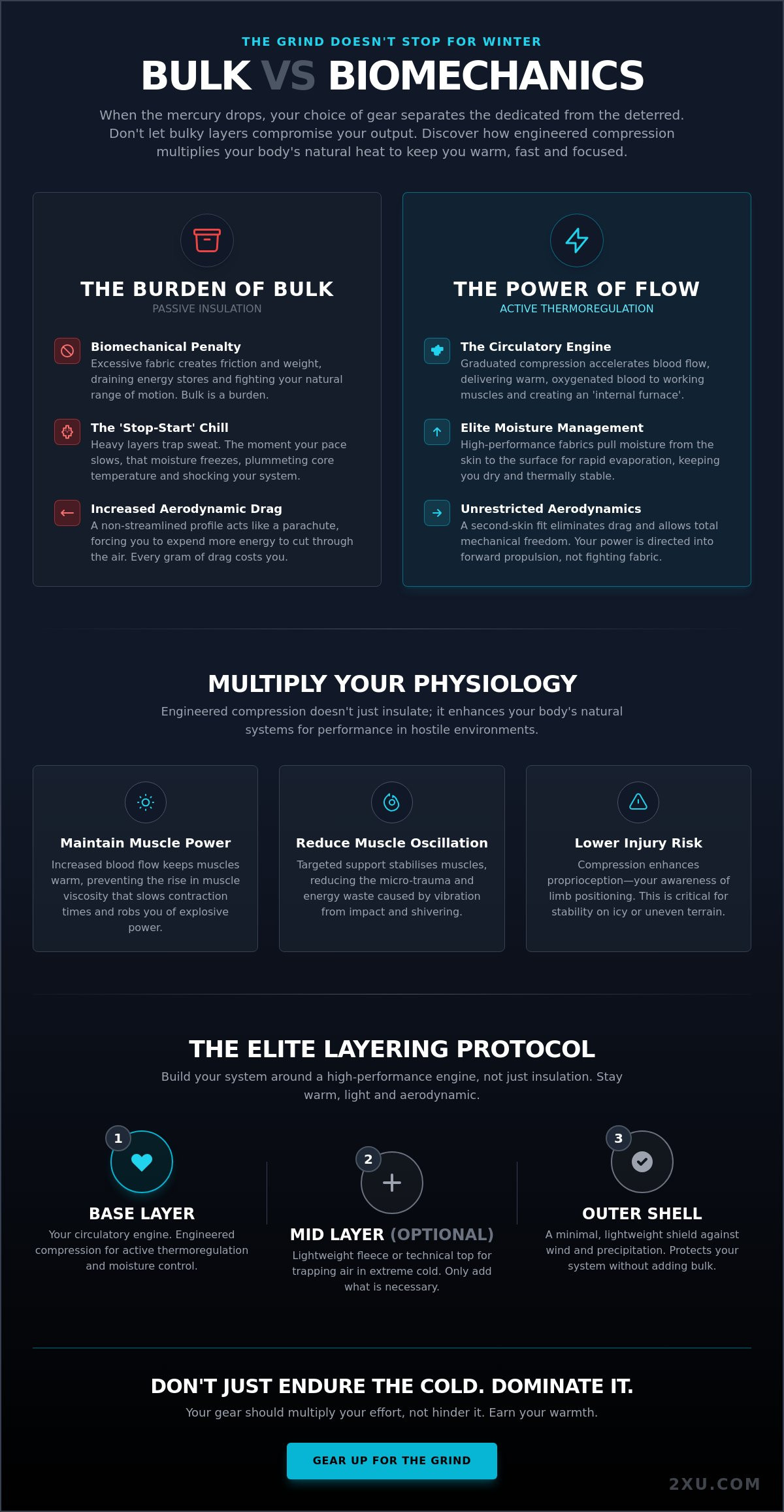
Standard thermal layers often rely on sheer bulk to trap heat. While this might work for low-intensity activity, it fails the high-performance athlete. Excessive fabric creates a massive biomechanical penalty. It increases wind resistance and compromises your aerodynamics. More importantly, heavy layers trap sweat. During the high-intensity segments of the grind, you produce significant moisture. Technical fabrics must move this moisture away instantly. If they don't, you face the "stop-start" chill. This rapid cooling during rest periods or downhill descents can plummet your core temperature, forcing your heart to work harder just to stay warm rather than driving your pace.
The Mechanical Cost of Winter Bulk
Bulk is a burden that drains your energy stores. When you layer up with traditional fleece or heavy knits, you introduce friction between every fabric surface. This creates resistance against your natural range of motion. Elite athletes prioritise a streamlined profile because every gram of unnecessary weight increases the metabolic cost of your run. There is also a psychological price. Feeling heavy and restricted during an endurance session leads to early mental fatigue. You need gear that feels like a second skin, allowing for total mechanical freedom while maintaining thermal stability.
Injury Risks in the Cold
Cold muscles are brittle muscles. When tissue temperature drops, the risk of strains and tears increases exponentially. Your body is less efficient at absorbing shock, and your reaction times dull. A specialised compression garment acts as a proprioceptive safety net. It heightens your sensory awareness of limb positioning, which is critical when navigating icy or uneven terrain. While investigating whether do compression tights keep you warm, you must also consider muscle oscillation. Cold weather often triggers shivering, a process where muscles vibrate to generate heat. Engineered compression stabilises these muscles, reducing micro-trauma and ensuring your energy is spent on forward propulsion rather than involuntary heat generation.
The Science of Circulatory Warmth: How Compression Multiplies Heat
Warmth in elite sport is not a passive state. It is an active metabolic achievement. While standard thermal gear acts as a simple barrier to trap air, engineered compression works as an engine. When athletes ask, do compression tights keep you warm, they are often thinking about insulation. However, the true advantage of compression lies in circulatory thermoregulation. This is the process of using graduated pressure to enhance blood flow, ensuring that warm, oxygenated blood reaches your extremities rather than pooling in the lower limbs where it cools rapidly.
Efficient venous return prevents the stagnation of chilled blood. By applying specific pressure gradients, compression garments force blood back to the heart at an accelerated rate. This constant movement keeps your internal engine running hot. Peer-reviewed research on heat dissipation confirms that graduated compression garments facilitate more effective thermoregulation by managing the skin-to-fabric microclimate during peak exertion. This reduces the metabolic cost of maintaining your core temperature, allowing you to redirect that energy toward your physical output.
Graduated Compression and Blood Flow
The pressure gradient is the foundation of vascular efficiency. By applying the highest pressure at the ankle and decreasing it toward the thigh, compression tights assist the calf pumps in overcoming gravity. This mechanical advantage ensures a steady supply of warm blood to the working muscles. Increased oxygen delivery to active muscle tissues accelerates metabolic heat production, ensuring your limbs remain functional in sub-zero environments. This "Internal Furnace" concept relies on keeping your vascular system optimised so the heat produced by your heart and lungs is distributed effectively across your entire kinetic chain.
Moisture Architecture vs. Damp Chills
In the cold, moisture is a lethal variable. The physics of evaporative cooling means that wet skin loses heat up to 25 times faster than dry skin. If your gear traps sweat, you will experience a rapid, dangerous temperature drop the moment your intensity wanes. Engineered technical fibres are designed with a specific moisture architecture to pull sweat away from the surface of your skin instantly. Unlike standard knit fabrics that absorb and hold liquid, high-filament yarns disperse moisture across a wider surface area for rapid evaporation. This ensures you stay dry and prevents post-exercise hypothermia during the cool-down phase. Engineered compression clothing provides the vascular support and moisture management required to maintain this thermal equilibrium throughout the grind.
Thermal vs. Compression: Engineering the Right Base Layer
Understanding the difference between passive insulation and active thermoregulation is critical for any athlete training through a winter cycle. Traditional thermal base layers rely on passive insulation; they use lofted fabrics to trap a layer of air against your skin. While this provides immediate warmth, it often creates a bulky profile that hinders biomechanical efficiency. In contrast, engineered compression provides active thermoregulation. It doesn't just trap heat; it manages your body's internal temperature by optimising circulatory efficiency and muscle function.
When you ask, do compression tights keep you warm, you must evaluate the weight-to-warmth ratio. For high-intensity output, compression is the superior choice. It offers a streamlined, aerodynamic profile that reduces drag while providing the necessary thermal protection. This is backed by peer-reviewed research on compression and thermoregulation, which demonstrates that lower body compression garments can lead to significantly higher skin temperatures in cold environments (10°C) compared to non-compressive gear. By maintaining this temperature through blood flow rather than thick fabric, you preserve your power-to-weight ratio and maintain agility during the grind.
When to Choose Traditional Thermals
Traditional, non-compressive thermals have a specific place in an athlete's toolkit. They are best suited for low-intensity activities where your heart rate remains below Zone 2. In these scenarios, your body isn't producing enough metabolic heat to rely on circulatory thermoregulation alone. They are also ideal for static environments or extreme recovery phases where the goal is maximum heat retention during total rest. However, for dynamic movement, the limitations of standard thermals become clear. They lack the mechanical stability required to control muscle oscillation and often fail to manage moisture effectively at high work rates.
The Hybrid Advantage: Thermal Compression
The performance sweet spot is found in hybrid engineering. Advanced fabrics like 2XU PWX Thermal incorporate brushed internal fibres. These specialised technical yarns create small pockets to trap air for insulation without adding the bulk of a traditional fleece. This allows for 360-degree stretch and uncompromised mobility. The mathematical advantage of this system is total body coverage. Using Compression Shirts alongside thermal tights ensures your upper body maintains a consistent temperature while receiving the same vascular support as your legs. This integrated approach allows you to push through sub-zero conditions with the confidence that your gear is working as hard as your cardiovascular system.
- Active Warmth: Multiplies heat through enhanced blood flow.
- Aerodynamic Profile: Eliminates the drag and weight of traditional winter bulk.
- Mechanical Stability: Provides muscle support that standard thermals cannot match.
- Moisture Control: Rapidly transports sweat to prevent the post-run chill.
The Elite Layering Protocol for Sub-Zero Output
Layering for high-intensity output is a precise management of your body's micro-climate. It is not a matter of stacking fabrics until the chill disappears. For the serious athlete, every layer must serve a functional purpose that supports the kinetic chain. The base layer is the most critical component of this system. It must be compression. Because compression requires direct skin contact to facilitate the circulatory benefits discussed earlier, it must be the first thing you put on. This foundation is what allows you to validate the question: do compression tights keep you warm? The answer is yes, provided they are the primary layer responsible for managing blood flow and moisture transfer.
Once the base layer is established, the mid-layer provides breathable insulation. This layer should trap heat while allowing vapour to escape, preventing the moisture build-up that leads to rapid cooling. Finally, the outer shell acts as a technical barrier. Its job is to protect your internal micro-climate from the convective heat loss caused by wind and rain. By following this tripartite structure, you ensure that your gear works in harmony with your metabolic heat production rather than fighting against it.
Step-by-Step Layering for Runners
In temperatures between 0°C and 10°C, a single layer of high-performance compression tights paired with a technical tee is often sufficient. Your body produces enough heat during the grind to maintain thermal equilibrium. However, when the mercury drops below 0°C, you must transition to thermal compression tights paired with a wind-resistant shell. This combination provides the necessary shield against the elements without adding restrictive bulk. During the warm-up phase, you may start with an extra insulating layer, but you must be disciplined enough to shed it once your heart rate climbs. Maintaining a performance-ready core temperature requires constant adjustment to prevent overheating and subsequent sweat accumulation.
Protecting the Kinetic Chain
Specific zones of the body are more vulnerable to the cold and require targeted protection. The calves and Achilles tendons are prone to tightening in low temperatures, which can lead to strains or reduced power output. Maintaining consistent warmth in these areas is non-negotiable. If you are travelling to cold-weather races, integrating Flight Pressure Socks into your protocol ensures your circulatory system is primed and your legs remain fresh before you even hit the start line. Additionally, ensure your lower back and core are shielded. A cold core triggers a survival response that restricts blood flow to the limbs, immediately compromising your mechanical efficiency. Protect these vital zones to keep your engine running at peak capacity. Equip yourself with elite training apparel to ensure your winter output remains uncompromised.
2XU PWX Thermal: Engineered for the Toughest Conditions
The development of PWX Thermal represents a significant advancement in material science. We transitioned from standard performance compression to thermal dominance by re-engineering the fabric's core structure. When you ask, do compression tights keep you warm, the answer is validated through rigorous laboratory testing. We use specialised instrumentation to measure heat retention and muscle power output in simulated sub-zero environments. This data-driven approach ensures that our gear doesn't just feel warm; it maintains the physiological conditions necessary for elite output. We don't accept average standards because the world's best athletes don't either.
Our commitment to the multiplication of human potential is grounded in tangible results. Every piece of 2XU equipment undergoes peer-reviewed validation to ensure it meets the demands of the grind. By prioritising circulatory efficiency and mechanical stability, we provide a product that allows you to maintain your training volume regardless of the season. This is the 2XU promise: technical superiority that translates into mathematical improvements in your performance. You earn your place through hard work; we provide the engineering to make that work go further.
Proprietary Fabric Technology
The foundation of our thermal range is a sophisticated blend of high-filament polyamide yarns. These fibres are engineered for maximum durability and moisture transport without the use of standard materials. Our 105D fabric provides powerful compression to reduce muscle oscillation and fatigue, which is critical when cold temperatures increase the risk of micro-trauma. The secret to our heat-trapping capability is the brushed internal layer. This technical finish creates a soft-touch surface that holds a layer of warm air against the skin while simultaneously pulling sweat away to prevent the post-exercise chill. It's a dual-action system designed for the uncompromising athlete.
The Result: Human Multiplied
2XU gear is designed to help you push past the winter slump and maintain your discipline when others retreat indoors. By managing thermoregulation through circulatory support rather than bulk, we help you stay light, fast, and powerful. The cold is not an obstacle; it is an opportunity to sharpen your resilience and outwork the competition. Results are earned in the silence of the winter grind, and our technology ensures your body is ready to meet that challenge. For those transitioning between seasons or training in variable climates, understanding your gear is essential. Explore our guide to Running Shorts to continue optimising your performance as the temperatures rise. Respect the process. Trust the science. Multiply your output.
Master the Winter Grind
The cold is no longer a valid excuse for compromised performance. We have established that the answer to do compression tights keep you warm lies in active circulatory thermoregulation rather than passive, bulky insulation. By enhancing blood flow and managing moisture through high-filament technical yarns, you maintain a performance-ready core temperature without the mechanical penalty of traditional layers. Our PWX Thermal fabric technology, developed through rigorous laboratory validation and collaborations with the Australian Institute of Sport (AIS), ensures your muscles remain warm and stable.
Graduated compression doesn't just protect you from the elements; it accelerates your recovery and sustains your power throughout the most demanding sessions. You have the protocol. Now you need the equipment to execute it. Don't let the mercury dictate your results. Earn your place by training with the same precision as the world's elite. Respect the grind and stay focused on the mathematical improvement of your physical output.
Maximise your winter performance with 2XU Thermal Compression
The weather doesn't care about your goals. Prove that you do.
Frequently Asked Questions
Are compression tights warmer than regular gym leggings?
Compression tights provide superior warmth because they facilitate active thermoregulation. While regular leggings offer a passive barrier, engineered compression accelerates blood flow to generate internal heat. This vascular efficiency, combined with high-denier technical yarns, ensures your muscles remain at a performance-ready temperature. You don't just feel warmer; your biology is optimised to produce more heat during the grind.
Can I wear compression tights as a base layer under my normal clothes?
Yes, compression gear is designed to be worn directly against the skin to function as an elite base layer. This direct contact is necessary for the graduated pressure to influence your circulatory system effectively. Whether you are layering under running apparel or standard training gear, the streamlined profile ensures you maintain a full range of motion without the bulk of traditional thermals.
Do compression tights help with cold feet and poor circulation?
They are highly effective at addressing cold extremities by preventing blood from pooling in the lower limbs. By applying graduated pressure, these garments force chilled blood back to the heart to be reheated and re-oxygenated. This continuous cycle ensures that warm blood is redistributed to your feet, which is critical for maintaining mechanical stability and sensory feedback during winter training.
How do I know if my compression tights are 'thermal' enough for winter?
Verify the technical specifications of the fabric architecture. True thermal compression, such as 2XU PWX Thermal, features a brushed internal layer designed to trap pockets of air for insulation. You should also look for a high-denier rating, like 105D, which indicates a denser fabric capable of providing both powerful muscle support and superior heat retention in sub-zero environments.
Should I size up in thermal compression tights for a more comfortable fit?
Never size up, as this compromises the integrity of the pressure gradient. To answer the question, do compression tights keep you warm, they must fit tightly enough to compress the vascular system. A loose fit nullifies the circulatory benefits and allows cold air to circulate between the fabric and your skin. Trust the size guide to ensure the engineering works as intended.
Will compression tights make me overheat if the sun comes out during my run?
No, because technical fabrics are engineered with advanced moisture architecture. High-filament yarns pull sweat away from the skin instantly, allowing for efficient evaporative cooling if your core temperature rises too high. This dynamic regulation ensures you stay in the performance sweet spot, preventing the overheating often associated with heavy, non-breathable winter layers.
Do compression tights lose their warming properties after multiple washes?
Elite compression gear is engineered for long-term durability and will not lose its thermal properties if cared for correctly. High-quality technical yarns maintain their elasticity and brushed texture through repeated wash cycles. Unlike standard fabrics that may thin or pill, professional-grade training apparel is built to withstand the rigours of a sustained winter cycle without compromising on heat retention.
Can compression gear help prevent winter-related muscle cramps?
Yes, by maintaining optimal muscle temperature and reducing oscillation. Cold weather often leads to involuntary muscle contractions and cramping as the body struggles to stay warm. Compression gear stabilises the muscle groups and ensures a steady supply of oxygenated blood, which significantly reduces the risk of cramps. This allows you to maintain your discipline and push through the most hostile training conditions.