
Women's Compression Buying Guide: Engineering Your Peak Performance
What if your gear was a precision-engineered tool designed to multiply your physiological output rather than just a layer of fabric? Most athletes treat their wardrobe as an afterthought; however, the wrong choice allows muscle oscillation to trigger premature fatigue and stalls your recovery before you even leave the track. Selecting the correct women's compression is not a matter of style. It's a technical requirement for those who respect the grind and demand mathematical improvements in their results.
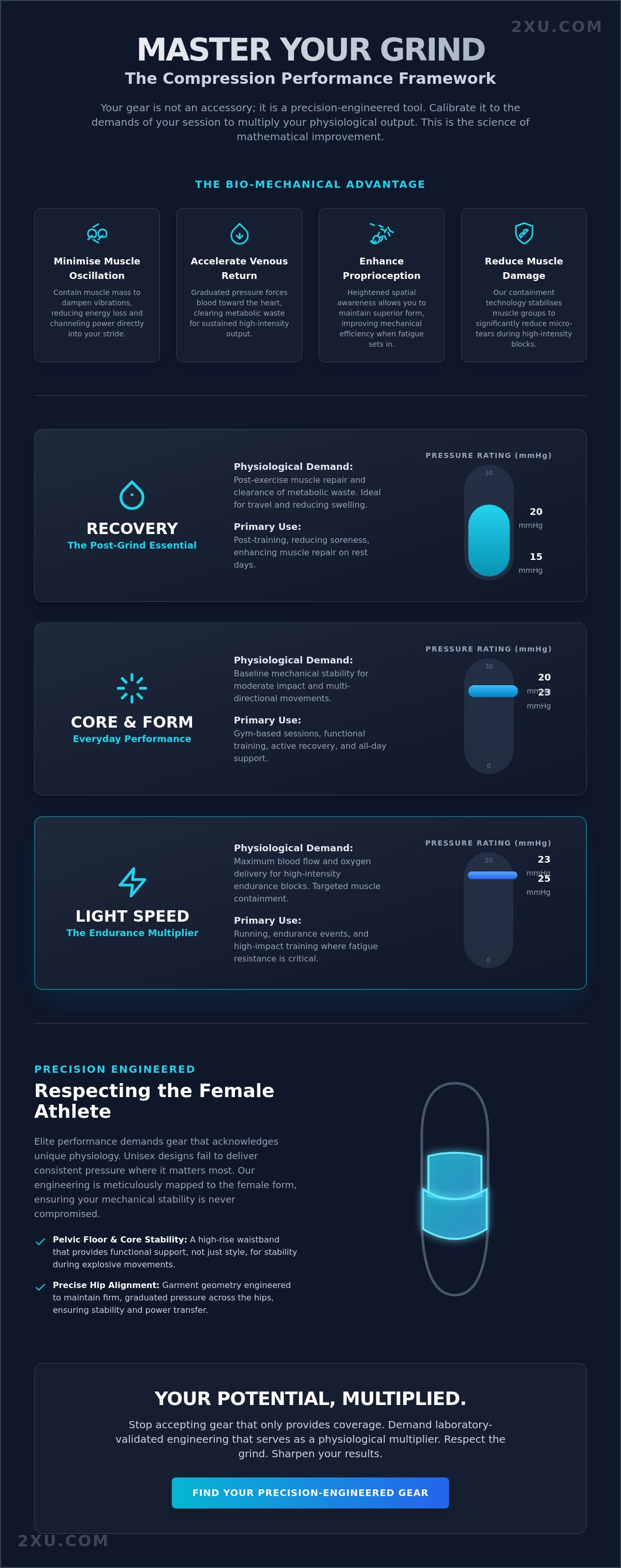
You understand that every millimetre of movement matters when you're pushing toward a new personal best. This guide will teach you to master the science of medical-grade compression and select the precise technical gear needed to increase your mechanical stability. We'll break down the performance framework across specific tiers, ranging from 15-20 mmHg for all-day support to firm 25-28 mmHg for high-intensity output. You'll learn how to optimise blood lactate clearance and eliminate gear that shifts during endurance blocks, ensuring your potential is exponentially multiplied through laboratory-validated engineering.
Key Takeaways
- Define graduated compression as a physiological tool that facilitates venous return and minimises muscle oscillation during high-intensity blocks.
- Identify the precise pressure rating your training demands by navigating the performance framework, from mild recovery tiers to firm 28 mmHg output levels.
- Evaluate garment geometry—tights, shorts, or sleeves—to target specific muscle groups and optimise thermal regulation during endurance sessions.
- Master the technical fit protocols to ensure your women's compression functions as a physiological multiplier rather than a standard tight.
- Discover the 2026 elite gear standards designed to sharpen your performance through laboratory-validated engineering and superior mechanical stability.
What is Women's Compression? Beyond the Standard Tight
Stop confusing aesthetic activewear with high-performance engineering. While standard tights provide coverage, elite women's compression serves as a precision tool for venous return. Graduated compression is the pressure gradient that forces blood toward the heart. This isn't about comfort; it's about clearing metabolic waste and accelerating the circulation required for sustained output. If you want to understand the clinical roots of these tools, researching what are compression garments? reveals a foundation in medical science that we've adapted for the elite athlete. Standard leggings lack the laboratory-validated weave required to maintain these specific pressure gradients.
We operate on the "Human Multiplied" principle. Every time your foot strikes the pavement, energy is lost through muscle oscillation. This vibration causes fatigue and limits your mechanical efficiency. Technical compression contains the muscle mass, dampening these vibrations and allowing you to channel that energy back into your stride. You aren't just wearing gear. You're wearing a mechanical advantage that respects the grind.
The Bio-Mechanical Advantage
High-impact training creates micro-tears in muscle tissue. Our containment technology stabilises the muscle, significantly reducing this damage during high-intensity blocks. Beyond physical protection, these garments enhance proprioception. This heightened spatial awareness allows you to maintain superior form even when fatigue begins to set in. By improving mechanical efficiency, you effectively reduce the energy cost of movement. You're training to be a more efficient machine.
Why Female-Specific Engineering Matters
Elite performance requires gear that respects the unique physiological demands of the female athlete. Standard unisex designs often fail to maintain consistent pressure gradients across the hips and waist. Our engineering focuses on pelvic floor support and precise hip alignment to ensure stability during explosive movements. A high-rise waistband isn't a style choice. It's a functional necessity for core stability. We've meticulously mapped the female form to ensure that the compression remains firm where it matters most, without sacrificing the integrity of the garment. This is how you sharpen your results.
Choosing Your Tier: The 2XU Performance Framework
Selecting the right tier of women's compression isn't about personal preference; it's about matching the physiological demand of your session to the specific mechanical support of the garment. 2XU utilises a proprietary circular knit technology to achieve this. Unlike inferior weaves, this construction ensures 360-degree stretch and uniform pressure application across every muscle group. We measure this pressure in millimetres of mercury (mmHg). This metric is the only objective way to calibrate your gear to your training intensity and ensure your physical output is multiplied.
Core & Form: Everyday Performance
For gym-based sessions and moderate impact training, the Core and Form lines provide the necessary baseline for mechanical stability. These women's compression garments deliver moderate graduated compression, typically calibrated within the 20-23 mmHg range. They prioritise lightweight flexibility and all-day comfort for multi-directional movement. For instance, the Form Stash Hi-Rise Tights integrate functional storage pockets without compromising the integrity of the pressure gradient. It's the standard for those who demand discipline in every movement, even during active recovery or deload phases.
Light Speed: The Endurance Multiplier
When you move into high-intensity endurance blocks, the biological requirements become more demanding. The Light Speed tier is engineered specifically for the endurance multiplier effect. It utilises firm graduated compression (23-25 mmHg) to drive maximum blood flow and oxygen delivery to the working muscles. This tier features Muscle Containment Stamping (MCS) technology. MCS is a revolutionary support system that maps the key muscle groups, such as the quadriceps and calves, to provide targeted support where oscillation and micro-tears are most likely to occur. There is significant scientific evidence for runners that this level of support reduces muscle damage and improves performance metrics during the most gruelling blocks. You can explore the Light Speed collection to see how this technical mapping works in practice.
Recovery: The Post-Grind Essential
Respecting the grind means respecting the recovery phase. Recovery is a critical physiological window that demands its own specific technical gear. Our Recovery tier provides extra-firm graduated compression, ranging from 25-28 mmHg. This is the highest level of pressure available for non-medical athletic use. It's designed to maximise venous return and clear blood lactate exponentially faster than standard rest. The Power Recovery Compression Tights are a staple in elite athlete protocols. They reduce swelling and post-exercise soreness by forcing deoxygenated blood back to the heart with clinical precision.
Anatomy of Support: Tights, Shorts, or Sleeves?
Discipline dictates your selection. You don't choose gear based on aesthetics; you choose it based on the muscle groups you intend to dominate. While we have focused on the lower body, total body conditioning requires integrating compression shirts to stabilise the core and upper extremities. Every tactical choice in your women's compression kit serves a specific biological purpose. There are no shortcuts in elite performance.
Compression Tights: Total Lower Body Containment
Full-length tights are the gold standard for total leg muscle stability. They provide the maximum surface area for graduated pressure, making them essential for high-impact HIIT sessions and heavy lifting where mechanical support is non-negotiable. Beyond stability, full-length coverage is a critical tool for temperature regulation in cold climates. They maintain muscle warmth and ensure that your circulation remains peak even when external conditions are sub-optimal. Use these when total recovery and containment are the primary objectives. They offer the most comprehensive protection against muscle oscillation during high-volume endurance blocks.
Compression Shorts & Half Tights
When your training cycle shifts toward explosive power and speed work, mobility becomes the priority. Compression shorts and half tights target the glutes, hamstrings, and quads without the thermal load of a full tight. This makes them the most versatile form of women's compression for summer blocks. They provide the necessary containment for the high-torque muscle groups of the upper leg while allowing for maximum range of motion at the knee. If you are focusing on gait efficiency and reducing drag during sprint intervals, consult our Running Shorts guide to understand the mechanical requirements of elite speed.
Specialised Sleeves and Socks
Lower-leg support is a specific requirement for athletes prone to shin splints or calf strains. Calf sleeves allow you to target the lower extremities while maintaining your preferred choice of performance sock. However, for the travelling athlete, the science of Flight Pressure Socks is indispensable for combating travel fatigue and DVT during long endurance blocks. Sleeves are a tactical addition for multi-day events where you need targeted support without the complexity of a full garment change. They allow for rapid application and removal, ensuring you can manage muscle vibration on the fly without interrupting the rhythm of your competition.
The Technical Fit: Ensuring Your Gear Performs
Precision is non-negotiable. If your women's compression feels like a standard yoga tight, you've failed the technical requirement. Compression only works if the fit is precise; anything too loose is just a legging. You're looking for the precise fit of luxury second skin gym leggings that provides a consistent, firm wrap around the muscle belly to facilitate venous return. Use this checklist to test the functional firmness of your garment:
- The fabric should be difficult to pinch away from the skin at the mid-thigh or calf.
- Pressure must feel uniform across the entire muscle group without "pinching" at the joints.
- The garment should stay in place during a full squat or sprint without the waistband sliding.
High-intensity movement demands specific construction. A crotch gusset ensures the garment moves with you rather than against you, while flatlock seams eliminate the risk of chafing during long endurance blocks. These details aren't for comfort; they're for performance continuity. If the fabric sheers or turns white when you pull it on, the size is too small. This over-stretching compromises the integrity of the graduated pressure and limits the garment's lifespan. Respect the engineering by choosing the size that maintains fabric opacity.
Measuring for Success
Don't guess your size based on your "usual" clothing. 2XU uses height and weight charts as the primary metrics because they provide the most accurate estimation of muscle volume and limb length. Standard waist measurements are often misleading for athletes with high muscle density. For specialised sleeves, use a tape measure to find the widest part of the calf or thigh to ensure the pressure gradient is correctly positioned. Apply the two-finger rule: you should be able to slide two fingers under the waistband or sleeve cuff, but no more. This ensures the garment is secure without restricting circulation. Selecting the correct women's compression size requires discipline and attention to the data provided in the sizing guides.
Maintenance of Technical Yarns
You've invested in elite gear; don't destroy it with poor maintenance. Avoid high heat at all costs. The dryer is the enemy of engineered elasticity and will break down the technical yarns that provide your mechanical support. Stick to cold water washing protocols to preserve the life of your performance gear. Never use fabric softeners on technical moisture-wicking fabrics. Softeners leave a waxy residue that clogs the pores of the fabric, effectively killing its ability to manage sweat and regulate temperature. Protect your tools so they can protect your performance. Find your precise fit within the 2XU collection today.
Standout Women's Compression for the 2026 Season
The 2026 season demands a higher standard of laboratory-validated gear. You've mastered the fit and the framework. Now you must deploy the specific tools required for your training block. The Light Speed Hi-Rise Compression Tights remain the definitive choice for the elite runner seeking to eliminate muscle oscillation. For the athlete who demands functional storage without sacrificing mechanical stability, the Form Stash series provides the necessary solution. Every piece of equipment in this collection is designed to ensure your human potential is multiplied through superior engineering.
The Elite Choice: Light Speed React
The Light Speed React represents the pinnacle of quad and calf containment. This model features a specialised Hi-Rise waistband designed for core stability during high-torque intervals. We utilise our proprietary PWX (Power-Weight-Flexibility) technical fabric to deliver a high-denier wrap that maintains its integrity under extreme stress. While the initial investment in this women's compression gear is higher than standard apparel, the engineering justification is clear. This fabric is built to outlast average standards. It maintains its specific pressure gradient through hundreds of high-intensity sessions. It's a tool for those who respect the grind and refuse to settle for subpar equipment.
The Recovery Protocol: Refresh vs. Power
Your discipline must extend into the post-race window. We categorise recovery into two distinct models to match your physiological needs. The Refresh Recovery Tights are engineered for everyday use, clearing metabolic waste during travel or light activity. In contrast, the Power Recovery Tights are the ultimate post-race tool. They feature over-the-foot stirrups to drive venous return from the furthest extremity. This ensures that blood lactate is cleared with mathematical precision. The disciplined athlete never skips this phase. You earn your next session by respecting the recovery requirements of the last one. Don't let a lack of recovery gear stall your progress.
The Form Stash series addresses the gap between technical performance and practical utility. It integrates multiple pockets for essentials while maintaining the graduated compression necessary for physiological benefits. This isn't a compromise; it's an advancement in how we engineer gear for the multi-sport athlete. Whether you're in the middle of a marathon block or a heavy lifting phase, your gear must perform without fail.
Shop the full Women's Compression collection to multiply your performance.
Master the Mechanics of Your Performance
Success isn't found in a single session; it's engineered through the compounding results of disciplined training and precise recovery. You now possess the technical framework to select women's compression that matches your physiological demands. Whether you're deploying firm 25mmHg pressure for endurance blocks or utilising extra-firm recovery tiers to clear lactate, your gear must function as a mechanical multiplier. Remember that a precise fit is non-negotiable. If the garment isn't providing a laboratory-validated wrap, it isn't compression.
Our commitment to your output is grounded in tangible data. We utilise proprietary MCS technology to map muscle containment and circular knit 360-degree stretch to ensure uniform support during high-torque movement. These aren't lifestyle leggings. They're tools featuring clinically proven graduated pressure designed to sharpen your results and protect your longevity in the sport. You've done the work to understand the science; now it's time to apply it to the grind. Respect your potential by equipping yourself with the absolute best.
Engineer your breakthrough. Shop the Women's Compression Collection.
Frequently Asked Questions
How tight should my women's compression tights actually feel?
Your tights must feel like a firm second skin that provides a consistent wrap without restricting your range of motion. If you can easily pinch the fabric away from your quad, the mechanical support is insufficient. It should be challenging to put on but comfortable once positioned. This level of firmness is necessary to facilitate the graduated pressure required for venous return.
Can I wear my 2XU compression gear all day?
Mild to moderate compression tiers are suitable for all-day wear to manage fatigue during long periods of standing or travel. However, extra-firm recovery models are engineered for specific post-grind protocols and should typically be limited to three to five hours. Prolonged use of high-pressure gear without movement can occasionally impede circulation rather than assist it. Match the tier to your activity level.
What is the difference between compression and standard yoga leggings?
Standard yoga leggings provide coverage and aesthetic shaping whereas women's compression delivers laboratory-validated graduated pressure. Yoga fabrics lack the high-denier circular knit required to contain muscle oscillation. Technical compression is a physiological tool designed to multiply your power output and accelerate recovery; in contrast, standard activewear is simply a layer of flexible fabric.
Does women's compression really help with cellulite or just performance?
Our engineering focuses exclusively on mechanical stability and circulatory efficiency rather than aesthetic surface corrections. While the firm wrap of high-performance gear can temporarily smooth the appearance of the skin, this is a secondary effect of the pressure gradient. We prioritise the biological clearance of metabolic waste and the reduction of muscle vibration to ensure your athletic output is maximised.
How often should I replace my performance compression gear?
You should replace your performance gear every six to twelve months if you are training three to five times per week. Technical yarns eventually lose their elasticity and their ability to maintain precise mmHg ratings. Once the garment feels easier to put on or the fabric sheers significantly, the mechanical advantage has been compromised. Discipline in your gear rotation ensures you never train with sub-optimal support.
Should I choose shorts or full tights for marathon training?
Use full tights for your longest endurance blocks and recovery sessions to ensure total leg muscle containment. Shorts are a superior tactical choice for interval sessions or warm-weather training where gait efficiency and thermal regulation are the primary concerns. Many elite athletes use full-length women's compression for the first 48 hours post-race to exponentially speed up blood lactate clearance.
Can I wear compression gear during pregnancy for support?
Medical consultation is required, but you can wear compression gear during pregnancy to manage lower-limb swelling and provide pelvic floor support. Mild to moderate pressure tiers are effective for maintaining circulation during this period. Ensure the waistband does not apply excessive pressure to the abdomen. Focus on the graduated support provided to the calves and thighs to reduce travel fatigue.
How do I wash my technical compression gear without damaging the elasticity?
Wash your gear in cold water on a gentle cycle and always avoid the use of fabric softeners. Softeners coat the technical fibres and destroy their moisture-wicking properties and elasticity. You must air dry your garments in the shade. High heat from a dryer will break down the circular knit structure and render the graduated pressure ineffective. Protect your tools.