
What Does a Leg Compression Sleeve Do? The Science of Multiplying Performance
Your training isn't limited by your lungs; it's limited by the mechanical failure of your muscles under repetitive impact. If you've ever asked what does a leg compression sleeve do, you've likely felt that leaden weight in your calves during the dark miles of an endurance effort. You realise that every micro-tear and bout of muscle oscillation is a tax on your total output, and you're searching for a way to multiply your physical potential rather than just surviving the session.
Understand that these are not just apparel; they are technical tools for biological management. We've used medical-grade pressure measurement to validate how graduated compression amplifies your power and stabilises your anatomy against high-impact forces. This guide explores the science of venous return and muscle containment. You'll discover how to accelerate your recovery between sessions and reduce the damage that hinders your next breakthrough. It's time to stop guessing and start engineering your performance.
Key Takeaways
- Master the physics of graduated pressure to optimise blood flow and oxygen delivery during your most demanding training sessions.
- Identify what does a leg compression sleeve do to neutralise muscle oscillation and protect your anatomy from repetitive impact micro-trauma.
- Accelerate your physiological recovery by utilising engineered compression to manage lymphatic drainage and clear metabolic waste.
- Implement a tactical protocol for active and recovery phases to ensure you are multiplying your output every hour of the day.
- Recognise the necessity of circular knit construction and medical-grade validation to achieve consistent, 360-degree muscle stabilisation.
The Physiological Mechanism: How Leg Compression Sleeves Work
To understand what does a leg compression sleeve do, you must stop viewing it as mere apparel and start seeing it as a precision-engineered tool for circulatory management. A technical compression garment is designed to apply a specific, measurable pressure profile to the limbs. This isn't about simple tightness; it's about the physics of fluid dynamics within your vascular system. By applying graduated pressure, we manipulate the way blood moves through your muscles during the most intense phases of the grind. You're not just wearing a sleeve; you're deploying a mechanical intervention to optimise your biology.
The Physics of Graduated Compression
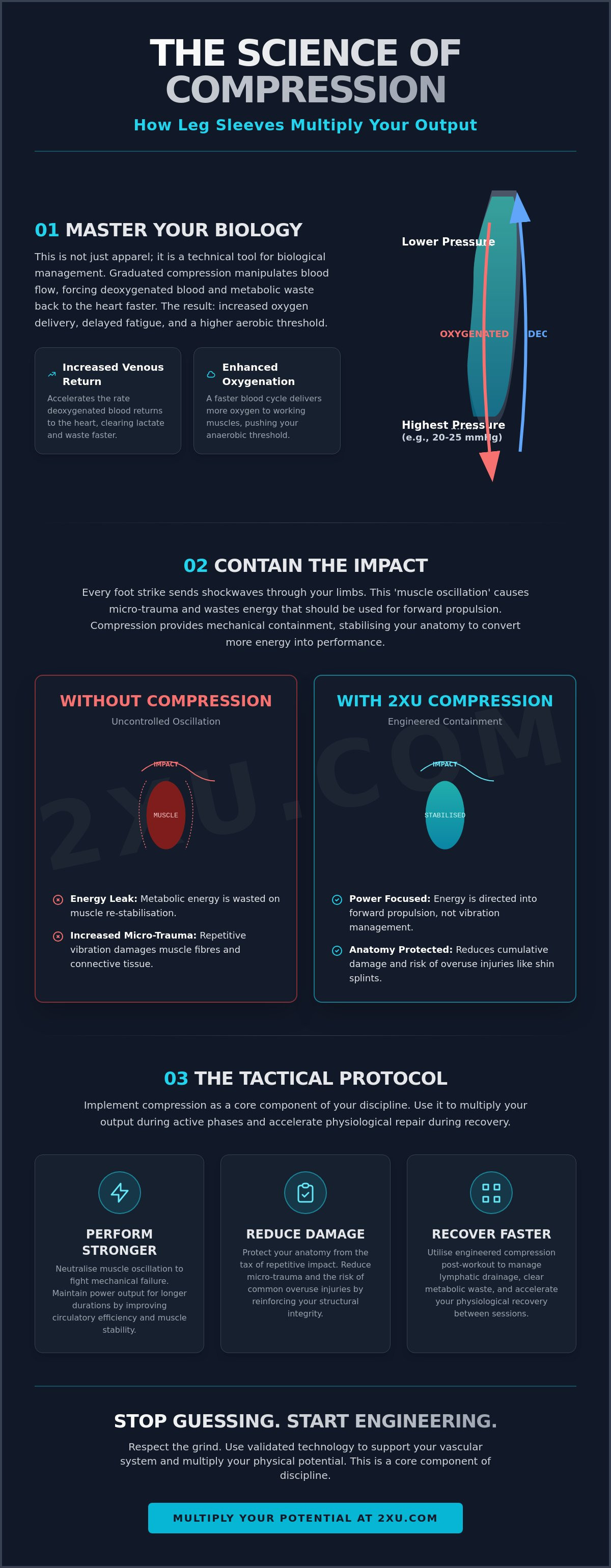
Pressure in high-performance gear is measured in millimetres of mercury (mmHg). In an engineered sleeve, the highest level of compression is applied at the ankle, with the pressure decreasing systematically as it moves up the leg. This gradient is the engine of the garment. It creates a pressure differential that forces deoxygenated blood and metabolic waste products out of the lower extremities and back toward the heart. While generic tight clothing often applies uniform pressure that can actually restrict flow or cause blood to pool, precision compression ensures the pathway remains open and efficient. This mechanical advantage allows for the rapid clearance of lactate, keeping your muscles functional for longer durations.
Oxygenation and the Aerobic Threshold
The faster you can cycle blood, the more oxygen you can deliver to your working muscles. This increased blood turnover is critical for maintaining your aerobic threshold during long-duration efforts. When your muscles receive a steady supply of oxygenated blood, you delay the transition into anaerobic metabolism, the point where fatigue typically forces a reduction in power. This shift isn't a marginal gain; it's a mathematical improvement in your sustained output. By managing the tax of repetitive movement, you're able to sharpen your focus on the miles ahead rather than fighting the failure of your own anatomy.
Venous return is the primary driver of circulatory efficiency, defined as the rate at which deoxygenated blood travels back to the heart to be re-oxygenated.
Respecting the science behind this process is what separates elite athletes from the average. You don't just wear the gear to look the part; you use it to multiply your physical potential. Every session demands discipline, and using validated technology to support your vascular system is a core component of that discipline. If you want to push past previous limits, you need to master the mechanics of your own recovery and output.
Reducing Muscle Oscillation: The Mechanical Advantage
Every strike on the pavement is a high-velocity mechanical event. When your foot hits the ground, a shockwave travels through your limb, causing your soft tissue to vibrate violently. This phenomenon, known as muscle oscillation, is a primary driver of fatigue and structural damage. While you might not feel every individual vibration, the cumulative effect of these oscillations results in micro-trauma to the muscle fibres and the connective tissues. If you're asking what does a leg compression sleeve do, the answer starts with mechanical containment. By providing a firm structural wrap around the muscle belly, the sleeve dampens these vibrations and protects your anatomy from the tax of repetitive impact.
Uncontrolled oscillation is a significant energy leak. When your muscles are allowed to shift laterally upon impact, your body must expend energy simply to restabilise the tissue and maintain alignment. This is energy that should be directed toward forward propulsion and power output. By utilising precision-engineered compression clothing, you effectively brace the muscle group, ensuring that more of your metabolic energy is converted into performance rather than being lost to internal friction and vibration management.
Stabilising the Calf and Lower Leg
High-impact efforts, such as sprinting or long-distance running, place immense stress on the gastrocnemius and soleus muscles. As these muscles fatigue, their ability to absorb shock diminishes, often leading to common overuse injuries like shin splints. A compression sleeve acts as a secondary layer of support, holding the calf muscles tight against the tibia and fibula. This mechanical firmness reduces the tugging on the periosteum, the sensitive tissue surrounding the bone, which is the root cause of shin pain. You aren't just wearing a garment; you're reinforcing your structural integrity so you can sustain the grind without compromise.
Proprioception: Heightened Body Awareness
Performance isn't just about force; it's about precision. Proprioception is your brain's ability to sense the position and movement of your limbs in space. The constant tactile feedback provided by the pressure of the sleeve on your skin sharpens the neural pathways between your lower legs and your central nervous system. This heightened awareness allows for more efficient foot strikes and improved running economy. Research into Recovery Sleeves and other compression garments indicates that this sensory input can lead to better form, especially during the later stages of a session when fatigue typically causes your technique to break down. When your form stays sharp, your efficiency remains high, allowing you to multiply your output even when the miles get dark.
Accelerating the Recovery Cycle: Beyond the Workout
Recovery is not an absence of effort; it is a calculated phase of physiological restoration. The most disciplined athletes realise that the work doesn't end when the stopwatch stops. True performance multiplication occurs in the hours following the grind, where your body must repair structural damage and clear the chemical byproducts of exertion. If you're still questioning what does a leg compression sleeve do after the race is over, the answer lies in the management of your internal biological environment. By maintaining a precise pressure profile, these technical tools ensure that your transition from action to recuperation is as efficient as possible.
Post-exercise stiffness is often the result of fluid accumulation and metabolic stagnation. When you remain static after a session, gravity causes blood and lymph to pool in your lower extremities. This increases internal pressure and slows the delivery of the nutrients required for tissue repair. Compression clothing provides the mechanical force necessary to counteract this pooling, facilitating a "biological flush" that keeps your system in a state of constant turnover. You're not just resting; you're actively purging the waste that hinders your next session.
Lactate Clearance and Metabolic Waste
The lymphatic system lacks a central pump like the heart; it relies on muscle contraction and external pressure to move fluid. During intense efforts, your muscles produce lactate and other metabolites that contribute to the sensation of heavy, leaden legs. Engineered compression assists the lymphatic vessels in clearing these byproducts from the muscle tissue. This accelerated clearance is vital for athletes who demand a high training volume. By reducing the time metabolic waste sits in your system, you effectively shorten the window between peak performances. You earn the right to train harder, sooner.
Managing Delayed Onset Muscle Soreness (DOMS)
Delayed onset muscle soreness is the physiological tax of pushing your limits. It's caused by micro-tears in the muscle fibres and the subsequent inflammatory response as your body rushes to repair the damage. While inflammation is a necessary part of growth, excessive swelling can restrict movement and cause significant pain. Compression sleeves limit the physical space available for this swelling to occur. By containing the inflammatory response, you reduce the perceived stiffness and pain associated with DOMS. This is central to the 2XU mission: we provide the tools that allow you to back up a brutal session with another one, multiplying your total output over a training block. Respect the recovery window as much as the workout itself.
Using compression as a recovery tool involves a few key protocols:
- Immediate Application: Put on your sleeves within 30 minutes of finishing your session to catch the peak of the inflammatory response.
- Extended Wear: Maintain compression for 2 to 4 hours post-workout to maximise venous return and metabolic clearance.
- Elevated Recovery: Combine compression with elevation to further assist the pressure gradient in moving fluids toward the heart.
Tactical Deployment: When and How to Wear Leg Sleeves
Timing determines the efficacy of your technical gear. You don't just put on a sleeve because it's part of your kit; you deploy it as a tactical intervention. For the serious athlete, understanding what does a leg compression sleeve do involves mastering two distinct protocols: active performance and passive recovery. If you fail to time your usage correctly, you're leaving potential gains on the track. Performance is a game of margins, and your equipment strategy must be as disciplined as your training block.
The active protocol is designed for high-impact efforts. Wear your sleeves during long-duration runs, racing, and plyometric sessions where muscle oscillation is highest. For triathletes, sleeves are a critical advantage. They can be worn under a wetsuit during the swim, providing immediate calf support the moment you hit the transition to the bike. This eliminates the need to fiddle with gear while your heart rate is redlining. You move faster because your equipment is already in place, stabilising your anatomy for the work ahead.
Active Performance vs. Passive Recovery
While active use focuses on stabilisation, the recovery protocol is about biological restoration. Wear your sleeves immediately after your session for a window of two to four hours. This timeframe is when the inflammatory response is most volatile. If your training involves travel, the stakes are higher. Utilising flight pressure socks or sleeves during long-haul trips is non-negotiable for preventing travel fatigue and DVT. Respecting the grind means protecting your body during the 'down' hours so you can maintain discipline when it's time to go again. Consistency in recovery is what allows for consistency in effort.
Sizing and Fit for Maximum Compression
Precision is the difference between a technical tool and a useless accessory. Sizing must be based on calf circumference at the widest point, not your height or weight. A sleeve that is too loose provides zero mechanical advantage. Conversely, one that is too tight can restrict arterial flow. Use the firmness test: the garment should feel like a second skin that provides a distinct, supportive wrap. It should never feel like a tourniquet. Avoid low-quality fabrics that lose their elasticity after a few washes; elite performance requires materials that maintain their graduated pressure profile over hundreds of hours of use. If the fabric fails, the compression fails, and your performance multiplication stops.
Equip yourself with the tools required to multiply your output. Explore our range of precision-engineered compression clothing and refine your tactical deployment.
The 2XU Difference: Engineered to Multiply the Human
Average standards have no place in elite performance. While many brands offer basic elasticated wraps, 2XU approaches equipment through the lens of meticulous sports science and industrial engineering. If you are still evaluating what does a leg compression sleeve do, you must look at the construction of the garment itself. We don't settle for simple fabrics; we develop proprietary technologies designed to manage the mechanical and biological tax of your most ambitious sessions. Our mission is the mathematical multiplication of human output, a promise validated through rigorous laboratory testing and peer-reviewed research.
The foundation of our gear is the circular knit construction. Unlike standard knits that provide uneven tension, our 360-degree knit ensures consistent, graduated pressure across the entire muscle group. This engineering prevents the pressure "dead zones" that lead to fluid pooling or inadequate stabilisation. By using medical-grade pressure measurement devices, we ensure that every sleeve delivers the precise mmHg required to actually change your physiology. We reject the average manufacturing approach, instead opting for specific instrumentation that validates the graduated profile of every production run. Respect for the grind requires equipment that works as hard as you do.
Advanced Fabric Engineering
Our proprietary PWX fabric is the result of years of development in high-performance textile engineering. We utilise high-filament yarns that provide superior moisture-wicking and long-term durability without the use of standard materials that lose their shape after a single season. The power-weight ratio of these fabrics is significantly higher than traditional athletic wear, providing maximum muscle containment with minimal bulk. This allows for unrestricted range of motion while maintaining the mechanical brace required for high-impact loads. To support your longest outdoor efforts, we integrate UPF50+ sun protection and antibacterial properties to manage the biological realities of high-intensity training. Every thread is a deliberate choice made to sharpen your edge.
Proven by Science, Earned by Effort
We don't rely on generalised claims or marketing fluff. Our technology is grounded in collaborations with world-leading sports institutes and elite academic research teams. This data-driven approach ensures that the "Human Multiplied" identity is a tangible reality for every athlete who wears the 'X'. While our science is elite, our gear is inclusive; it's designed for anyone with the discipline to push their physical limits and the ambition to be better than they were yesterday. You earn your place through hard work; we provide the engineering to ensure that work is never wasted.
Stop settling for apparel and start investing in technical tools. The path to your next breakthrough begins with equipment that matches your intensity. Shop 2XU Compression Leg Sleeves and start multiplying your output today.
Master the Mechanics of Your Performance
Understanding what does a leg compression sleeve do is the first step toward reclaiming your physical potential. You've seen how graduated pressure profiles optimise venous return and how medical-grade circular knit technology stabilises your anatomy against the destructive forces of muscle oscillation. These aren't marginal gains; they are the foundation of a disciplined training protocol used by elite triathletes and IRONMAN champions to sustain the grind. It's about ensuring that every watt of energy you produce is directed toward propulsion rather than being lost to internal vibration.
Our equipment is independent laboratory validated to ensure that every millimetre of fabric serves a physiological purpose. By mastering the tactical deployment of active and recovery compression, you're not just wearing gear; you're engineering a faster version of yourself. Respect the science and trust the data that has been proven at the highest levels of global competition. When you choose technical tools designed for biological management, you're choosing to multiply your output.
Engineered to multiply your performance; explore the 2XU Compression collection.
The work is hard, but the rewards are earned through precision and effort. Keep pushing, keep recovering, and let the engineering handle the rest.
Frequently Asked Questions
What is the difference between a leg compression sleeve and a compression sock?
A leg compression sleeve terminates at the ankle, while a compression sock encapsulates the entire foot and calf. Triathletes often prefer sleeves because they can be worn under a wetsuit during the swim without trapping water in the foot area. This allows you to maintain calf stabilisation during the transition to the bike without needing to change your gear. It also gives you the flexibility to pair the sleeve with your preferred high-performance technical socks.
Can I wear leg compression sleeves while sleeping to speed up recovery?
You should avoid wearing leg sleeves while sleeping because the lack of foot compression can cause fluid to pool at the ankles when your body is in a horizontal, low-activity state. If you require overnight recovery, choose full-length compression socks to ensure a continuous pressure gradient from the toes upward. Sleeping in sleeves risks interrupting the very venous return you are trying to optimise during your rest phase.
How long should I wear my compression sleeves after a hard training session?
Aim for a recovery window of 2 to 4 hours immediately following your session to maximise the physiological benefits. This duration allows the graduated pressure to assist the lymphatic system in clearing metabolic byproducts and managing the peak of the inflammatory response. If you're wondering what does a leg compression sleeve do during this time, it's effectively acting as a biological flush to prepare your muscles for the next grind.
Will wearing compression sleeves help prevent shin splints and calf strains?
Yes, sleeves provide a mechanical advantage by dampening the vibrations that lead to shin splints and calf strains. By bracing the muscle group firmly against the bone, you reduce the tugging on the periosteum and prevent the micro-trauma caused by repetitive ground impact shockwaves. It is a proactive tool for maintaining your structural integrity during high-volume training blocks or when increasing your intensity.
How tight should a leg compression sleeve be for it to actually work?
Your sleeve must provide a firm, second-skin fit that offers distinct support without restricting arterial circulation. Most athletes require a graduated profile between 15 and 30 mmHg, which is tight enough to stabilise tissue but not so restrictive that it causes numbness or skin irritation. Sizing should always be determined by your largest calf circumference rather than height or weight to ensure the pressure gradient is mathematically accurate.
Do compression sleeves lose their effectiveness over time with frequent washing?
High-quality circular knit fabrics are engineered for durability, but they will eventually lose elasticity if the fibres are mistreated. To preserve the technical integrity of the garment, always wash in cold water and avoid the dryer entirely. High heat is the primary enemy of the elastic fibres that provide the graduated pressure required for performance multiplication; air drying is a non-negotiable part of gear maintenance.
Can I use leg compression sleeves for sports other than running, like basketball or cycling?
Absolutely. Any sport involving explosive lateral movements or repetitive load can benefit from the mechanical stabilisation of an engineered sleeve. In basketball, the gear manages the shock of jumping and landing; in cycling, it assists in venous return during long, sustained efforts at high cadences. It is a versatile tool for any serious athlete who respects the physical tax of their chosen discipline.
Is there a scientific consensus on whether compression gear actually works?
The scientific consensus is robust regarding the benefits for recovery and the significant reduction of perceived muscle soreness post-exercise. While direct speed increases are still being researched, the data clearly shows that compression reduces muscle oscillation and markers of physiological stress like creatine kinase. If you can recover faster and maintain better form through fatigue, your long-term performance output will mathematically improve.