
The Best Way to Clean a Wetsuit: Engineering Longevity for Peak Performance
Neglecting your gear is a deliberate choice to compromise your next performance. You have invested in premium Yamamoto neoprene because every millimetre of buoyancy and flexibility counts toward your split times, yet salt crystals and bacteria act as silent abrasives against your equipment. It's frustrating to feel your high-end triathlon wetsuit lose its supple edge or develop an odour that signals biological decay. You demand excellence from your body, and your gear must meet that same standard of discipline.
Mastering the best way to clean a wetsuit is the final stage of your recovery protocol. This is about more than hygiene; it's about engineering longevity and preventing neoprene fatigue through rigorous maintenance. By following a scientific cleaning process, you ensure the molecular integrity of your suit remains uncompromised by the harsh realities of the ocean. This guide provides the exact steps to eliminate odours and maintain maximum mechanical stability. You'll learn how to protect your investment and ensure your "human multiplied" potential is never limited by equipment failure.
Key Takeaways
- Identify how salt crystals act as microscopic abrasives within the fabric matrix, leading to internal cell collapse and premature neoprene fatigue.
- Implement the professional three-step protocol—Rinse, Sanitise, and Restore—to master the best way to clean a wetsuit for maximum longevity.
- Protect the chemical integrity of your equipment by understanding why standard detergents are the enemy of engineered polymers and specialised SCS coatings.
- Execute advanced drying and storage techniques, including the "Double-Dry" method, to preserve the mechanical stability and buoyancy of your suit.
- Integrate gear maintenance into your recovery protocol to ensure your equipment performs at the same elite level as your physical output.
The Science of Neoprene Fatigue: Why Cleaning Multiplies Gear Longevity
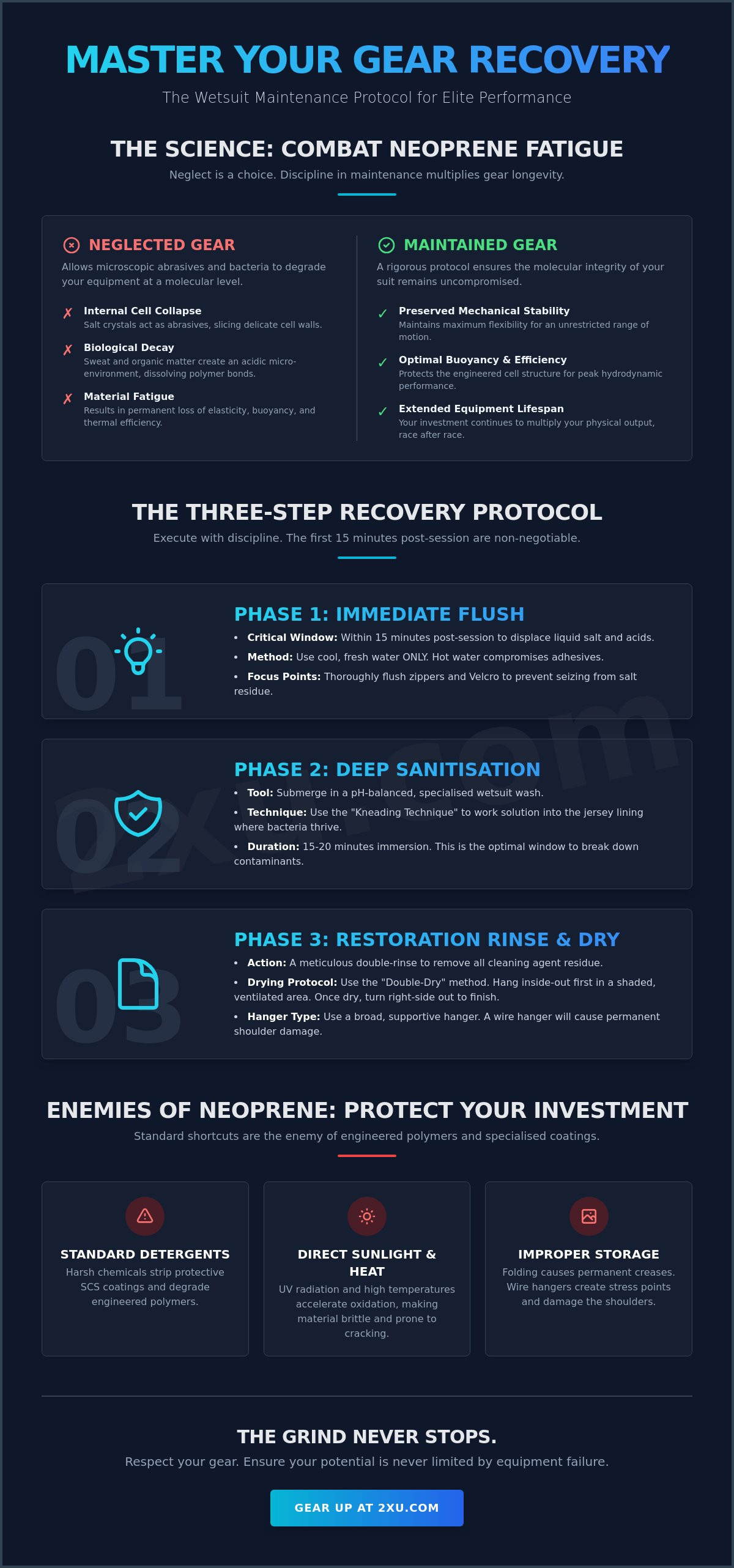
Every second in the water is a calculation of drag, buoyancy, and power. If your gear fails to respond to your output, your training is compromised. Neoprene Fatigue is the definitive term for the structural loss of elasticity and buoyancy caused by internal cell collapse within the engineered material. When you neglect your equipment, you allow it to degrade at a molecular level. Mastering the best way to clean a wetsuit is a mandatory component of the Recuperation phase in the 2XU framework. You wouldn't skip a post-race recovery protocol for your muscles; don't skip it for your suit. Discipline in maintenance ensures your gear performs as hard as your body does during the grind.
Microscopic Degradation: Salt and Chlorine
Salt and chlorine represent constant threats to material integrity. As moisture evaporates from the neoprene foam, it leaves behind jagged salt crystals that act as microscopic abrasives. These crystals slice through the delicate cell walls of the matrix during every stroke, leading to a permanent loss of thermal efficiency and flexibility. Chlorine is equally aggressive, as it accelerates the oxidation of technical materials and causes the polymer to become brittle and prone to cracking under tension. Osmotic stress describes the destructive pressure exerted on neoprene cells as they attempt to equalise salinity levels across their membranes, ultimately compromising the suit's mechanical stability and buoyancy.
The Bacteria Factor: More Than Just a Smell
Odour is more than a nuisance; it is a bio-indicator of material failure. Organic matter, sweat, and uric acid trapped within the fabric lining create an acidic micro-environment that actively dissolves the bonds between polymer chains. These microbes diminish the flexibility of the internal jersey, turning a high-performance tool into a restrictive cage that fights against your natural range of motion. A standard rinse is a superficial gesture that fails to neutralise these deep-seated biological contaminants. You must use specialised solutions to break down these oils and maintain the elite performance standards required for the grind. Respect the suit that gives you the edge by ensuring it remains biologically and chemically pristine.
The 2XU Three-Step Protocol: Rinse, Sanitise, and Restore
Performance is won in the details. Just as you wouldn't leave your muscles to seize after a threshold session, you cannot leave your gear to degrade. The first 15 minutes post-session are the critical window for maintenance. This is the "Immediate Rinse" rule. During this time, the salt and organic acids are still in a liquid state, making them easier to displace before they begin their destructive work on the material's cellular structure. Following a systematic protocol is the best way to clean a wetsuit and ensure your investment continues to multiply your physical output on race day.
Phase 1: The Immediate Cold-Water Flush
Fresh water must displace salt water instantly. The goal is to prevent the formation of jagged crystals that cause internal friction. Use cool, fresh water to flush the entire suit, paying specific attention to the zippers and Velcro. These mechanical components are prone to seizing if salt residue is allowed to dry. Cool water is non-negotiable. High temperatures can compromise the engineered laminates and adhesives that hold your suit together. A thorough flush ensures the mechanical stability of the suit remains intact for your next entry into the water.
Phase 2: Deep Sanitisation
A simple rinse is insufficient for long-term gear health. You must use a pH-balanced wetsuit wash to neutralise the organic acids from sweat and skin oils. Scientific research into neoprene degradation confirms that chemical exposure and biological buildup significantly reduce the lifespan of engineered polymers. Submerge the suit and use the "Kneading Technique" to work the cleaner into the limestone neoprene cells. This ensures the solution penetrates the jersey lining where bacteria thrive. An immersion time of 15 to 20 minutes is the optimal window for the chemical agents to break down contaminants without over-saturating the material.
Phase 3: The Restoration Rinse
The final phase requires a meticulous double-rinse. Residual cleaning agents can cause skin irritation and create a tacky surface that attracts more debris. Focus your efforts on the armpits and crotch areas. These zones experience the highest concentration of salt and biological waste during intense training. If you are using a premium triathlon wetsuit, this level of discipline is what separates elite athletes from the pack. Use the "Inversion Strategy" by cleaning and rinsing the interior first. The lining is where the most significant biological damage occurs, so it must be your primary focus before addressing the outer skin.
Before moving to storage, perform a final mechanical inspection. Run the zippers to ensure smooth travel and check the seams for any signs of tension fatigue. This level of scrutiny ensures that when you reach for your gear, it is ready to perform at its peak. Discipline in the wash tank translates to confidence on the starting line.
Chemical Integrity: Protecting Your Performance Investment
Using household detergents is a tactical error that compromises your equipment's structural stability. These common cleaners are engineered to strip oils and organic stains from traditional fabrics, but they are far too aggressive for the sophisticated polymer matrix of a high-end suit. When you apply standard soaps, you initiate a chemical reaction that leaches the essential plasticisers from the material. This results in a brittle, inflexible suit that no longer moves in synchronisation with your body. Understanding the best way to clean a wetsuit requires a commitment to using only pH-balanced, biodegradable solutions specifically designed for engineered elastomers.
Why Detergents Destroy Elasticity
The surfactants found in laundry and dish soaps are the primary enemy of elasticity. These industrial agents penetrate the porous structure of the material and strip away the protective oils that keep the cells supple. Once these oils are removed, the neoprene becomes prone to "dry rot," a condition where the material loses its ability to rebound after being stretched. There is also a severe risk of delamination. Aggressive chemicals can dissolve the industrial adhesives that bond the neoprene core to the internal jersey lining, causing the layers to separate and creating pockets of water that increase drag. While some casual guides might suggest shortcuts, following REI's expert advice on wetsuit care confirms that only specialised cleaners should touch your gear.
Maintaining the Hydrophobic Coating
The Super Composite Skin (SCS) coating on your suit is a masterpiece of fluid dynamics. This micellar structure reduces the coefficient of dynamic friction, allowing you to glide through the water with minimal resistance. Improper chemical exposure creates "drag spots" where the coating has been etched or dissolved by harsh solvents. These damaged areas disrupt laminar flow and force your muscles to work harder to maintain speed. To truly understand how this technology functions, you should investigate the deeper neoprene wetsuit science that underpins our high-performance designs. Protecting this coating is not optional if you intend to maintain your competitive edge.
The "No Heat" mandate is a non-negotiable rule of gear discipline. Hot water acts as a catalyst for material failure by accelerating the breakdown of polymer bonds and softening the glues used in seam construction. Even a single wash in high temperatures can cause permanent shrinkage and warping of the engineered panels. Stick to cool or lukewarm water to ensure the mechanical stability of your suit remains intact. Respect the science behind the material, and it will respect your need for speed on race day. Your gear is an extension of your physical potential; treat its chemical integrity with the same rigour you apply to your training nutrition.
Advanced Drying and Storage: Maintaining Mechanical Stability
Your commitment to the grind doesn't end when you step out of the rinse tank. Drying is a precision exercise in maintaining mechanical stability. If you leave your suit damp or exposed to the elements, you're inviting structural failure and biological growth. The best way to clean a wetsuit must always be followed by a rigorous drying protocol to prevent material degradation. Amateurs treat drying as a passive process; elite athletes treat it as the final stage of gear recovery. You demand peak performance from your body, and your equipment requires the same level of discipline to remain race-ready.
The Inversion Technique
Execution of the "Double-Dry" method is non-negotiable. Always begin the drying process with the suit inside out. The internal fabric lining holds the highest concentration of moisture and residual biological matter. Drying this side first is the only way to prevent the growth of mould and the onset of "wetsuit rash" caused by bacterial colonies. Use high-velocity airflow from a fan to accelerate evaporation. Never use a heater or a hair dryer. Forced heat is a catalyst for polymer breakdown and will ruin the engineered elasticity of the material. Once the interior is dry to the touch, flip the suit to finish the outer skin. This ensures the surface remains supple and prevents the neoprene from becoming brittle through uneven moisture loss.
Storage Mechanics
Gravity is a relentless force that works against the integrity of your gear. Using a standard, thin clothes hanger is an amateur mistake that leads to permanent shoulder distortion. This "shoulder creep" thins the neoprene in high-stress zones, compromising both thermal insulation and the range of motion required for an efficient swim stroke. For long-term preservation, use the "Waist-Fold" method. Drape the suit over the horizontal bar of a thick, specialised hanger at the waistline to eliminate vertical tension on the shoulders. If space allows, laying the suit flat in a cool, dark environment is the gold standard for off-season preservation. It ensures zero mechanical stress on the seams and maintains the suit's original anatomical shape.
UV radiation is the silent killer of neoprene flexibility. Direct sunlight causes rapid cross-linking in the polymer chains, turning a supple, high-performance tool into a stiff and unresponsive shell. Similarly, the boot of a car is a "neoprene oven" that must be avoided. Internal vehicle temperatures can exceed 60 degrees Celsius, which is sufficient to melt industrial adhesives and warp engineered panels. Store your gear in a climate-controlled environment with stable humidity to ensure the material remains primed for explosive output. Respect the science of storage to ensure your gear is as prepared for the next session as you are.
Invest in equipment that is engineered to endure the rigours of your training schedule. Explore our collection of high-performance triathlon wetsuits and experience the "human multiplied" advantage on your next start line.
The Grind Never Stops: Discipline in Gear Maintenance
Your training block is a sequence of high-intensity efforts and calculated recoveries. You don't skip your post-run stretching or your nutritional window; you shouldn't skip your equipment recovery either. The best way to clean a wetsuit is to treat it as a mandatory extension of your physical cool-down protocol. This level of discipline ensures your gear is primed to multiply your potential the next time you face the water. Elite performance is not an accident. It's the result of a relentless commitment to excellence in every facet of your preparation. If you want breakthrough results, you must maintain the tools that make them possible.
Earning Your Edge
Breakthrough results come from a foundation of meticulous attention to detail. When you maintain the chemical and mechanical integrity of your triathlon wetsuit, you protect the engineered flexibility that saves critical seconds during the swim and T1. A supple, well-cared-for suit allows for maximum stroke extension and peels off instantly in transition. This is the "Human Multiplied" philosophy applied to longevity. It's about ensuring every engineered cell of your suit is ready for the struggle. Respect the suit that gives you the edge, and it will respond when you push for a personal best. Neglecting your gear is a choice to accept average standards, and average is the enemy of the elite.
Ready for the Next Session
Establish a routine that makes these steps second nature. The cost-per-use benefit of disciplined maintenance is a mathematical certainty, as it prevents the premature failure of high-end materials. Beyond the financial logic, there's a profound mental advantage to starting every session with pristine, high-performance equipment. It reinforces a professional mindset and signals that you are an athlete who respects the grind. In the tripartite athletic framework, maintenance is the final stage of recuperation that prepares you for the next action. Multiplied performance requires multiplied care. Do not let average maintenance standards compromise your mathematical improvements in results. Explore 2XU High-Performance Wetsuits to find the gear that matches your unyielding ambition.
Engineering Your Competitive Edge
Your gear is a precision instrument designed to multiply your physical output. Mastering the best way to clean a wetsuit is not a chore; it's the final stage of your recovery protocol. By implementing a rigorous sanitisation and inversion drying strategy, you protect the molecular integrity of your equipment against neoprene fatigue. Discipline in maintenance ensures that every engineered cell remains ready for the struggle, allowing you to focus entirely on your split times rather than equipment failure.
True performance requires gear that meets your unyielding standards. Our suits feature proprietary Yamamoto Neoprene and a specialised SCS Hydrophobic Coating to ensure you maintain maximum buoyancy while reducing dynamic drag. When you respect the science of your equipment, you earn the right to push your limits. Don't let average maintenance habits compromise your mathematical improvements in results. Arrive at your next start line with the confidence that your gear is as prepared as you are.
Optimise your swim with 2XU Performance Wetsuits
The grind never stops, and neither should your pursuit of perfection. Take pride in the details, respect the process, and prove that your potential is limitless. You've done the hard work in the water; now ensure your equipment is ready to help you multiply the result.
Frequently Asked Questions
Can I wash my wetsuit in a washing machine?
No. Mechanical agitation and spin cycles will destroy the internal cell structure of your neoprene. The centrifugal force and heat from a machine cause permanent compression and delamination of the engineered layers. Hand wash your suit in a tub to maintain the mechanical stability required for elite performance.
How often should I use a specialised wetsuit cleaner?
Perform a deep sanitisation every three to five sessions or whenever biological buildup is evident. While a fresh water flush is mandatory after every exit, using a dedicated solution is the best way to clean a wetsuit to neutralise organic acids. This frequency ensures that bacteria don't compromise the flexibility of the internal jersey lining.
Is it safe to use baby shampoo to clean my triathlon wetsuit?
Avoid baby shampoo. These products often contain oils and fragrances that leave a residue on the neoprene and can degrade the specialised SCS coating. You must use a pH-balanced cleaner designed for high-performance elastomers to ensure you don't strip the essential plasticisers that keep your gear supple and responsive.
What is the fastest way to dry a wetsuit for a double-session day?
Use a high-velocity fan in a low-humidity environment after patting the suit with a microfiber towel. This method provides the necessary airflow to accelerate evaporation without the risks associated with heat. Always prioritise drying the interior first to maintain hygiene and comfort for your second effort of the day.
How do I remove the smell of urine from my wetsuit?
Utilise an enzymatic cleaner that specifically targets biological waste. These solutions contain active microbes that consume urea and bacteria at a molecular level. Standard fresh water rinses are insufficient because they cannot break the chemical bonds of organic contaminants that have penetrated the porous neoprene cells.
Can I use a hair dryer to speed up the drying process?
Never apply forced heat to your equipment. High temperatures act as a catalyst for material failure; they cause the neoprene cells to expand and burst. This results in a permanent loss of buoyancy and thermal efficiency. Stick to ambient airflow to preserve the structural integrity of your performance investment.
What happens if I leave my wetsuit in the sun to dry?
UV radiation causes rapid cross-linking in polymer chains, which turns your supple suit into a brittle and unresponsive shell. Sunlight also weakens the industrial adhesives used in seam construction. Always dry your gear in the shade to prevent this irreversible chemical degradation and maintain your competitive edge.
How should I store my wetsuit during the winter off-season?
Lay the suit flat in a cool, dark, and climate-controlled environment. If you must hang it, use the waist-fold method on a thick hanger to eliminate vertical tension on the shoulders. Ensure the suit is 100% dry before storage to prevent mould growth from compromising the material during the off-season grind.