
What to Wear Under a Wetsuit for a Triathlon: The Performance Blueprint
Your choice of base layer is the technical interface that dictates your hydrodynamic efficiency and total transition speed. Understanding exactly what to wear under a wetsuit for a triathlon is not a matter of modesty; it is a requirement for mechanical stability and peak performance. If you've ever felt the searing sting of wetsuit burn or lost precious seconds struggling with gear in T1, you know that average preparation leads to average results.
You've likely felt the anxiety of fluctuating water temperatures and the fear that your kit will fail you when the intensity peaks. We're here to solve that. This blueprint provides the scientific framework to eliminate chafing and optimise your thermoregulation throughout the race. We will examine the latest USAT and Ironman regulations, the engineering behind advanced trisuits, and the layering protocols designed to multiply your physical output from the first stroke to the final stride.
Key Takeaways
- Quantify the friction coefficient of your base layer to prevent dermal irritation and maintain peak hydrodynamic efficiency.
- Discover why the trisuit is the definitive solution for what to wear under a wetsuit for a triathlon to maximise transition velocity.
- Utilise compression fabrics to reduce muscle oscillation and improve water-feel through enhanced proprioceptive feedback.
- Eliminate the Transition Trap by selecting technical layers that facilitate a rapid, tactical peel of your neoprene armour.
- Respect the grind by mirroring your race-day gear configuration during open water simulations to ensure total mechanical stability.
The Strategic Importance of Under-Wetsuit Layering
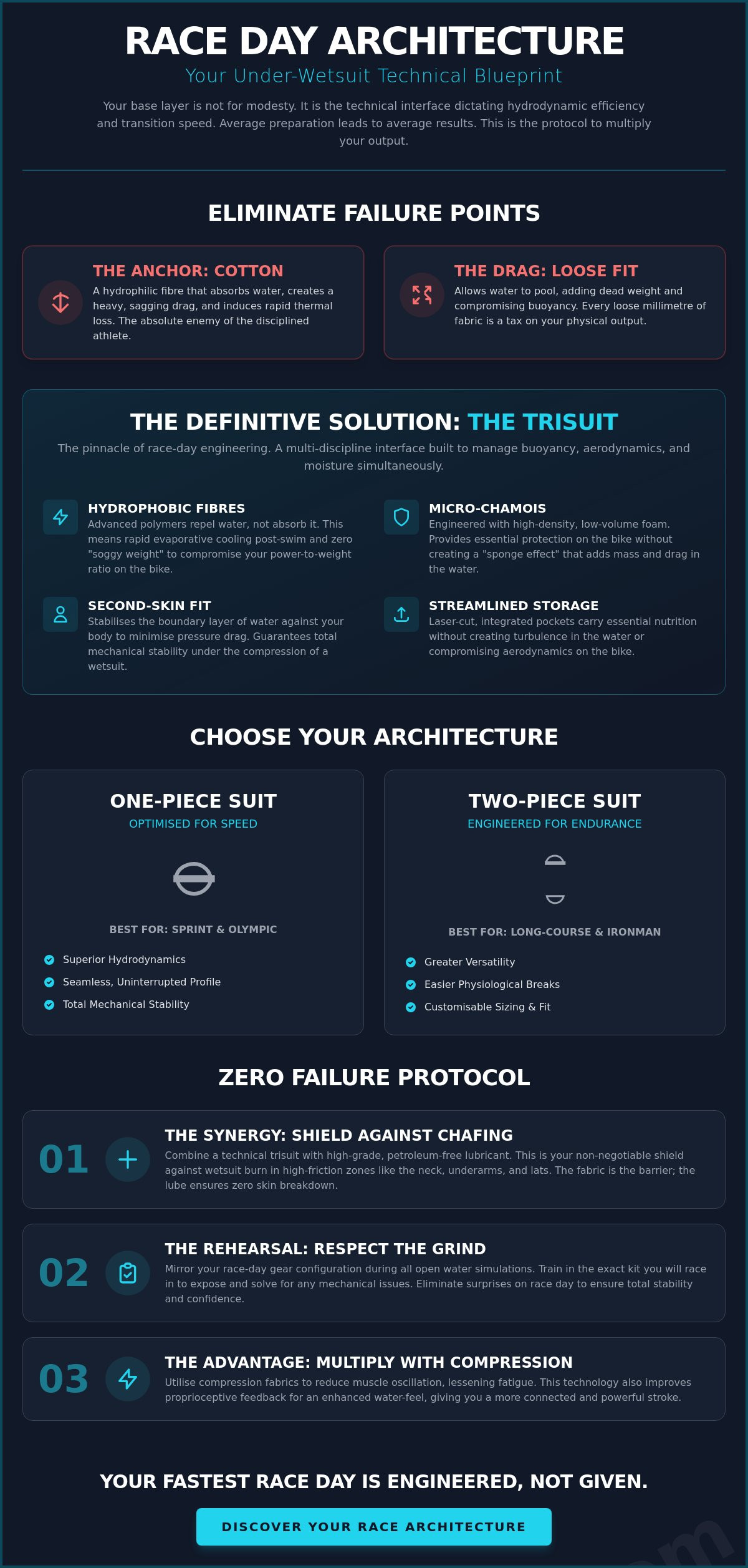
The choice of what to wear under a wetsuit for a triathlon is a technical decision that dictates your mechanical efficiency. Your under-layer is the primary interface between your skin and your neoprene armour. It's a functional component, not a modesty garment. If you choose incorrectly, you're increasing your friction coefficient. This specific measurement of resistance determines whether your gear glides or grinds against your body. High friction leads to dermal shearing and the debilitating "wetsuit burn" that ruins a race before you even reach T1. Cotton is the absolute enemy of the disciplined athlete. It is a hydrophilic fibre that absorbs massive amounts of water, creating a heavy, sagging anchor that induces rapid thermal loss through conductive cooling. Professional athletes utilise a specialised Trisuit engineered from technical, water-repellent polymers to ensure core thermoregulation remains within optimal performance parameters.
Hydrodynamics and the Internal Layer
A loose fit is a failure of preparation. Any gap between your skin and your base layer allows water to pool, creating a "sloshing" mass that adds dead weight and compromises your natural buoyancy. This internal water movement creates unpredictable mass shifts that interfere with your stroke mechanics and rotational stability. In fluid dynamics, we focus on the boundary layer; this is the thin layer of fluid immediately adjacent to the body's surface where viscous forces are most significant. By maintaining a snug, second-skin fit, you stabilise this boundary layer and minimise the pressure drag that slows your swim splits. Every millimetre of excess fabric is a tax on your physical output.
The Reality of Wetsuit Chafing
The grind of a long-distance swim exposes high-friction zones to thousands of repetitive cycles. Your neck, underarms, and lats are the primary targets for mechanical shearing. Technical fabrics act as a sacrificial barrier, absorbing the kinetic energy of the neoprene's movement so your dermis remains protected. You cannot rely on fabric alone. You must integrate your technical apparel with high-grade, petroleum-free anti-chafe lubricants. This synergy between gear and lubrication ensures zero skin breakdown, allowing you to exit the water with your physical output potential fully preserved. Don't let an avoidable injury in the water dictate your performance on the asphalt. Respect the preparation, and the results will follow.
The Trisuit: The Ultimate Race-Day Architecture
The trisuit represents the pinnacle of race-day engineering. It is the definitive answer for what to wear under a wetsuit for a triathlon. This is not merely clothing; it is a multi-discipline interface designed to manage buoyancy, aerodynamics, and moisture simultaneously. Unlike standard swimwear, a professional trisuit features a micro-chamois engineered for low-profile comfort. This padding is constructed from high-density, low-volume foam that provides essential protection on the bike without absorbing water during the swim. It eliminates the "sponge effect" that adds unnecessary mass and drag. Integrated storage pockets are laser-cut and streamlined to ensure you can carry essential nutrition without creating turbulence in the water or air. Every seam and panel is mapped to the athlete's anatomy to ensure total mechanical stability under the compression of a wetsuit.
One-Piece vs. Two-Piece Trisuits
One-piece suits offer superior hydrodynamics and a seamless profile. They provide total mechanical stability, ensuring the garment never rides up or bunches under your neoprene armour. This is the optimal choice for sprint and Olympic distances where speed is the primary metric. Two-piece suits offer greater versatility for long-course athletes. They allow for easier physiological breaks and customisable sizing between the torso and lower body. If you are targeting an IRONMAN distance, the marginal gain in comfort during a ten-hour grind may outweigh the minor hydrodynamic advantage of a single-piece suit. Choose the architecture that matches your specific race objectives.
Technical Fibre Performance
High-performance trisuits utilise advanced polymers engineered for rapid moisture transfer and heat dissipation. These technical fibres are hydrophobic, meaning they repel water rather than soaking it up. After exiting the water, the fabric initiates immediate evaporative cooling, preventing the "soggy weight" that compromises your power-to-weight ratio on the bike. Breathability metrics are critical; advanced polymers facilitate the movement of thermal energy away from the core to prevent overheating during high-intensity efforts. For a deeper dive into the engineering of these garments, consult The Ultimate Triathlon Suit Guide: Engineering Your Fastest Race Day. To ensure your gear can handle the intensity of the swim and the heat of the run, explore our range of elite trisuits designed for maximum output.
Training vs. Racing: Choosing Your Base Layer
Mastery is built through repetition. If your training gear doesn't mirror your race-day configuration, you're training for failure. The grind of preparation requires you to understand exactly what to wear under a wetsuit for a triathlon long before you rack your bike in transition. Casual swimwear is a liability in high-performance environments. These garments are engineered for leisure, not the sustained mechanical stress of an open water swim. They lack the necessary mechanical stability, often sagging as they absorb water and creating massive internal drag that disrupts your hydrodynamics. Every training session is a data point; don't corrupt your results with substandard equipment.
Extreme environmental conditions require tactical adjustments. When water temperatures plummet toward the mandatory wetsuit threshold of 14.4°C, your core thermoregulation becomes the priority. In these scenarios, adding a specialised neoprene vest or a thermal base layer under your primary suit is essential. These additions provide the necessary insulation to maintain peripheral blood flow and prevent the onset of cold-shock response. Ensure these layers are thin enough to avoid restricting your scapular rotation. Your goal is maximum output, not restricted movement.
The Training Kit: Durability and Chlorine Resistance
High-performance training apparel must be engineered to survive the harsh chemical environment of the pool. Technical polymers with high chlorine resistance prevent the degradation of elastic fibres, ensuring your kit maintains its compression profile over hundreds of kilometres. For athletes focused on technical refinement, buoyancy shorts are a critical tool. They simulate the horizontal body position of a full wetsuit during pool-based sessions, allowing you to master your stroke mechanics under race-like conditions. For a comprehensive breakdown of how your outer layer interacts with your base kit, read our Triathlon Wetsuit: A Performance-Driven Guide to Your Fastest Swim.
Gender-Specific Considerations
Anatomical support is non-negotiable for maintaining focus during the swim. For women, this involves selecting trisuits with integrated support or pairing them with high-impact sports bras that don't trap excessive water. Men require compression liners that provide anatomical support and prevent shifting during the transition from the horizontal swim to the vertical run. Avoid garments with bulky seams or heavy waistbands. These create concentrated pressure points under the tight seal of a wetsuit, leading to dermal irritation and lost efficiency. Every piece of gear must earn its place in your kit through proven performance and zero interference with your physical output.
Compression Technology: Multiplied Performance Under Neoprene
Most athletes view their base layer as a passive garment designed for modesty. They're wrong. When evaluating what to wear under a wetsuit for a triathlon, you must look beyond mere comfort and focus on the physiological multiplication of your effort. Compression technology serves as a mechanical stabiliser for your muscle groups. During the swim, every stroke generates muscle oscillation. This rapid vibration causes micro-tears in the muscle fibres, leading to premature fatigue. By wearing high-grade technical apparel under your neoprene, you dampen these vibrations and preserve your muscular integrity for the bike and run legs. This isn't a marginal gain; it's a fundamental requirement for athletes who refuse to accept average results.
Technical compression also improves proprioception, which is your body's ability to sense its position in space. The skin-tight technical feedback from advanced compression fabrics provides a heightened "feel" for the water. This allows for more precise hand entry and a more efficient catch phase. You're not just swimming; you're operating with a calibrated mechanical interface that ensures every watt of energy is converted into forward propulsion. Equip yourself with elite compression clothing to ensure your muscles remain stabilised from the first dive to the final sprint.
The Science of Venous Return
Horizontal movement in the water presents a unique physiological challenge: blood pooling. Graduated compression technology facilitates venous return by applying calculated pressure to the extremities, forcing deoxygenated blood back toward the heart. This process is critical during the final 200 metres of the swim and the first 500 metres of the bike leg. By priming your circulatory system while you're still in the water, you reduce the "heavy leg" sensation during the transition. For a deeper technical analysis of these mechanics, read our Compression Shirts: The Scientific Guide to Performance & Recovery.
Reducing Muscle Fatigue
The core and lats are under constant stress during high-cadence swimming. Compression garments protect these primary movers from excessive vibration, saving critical energy reserves for the run finish. This is the "multiplication" effect: by reducing the energy cost of the swim, you increase your available output for the remainder of the race. The mechanical efficacy of 2XU compression fabrics is validated through independent laboratory testing using the Salzmann pressure measurement device, ensuring that every square centimetre of fabric delivers the exact millimetres of mercury (mmHg) required for physiological benefit. We don't guess at performance; we measure it.
Mastering the Transition: T1 Efficiency and Gear Integration
Transition 1 is the high-stakes intersection where your swim preparation meets your cycling output. If you've chosen correctly when deciding what to wear under a wetsuit for a triathlon, your gear will act as a tactical sliding surface for the removal of your neoprene armour. Many athletes fall into the "Transition Trap" by wearing bulky, non-technical garments that bunch at the ankles and hips. This creates a tether effect, forcing you to fight your equipment rather than moving toward your bike. A high-performance trisuit provides a low-friction interface, allowing the wetsuit to peel away from the limbs with minimal resistance. This seamless removal provides a critical psychological edge, building immediate momentum for the bike split while your competitors are still struggling with their sleeves.
Final equipment integration is a requirement for total mechanical stability. Before the klaxon sounds, verify that your timing chip is secured under the leg of your trisuit or the cuff of your wetsuit to prevent it from snagging during a rapid peel. If you utilise a heart rate monitor, it must be positioned firmly under your technical suit. This ensures the sensors maintain skin contact throughout the high-intensity movement of the swim and the subsequent transition. Every second saved in T1 is a second earned on the road. Discipline in gear preparation leads to dominance in execution.
The 30-Second T1 Strategy
Success in T1 requires a methodical execution from the water's edge to the bike rack. As you exit the water, unzip your wetsuit and peel it to the waist while running toward your station. A snug-fitting base layer ensures there is no excess fabric for the neoprene to catch on as it passes the hips. Common mistakes include wearing loose swim jammers that create a bulky mass at the waist, which can trap the wetsuit and stall your progress. Your under-layer should be an aerodynamic extension of your body that facilitates speed, not a barrier that creates drag.
Post-Swim Thermoregulation
Transitioning from a wet environment to high-speed wind on the bike induces a rapid evaporative cooling effect. Technical polymers are engineered to manage this shift by moving moisture away from the skin while providing a baseline barrier against wind chill. This maintains your core temperature and prevents the muscular tightening that can derail your power output during the first few kilometres of the bike leg. Respect the grind by ensuring every piece of your kit is tested under race-like conditions. A meticulously prepared T1 is the hallmark of an elite athlete who understands that what to wear under a wetsuit for a triathlon dictates the success of the entire race day.
Execute the Blueprint for Race-Day Dominance
Mastering the mechanics of your base layer is the final step in a disciplined preparation cycle. You've learned that a high-performance trisuit is the definitive solution for what to wear under a wetsuit for a triathlon. It provides the necessary hydrodynamic efficiency and mechanical stability to protect your output during the swim. By integrating proprietary compression technology, you reduce muscle oscillation and prime your circulatory system for a seamless transition to the bike. This technical interface ensures that your body remains a calibrated machine from the first dive to the final stride. Every decision you make regarding your kit should serve the singular goal of increasing your physical efficiency.
Don't leave your results to chance or substandard equipment. Our gear is used by elite IRONMAN champions who demand laboratory-validated performance and maximum hydrodynamic efficiency. Shop the 2XU Triathlon Collection and multiply your performance.
Respect the grind and trust the science behind your kit. Every training hour has led to this moment. You've put in the hard work; now let your gear amplify every watt of energy you bring to the course. Step up to the start line with the total confidence that your potential is multiplied.
Frequently Asked Questions
Do I need to wear a bra under my trisuit and wetsuit?
Integrated support in many trisuits is sufficient for most athletes, but high-impact requirements may necessitate a separate sports bra. If you require additional stability, ensure the garment is constructed from technical polymers that don't retain water. Avoid cotton at all costs; it will become a heavy, waterlogged liability that induces chafing and thermal loss during the bike leg.
Is it okay to wear nothing under a wetsuit for a triathlon?
Nudity is strictly prohibited by ITU and IRONMAN race regulations, and the mechanical friction of neoprene against bare skin will cause severe dermal damage. Without a technical interface, the internal surface of the wetsuit will induce aggressive shearing on your lats and torso. You must wear a specialised base layer to ensure mechanical stability and to facilitate a rapid transition in T1.
Can I wear a regular swimsuit for my first triathlon?
A standard swimsuit is acceptable for entry-level participation, but it lacks the critical architecture required for the bike and run disciplines. Standard swimwear provides zero padding for the cycling leg and no anatomical support for the high-impact stresses of the run. While it functions under a wetsuit, it is a compromise that will likely reduce your total physical output across the full race distance.
How do I prevent the wetsuit from rubbing my neck during the swim?
Apply high-grade, petroleum-free anti-chafe lubricant generously to your neck and ensure your under-layer does not have protruding seams in high-friction zones. The rub is caused by the repetitive rotation of your head during bilateral breathing. A technical trisuit with a low-profile collar acts as a sacrificial barrier, absorbing the mechanical energy of the neoprene's movement so your skin remains intact.
Should I wear my heart rate monitor under my wetsuit?
Position your heart rate strap directly against the skin, secured firmly beneath your trisuit to maintain sensor contact throughout the swim. Placing the monitor under your technical apparel prevents it from shifting or being displaced during the high-velocity movement of wetsuit removal in T1. This ensures your data remains consistent as you transition from the water to the bike, allowing for precise effort management.
What is the best way to dry my under-layer during the bike leg?
Rely on the moisture-wicking properties of technical polymers and the natural airflow of the bike leg to achieve rapid evaporation. Do not waste time in transition attempting to towel-dry your kit. High-performance fabrics are engineered to move moisture from the skin to the surface where it evaporates instantly at speed, preventing the "soggy weight" that compromises your power-to-weight ratio.
Does wearing a trisuit under a wetsuit make me slower?
Wearing a trisuit is the most efficient choice for what to wear under a wetsuit for a triathlon because it stabilises the body's boundary layer. Rather than slowing you down, it provides a streamlined profile that prevents water from pooling against your skin. This technical interface reduces internal drag and ensures your transition velocity is maximised, ultimately resulting in a faster total race time.
How do I put on a wetsuit without damaging the under-layer?
Utilise plastic bags over your hands and feet to slide your limbs through the neoprene sleeves without creating high-tension snags on your technical apparel. This method allows the wetsuit to glide over the fabric of your trisuit, ensuring a snug fit without bunching. Once the suit is on, perform a series of deep squats and arm rotations to settle the neoprene into its optimal performance position.