
Neoprene Wetsuit Science: Engineering Peak Performance in the Water
Your neoprene wetsuit isn't a garment; it's a piece of precision-engineered machinery designed to manipulate fluid dynamics in your favour. You've likely felt the frustration of shoulders that fight your stroke or a mid-season race where the heat build-up becomes a physiological tax you didn't account for. These aren't just minor annoyances; they're mechanical failures that compromise your body position and drain your power reserves. Every millimetre of a high-performance neoprene wetsuit must serve a mathematical purpose, from buoyancy distribution to thermal regulation.
We've analysed the data to prove that mastering the technical mechanics of material density and panel placement is the only way to optimise your buoyancy, thermal efficiency, and swim split times. This article deconstructs the science behind the 2026 standards, including the 5mm thickness limits and hydrodynamic coatings that reduce drag. You'll gain a comprehensive understanding of the Tripartite Athletic Framework, focusing on how action and readiness are multiplied through laboratory-validated engineering. Prepare to eliminate shoulder restriction and correct buoyancy imbalances to achieve a total range of motion in the water.
Key Takeaways
- Understand why limestone-based closed-cell elastomers are the engineering standard for superior insulation and buoyancy in 2026.
- Master the technical mechanics of millimetre thickness to ensure your water displacement results in an optimised, hydrodynamic body position.
- Discover how specialised SCS coatings on a high-performance neoprene wetsuit significantly reduce skin friction to sharpen your swim splits.
- Apply a data-driven framework for selecting suit thickness based on water temperature to prevent metabolic overheating and maintain metabolic efficiency.
- Learn how laboratory-validated design and the "second skin" philosophy provide the mechanical stability required to multiply your total power output.
Neoprene Wetsuit Technology: Engineering Your Swim
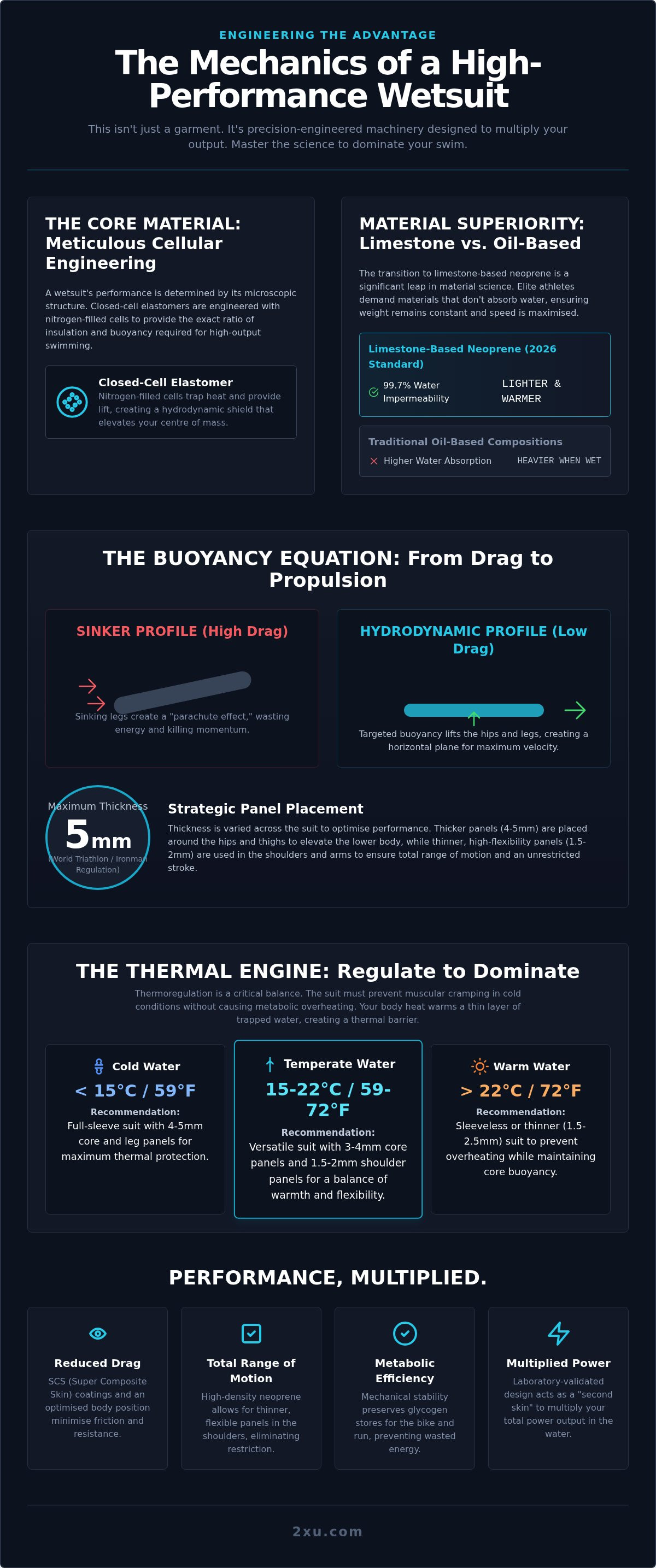
Neoprene is a closed-cell elastomer, a material meticulously engineered to provide the exact ratio of insulation and buoyancy required for high-output swimming. It isn't a substitute for the thousands of metres you've logged in the pool. It's a multiplier. Within the context of the Science of Wetsuits, this material acts as a hydrodynamic shield that preserves core temperature while elevating your centre of mass. In 2026, the distinction between average gear and elite equipment is defined by the precision of this cellular engineering. You earn your speed through discipline; we provide the tool to ensure that effort isn't wasted.
The Mechanics of Closed-Cell Elastomers
The performance of your neoprene wetsuit depends on the mechanics of its nitrogen-filled cells. These microscopic pockets trap heat and provide the necessary lift to keep you in a horizontal, low-drag position. The engineering challenge lies in the ratio of nitrogen to elastomer. A higher cell count increases flexibility and buoyancy but requires extreme manufacturing precision to maintain structural integrity. Uniform cell distribution is non-negotiable. If the distribution is uneven, you'll experience buoyancy imbalances that force your core to work harder just to stay level. Meticulous laboratory validation ensures that every square centimetre of the suit provides consistent mechanical support.
Limestone Neoprene vs. Traditional Compositions
The transition from oil-based compositions to limestone-based neoprene represents a significant leap in material science. Limestone-derived materials contain high levels of calcium carbonate, creating a structure that offers 99.7% water impermeability. This makes the suit lighter, warmer, and more durable than older iterations. Choosing this material isn't just a preference. It's a commitment to the discipline of investment. Elite athletes demand materials that don't absorb water, ensuring that the suit's weight remains constant from the first stroke to the final transition. It stays light. You stay fast.
Cell density is the primary driver of flexibility. High-density neoprene allows for thinner panels in the shoulders without sacrificing thermal efficiency. This ensures a total range of motion, allowing you to maintain your natural stroke mechanics even when wearing a suit designed for colder climates. We don't build a neoprene wetsuit to make the swim easy. We build it to make you faster. Respect the grind, trust the data, and use the technology to multiply your physical output.
The Science of Buoyancy and Thermal Efficiency
Buoyancy is the primary mechanical advantage provided by a high-performance neoprene wetsuit. This effect is governed by Archimedes' principle, where the upward buoyant force exerted on a body is equal to the weight of the fluid displaced. Neoprene thickness, measured in millimetres, is the critical variable here. In 2026, World Triathlon and Ironman regulations maintain a 5mm maximum thickness limit to prevent excessive artificial lift. This design boundary forces engineers to be meticulous. By strategically placing thicker panels around the hips and thighs, we can force the body into a horizontal plane, significantly reducing frontal drag and increasing velocity without increasing your metabolic cost.
Hydrodynamic Lift and Body Position
Lifting the hips is the most effective way to minimise the cross-sectional area resisting forward motion. For athletes with a "sinker" profile, typically those with high bone density or heavy leg musculature, precision-engineered buoyancy is a non-negotiable tool. When your legs sink, you create a parachute effect that kills momentum and forces your core to work harder for stabilisation. Optimising your body position through targeted lift allows for a more efficient stroke rate. This mechanical stability preserves your glycogen stores for the bike and run phases, ensuring your effort is multiplied rather than wasted on fighting gravity.
Thermoregulation for High-Output Athletes
Thermoregulation is a delicate balance between protection and performance. A neoprene wetsuit functions by trapping a thin film of water between your skin and the elastomer. Your body heat warms this layer, creating a thermal barrier that prevents muscular cramping in cold conditions. Research into the material science of neoprene demonstrates how cell resilience is vital for maintaining this barrier under the pressure of deep-water immersion. However, there is a definitive scientific threshold where warmth becomes an inhibitor.
In water temperatures approaching 24.5°C, high insulation leads to metabolic overheating. This results in rapid dehydration and elevated heart rates, which can compromise your entire race strategy. You must select a suit that hits the specific "sweet spot" for your race environment. Finding the right balance between buoyancy and thermal regulation is a key part of the grind. Explore our range of triathlon wetsuits to find the engineering that matches your specific performance data.
Performance Analysis: Triathlon vs. Standard Neoprene Suits
Standard ocean wear is built for survival; a high-performance neoprene wetsuit is built for speed. While a surfing suit prioritises durability for sitting on a board and resisting reef abrasion, a triathlon-specific suit is engineered for the relentless, high-frequency repetition of the freestyle stroke. Using general-purpose gear for a race is a tactical error that ignores the mathematical reality of drag and energy expenditure. In 2026, elite output demands specialised tools, not general-purpose equipment. You don't settle for average in your training; don't settle for it in your gear.
Shoulder Mobility and Stroke Mechanics
The primary failure point in standard suits is shoulder restriction. To eliminate this, triathlon engineering utilises ultra-thin neoprene, typically 1.5mm to 2mm, in the underarm and shoulder panels. This reduction in thickness is a calculated decision to minimise resistance during the recovery phase of your stroke. By reducing the force required to rotate the arm, you significantly delay shoulder fatigue during 1500m or 3800m swim legs. This ensures your stroke mechanics remain consistent from the first buoy to the shore, maintaining the mechanical stability of your swim split. The tensile strength required for these high-frequency rotations is validated through rigorous laboratory testing to ensure the material does not degrade under peak loads.
Surface Friction and Drag Coefficients
Hydrodynamics is a game of friction. Raw neoprene has a high drag coefficient, creating turbulence that slows you down. High-performance suits utilise Super Composite Skin (SCS), a specialised coating that makes the surface of the suit hydrophobic. SCS technology reduces the coefficient of dynamic friction significantly compared to untreated neoprene. This isn't just a lab statistic. It translates to a measurable increase in velocity, saving critical seconds per 100 metres. Every second saved is a direct result of the discipline you bring to your gear selection and the meticulous validation of the material science.
Your race doesn't end at the water's edge. Standard suits are notoriously difficult to remove, but triathlon-engineered gear includes "Quick Release" panels at the ankles and wrists. These panels use a high-stretch elastomer that allows the suit to be stripped in seconds during T1. In a sport where every margin matters, wasting time fighting a suit is unacceptable. We design for the entire Tripartite Athletic Framework: Readiness, Action, and Recuperation. This is how you multiply your performance and respect the grind of the transition.
Precision Fit: Selecting the Right Neoprene Thickness
The "second skin" philosophy is the foundation of hydrodynamic efficiency. If your neoprene wetsuit doesn't fit with absolute precision, you aren't racing; you're dragging an anchor. A loose fit allows for "flushing," where cold water enters the suit and displaces the warm thin-film layer you've worked to heat. This adds dead weight and forces your body to expend energy on thermoregulation that should be directed toward forward propulsion. In 2026, 2XU utilise laboratory-validated sizing charts to ensure every athlete achieves the compression required for mechanical stability without compromising respiratory capacity.
Selecting thickness is a calculation based on water temperature and metabolic output. Use this framework for your 2026 season:
- 14°C–18°C: 5mm torso panels for maximum lift and thermal retention, paired with 3mm extremities.
- 19°C–22°C: 3mm/2mm configurations to balance buoyancy with flexibility.
- 23°C–24°C: 2mm panels or sleeveless options to prevent metabolic overheating.
The 5-Point Fit Checklist
Precision requires a systematic approach. First, verify the neck seal; it must be tight enough to prevent intake without restricting the carotid artery. Second, ensure there is no "bridge" or air pocket in the small of your back, as this will trap water and increase drag. Third, check that wrist and ankle seals are under enough tension to maintain hydrodynamic integrity. Fourth, the underarms must be flush against the skin to prevent chafing. Finally, the torso should feel tight but allow for full lung expansion. If these points aren't met, your suit is a liability.
Maintenance and Longevity
Neoprene is a high-performance elastomer, but it is susceptible to cellular breakdown. Salt and chlorine are the primary enemies. When these chemicals dry, they form crystals inside the closed-cell structure, acting like sandpaper that degrades the material from the inside out. This leads to "neoprene crunch," a loss of elasticity that ruins your range of motion. To prevent this, rinse your suit in fresh water immediately after every swim. Dry it in the shade, as UV radiation breaks down the molecular bonds of the material. Store it flat or on a wide-contoured hanger to avoid permanent crease points that compromise thermal efficiency. Respect your gear, and it will respect your effort. Select your size using our validated triathlon wetsuit sizing guide to ensure your performance is multiplied on race day.
Multiplied Performance: Why 2XU Leads the Field
The mission at 2XU is to provide the engineering required to multiply human output. A high-performance neoprene wetsuit is a critical component of a broader triathlon gear ecosystem. This system supports the Tripartite Athletic Framework: Readiness, Action, and Recuperation. We respect the "Grind"; our gear works as hard as the athlete. In 2026, the gap between the podium and the pack is defined by the mathematical precision of your equipment. Every watt of energy you produce must be translated into forward motion without being drained by mechanical inefficiency.
The 2XU Technical Advantage
Our technical advantage is grounded in the use of premium Yamamoto limestone neoprene. This material is validated for superior impermeability and exceptional cell resilience. We don't rely on generic claims. Meticulous testing by sports scientists ensures that every suit provides the mechanical stability required for elite results. Your triathlon wetsuit acts as the ultimate race-day tool, correcting your body position through laboratory-proven hydrodynamics. This validation process involves proprietary measurement instrumentation to confirm that our fabrics deliver the exponential enhancement promised by the brand identity.
Join the Elite
Respect your training by choosing equipment that matches your intensity. You've spent months sharpening your physical engine; don't compromise that effort with average gear. Every athlete has the potential to multiply their results through advanced material science. The 2026 season demands a higher standard of preparation. Choosing 2XU means you're aligning your ambition with a brand that refuses to compromise on performance. This elite status is earned through discipline and the refusal to accept standard industry benchmarks. It's time to select the equipment that works as hard as you do. Gear up for your next breakthrough and let the science of multiplication drive your performance.
Master the Water: Your 2026 Performance Evolution
Engineering your fastest swim split is a calculation of material science and physiological discipline. We've deconstructed how limestone-based elastomers and targeted buoyancy panels eliminate the mechanical failures that hinder your progress. By prioritising a precision fit and specialised coatings, you transform from a swimmer fighting the water into a hydrodynamic machine. Every neoprene wetsuit in our collection is laboratory validated for hydrodynamic efficiency and is worn by world-class triathletes who refuse to settle for average standards.
You've put in the work. You've respected the grind. Now, ensure your equipment matches your ambition. Our gear is engineered with premium Yamamoto neoprene to provide the mechanical stability and thermal efficiency required for elite output in the 2026 season. Don't leave your results to chance when you can rely on proven data. Secure the tool that multiplies your potential and proves the concept that human is multiplied.
Shop the 2XU Performance Wetsuit Collection and secure your next performance multiplier. Every metre you've logged in training has led to this moment. Go out and earn your place at the front of the pack.
Frequently Asked Questions
Is a neoprene wetsuit necessary for my first triathlon?
A neoprene wetsuit is a vital performance tool, even for your first race. While not always mandatory depending on water temperature, the buoyancy it provides reduces the energy required to stay afloat and maintains an efficient body position. For water below 16°C, it's often required for safety. Beyond warmth, the psychological confidence and mechanical lift allow you to focus on your stroke mechanics rather than simply surviving the swim leg.
What is the difference between 3/2mm and 4/3mm neoprene thickness?
The numbers indicate the thickness in millimetres of the torso and limbs respectively. A 3/2mm suit prioritises flexibility and is engineered for temperate water conditions. A 4/3mm suit provides increased thermal retention and buoyancy for colder environments. In the 2026 season, precision-engineered panels ensure that even thicker suits maintain a total range of motion in the shoulders. Choose your thickness based on the specific thermal demands and your own buoyancy profile.
Can I use a surfing wetsuit for open water swimming or triathlons?
You can, but using a surfing suit is a tactical error that compromises your velocity. Surfing suits are built for durability and sitting on a board; they lack the hydrodynamic coatings and shoulder flexibility required for continuous freestyle swimming. A specialised neoprene wetsuit for triathlon uses limestone-based elastomers to reduce skin friction and optimise your body position. Using the wrong tool for the job results in wasted energy and slower split times.
How should a neoprene suit fit to ensure maximum performance?
Your suit must fit like a "second skin" with no air pockets or sagging material. Any loose areas allow for water "flushing," which adds dead weight and ruins thermal efficiency. The suit should feel restrictive on land but allow for full lung expansion during exertion. If you can easily pull the material away from your torso, it's too large. A tight fit is non-negotiable for achieving the mechanical stability required for elite performance.
How do I prevent chafing while wearing a performance wetsuit?
Apply a specialised, non-petroleum lubricant to high-friction zones such as the neck, underarms, and ankles. Chafing often results from an incorrect fit or the buildup of salt and abrasive particles. Ensure the suit is pulled up high enough in the crotch and armpits to eliminate skin-on-material friction. Meticulous cleaning after every swim session is also required to remove the crystals that cause skin irritation and degrade the elastomer over time.
Does neoprene lose its buoyancy over time with frequent use?
Neoprene gradually loses buoyancy as the nitrogen-filled cells within the elastomer compress over years of heavy use. Exposure to UV radiation and chemicals like chlorine accelerates this cellular breakdown. While high-quality limestone neoprene is more resilient than older materials, frequent racing will eventually reduce the mechanical lift. Laboratory-validated gear should be inspected annually to ensure it still meets the performance standards required for competitive racing and provides the necessary water displacement.
What is the best way to repair a small tear in my neoprene suit?
Use a specialised neoprene adhesive to bond "fingernail nicks" or small punctures immediately. Apply a thin layer to both sides of the tear, wait for it to become tacky, and then press the edges together firmly. For larger structural failures, professional repair is required to maintain the integrity of the seams. Addressing minor damage prevents water entry from expanding the tear and compromising the suit's hydrodynamics. Proper maintenance is part of the athlete's discipline.
Are 2XU wetsuits legal for IRONMAN and World Triathlon races?
Every 2XU suit is engineered to comply with the 5mm maximum thickness limit mandated by IRONMAN and World Triathlon. Our designs are meticulously checked against 2026 competition rules to ensure they are legal for all sanctioned events. Using a 2XU neoprene wetsuit ensures you are competing within the regulations while benefiting from the maximum allowable mechanical lift. Don't risk disqualification by using unvalidated gear; trust the science that supports your ambition.