
Women's Compression Tights: The Scientific Buying Guide to Peak Performance (2026)
Every millimetre of muscle oscillation during a high-intensity sprint or a heavy lift represents a mathematical leak in your total power output. You understand the demands of the Grind and the frustration when muscle fatigue or delayed onset muscle soreness forces an unscheduled break in your training cycle. It is a common struggle to find women's compression tights that maintain their mechanical integrity without slipping or losing tension over time. We respect the discipline required to push your limits, and we believe your apparel should be an engineering solution, not just a layer of fabric.
This guide provides the technical framework to master the science of graduated compression. You will learn how to select gear that multiplies your power, facilitates faster circulation, and supports the critical 'Ready, Action, Recovery' cycle. We will examine the laboratory-validated data behind medical-grade circular knit technology and specialised fabric construction. By the end of this analysis, you will possess the expert knowledge needed to choose a technical fit that reduces muscle vibration and ensures your physical output is exponentially enhanced during every session.
Key Takeaways
- Understand how graduated compression serves as a mechanical tool to optimise venous return and reduce muscle oscillation during high-impact movement.
- Learn to select women's compression tights by matching specific millimetres of mercury (mmHg) levels to your training intensity and recovery requirements.
- Identify the performance benefits of Muscle Containment Stamping (MCS) to protect against micro-tears and maintain mechanical stability during the Grind.
- Master the 'second skin' fit requirement by using height and weight metrics to ensure peak pressure optimisation and technical efficacy.
- Implement the 'Ready, Action, Recovery' tripartite framework to integrate discipline into your athletic routine and achieve breakthrough results.
The Science of Compression: Why Your Choice of Tights Matters
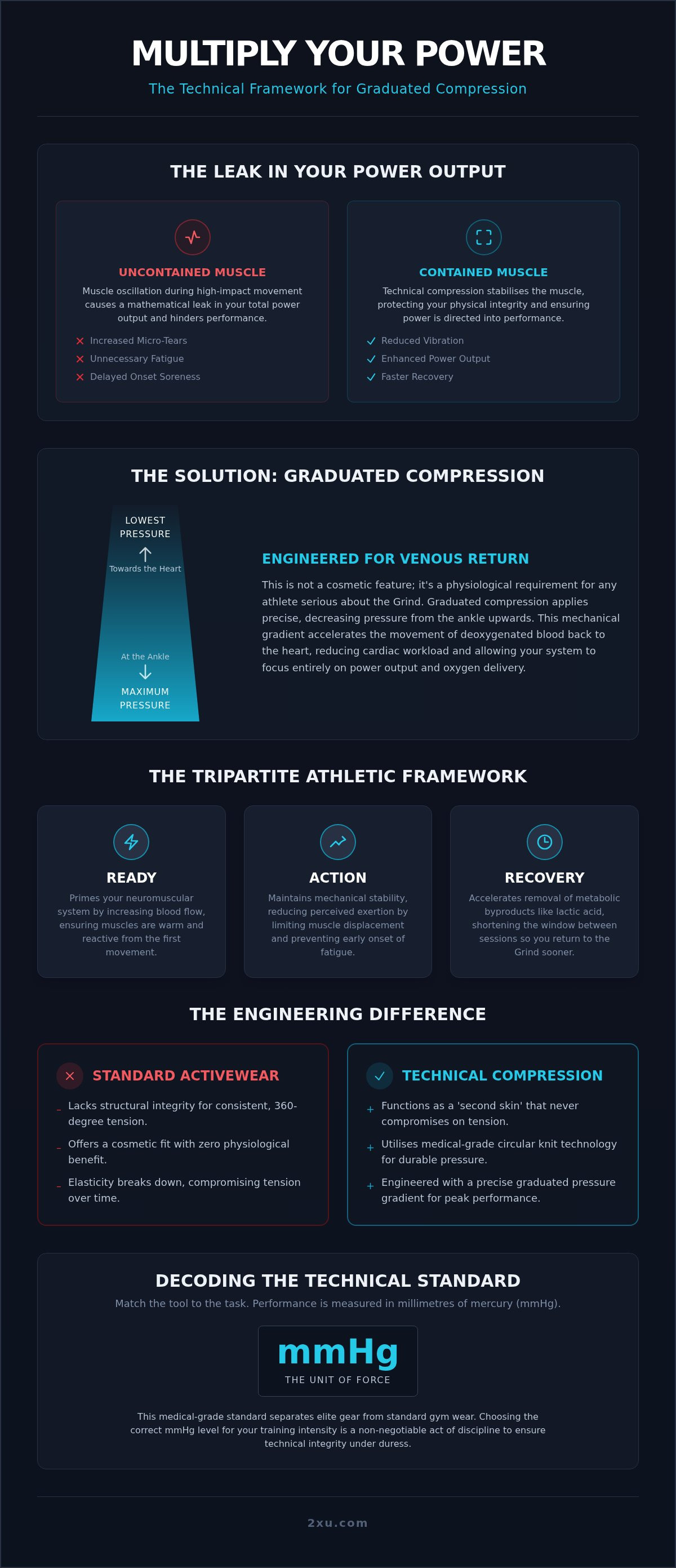
Elite performance isn't an accident; it's the result of precise mechanical interventions designed to multiply your natural capability. When you select women's compression tights, you aren't just buying athletic apparel. You're deploying a sophisticated tool for venous return optimisation. The Science of Compression dictates that applying specific external pressure to the limbs facilitates the movement of deoxygenated blood back to the heart. This process reduces the cardiac workload, allowing your circulatory system to focus entirely on sustained power output and oxygen delivery to working muscles.
Beyond fluid dynamics, high-level compression serves as a critical dampener for muscle oscillation. Every time your foot strikes the pavement or you execute a heavy lift, your muscles undergo rapid vibration. This oscillation is a primary driver of micro-tears and unnecessary fatigue. Proper compression stabilises the muscle belly, protecting your physical integrity during the most demanding training sessions. This mechanical support is coupled with heightened proprioception. By stimulating sensory receptors in the skin, the fabric provides superior body awareness, allowing you to maintain perfect form even when the Grind becomes punishing. Choosing the right gear is a direct investment in both your 'Action' and 'Recovery' phases.
The Tripartite Athletic Framework
True athletic advancement requires a holistic understanding of the training cycle. We utilise a specific three-part framework to ensure your gear supports every stage of your journey.
- Ready: Technical compression primes your neuromuscular system by increasing skin temperature and blood flow before you begin. This preparation ensures your muscles are warm and reactive from the first movement.
- Action: During the heat of training, the gear maintains mechanical stability. It reduces the rate of perceived exertion by limiting muscle displacement and preventing the early onset of fatigue.
- Recovery: Once the work is done, graduated pressure accelerates the removal of metabolic byproducts like lactic acid. This process shortens the window between sessions, allowing you to return to the Grind sooner.
Beyond Standard Leggings: The Engineering Difference
Standard activewear leggings often fail because they lack the structural integrity to provide consistent, 360-degree tension. They may feel tight, but they offer zero physiological benefit. True performance gear ensures women's compression tights function as a second skin that never compromises on tension. We utilise specialised medical-grade circular knit technology to ensure pressure remains constant and durable across the entire surface of the limb. These garments are built to resist the breakdown of elasticity that occurs in lesser products. Graduated compression is defined as the application of maximum pressure at the ankle that decreases linearly toward the heart to facilitate superior blood flow and venous return.
Decoding Compression Levels: Graduated vs. Uniform Pressure
Uniform pressure is a cosmetic attribute. Performance-grade women's compression tights are defined by a precise pressure gradient that is mathematically engineered to facilitate venous return. This graduated mechanism applies the highest pressure at the ankle, where the circulatory system faces the greatest gravitational resistance, and systematically decreases toward the heart. This isn't a suggestion; it's a physiological requirement for any athlete serious about the Grind. We measure this force in millimetres of mercury (mmHg), a technical standard that separates elite medical-grade apparel from standard gym wear.
Scientific validation is the foundation of our design philosophy. An updated systematic review and meta-analysis confirms that while compression may not alter absolute race times, it significantly reduces soft tissue vibration. This reduction in vibration is what prevents the micro-trauma that leads to delayed onset muscle soreness. By controlling muscle oscillation through specific mmHg levels, we multiply your ability to sustain high-intensity efforts without mechanical failure. Reaching your peak requires gear that maintains its technical integrity under extreme duress.
Understanding mmHg Ratings
Choosing the wrong level of pressure is a failure of discipline. You must match the tool to the task to ensure your physical output is multiplied rather than hindered.
- Mild Compression (15-20mmHg): Ideal for all-day wear and light activity. These garments provide subtle support for extended periods of standing or travel, aiding in general circulatory health.
- Moderate to Firm Compression (20-25mmHg): Engineered for high-intensity training and racing. This range is the standard for athletes who need to maintain mechanical stability during explosive movements.
- Extra Firm Compression (25-28mmHg+): Specifically for maximum recovery and reducing swelling. These are high-intervention tools designed to be worn post-exercise to flush metabolic waste.
The Role of Technical Fibres
High-filament yarns are essential for moisture management and thermoregulation. We use engineered polymers and high-denier yarns to ensure the fabric provides maximum power while remaining flexible. Unlike inferior brands that rely on low-grade materials, our fabrics are designed to maintain their tension over hundreds of wash cycles. We reject average standards because your performance depends on the mechanical integrity of your gear. If the tension fails, your recovery fails. For those who demand tangible results, exploring our range of high-performance compression clothing is the next logical step in your training evolution.
Choosing Your Gear: A Framework for Every Athlete
Selecting women's compression tights is a technical decision that must be grounded in the mechanical demands of your discipline. You don't choose gear based on aesthetics; you choose it based on the specific strain your sport places on your physiology. High-impact running requires different containment than a recovery session or a cold-weather endurance grind. Every piece of equipment in your arsenal must serve a dedicated purpose in the 'Ready, Action, Recovery' cycle. To achieve breakthrough results, your choice of apparel must be as disciplined as your training programme.
Functional details also dictate performance efficiency. Evaluate your storage requirements objectively. Endurance athletes require secure stash pockets for nutrition and essentials, while gym-based work demands a sleek, streamlined profile to prevent interference with equipment. Environmental factors are equally critical. For those who maintain their discipline in freezing temperatures, thermal 'Ignition' fabrics provide essential thermoregulation. These specialised fabrics trap body heat without sacrificing the moisture-wicking properties or the graduated pressure required for peak output. Match your technology to your ambition.
Collection Breakdown: Light Speed vs. Core vs. Recovery
We have engineered distinct collections to address the specific mechanical needs of different athletic phases. Understanding these differences is essential for the data-driven athlete.
- Light Speed: Specifically engineered for high-velocity running. These utilise Muscle Containment Stamping (MCS) to support the quadriceps and calves, significantly reducing the muscle vibration that leads to fatigue during long-distance efforts.
- Core: The versatile standard for the gym, HIIT, and field sports. These provide moderate graduated pressure to ensure stability and improved circulation across a wide range of movements.
- Recovery: Designed for the critical period after the Grind. These apply extra-firm pressure to return your body to its peak state as rapidly as possible by flushing metabolic waste.
The Impact of Muscle Containment Stamping (MCS)
Laboratory validation proves that mapping key muscle groups provides a tangible performance edge that standard leggings cannot match. MCS technology applies a targeted, internal stamping pattern that traces the primary muscles used during specific movements. This targeted support reduces muscle strain and improves power output by concentrating the compression where it is needed most. It acts as a secondary structural layer, reinforcing your natural architecture. Muscle Containment Stamping multiplies your explosive potential by providing a reinforced mechanical framework that supports your muscles during peak load.
Engineering the Perfect Fit: Sizing and Maintenance
Fit is not a matter of personal preference; it is a critical performance metric. For women's compression tights to function as a physiological intervention, a "second skin" fit is non-negotiable. If the garment does not feel restrictive during the initial application, it lacks the tension required to facilitate venous return or dampen muscle oscillation. This mechanical interface must maintain constant, firm contact with the skin to ensure the graduated pressure profile remains anatomically aligned. Anything less is merely activewear, not a performance tool.
The engineering extends to the waistband, which must be selected based on your specific training intensity. Flat-bonded waistbands provide a low-profile, aerodynamic finish that is ideal for HIIT and floor work where bulk causes interference. Conversely, drawstring waistbands offer the absolute security required for high-velocity running and endurance sessions. Choosing the wrong interface can lead to slipping, which compromises the pressure gradient and distracts you from the Grind. Precision in selection leads to precision in execution.
How to Measure for Performance
We reject standard dress sizing because it fails to account for the mathematical relationship between body mass and surface area. We utilise a specialised height and weight matrix to ensure height-pressure optimisation. Pressure is a function of limb circumference and length; therefore, your technical size may differ from your casual wardrobe. Sizing up for comfort is a common failure of discipline that negates the physiological benefits of the garment. Once on, perform the "tug test": ensure the fabric is pulled firmly into the crotch and the graduated pressure sits precisely at the ankle. If the fabric bunches or sags, your power output is being leaked.
Preserving Your Investment
Respect the engineering behind your gear by following strict maintenance protocols. Heat is the primary enemy of engineered polymers. Never use a tumble dryer. The high temperatures of a dryer destroy the elasticity and structural integrity of the technical fibres, rendering the compression profile useless. Wash your tights in cold water using specialised detergents designed for technical apparel to remove salt and sweat without degrading the mechanical properties. Store them flat or folded in a cool environment to maintain the tension retention that defines our laboratory-validated gear. Secure your performance edge and shop the full range of women's compression tights to ensure your next session is backed by elite technology.
The Next Generation: Empowering the Future Athlete
The path to elite status is forged through the Grind, and this journey often begins long before an athlete reaches the professional ranks. Establishing a foundation of discipline and recovery habits in the early stages of development is essential for long-term physiological optimisation. We believe that the technology found in high-performance women's compression tights should be accessible to those earning their place in the next generation of sport. By integrating laboratory-validated gear into a young athlete's routine, we reinforce the importance of professional preparation and respect for the biological recovery cycle. It's about building a mindset where every session is supported by the best engineering available.
Youth Performance Gear
Developing athletes face unique mechanical stresses as their muscles and skeletal structures grow under the load of intense training. We have adapted our proprietary PWX fabric technologies to meet the specific requirements of younger competitors, ensuring they receive elite-level support. This gear provides the same medical-grade circular knit tension found in our adult ranges, offering critical mechanical stability during school-level sports and club competitions. By reducing muscle oscillation in developing limbs, we help mitigate the risk of common overuse injuries and soft tissue strain. This isn't about mere comfort; it's about providing a technical framework that supports growing muscles during high-impact action. Encouraging a mindset of preparation and active recovery ensures that these athletes are equipped to handle the increasing demands of their chosen disciplines.
Start the Journey to Multiplication
The core of our philosophy is the concept that the human is multiplied. Every hour spent in training, every rep in the gym, and every kilometre on the road is an investment that deserves to be protected by superior engineering. As established in our tripartite framework, the 'Ready, Action, Recovery' cycle is the blueprint for sustained athletic advancement at any age. The right gear acts as a force multiplier, ensuring that none of your effort is wasted through unnecessary fatigue or prolonged soreness. Whether you are a seasoned competitor or looking to equip a rising star, the choice of technical compression is a commitment to excellence. Explore the full range of Youth Compression gear for the next generation and provide your future champions with the tools to dominate their field.
Master the Science of Multiplication
Peak performance is the result of disciplined training combined with precise mechanical interventions. Understand that women's compression tights are not mere apparel; they're engineered tools designed to optimise venous return and dampen muscle oscillation. By selecting gear based on the 'Ready, Action, Recovery' framework, you ensure every session contributes to your ultimate potential. Precision in fit and a commitment to laboratory-validated technology are the markers of an athlete who respects the Grind.
Our circular knit technology provides the 360-degree support necessary to maintain structural integrity under extreme load. This standard of excellence is endorsed by elite athletes globally who refuse to compromise on their physical output. Whether you're refining your own training or equipping the next generation, the data proves that graduated pressure is the key to faster recovery and sustained power. Your journey to doubling your capability starts with disciplined choices.
Shop the Youth Compression Collection to Multiply Future Performance and secure the technical edge required to dominate your discipline. Earn your place through hard work and let the science handle the rest.
Frequently Asked Questions
How tight should my compression tights actually feel?
Your women's compression tights must feel like a restrictive second skin that requires significant effort to apply. If they slide on like standard leggings, they lack the tension needed for physiological optimisation. You should feel a firm, graduated pressure that is strongest at the ankle. This level of restriction is necessary to stabilise the muscle belly and reduce oscillation during the Grind. It shouldn't be painful, but it must be noticeably firm.
Can I wear compression tights for the entire day?
You can wear mild compression (15-20mmHg) for the entire day to improve general circulation and reduce leg swelling. However, extra-firm recovery tights are engineered for shorter windows of maximum intervention. Prolonged wear of high-pressure garments during sedentary periods is generally unnecessary. For all-day discipline, select a versatile pair that balances support with comfort. Always ensure the fit is precise to avoid pressure points that could compromise your venous return during the Grind.
What is the difference between active and recovery compression?
Active compression is engineered to reduce muscle oscillation and maintain mechanical stability during high-intensity movement. It focuses on protecting the muscle from micro-tears during the Action phase. Recovery compression applies a higher, extra-firm pressure gradient specifically designed to flush metabolic waste post-exercise. While active gear supports your power output during the Grind, recovery gear accelerates your return to peak state. Both are essential components of the tripartite athletic framework for total performance.
How do I know if my compression tights have lost their effectiveness?
Your tights have lost their effectiveness when they no longer require effort to put on or feel significantly easier to stretch. Technical fibres eventually lose their tension retention properties after hundreds of wash cycles. Perform a "snap test" by pulling the fabric; it should immediately return to its original shape with force. If the fabric feels thin or the graduated pressure at the ankle seems diminished, the mechanical integrity is compromised and your results will suffer.
Do compression tights actually help with shin splints or calf strains?
Compression gear provides critical mechanical stability that helps manage the symptoms of shin splints and calf strains. By reducing muscle oscillation, the fabric limits the repetitive stress placed on the periosteum and soft tissues. This stabilising effect, combined with heightened proprioception, allows for better body awareness and more controlled movement. While not a cure, laboratory-validated women's compression tights are an effective tool for protecting your muscles during the most punishing training sessions.
Is it better to choose high-rise or mid-rise compression tights?
The choice depends on your specific mechanical demands and core stability requirements. High-rise tights provide maximum coverage and support for the abdominal wall, which is often preferred for HIIT and heavy lifting. Mid-rise options offer greater freedom of movement at the waist, which some endurance runners prefer for breathability during the Grind. Both styles utilise the same circular knit technology. Choose the rise that ensures you remain focused on your performance without distraction.
How often should I replace my performance compression gear?
Performance compression gear should typically be replaced every 6 to 12 months if you are training consistently. The mechanical properties of engineered polymers degrade over time due to sweat, body oils, and repeated stretching. Even with perfect maintenance, the specific mmHg pressure levels will eventually drop below the technical threshold required for optimisation. Respect your training by ensuring your gear is always capable of multiplying your physical output at its laboratory-validated standard.
Can I wear compression tights under my regular training shorts?
Layering women's compression tights under regular training shorts is a common practice that does not diminish their technical efficacy. The physiological benefits are derived from the direct mechanical interface between the fabric and your skin. As long as the tights are sized correctly using the height and weight matrix, they will provide the necessary graduated pressure. This layering technique is ideal for athletes who want the benefits of compression with the aesthetic of traditional athletic sportswear.