
Leg Compression Sleeves: The Science of Accelerating Muscle Recovery
Your rest day isn't a passive break from the Grind; it's a critical window to mechanically multiply your physical output. You've felt the leaden weight of delayed onset muscle soreness (DOMS) after a high-impact run, where every step feels like a battle against your own physiology. This fatigue isn't just a sign of effort. It's the result of inefficient venous return and excessive muscle oscillation that compromises your next session. Integrating a precision-engineered leg compression sleeve into your protocol ensures that your recovery is as disciplined as your training.
By mastering the science of compression, you turn your recovery into a tactical advantage. This article explores the graduated compression mechanisms that accelerate blood flow and minimise tissue damage. We'll detail how laboratory-validated pressure profiles optimise circulatory efficiency, effectively doubling your recovery potential. This allows you to transition between sessions with unprecedented speed. You don't just recover. You prepare for the next breakthrough.
Key Takeaways
- Understand why elite performance requires more than passive rest; it requires an active commitment to the recovery phase of the tripartite framework.
- Discover how a precision-engineered leg compression sleeve applies graduated pressure to optimise venous return, effectively acting as a mechanical second heart to flush metabolic waste.
- Learn to select the correct tactical gear by distinguishing between the high-octane action of sleeves and the comprehensive recovery provided by full-length tights.
- Master the 2-hour rule to ensure your recovery protocol begins immediately post-session, when your muscles are most receptive to external pressure gradients.
- Recognise the importance of laboratory-validated pressure profiles in ensuring your gear provides the specific mechanical stability required for elite output.
Beyond the Surface: What Are Leg Compression Sleeves?
Elite performance isn't just about the intensity of your session. It's about how you command the hours between them. Average athletes wait for soreness to fade; disciplined athletes use technology to accelerate the timeline. A leg compression sleeve is not a simple accessory or a passive bandage. It's a precision-engineered instrument designed for the Recovery phase of the tripartite athletic framework. Respecting the Grind means refusing to accept standard recovery times that slow your training frequency. You don't just want to heal. You want to multiply your output.
A high-performance leg compression sleeve is a specialised compression garment designed to exert precise pressure on the lower limbs. While medical-grade supports are often designed for clinical management of swelling, athletic compression is built for power and durability. It addresses the specific physiological demands of high-velocity movement and the subsequent biological repair process. This technology provides the mechanical stability required to protect muscle fibres during your most demanding high-output sessions.
The Anatomy of a High-Performance Sleeve
The engineering of elite gear begins with the selection of technical fabrics. We utilise powerful, lightweight yarns that offer superior moisture management and durability without the bulk of traditional materials. These engineered fibres are woven using a 360-degree knit construction. This ensures that the pressure applied is uniform across the entire circumference of the limb. This seamless design eliminates friction points and ensures that the graduated compression profile remains consistent, even during explosive movements. Every millimetre of the knit is optimised to support your physiology.
Mechanical Stability and Muscle Oscillation
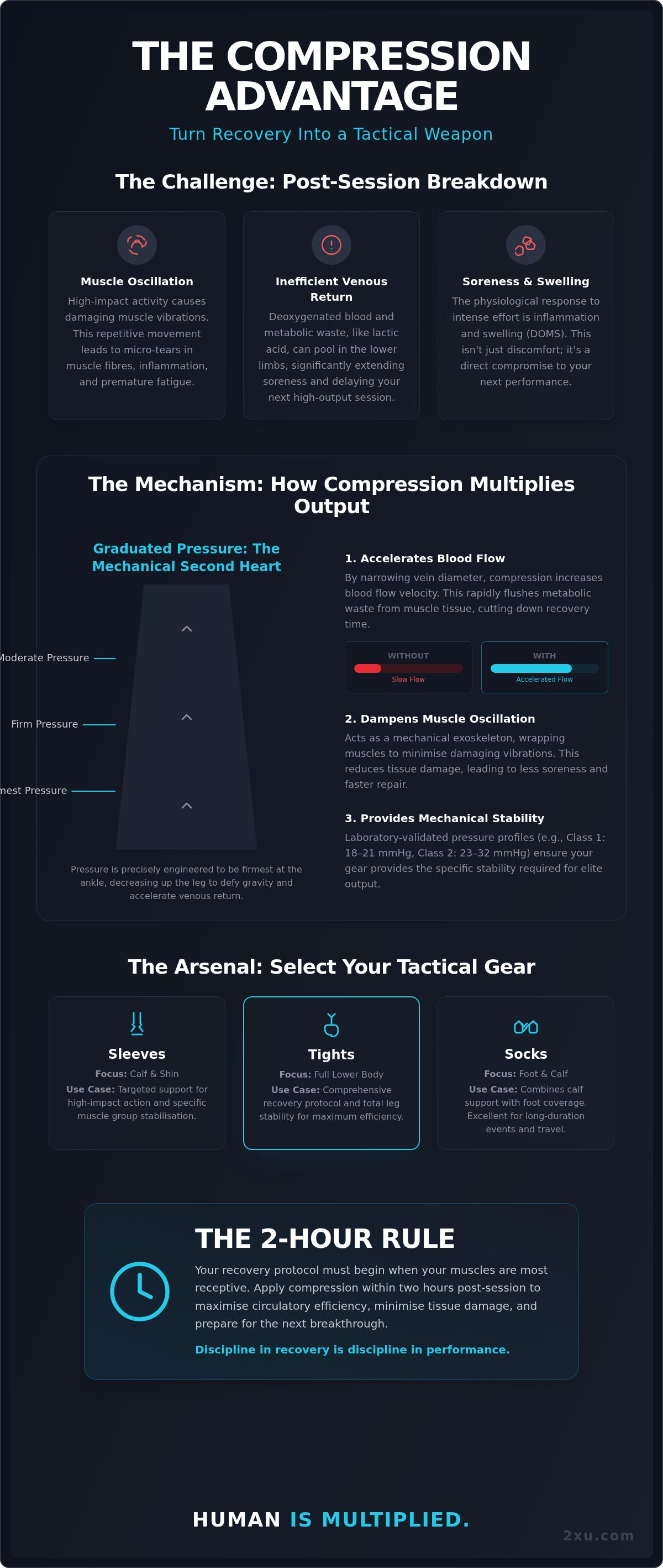
During a high-impact run or an intense training session, your muscles experience significant vibration, known as muscle oscillation. This repetitive movement causes micro-tears in the muscle fibres and leads to premature fatigue. A leg compression sleeve acts as a mechanical exoskeleton for the calf and shin. It wraps the muscle groups tightly to dampen these vibrations. By minimising unnecessary muscle movement during impact, you reduce the overall damage sustained by the tissue. This results in less inflammation and a faster transition from one session to the next. You aren't just wearing a sleeve; you're reinforcing your body's structural integrity.
The Physiological Mechanism: How Compression Multiplies Recovery
Venous return is the primary bottleneck in athletic recuperation. While the heart pumps oxygenated blood to the extremities, the return of deoxygenated blood and metabolic waste relies heavily on the "second heart"—the calf muscle pump. A leg compression sleeve acts as a mechanical catalyst for this process. By applying external pressure to the lower limb, the sleeve reduces the diameter of the major veins. According to the principles of fluid dynamics, as the cross-sectional area of the vessel decreases, blood flow velocity increases. This acceleration ensures that waste products like lactic acid are flushed from the tissue with maximum efficiency. Graduated compression is defined as a pressure gradient that is firmest at the ankle and decreases up the leg.
This mechanical intervention doesn't just assist the body; it multiplies its natural biological capacity. By force-multiplying the efficiency of the calf muscle pump, you reduce the time your body spends in a state of inflammation. To achieve these results, you must look for gear that offers laboratory-validated pressure profiles rather than simple elastic support. If you're serious about your output, you should invest in precision-engineered compression apparel that respects the complexity of human vascular architecture.
Graduated Compression: The Physics of Blood Flow
Uniform pressure is fundamentally inferior for venous return. If pressure is equal across the entire leg, it can lead to blood pooling rather than upward movement. Mathematical precision is required to engineer a gradient that effectively defies gravity. High-performance gear often targets Class 1 (18–21 mmHg) or Class 2 (23–32 mmHg) compression levels to meet specific physiological demands. This specific gradient ensures that deoxygenated blood is directed toward the heart at an optimised rate. This isn't just about comfort. It's about the physics of biological acceleration.
Reducing Inflammation and Lymphatic Drainage
Post-exercise swelling is the result of interstitial fluid accumulating in the muscle tissue. This build-up contributes significantly to the sensation of heaviness and the onset of Delayed Onset Muscle Soreness (DOMS). Compression garments facilitate lymphatic drainage by applying the necessary pressure to move this fluid back into the circulatory system. A systematic review and meta-analysis on muscle recovery confirms that compression significantly mitigates the decline in muscle strength and power following intense exertion. By preventing the stagnation of fluid and waste, you protect your muscle fibres from prolonged inflammatory stress. This disciplined approach to recovery ensures that you return to the Grind with your full physical potential restored.
Sleeves vs. Tights vs. Socks: Selecting Your Tactical Gear
Selecting your gear is a tactical decision. You don't just pick what looks right; you select the instrument that fits the specific phase of the tripartite athletic framework. While full-length tights provide comprehensive support for the entire lower kinetic chain, a leg compression sleeve offers targeted mechanical stability during the Action phase. This is critical for triathletes who demand maximum transition speed. Sleeves allow you to maintain graduated compression on the calves while keeping the feet free, which is essential for rapid footwear changes or swimming legs.
Recovery doesn't stop when you leave the track or the pool. Long-haul travel introduces unique physiological stressors, including the risk of DVT and significant travel fatigue. For these sedentary periods, specialised flight pressure socks are the superior choice. They provide the necessary pressure gradient to manage venous return when the "second heart" isn't actively pumping during movement. You must choose the tool that matches the environmental constraints of your recovery.
Full tights are reserved for total body conditioning and the Recovery phase. When your entire lower body requires the multiplication of its natural repair processes, the comprehensive coverage of a tight is unmatched. This is the gear you wear when the session is over and the focus shifts entirely to biological restoration. By supporting the glutes, hamstrings, and quads alongside the calves, you ensure that no part of your physiology is left to recover at an average pace.
The Case for Leg Sleeves in Training
Climate and customisation often dictate your choice of gear. In warmer Australian environments, heat management becomes a performance variable that can't be ignored. A leg compression sleeve provides the mechanical benefits of compression without the thermal load of a full tight. This flexibility allows you to pair your sleeves with your preferred athletic socks. You get personalised comfort without compromising on the calf stability required for the Grind. The ease of application and removal also makes them ideal for multi-stage events where conditions or requirements change rapidly.
Comparing Compression Profiles
There's a fundamental difference between active performance compression and passive recovery gear. Active gear is engineered to handle the dynamic forces of movement and muscle oscillation. Passive recovery gear is optimised for sedentary periods like sleep or post-session rest. When your total body requires multiplication, full tights ensure that every major muscle group is supported. For those focusing on upper body stability and posture during the Preparation phase, Compression Shirts provide the same level of scientific validation to the torso and shoulders. Don't settle for a one-size-fits-all approach to your physiology.
Implementation Strategy: Optimising Your Recovery Protocol
To multiply your potential, you must apply the same discipline to your recovery as you do to the Grind. The 2-hour rule is your non-negotiable window. Applying your leg compression sleeve within 120 minutes of finishing a session ensures that you capitalise on peak metabolic activity and circulatory demand. This immediate intervention prevents the stagnation of metabolic byproducts before they can compromise your next session. If you miss this window, you're essentially choosing to recover at an average pace. Elite performance requires meticulous timing and a refusal to cut corners during the recuperation phase.
Timing Your Compression
Your protocol should span the entire tripartite framework to be truly effective. Pre-session application primes the muscles by increasing local blood flow and temperature, preparing the lower limbs for high output. During the session, the sleeve acts as a mechanical stabiliser to reduce micro-trauma and muscle oscillation in real-time. Post-session, the focus shifts to passive recovery, where the graduated pressure profile facilitates the removal of interstitial fluid and reduces swelling. Every minute you wear the gear during these phases is an investment in your future physical output.
Ensuring a Precision Fit
An elite fit is a matter of mathematical accuracy, not personal preference. You must measure your calf circumference at the widest point and correlate it with your height to ensure the pressure gradient aligns with your vascular anatomy. A sleeve that is too loose provides zero mechanical stability, while one that is too tight can impede arterial flow. A precision-fit compression sleeve should feel like a second skin, providing firm, graduated pressure without restricting joint mobility. You must be vigilant for signs of an incorrect fit:
- Numbness or tingling in the extremities.
- Lack of mechanical support or visible fabric sagging.
- Restricted range of motion in the ankle or knee joints.
If you experience these, your recovery is being compromised. To secure your recovery advantage, shop specialised compression clothing that meets these rigorous engineering standards.
Technical fabrics require specialised care to maintain their mechanical properties and laboratory-validated pressure profiles. Never use fabric softeners. These chemicals coat the technical fibres, clogging the knit and destroying the elasticity required for graduated compression. Wash your gear in cold water and air dry it away from direct heat to prevent fibre degradation. By respecting the equipment, you ensure it continues to provide the precise level of power and support your recovery demands. Discipline in maintenance is as important as discipline in training.
The 2XU Advantage: Engineered for the Elite Athlete
Average standards don't produce elite results. While competitors treat the leg compression sleeve as a basic support tool, we engineer it as a mechanical advantage designed to double your recovery efficiency. This is the Multiplication Promise: a commitment to providing technology that exponentially enhances your physical potential. We don't rely on marketing claims; we rely on data. Our pressure profiles are validated through rigorous testing with independent sports science institutes to ensure they meet the exact physiological requirements of the elite athlete.
The 2XU signature is a holistic understanding of the athlete's journey. From the initial Preparation phase to the final Recovery window, our gear is built to withstand the uncompromising demands of the Grind. This isn't just clothing; it's high-performance equipment. Every stitch and yarn is scrutinised to ensure it contributes to your mechanical stability and biological restoration. When you choose 2XU, you're choosing gear that has been proven in the laboratory and on the world stage.
Proprietary Fabric Engineering
Our engineering team focuses on the power-weight ratio of our specialised yarns. We avoid the bulk of traditional materials, opting instead for fabrics that provide maximum pressure with minimal weight. These fabrics are optimised for breathability and moisture-wicking, ensuring that even during the most intense sessions, your thermal regulation isn't compromised. We subject our gear to extreme resilience testing to ensure it maintains its graduated compression profile after 100+ wash cycles. This durability ensures that your investment in performance continues to pay dividends long after other brands have lost their elasticity.
Validated by the Elite
Professional triathletes and endurance runners don't leave their recovery to chance. They use 2XU to sharpen their performance and reduce the downtime between high-output sessions. Our technology has been a critical component in world-record endurance attempts, where the margin for error is non-existent. This level of validation is what separates us from the rest of the industry. You've earned your place through hard work and discipline; now it's time to equip yourself with the tools that respect that effort. Equip yourself with 2XU Leg Compression Sleeves and start multiplying your output today.
Master Your Recovery Phase
Your commitment to the Grind is only as effective as your commitment to recuperation. Mastering the physiological mechanisms of the leg compression sleeve allows you to turn downtime into a tactical advantage. By applying laboratory-validated graduated compression within the critical 2-hour post-session window, you optimise venous return and flush metabolic waste before it compromises your next performance. This disciplined approach to the tripartite framework ensures that you don't just rest; you actively multiply your biological capacity. You've seen how mechanical stability dampens muscle oscillation and how precise pressure gradients defy gravity to accelerate blood flow.
Trusted by elite athletes and professional sports teams, 2XU gear is engineered for maximum durability and performance. It's time to stop accepting average recovery speeds and start demanding more from your technical equipment. Multiply your recovery with 2XU Leg Compression Sleeves and secure your mechanical advantage today. Every session counts, and every hour of recovery determines your future physical output. Stay disciplined, respect the process, and continue to push your limits toward breakthrough results.
Frequently Asked Questions
How long should I wear leg compression sleeves after a run?
Wear your sleeves for two to four hours immediately following your session to maximise the recovery window. This timeframe allows the graduated pressure to facilitate venous return and flush metabolic waste while the muscles are still in an active repair state. For intense sessions or endurance runs, extending this to six hours ensures comprehensive lymphatic drainage. Consistency is key to multiplying your recovery speed and ensuring you are ready for the next day's Grind.
Can I sleep in my leg compression sleeves?
Sleeping in a leg compression sleeve is generally not recommended because the lack of foot coverage can lead to fluid pooling at the ankles when you are horizontal. For overnight recovery, full-length compression tights or socks are the superior tactical choice. These provide a complete pressure gradient from the foot upwards, ensuring that circulatory efficiency is maintained throughout the sleep cycle. Reserve your sleeves for active training and the immediate post-session recovery period.
Do leg compression sleeves help with shin splints?
Yes, these tools provide critical mechanical stability that reduces the strain on the connective tissues around the tibia. By dampening muscle oscillation during high-impact runs, they minimise the repetitive stress that often leads to medial tibial stress syndrome. While they are a powerful tool for management and prevention, they should be part of a broader discipline that includes proper load management and strength training. They act as a mechanical exoskeleton for your lower legs.
Is it better to wear compression sleeves or socks for recovery?
Socks are typically better for passive, sedentary recovery or travel because they include the foot, preventing swelling in the lower extremities. However, specialised sleeves are the elite choice for Action phases and transitions, such as during a triathlon. They allow you to maintain calf support while pairing them with your preferred performance socks. Your choice should depend on whether you are actively moving or in a stationary recovery state where foot coverage is required.
How tight should my leg compression sleeves be?
Your sleeves must be firm enough to provide graduated pressure without causing discomfort or restricting arterial blood flow. A precision fit should feel like a second skin, offering a noticeable squeeze that is most intense at the ankle and tapers off toward the knee. If you experience numbness, tingling, or skin discolouration, the fit is too restrictive. Conversely, if the fabric bunches or slips during movement, it will fail to provide the necessary mechanical stability.
How do I know what size leg compression sleeve to buy?
Meticulous measurement of your calf circumference is the only way to ensure an elite fit for your leg compression sleeve. Do not rely on height or weight alone, as these metrics don't account for specific muscle density or lower limb anatomy. Measure the widest part of your calf when the muscle is relaxed. Compare this data point against laboratory-validated sizing charts to find the specific profile that matches your unique physiology.
Can I wear leg compression sleeves during a triathlon swim?
You can wear them under a wetsuit, but ensure they are designed for aquatic use to prevent heavy water absorption. Many triathletes wear them throughout the entire event to save time during transitions. The primary benefit is that they keep the calves primed and stable for the bike and run legs. However, you must verify that the technical fabric is resistant to chlorine and salt water to prevent premature degradation of the elastic yarns.
How do I wash my compression gear to keep the elasticity?
Wash your gear in cold water using a mild detergent and avoid all fabric softeners. Softeners coat the technical fibres and destroy the elasticity required for graduated pressure. Air dry your sleeves in the shade rather than using a tumble dryer, as high heat can break down the yarns. Maintaining your gear with this level of discipline ensures that the laboratory-validated pressure profiles remain effective for over 100 wash cycles, protecting your performance investment.