
How to Pack for a Destination Triathlon: The Elite Performance Checklist
Your race doesn't start at the sound of the starting siren; it begins the moment you seal your bike box. For the elite athlete, the 24 hours spent in transit are as critical to the final podium result as the last six months of anaerobic threshold training. You understand that a single wetsuit tear in checked luggage or a bout of flight-induced oedema can negate thousands of hours of discipline before you even reach the transition area. Mastering how to pack for a destination triathlon is not merely about fitting gear into a bag; it's an exercise in engineered logistics and biological preservation.
We agree that the anxiety of forgetting a proprietary mechanical spare in a foreign country is a distraction you don't need when your focus should be on the grind. This guide provides a scientific framework to master your packing system, ensuring your high-performance equipment and your physiology arrive in peak condition. You'll gain a foolproof checklist designed to eliminate mechanical failures and maintain your physical output through long-haul travel. We'll examine the precise protocols for gear protection, internal compression strategies to combat leg swelling, and the essential spares required to maintain mechanical stability on race day.
Key Takeaways
- Utilise graduated compression clothing during transit to maintain circulatory efficiency and combat travel-induced oedema.
- Master how to pack for a destination triathlon by implementing a rigorous mechanical protection protocol for your high-performance wetsuit and gear.
- Assemble a specialized small-parts kit to ensure mechanical stability and self-sufficiency in foreign racing environments.
- Optimise your trisuit selection and nutrition logistics based on precise destination climate data and local variable audits.
- Implement a recovery multiplier protocol by packing specific restoration apparel to accelerate biological readiness for the return journey.
Travel Strategy: Optimising Biological Readiness in Transit
The journey to the start line is the zero-hour of your race preparation. Many athletes treat a flight as passive downtime, but for the elite performer, it's a critical phase of biological preservation. Every hour spent in a pressurised cabin at low humidity affects your plasma volume and muscle suppleness. Mastering how to pack for a destination triathlon means viewing your travel bag as a mobile recovery lab. If you arrive at your destination with heavy, swollen legs, you've already conceded a percentage of your peak power output before the triathlon even begins.
The Science of In-Flight Compression
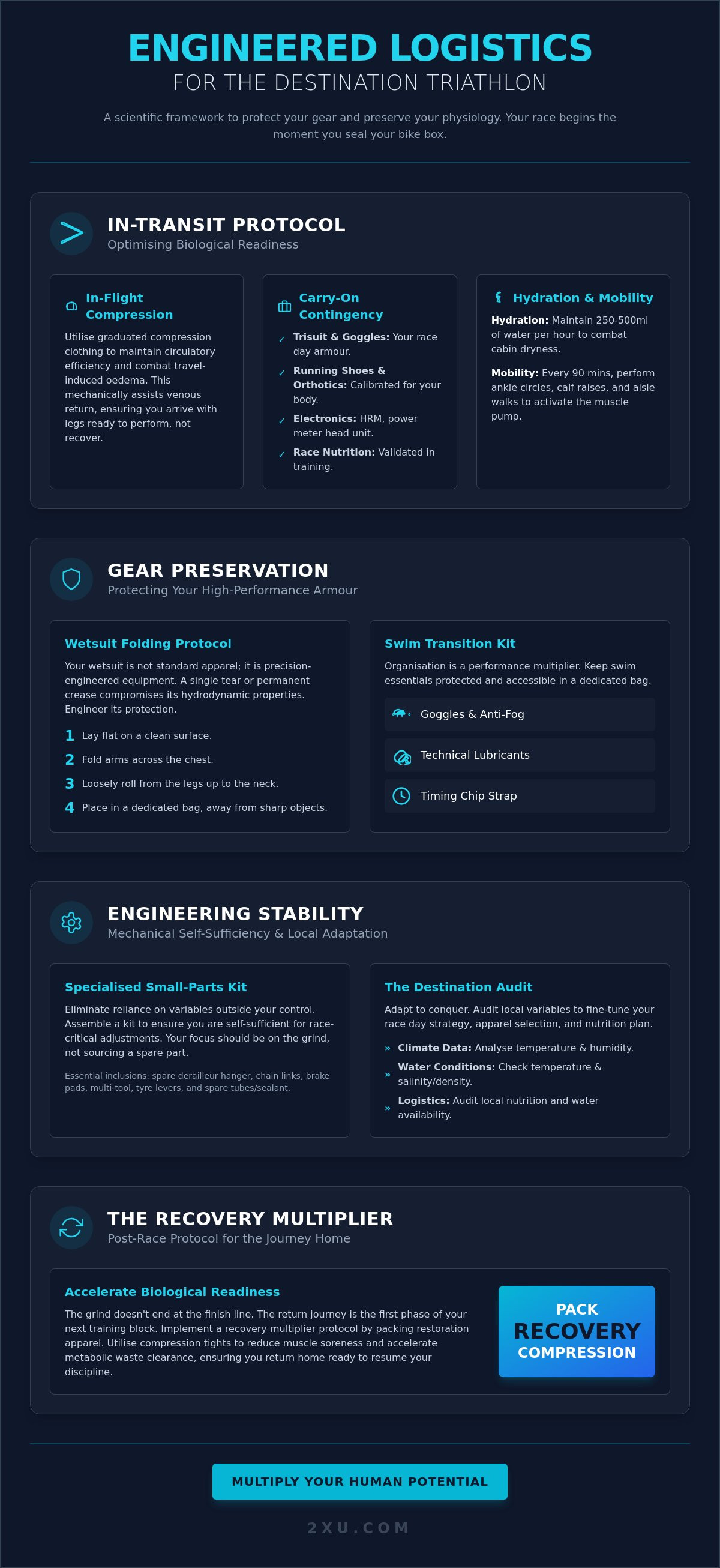
Sedentary travel for extended periods causes blood to pool in the lower extremities, leading to travel-induced oedema. Graduated compression clothing is your primary tool for counteracting this effect. By applying a specific pressure gradient that is tightest at the ankle and decreases up the leg, these garments mechanically assist venous return. This process keeps your blood circulating efficiently despite the lack of muscle pump activity. This is particularly vital for endurance athletes who often have high red blood cell counts; increased blood viscosity combined with dehydration and immobility creates a higher risk for deep vein thrombosis (DVT). Refer to our specialised guide on flight pressure socks to master the specific timing and application of compression during your journey.
The Carry-On Contingency List
Your checked luggage is a variable you cannot control once it leaves your hands. Respect the grind you've endured to get here by keeping your non-negotiable gear within reach. If a bike box goes missing, a replacement can often be sourced through local mechanics or event partners. However, your personal performance tools cannot be easily replaced 48 hours before a race. Ensure your carry-on includes:
- Your triathlon suit and swim goggles.
- Calibrated running shoes and orthotics.
- Primary electronics, including your heart rate monitor and power meter head unit.
- Essential race-day nutrition that you have validated during training.
When packing technical performance materials, avoid tight folds that might cause fibre stress or permanent creasing in the aerodynamic panels. Roll your garments loosely and place them in a dedicated mesh bag to maintain their mechanical integrity. Checking your primary race kit is a risk to months of discipline that you simply don't need to take.
Maintain a strict hydration protocol of 250ml to 500ml of water per hour, depending on cabin temperature and individual sweat rates. Combine this with a mobility routine; perform ankle circles, seated calf raises, and periodic walks down the aisle every 90 minutes. These movements, paired with compression, ensure that your lymphatic system continues to clear metabolic waste, arriving at your destination ready to perform rather than needing days to recover from the flight.
The Swim Split: Protecting Your High-Performance Armour
The swim is often where a race is compromised before it begins, not through lack of fitness, but through the mechanical failure of your gear. Your wetsuit is a precision engineered skin designed to maximise buoyancy and reduce hydrodynamic drag. Treating it like standard apparel in your luggage is a mistake that compromises its integrity. When refining how to pack for a destination triathlon, the protection of your neoprene must be absolute. Baggage handlers will not respect the delicate cell structure of your suit; you must engineer that protection yourself. Every millimetre of your kit must arrive in the same condition it left the laboratory.
Organisation in the swim transition is a performance multiplier. Use a dedicated transition bag to house your goggles, lubricants, and timing chip strap. Technical lubricants are non-negotiable for preventing salt water chafing, which can derail your concentration during the bike leg. Every element of your swim kit should have a specific, protected location within your luggage. When reviewing your destination race packing list, ensure you have accounted for the different water densities and temperatures of your race location.
Wetsuit Folding Protocol
Neoprene is a cellular material composed of thousands of microscopic nitrogen bubbles. Permanent compression occurs when the suit is folded tightly for extended periods, leading to crease lines where buoyancy is lost and water ingress increases. To prevent this, never fold your triathlon wetsuit. Instead, utilise a rolling technique. Start from the ankles and roll the suit upwards, using your soft technical training apparel as internal padding to maintain the roll radius. This prevents the material from collapsing on itself. Ensure the suit is placed in the centre of your bag, away from sharp hardware like bike tools or high heat areas of the aircraft hold that can degrade the specialised coatings. If you are serious about your output, you can't afford a suit that has lost its hydrodynamic edge due to poor logistics.
Open Water Optics and Safety
In foreign waters, visibility is a variable you must control. The "one pair is none" rule applies here. Pack mirrored goggles for high glare morning starts and a clear or polarised set for overcast conditions or low light swims. Maintaining mechanical focus requires an unobstructed field of vision, so include a dedicated anti-fog solution to prevent condensation during the temperature shift between air and water. Understanding the neoprene wetsuit science is critical here; buoyancy shifts based on water salinity and temperature, and your optics must allow you to sight effectively as your body position adjusts to these local variables. If you haven't yet secured a suit that meets the 2026 World Triathlon 5mm thickness regulations, explore our range of high-performance triathlon wetsuits to ensure your gear is as disciplined as your training.
Bike and Run: Engineering Mechanical and Biological Stability
The bike and run legs represent the highest duration of physical output during your race. You must engineer your gear selection to manage both mechanical and biological variables simultaneously. Understanding how to pack for a destination triathlon requires a clinical focus on the transition from water to land. If you fail to account for thermoregulation or mechanical spares, you are leaving your performance to chance. Respect the discipline of your training by ensuring your equipment is as prepared as your physiology.
The Technical Trisuit Audit
Your choice of trisuit is a calculated decision in fluid dynamics and thermal management. Sleeved suits offer superior aerodynamic properties by manipulating the boundary layer of air over the shoulders, yet they can trap heat in high-humidity environments. Sleeveless options prioritise maximum heat dissipation but increase your drag coefficient. Evaluate the destination climate data rigorously. If the forecast indicates temperatures exceeding 30 degrees Celsius, the cooling benefits of a sleeveless design may outweigh the marginal aero gains of sleeves.
Ensure the chamois is engineered specifically for your race duration. A sprint distance requires a low-profile pad to facilitate a rapid run, while a full-distance split demands high-density foam to maintain pelvic stability over 180 kilometres. When cleaning technical fabrics in hotel environments, avoid standard laundry detergents. These often contain surfactants that degrade the moisture-wicking properties of the textile. Use a pH-neutral cleanser and air-dry your kit away from direct sunlight to preserve the elastic memory of the fibres.
Running Apparel and Stability
Your run leg performance depends on your ability to maintain mechanical stability despite mounting fatigue. Mechanical stability is the reduction of muscle vibration during the run leg. This is achieved through integrated compression liners that delay muscle oscillation and the resulting micro-trauma to the quadriceps and hamstrings. Select your running shorts based on the local dew point and temperature forecast; lightweight, perforated fabrics are essential for high-humidity racing.
Mechanical spares are your insurance policy against a "Did Not Finish" (DNF) result. Pack a dedicated small parts kit containing a specific derailleur hanger for your frame, valve extenders, and spare cleats. While you must source CO2 canisters locally due to flight regulations, carry your own high-performance tyre levers and a precision multi-tool. For the run, utilise elastic laces to ensure consistent tension across the midfoot. Pair these with high-performance technical socks to eliminate friction. Blisters are not a badge of honour; they are a sign of poor logistical preparation. Every contact point must be engineered for stability to ensure your output remains uncompromised.
The Destination Audit: Adapting to Local Variables
The environment is a variable you must control through meticulous logistical preparation. Destination racing often introduces extreme thermal stress, varying humidity levels, or altitude shifts that deviate significantly from your home training environment. When analysing how to pack for a destination triathlon, you must account for the specific atmospheric conditions of the race venue. If the forecast indicates an unexpected cold front or a high-pressure heat dome, your gear must provide the necessary biological regulation to maintain your power output. Ambition without preparation is a recipe for failure; ensure your kit allows for rapid acclimatisation.
Fuel Logistics
Precision nutrition is the fuel for your high-performance engine. Never rely on local brands or on-course nutrition for race-day energy. This violates the primary rule of endurance racing: nothing new on race day. Pack your specific gels, electrolytes, and salt tabs based on a calculated sweat rate analysis conducted during your peak training phase. Liquid nutrition powders should be measured into individual bags and kept in your carry-on luggage to ensure they are available even if your checked bags are delayed. This level of discipline ensures your gastrointestinal system remains stable under the stress of high-intensity effort, preventing the caloric deficits that lead to "bonking" in the final kilometres.
Pre-Race Familiarisation Gear
Your "Local Recon" kit is essential for course familiarisation without compromising the integrity of your primary race kit. Pack a secondary training set to keep your race-day compression shirts fresh and physiologically effective for the main event. Course recon allows you to calibrate your handling to local wind patterns and road surfaces, which is critical for mechanical stability at high speeds. Include essential sun protection and lightweight layers for early morning transition setups. These variables might seem minor, but they prevent unnecessary thermal strain in the days leading up to the start, preserving your glycogen stores for the grind ahead.
Mechanical stability extends to your electronic systems. Pack universal adapters and dedicated charging blocks for your bike computer, heart rate monitor, and electronic shifting components. Establish a battery management protocol to ensure every device is at 100% capacity 24 hours before the siren. If you are racing in a region with inconsistent power grids, carry a high-capacity power bank as a fail-safe. Your gear is only as effective as its power source. Ensure you have the equipment to maintain your competitive edge in any climate. Shop our range of high-performance athletic accessories to complete your destination kit.
Post-Race Protocol: Multiplying Recovery for the Journey Home
The race doesn't end when you cross the finish line; it ends when your physiology has returned to a state of equilibrium. Amateurs often view the post-race period as a time for a total cessation of discipline, but the elite athlete understands the "Recovery Multiplier." Your body is in a state of systemic inflammation, glycogen depletion, and micro-trauma. If you have a flight scheduled within 24 to 48 hours of your event, you're entering a high-risk zone for prolonged stiffness and delayed onset muscle soreness (DOMS). Mastering how to pack for a destination triathlon requires a dedicated strategy for this window of biological vulnerability.
Managing the grind of travel after peak physical exertion is an exercise in engineered restoration. The return journey is often more taxing on your circulatory system than the flight to the event because your muscles are already compromised. You must pack specific apparel designed to accelerate restoration, ensuring that your journey home doesn't undo the hard work you put into the race itself.
Post-Race Compression Strategy
High-pressure graduated compression tights are your primary tool for clearing metabolic waste from the lower extremities after the siren has faded. Scientific validation confirms that graduated compression aids muscle repair by increasing blood flow by up to 18%, which accelerates the removal of blood lactate and reduces secondary muscle damage. Don't rely on the same garments you wore during the flight to the event. Pack a set of fresh, high-performance compression clothing specifically for the return journey. Wearing these for the duration of your flight home counteracts the circulatory stagnation caused by cabin pressure and physical exhaustion, allowing you to begin your next training cycle sooner.
Cleaning and Storage for Transit
Mechanical degradation begins the moment you pack damp, salt-encrusted gear. Before you begin your final pack, rinse all technical materials in fresh water. This is critical for your trisuit and wetsuit to remove chlorine, salt, and body oils that can break down technical fibres. Drying protocols in hotel rooms require discipline; utilise the air conditioning or bathroom fans to circulate air over your gear. Never pack a damp wetsuit directly into a sealed bag for more than 12 hours. This invites mould and can permanently damage the neoprene cell structure you worked so hard to protect.
Your final gear audit is the closing act of a disciplined race weekend. Use your original packing list to cross-reference every item as it goes back into your luggage. Transition areas are high-loss environments for expensive accessories like timing chip straps, heart rate monitors, and specialised bike tools. A systematic approach ensures you return home with your high-performance armour intact. Respect the effort you've invested. The discipline you show in packing for the return journey is what allows you to start the next phase of your development without delay. This is how human potential is multiplied.
Master the Logistics of Global Performance
Success at the start line is a direct result of the discipline you apply to your logistical preparation. By implementing a scientific approach to transit, you ensure that your physiology arrives ready to perform rather than needing days to recover from travel-induced fatigue. Protecting your high-performance armour and maintaining a strict nutrition audit are the final variables in your control. Mastering how to pack for a destination triathlon is the definitive step in moving from a participant to an elite performer. Your ambition deserves gear that is as unyielding as your work ethic.
We engineer our range to support the tripartite athletic framework, ensuring stability from the first swim stroke to the final run split. Utilising elite-level compression technology and durable, high-performance technical fabrics, our kit is designed to multiply your physical output in any climate. Shop 2XU Triathlon Gear and Multiply Your Performance. The grind is where you earn your place. Take these protocols, apply the discipline, and prove that your potential has no limits.
Frequently Asked Questions
Can I take my CO2 cartridges on a plane for a destination triathlon?
You cannot transport CO2 cartridges on a plane. Current aviation security regulations strictly prohibit compressed gas cylinders in both carry-on and checked luggage. You must source these locally at your destination or through an event mechanical partner upon arrival. Attempting to transport them risks baggage delays or confiscation, which compromises your race-day readiness and violates airline safety protocols.
Should I pack my wetsuit in my carry-on or checked luggage?
Pack your wetsuit in your carry-on luggage to ensure its protection. Your wetsuit is a precision tool with a delicate cellular structure that is vulnerable to permanent compression in a checked aircraft hold. By keeping it in your possession, you eliminate the risk of baggage handlers placing heavy gear on top of it. This ensures you maintain the buoyancy and hydrodynamic edge you've earned during the grind.
How do I prevent my bike from being damaged during air travel?
Utilise a hardshell bike case with integrated internal mounting frames to prevent structural damage. Mechanical stability is compromised if the frame or derailleur hanger is subjected to lateral impact during transit. Reinforce critical areas with high-density foam and remove the rear derailleur entirely to prevent it from being bent. Meticulous internal packing is the only way to ensure your machine arrives in laboratory-standard condition.
What is the best way to pack nutrition to avoid spills in my bag?
Double-seal all liquid gels and nutrition powders in heavy-duty, airtight bags to prevent pressure-induced leaks. Cabin pressure shifts can cause standard packaging to fail, leading to contamination of your technical apparel. Organise your fuel into daily rations to simplify your destination audit. This level of logistical discipline ensures that your calibrated race-day fuel is preserved and ready for immediate deployment at the start line.
Is it better to rent a bike at the destination or bring my own?
Bring your own bike to ensure your biomechanical fit and power transfer remain consistent. Learning how to pack for a destination triathlon is a necessary skill because a rental machine will never match the precision of your own setup. Your body has adapted to the specific geometry and mechanical feedback of your frame over thousands of kilometres. Don't sacrifice months of discipline for the sake of travel convenience.
How many days before the race should I arrive at a destination triathlon?
Arrive at the destination at least three to four days before the siren sounds. This window allows for biological stabilisation after long-haul travel and provides sufficient time for climate acclimation to local heat or humidity. It also offers a buffer for any mechanical issues that may arise during the unboxing process. Use this time for course recon and light mobility sessions in your compression clothing to ensure you are peaked.
What compression gear is best for long-haul flights before a race?
Wear graduated compression clothing with a high pressure rating for the duration of your flight. These garments are engineered to assist venous return and prevent travel-induced oedema, which can lead to heavy legs and decreased power output. By maintaining circulatory efficiency in transit, you preserve your physiological readiness. This is a non-negotiable part of the elite performance checklist for any serious athlete travelling to a race.
Can I wash my high-performance triathlon suit in a hotel sink?
You can wash your high-performance triathlon suit in a hotel sink using cold water and a pH-neutral cleanser. Avoid hotel-provided soaps, as they often contain harsh surfactants that degrade the technical fibres and moisture-wicking coatings. Rinse the garment thoroughly to remove salt or chlorine, then air-dry it away from direct sunlight. This maintenance protocol preserves the elastic memory and aerodynamic properties of your high-performance kit.