
Engineering Your Fastest Swim Split: A Scientific Approach to Improving Swim Time for Triathlon
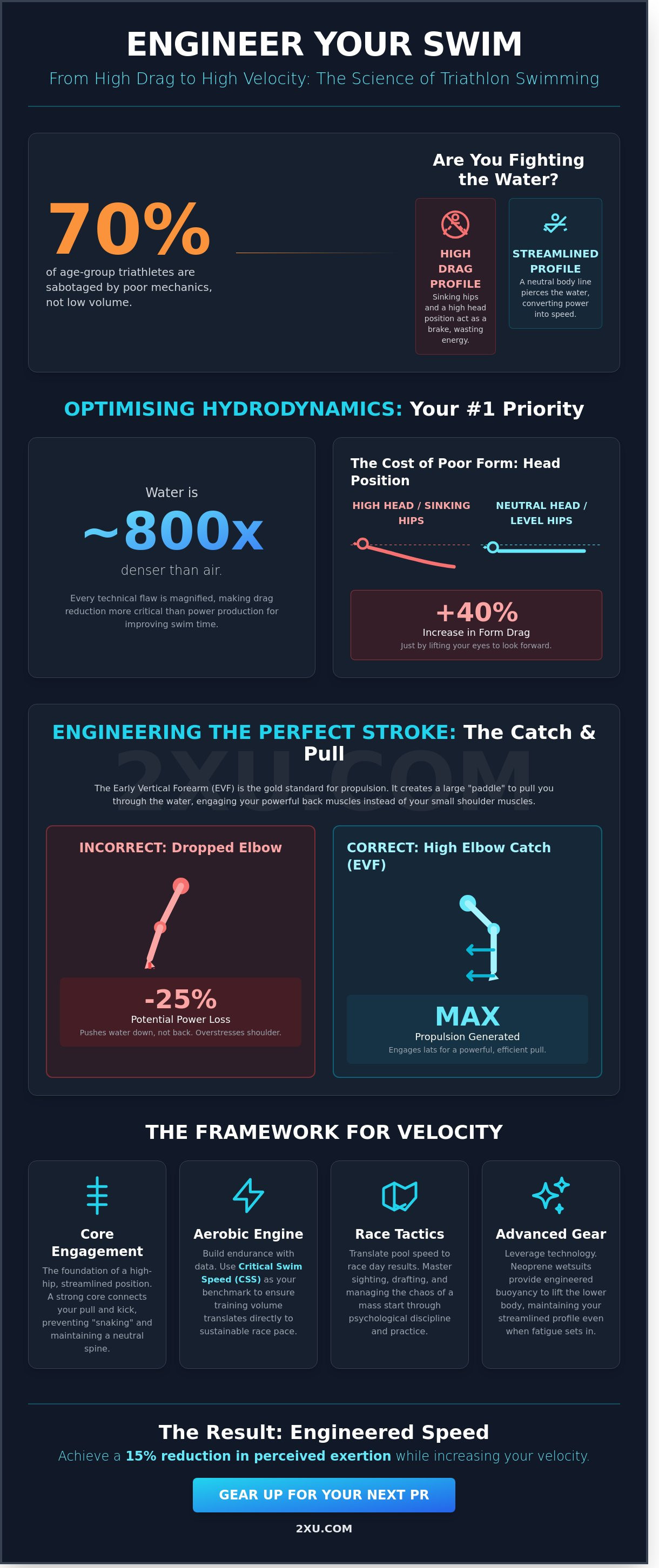
Your 4,000-metre pool sessions are likely sabotaging your race day performance. While most athletes believe sheer volume is the secret to improving swim time for triathlon, 70% of age-groupers struggle with sinking hips and drag-heavy mechanics that yardage alone cannot fix. It's a frustrating plateau where your effort doesn't translate to speed, leaving you redlined and exhausted before you even reach T1. You've earned your place through discipline and hard work, but without a focus on hydrodynamics, you're simply working harder to go slower.
We're here to shift your perspective from mindless laps to precision engineering. This guide provides the scientific framework to master the mechanics of fluid dynamics and physiological conditioning to ensure your human performance is multiplied. By applying these data-driven principles, you'll achieve a streamlined stroke and a 15% reduction in perceived exertion during the swim leg. We'll break down the specific drills to correct your body position, the conditioning required for open water confidence, and the recovery protocols that ensure every session leads to measurable pace improvements.
Key Takeaways
- Master the mechanics of hydrodynamics to engineer a body that pierces the water, reducing drag to multiply your velocity.
- Develop mechanical efficiency through a repeatable freestyle stroke, using the discipline of the grind to build unbreakable muscle memory.
- Build a robust aerobic engine by using Critical Swim Speed (CSS) as your performance benchmark for improving swim time for triathlon.
- Translate theoretical pool speed into race-day results by mastering open water tactics and the psychological discipline required for high-intensity mass starts.
- Optimise your performance potential through advanced gear and recovery protocols, leveraging engineered triathlon suits for superior thermoregulation.
Optimising Hydrodynamics: Reducing Drag to Multiply Your Speed
Water is an unforgiving medium. Because water is approximately 800 times denser than air, hydrodynamics becomes the absolute determinant of your velocity. You don't just swim; you engineer your body to pierce the water like a high-performance vessel. Every millimetre of surface area that isn't aligned with your direction of travel acts as a brake. For athletes focused on improving swim time for triathlon, the priority must be reducing frontal resistance before attempting to increase power output. High power applied to a high-drag profile is a recipe for premature fatigue and wasted energy.
Elite performance starts with the reduction of drag. If you haven't mastered your profile, you're fighting the water instead of moving through it. You must treat your body as a precision-engineered tool. This requires a shift in mindset from "swimming harder" to "swimming cleaner." Efficiency is the foundation of speed in the water.
The Science of Frontal Resistance
Drag isn't a single force but a combination of three distinct types: friction drag, form drag, and wave drag. Friction drag occurs as water molecules move across the surface of your skin or suit. Form drag is dictated by your physical shape and cross-sectional area. Wave drag is created by the turbulence you generate at the surface. Your head position dictates the entire kinetic chain; lifting your eyes to look forward forces your hips down, instantly increasing your form drag by up to 40 per cent. A hydrodynamic profile is defined as the total surface area of the athlete's body that directly opposes the water's flow during forward progression.
Body Position: The Tactical Advantage of Buoyancy
The most common barrier to speed is "sinking leg" syndrome. When your legs drop, you stop piercing the water and start pushing it. Correcting this requires relentless core engagement to keep the pelvis high and the spine neutral. You must also master the "catch" phase of the stroke, which provides the necessary leverage to maintain a high chest position. Utilising high-quality triathlon-specific swimming gear is essential for managing these forces during high-intensity open water segments.
The application of neoprene wetsuit science provides a mechanical solution to buoyancy issues. These suits are engineered to lift the lower body, ensuring optimal horizontal alignment even as fatigue sets in during the latter stages of a race. This technological intervention allows you to maintain a streamlined profile, directly improving swim time for triathlon by reducing the energy cost of every stroke. Respect the physics of the water. Master your alignment. Multiply your performance through discipline and data-driven gear choices.
Engineering the Perfect Stroke: 5 Steps to Mechanical Efficiency
Swimming is an engineering challenge. Water is 773 times denser than air, meaning every technical flaw is magnified by resistance. To master the art of improving swim time for triathlon, you must obsess over the physics of the water. This is not achieved through mindless laps; it is earned through the meticulous engineering of your stroke. You must treat your body as a machine designed to slice through a high-viscosity medium. This process requires respect for the grind. You will repeat drills until the movement is no longer a conscious choice but a hard-wired physiological response.
The Catch and Pull: Maximising Propulsion
The Early Vertical Forearm (EVF) represents the gold standard for generating propulsion in open water. Many triathletes lose 25% of their potential power by dropping the elbow during the initial phase of the stroke. You must rotate the shoulder and hinge at the elbow early to create a vertical paddle with your forearm. This position allows you to engage the latissimus dorsi, the largest muscle group in the upper body, rather than overtaxing the smaller, more vulnerable rotator cuff muscles. Use sculling drills at the front of your stroke to isolate the feel for the water. If you don't feel the pressure against your palms, you aren't moving forward.
High-Volume Drills for Muscle Memory
Technical proficiency is a product of volume. Use specific drills to break the stroke into manageable components before reintegrating them into a full cycle. Discipline in the pool translates to speed on race day. Improving swim time for triathlon requires a commitment to these repetitive movements until they become second nature.
- The 6-3-6 Drill: Take six kicks on your side, three strokes, and six kicks on the opposite side. This reinforces side-lying balance and core-driven rotation.
- Finger-tip Drag: Maintain a high elbow during the recovery phase by dragging your fingertips across the surface of the water. This prevents the wide, swinging recovery that causes lateral snaking.
- Technical Feedback: Use fins and paddles as diagnostic tools. If your hand entry is incorrect, a paddle will immediately shear or vibrate. This provides instant data on your mechanical efficiency.
Measure your output through Distance Per Stroke (DPS). An efficient athlete aims for 15 to 18 strokes per 25-metre pool length. If your count exceeds 22, you are fighting the water rather than moving through it. Pair this with bilateral breathing to ensure structural balance. Breathing every three strokes prevents the muscular imbalances that lead to shoulder impingement and ensures you can sight effectively in open water conditions. Your performance compression gear should facilitate this range of motion, allowing you to focus entirely on the mechanics of the catch. Human performance, multiplied, begins with mechanical precision.
Building the Aerobic Engine: Conditioning for Endurance
Triathlon swimming is an aerobic discipline; it's not a sprint. Success in the water requires a robust cardiovascular base that allows you to maintain speed while preserving energy for the bike and run. Improving swim time for triathlon depends on your ability to hold a high percentage of your threshold pace without red-lining. If you exit the water in a state of oxygen debt, your performance in the subsequent legs will suffer. You must train your body to process lactate efficiently at race intensity.
Embracing the grind in the pool translates to a fresher run leg. When you build a massive aerobic engine, your relative effort at race pace drops. This physiological efficiency is what separates elite finishers from the middle of the pack. You aren't just training to swim faster; you're training to make fast swimming feel easy.
Threshold Training and CSS Sets
Critical Swim Speed (CSS) is the definitive benchmark for endurance performance. It represents the theoretical pace you can sustain for a 1500m swim without fatiguing. To calculate your CSS, perform two maximum effort time trials: a 400m and a 200m. Use the formula (400m time - 200m time) / 2 to determine your CSS pace per 100 metres. This number provides a data-driven target for every interval session.
A standard CSS conditioning set involves 10 x 100m at your calculated CSS pace with exactly 15 seconds of rest between repetitions. This minimal recovery forces your aerobic system to remain engaged throughout the entire set. Monitor your intensity by targeting 85% to 90% of your maximum heart rate. This ensures you're working at threshold capacity rather than dipping into anaerobic zones that cause premature fatigue. Consistency in these sets will lead to a 5% to 8% improvement in pace over a 12 week training block.
Dry-Land Strength: Power Output for the Pull
Water is 800 times denser than air. Overcoming this resistance requires specific dry-land strength focused on the posterior chain and core. You must develop the lats, triceps, and glutes to maintain a rigid, streamlined profile. Exercises like deadlifts, pull-ups, and medicine ball slams are essential for increasing the raw power of your pull. Focus on explosive movements to improve the force you can exert during the catch phase of your stroke.
Proprioception is critical during heavy lifting. Many athletes utilise compression shirts to maintain postural awareness and muscle alignment during strength sessions. This technical gear provides sensory feedback that prevents your form from breaking down under load. By strengthening the core, you reduce snake-like movement in the water, which directly contributes to improving swim time for triathlon by minimising drag. Honour the discipline of dry-land work; it provides the mechanical foundation for your aerobic engine to drive.
Open Water Tactics: Translating Pool Speed to Race Day
Pool speed is theoretical. The black line doesn't fight back, but the ocean does. Achieving a personal best in a controlled 25-metre lane is a baseline, not a guarantee of success. True performance in improving swim time for triathlon depends on tactical execution and psychological grit. When the gun goes off, your heart rate can spike by 20 beats per minute instantly due to the mass-start adrenaline. You must maintain technical discipline while navigating physical contact and low visibility. The fastest swimmer in the pool is rarely the first one to T1 if they lack the ability to handle chop and current. Mediocrity has no place in the open water; you must be as clinical with your tactics as you are with your intervals.
Sighting and Navigation: The Shortest Path to T1
Every metre swum off-course is wasted energy. Use the "alligator eyes" technique to sight. Lift your goggles just above the surface to glimpse your target without dropping your hips. Don't lift your entire head; this creates immediate drag and kills your momentum. Identify a massive, fixed landmark 500 metres beyond the buoy, such as a building or a distinct tree line. This provides a more stable heading than a bobbing buoy. Practise this in every pool session. Sight every four to six strokes to make the movement instinctive before race day. Precision in navigation is the most direct route to improving swim time for triathlon.
Drafting and Strategic Positioning
Hydrodynamic research confirms that drafting can reduce energy expenditure by up to 25 per cent. This is not a shortcut; it is intelligent racing. While drafting at the feet of another swimmer is the standard tactic, swimming at the hip can be more effective in specific conditions. Positioning your head level with a lead swimmer's hip allows you to ride their bow wave. This can increase your efficiency by an additional 3 per cent compared to following directly behind. Identify a swimmer with a consistent, strong kick and stay locked in. If their navigation is erratic, leave them. Efficiency is only valuable if it leads you toward the finish line.
Respect the environment but don't fear it. High elbow recovery is essential for clearing surface chop. Deep, deliberate strokes provide the power necessary to punch through a head current. This is the grind. It requires intense focus and a refusal to settle for a sub-optimal line. Own your space in the water and execute your plan with total authority.
Prepare for the elements and dominate the water. Shop high-performance triathlon gear to multiply your speed.
Gear and Recovery: Multiplying Your Performance Potential
High-performance gear is not a luxury; it's a physiological extension of your body. To master improving swim time for triathlon, you must view your equipment as an engineered component of your race strategy. 2XU operates on a rigid philosophy: Prepare, Perform, Recover. This cycle ensures you aren't just training hard, but training with scientific precision. A high-calibre triathlon suit manages thermoregulation while aggressively reducing drag. It keeps your core temperature stable in 14-degree Celsius waters, preventing the metabolic drain of shivering and ensuring your energy is spent entirely on propulsion.
Advanced Neoprene Technology for Hydrodynamic Efficiency
Every millimetre of your suit dictates your position in the water. Advanced neoprene technology uses zonal buoyancy panels to lift the hips and legs. This correction places you in a more hydrodynamic horizontal plane without sacrificing the flexibility required for an efficient stroke. We utilise Super Composite Skin (SCS) coatings to reduce water surface tension to a level lower than human skin. Fit is the most critical variable. A suit that fits poorly creates "water parachuting" inside the garment, which can increase drag by over 12% and compromise your power output. Precision engineering allows you to slice through the water, effectively improving swim time for triathlon through reduced resistance.
Post-Swim Recovery: Managing Muscle Oscillation
Recovery is an active phase of the training cycle, not a period of passive rest. Elite athletes use graduated compression to flush metabolic waste from the limbs after high-intensity sets. This compression profile is verified using the Salzmann pressure measurement device to ensure the correct gradient. By containing the muscle, you significantly reduce muscle oscillation and the micro-tears that lead to delayed onset muscle soreness (DOMS). This is the 2XU standard: we don't accept mediocrity in our recovery protocols.
- Blood Flow: Graduated compression increases blood flow to the heart, accelerating the removal of blood lactate.
- Stability: Muscle Containment Stamping (MCS) provides targeted support to key muscle groups during the transition from water to land.
- Volume: Optimised recovery allows for a higher training volume without the risk of overtraining or injury.
Flight pressure socks assist athletes travelling to international race venues by maintaining circulation and preventing lower-limb oedema during long-haul transit. Respect the grind. Respect the recovery. This is how human performance is multiplied.
ENGINEER YOUR BREAKTHROUGH PERFORMANCE
Improving swim time for triathlon requires a clinical focus on mechanical efficiency and hydrodynamic drag reduction. You've seen how every degree of body rotation and every catch phase must be engineered for maximum propulsion. Success in the open water isn't about luck; it's about a rigorous aerobic conditioning programme and the tactical discipline to hold your line under pressure. When you master these variables, you move beyond mere effort and begin to command the water.
The final variable in your performance equation is the technology you wear. 2XU wetsuits are built with durable Yamamoto neoprene to provide elite-level buoyancy and flexibility across the 360-degree stroke cycle. Our proprietary PWX compression fabric is scientifically proven to reduce muscle fatigue, specifically lowering muscle oscillation by up to 33% to preserve your power for the bike and run. This isn't just gear; it's a technical tool designed to help you exceed your previous limits. Respect the grind, trust the data, and refuse to accept mediocrity. Your fastest split is waiting for you to claim it.
Shop 2XU Triathlon Wetsuits and Multiply Your Performance
Step onto the sand with the absolute confidence of an athlete who has left nothing to chance.
Frequently Asked Questions
How often should I swim to see real improvement in my triathlon time?
Aim for 3 to 4 structured sessions per week to trigger physiological adaptations. Consistency is the foundation of the grind. Research by the American College of Sports Medicine suggests that 3 sessions per week maintain aerobic capacity; however, 4 sessions are required for significant performance gains. This frequency ensures your muscle memory remains sharp and your power output stays consistent across the 1500m or 3800m distance. Don't skip sessions if you want to multiply your results.
Is it better to focus on distance or speed during my swim sessions?
Prioritise high-intensity interval training over junk miles to maximise your VO2 max. While base endurance matters, improving swim time for triathlon requires specific threshold work. A 2018 study in the Journal of Strength and Conditioning Research showed that athletes performing 20 sets of 50-metre sprints with 15-second rest intervals improved their pace by 4% more than those swimming continuous distances. Efficiency is engineered through intensity. Respect the process and push your limits.
Can a wetsuit actually make me a faster swimmer?
A high-performance wetsuit can reduce your swim time by 5 to 10 seconds per 100 metres. This speed boost comes from increased buoyancy and reduced hydrodynamic drag. Advanced neoprene panels, such as those engineered with 39-cell buoyancy, lift your hips to an optimal horizontal position. This mechanical advantage allows you to maintain a higher power output while expending 15% less energy. It's about preparation and performance, ensuring you're ready for the bike leg.
What is the most common mistake triathletes make in the water?
Over-gliding and a low stroke rate are the primary limiters for most age-group athletes. Many swimmers attempt to mimic elite pool swimmers by holding their glide too long, which causes a loss of momentum in open water. Data from elite coaching programmes shows that a stroke rate below 55 strokes per minute often leads to "dead spots" in the water. Maintain a continuous pull to keep your velocity constant. Human performance is multiplied when you eliminate inefficiency.
How do I stop my legs from sinking while I swim?
Engage your core and press your chest down to level your body profile. Sinking legs create massive drag, often adding 20% to your total resistance. Focus on a compact, 2-beat kick for endurance or a 6-beat kick for power. By activating your transverse abdominis, you create a rigid platform that keeps your lower body high. This position is vital for improving swim time for triathlon by minimising the frontal surface area you must push through the water.
Should I use a nose clip or earplugs for open water swimming?
Use earplugs if you experience vertigo or "surfer's ear" in temperatures below 16 degrees Celsius. Cold water entering the ear canal can disrupt your vestibular system and cause 30 seconds of disorientation during the transition to the bike. Nose clips are less common but beneficial for athletes who struggle with sinus irritation from salt water. Choose equipment that removes distractions so you can focus purely on the performance ahead. Every piece of gear must serve a purpose.
How can I reduce anxiety during the triathlon swim start?
Execute a 10-minute dynamic warm-up to regulate your heart rate before the gun fires. Anxiety often stems from a sudden spike in heart rate and the "cold shock" response. By performing 4 sets of 25-metre sprints in your wetsuit, you prepare your cardiovascular system for the 140 to 160 beats per minute intensity of a race start. Control your breathing and trust the hours of discipline you've invested in the grind. You've earned your place.