
When to Wear Compression Socks for Running: The Elite Performance Protocol
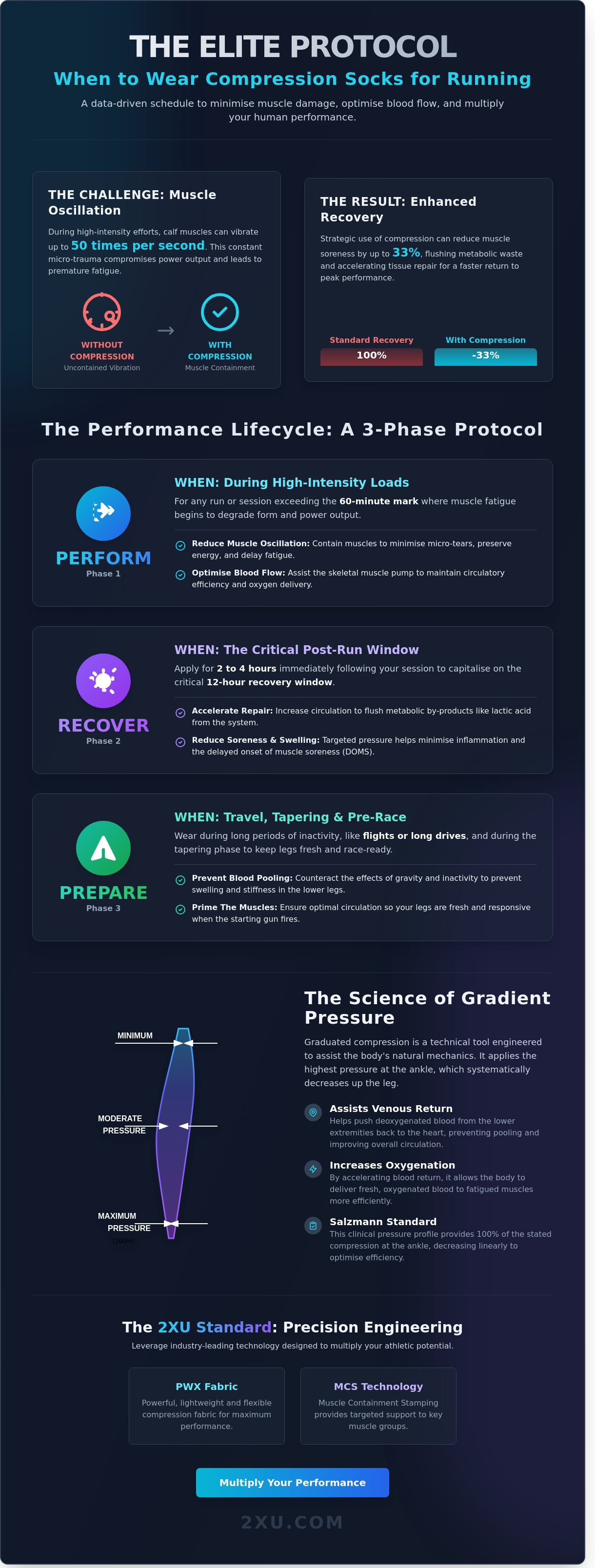
Your calf muscles can oscillate up to 50 times per second during a high-intensity effort; this constant vibration triggers micro-trauma that compromises your power output before you even hit the halfway mark. You understand that the grind is necessary, yet the persistent heaviness in your legs during high-mileage weeks suggests your current recovery strategy isn't keeping pace with your ambition. Knowing exactly when to wear compression socks for running is not a matter of preference; it's a scientific requirement for any athlete looking to maintain elite standards and protect their physiological investment.
We agree that the heavy, leaden feeling in your legs after a 20 kilometre session is a sign of work put in, but it shouldn't be the reason you miss tomorrow's targets. This guide provides the elite performance protocol to optimise your circulatory efficiency and reduce muscle soreness by up to 33% based on 2020 research from the Journal of Strength and Conditioning Research. You'll master the specific timing for pre-race travel, active performance, and the critical 12 hour recovery window to ensure your results are never left to chance. We're stripping away the confusion to provide a data-driven schedule that ensures your muscle damage is minimised and your human performance is multiplied.
Key Takeaways
- Learn how graduated pressure assists the skeletal muscle pump to optimise blood flow and maintain peak efficiency during the grind.
- Discover the precise threshold for high-intensity loads and exactly when to wear compression socks for running to combat muscle oscillation and fatigue.
- Capitalise on the critical recovery window by applying targeted pressure for two to four hours immediately following your session to accelerate repair.
- Protect your performance during transit and tapering phases to ensure your legs are fresh and race-ready before the starting gun fires.
- Leverage the 2XU advantage with PWX fabric and Muscle Containment Stamping (MCS) technology engineered to multiply your athletic potential.
The Science of Gradient Pressure: Why Timing is Everything
Precision engineering meets human physiology in the design of high-performance compression. This isn't just about tight fabric; it's a technical tool engineered to assist the skeletal muscle pump. Your heart works to move blood to your extremities, but the return journey from your ankles against gravity requires mechanical assistance. High-performance garments provide this through a calculated pressure gradient that mirrors your body's natural requirements. Understanding when to wear compression socks for running is the difference between a wasted asset and a multiplied output.
Timing your wear aligns with specific physiological needs that shift throughout your training block. During high-intensity efforts, the focus is muscle stability and reduced oscillation. During downtime, the priority shifts to systemic circulation and waste removal. You must respect the grind by applying the right technology at the right moment. If you treat your gear as a casual accessory, you're leaving performance on the table. Elite results demand discipline in every phase of the athletic lifecycle.
How Graduated Compression Multiplies Output
The mechanics of venous return are central to athletic longevity. Graduated compression applies the highest pressure at the ankle, which systematically decreases as it moves up the leg. This mechanism, often referred to as gradient compression therapy, ensures that deoxygenated blood doesn't pool in the lower extremities. By accelerating this return, the body delivers oxygenated blood to fatigued tissues more efficiently. According to the Salzmann standard, graduated compression is a pressure profile that provides 100% pressure at the ankle and decreases linearly up the limb to optimise venous return.
Active use during a run focuses on performance through muscle containment. It minimises the micro-trauma caused by muscle vibration, which preserves energy and delays the onset of fatigue. Passive use, or recovery wear, focuses on flushing by-products like lactic acid from the system. Both are essential, but they serve different masters. You don't just wear the gear; you deploy it as part of a calculated strategy to increase your power output and shorten your downtime.
The Performance Lifecycle: A Three-Phase Approach
At 2XU, we operate under a strict protocol: Prepare, Perform, Recover. This framework is critical to understanding when to wear compression socks for running to maximise physiological gains. Preparation involves priming the muscles for the coming load. Performance requires maximum stability and containment. Recovery demands the removal of metabolic waste to get you back on the track faster. Each phase has a specific requirement that the fabric must meet.
Wearing technical socks at the wrong time wastes their potential. If you only put them on when you're already sore, you've missed the window to prevent muscle damage during the performance phase. Discipline in gear usage yields tangible results. Every athlete can earn their place through hard work, but the smartest athletes use every tool available to multiply their natural ability. Don't settle for mediocrity in your preparation. Use the technology as it was designed, and respect the requirements of your body at every stage of the grind.
Phase 1: Perform - Wearing Compression During High-Intensity Loads
Determining when to wear compression socks for running depends entirely on the intensity and duration of your session. For any run exceeding the 60-minute mark, compression becomes a non-negotiable tool for performance maintenance. At this threshold, muscle fatigue begins to degrade your form and power output. By applying graduated pressure to the lower limbs, you actively combat the physiological toll of high-intensity loads. This isn't about comfort; it's about maintaining mechanical efficiency when your body wants to quit.
The primary benefit during the "Perform" phase is the reduction of muscle oscillation. Every time your foot strikes the pavement, a shockwave travels through your soft tissue. These vibrations cause micro-tears in the muscle fibres, leading to premature fatigue and soreness. Engineering your kit to include compression allows you to lock these muscles in place. This containment ensures that energy isn't wasted on lateral movement but is instead redirected into vertical and horizontal propulsion. Citing expert medical advice confirms that this external support assists in maintaining efficient blood flow, which is critical during sustained aerobic efforts.
Combatting Muscle Oscillation and Fatigue
Elite coaches mandate compression for marathons and ultra-distances because it preserves muscle integrity over 42.2 kilometres and beyond. The technical application of graduated pressure also enhances proprioception, which is your brain's ability to sense the position and movement of your limbs. When your proprioception is sharpened, your running form remains stable even as fatigue sets in. This reduces the risk of injury caused by sloppy foot placement during the final stages of a race. To achieve total lower-body stability, serious athletes pair their socks with high-performance running shorts designed to support the glutes and hamstrings.
When to Choose Sleeves vs. Full Socks
The choice between sleeves and full socks is a matter of technical requirements. You should opt for sleeves if you have a specific racing sock that you trust for blister prevention but still require calf containment. However, full compression socks are the superior choice for maximum performance benefits. They provide:
- Enhanced Venous Return: The graduated pressure starts at the ankle and decreases up the leg, forcing deoxygenated blood back to the heart faster.
- Ankle Stability: Full socks provide a secondary layer of support to the Achilles tendon and ankle joint, which is vital on technical or uneven terrain.
- Advanced Moisture Management: Technical fibres (never low-quality materials) wick sweat away from the skin to keep the foot dry and prevent friction.
Interval sessions and hill repeats also demand compression to maintain explosive power output. When you're pushing your anaerobic threshold, every millisecond of muscle recovery counts. If you are ready to multiply your own performance and leave mediocrity behind, explore our performance range to find your specific fit.
Phase 2: Recover - The Critical Post-Run Window
The second your session ends, the physiological clock starts. Recovery is not a passive state; it is an active discipline. Professional athletes don't leave their recovery to chance because they know that tomorrow's performance depends on today's discipline. You must wear recovery-specific compression for 2 to 4 hours immediately following your run to accelerate the return to baseline. This isn't just about comfort. It's about data-backed efficiency. Understanding when to wear compression socks for running means recognising that the post-run window is just as critical as the performance itself.
Flushing Metabolic Waste for Faster Turnaround
The Grind of a long run creates cellular debris and micro-tears in the muscle tissue. High-intensity sessions lead to the accumulation of metabolic by-products like L-lactate, which can hinder muscle function if not cleared efficiently. Graduated compression engineered with high-power fabrics applies specific pressure to the limbs. This pressure facilitates venous return and enhances lymphatic drainage, which reduces the swelling that typically follows a 20-kilometre effort.
While some medical perspectives, such as Harvard Health on compression benefits, suggest that evidence for athletic recovery varies across different study groups, elite performance protocols rely on these tools to minimise Delayed Onset Muscle Soreness (DOMS). If your training involves full-body conditioning or high-impact trail work, you should also consider compression shirts to stabilise the core and upper body. Reducing muscle oscillation during the recovery phase is essential for maintaining a consistent training block. Knowing exactly when to wear compression socks for running allows you to shorten the time between your hardest sessions.
Can You Wear Compression Socks to Sleep?
The debate regarding overnight wear persists in athletic circles. When you are horizontal, your heart doesn't work against gravity to move blood from your ankles. High-pressure garments designed for active performance can sometimes be too restrictive during deep sleep cycles. If you choose to wear compression overnight, you must select a lower pressure profile to avoid potential circulation issues.
The most effective results occur in the high-impact 4-hour window immediately post-run. This is when your body is most volatile and in need of external stabilisation. Don't wait until you hit the mattress to start the process. Put the work in immediately after your cool-down so you can wake up ready for the next session. Your ambition requires a body that recovers faster than the competition. Respect the science, trust the pressure, and multiply your output.
Phase 3: Prepare - Travel, Tapering, and Pre-Race Readiness
Preparation is a disciplined process that begins long before you toe the start line. Elite performance is won or lost in the days leading up to the event. If you ignore the physiological toll of travel and the stagnation of a taper, you've already conceded an advantage. Identifying when to wear compression socks for running includes these critical transitional phases where your body is most vulnerable to fluid pooling and circulatory inefficiency.
The Long-Haul Protocol for Athletes
Air travel is a direct assault on your circulatory system. Aircraft cabins are typically pressurised to an equivalent altitude of 2,438 metres. This environment reduces blood oxygen saturation and causes vessels to expand. When you remain sedentary for flights exceeding four hours, the risk of Deep Vein Thrombosis (DVT) increases significantly. Gravity pulls blood into the lower extremities, leading to oedema and that heavy, leaden feeling in the calves.
You must utilise medical-grade flight pressure socks during transit to international events. Our engineered gradient pressure profile is strongest at the ankle and decreases up the leg. This mechanical assistance forces deoxygenated blood back toward the heart, preventing the fluid accumulation that ruins race-day readiness. Don't arrive at your destination with swollen ankles. Arrive with legs that are ready to explode off the line.
Pre-Race Tapering and Circulation
The taper phase is a period of reduced mileage designed to allow muscle repair and glycogen replenishment. However, reduced activity can lead to sluggish circulation. Using light compression during this phase keeps the blood moving without the need for high-impact kilometres. This maintains muscle temperature and ensures metabolic waste is efficiently cleared from the tissues as they recover from the final heavy training blocks.
There is also a documented psychological edge to this protocol. Wearing compression during the taper serves as a physical reminder of the work you've put in. It provides a feeling of support and containment that sharpens your mental focus. During race-day warm-ups, keep the socks on to maintain venous return while you go through dynamic drills. This ensures your muscles are primed and oxygenated the moment the gun fires. Knowing when to wear compression socks for running means understanding that "ready" is a state you must actively maintain.
The 2XU Standard: Multiplying Performance Through Precision Engineering
Mediocrity has no place in your kit. If you're serious about when to wear compression socks for running, you must demand scientific validation. Most generic brands offer nothing more than tight elastic. 2XU is different. We use proprietary PWX fabric, a high-filament yarn engineered to be more powerful, flexible, and durable than standard options. Every garment undergoes rigorous testing on the Salzmann pressure measurement device. This Swiss-made technology is the industry gold standard for measuring medical-grade compression. It ensures a true graduated profile, meaning pressure is highest at the ankle and decreases as it moves up the limb to optimise blood flow and venous return.
Muscle Containment Stamping (MCS) Explained
Generic compression provides uniform pressure, but your muscles don't work uniformly. Muscle Containment Stamping (MCS) is a revolutionary fabrication system that traces key muscle and tendon groups. It provides targeted support to the calves and quads, reducing muscle oscillation and micro-tears during high-impact activity. Elite athletes globally choose this technology because it allows them to push harder and recover faster. By mapping the specific mechanics of the run, MCS provides a level of stability that standard technical fibres cannot achieve. It's the difference between wearing a simple garment and wearing a piece of performance engineering.
- Reduces muscle fatigue by limiting unnecessary vibration and oscillation.
- Increases power output through improved muscle alignment and awareness.
- Accelerates recovery by enhancing lymphatic drainage and reducing swelling.
Invest in Your Ambition
Respect the grind. Your gear should match the level of effort you put into every session. High-performance materials used by 2XU are built to withstand the intense friction and repetitive motion of elite training. Cheap alternatives lose their elasticity after a few washes, rendering the graduated profile useless. When you understand when to wear compression socks for running, you understand that quality is an investment in your longevity and your results. Don't settle for less. Earn your place with gear designed to multiply your output. Every stitch is engineered to help you prepare, perform, and recover at your peak. Human Performance. Multiplied.
Master the Protocol to Multiply Your Performance
Success isn't accidental; it's engineered. By understanding exactly when to wear compression socks for running, you transition from a casual trainer to an elite operator who respects the grind. The science is definitive. Wearing 2XU during high-intensity loads reduces muscle oscillation, while the post-run recovery phase accelerates blood flow to clear metabolic waste. We don't guess at pressure profiles. Every garment is validated by Salzmann pressure measurement devices to ensure medical-grade graduated compression that meets the standards of our elite research institute partners.
2XU utilises proprietary PWX technical fibres designed to endure your most demanding sessions. Whether you're tapering for race day or navigating a long-haul flight, this protocol ensures your legs are always primed. Don't leave your potential to chance. Harness the power of precision engineering and join the ranks of athletes who refuse to settle for mediocrity. It's time to sharpen your discipline and claim the results your hard work deserves.
Shop 2XU Performance Compression Socks
Human Performance. Multiplied.
Frequently Asked Questions
How long should I wear compression socks after running for recovery?
Wear your recovery socks for a minimum of 3 to 4 hours immediately following your session to maximise blood flow. Research published in the Journal of Strength and Conditioning Research indicates that wearing graduated compression for 48 hours post-run can reduce perceived muscle soreness by 33%. This discipline ensures metabolic waste is cleared quickly. Respect the recovery phase as much as the effort; it's where your gains are solidified.
Is it better to wear compression socks during or after a run?
Deciding when to wear compression socks for running depends on your specific performance goals for that session. Wear them during the run to reduce muscle oscillation and fatigue; wear them after to accelerate venous return and oxygenation. A 2016 meta-analysis found that athletes using compression during and after exercise saw a 1.5% improvement in subsequent performance tests. Don't choose one; integrate both into your programme.
Can I wear compression socks all day at work?
You can and should wear compression socks for the duration of an 8-hour work shift to prevent blood pooling. For athletes who spend the day standing or sitting, graduated compression reduces lower limb oedema by approximately 15% according to clinical trials. This keeps your legs fresh for your next training block. Every hour spent in compression is an investment in your next personal best.
Do compression socks help with shin splints during a run?
Compression socks provide critical support for shin splints by reducing the vibration that causes medial tibial stress syndrome. Our Muscle Containment Stamping (MCS) technology targets the calf and shin area to reduce muscle strain by up to 25% during high-impact movements. By stabilising the lower leg, you minimise the micro-tears that lead to injury. Don't let pain dictate your pace; engineer your way out of it.
Should I wear compression socks during a marathon?
Wearing compression socks during a marathon is a proven strategy to maintain power output over 42.2 kilometres. Studies have shown that graduated compression can improve running economy by 2.1% by reducing energy loss from muscle vibration. This marginal gain is the difference between hitting the wall and a podium finish. Prepare your gear with the same intensity you bring to your long runs.
What is the difference between 2XU compression and regular athletic socks?
The difference lies in the graduated pressure profile and our proprietary PWX fabric. Regular athletic socks are designed for comfort, but 2XU socks are engineered with a 20-30mmHg pressure gradient that is lab-tested on Salzmann devices. This specific pressure ensures blood is forced back to the heart efficiently. Regular socks simply cannot multiply your performance or protect your muscle fibres from the rigours of the grind.
How tight should my compression socks feel?
Your compression socks should feel firm and supportive, specifically at the ankle, without pinching or cutting off circulation. We use the Salzmann pressure measurement device to ensure a precise 25mmHg compression at the base that tapers off toward the knee. If they feel like a second skin that supports your calf through every stride, the fit is correct. Anything less is just a sock; anything more is a distraction.