
Best Women's Padded Tri Shorts: Engineering Comfort for the Long Grind
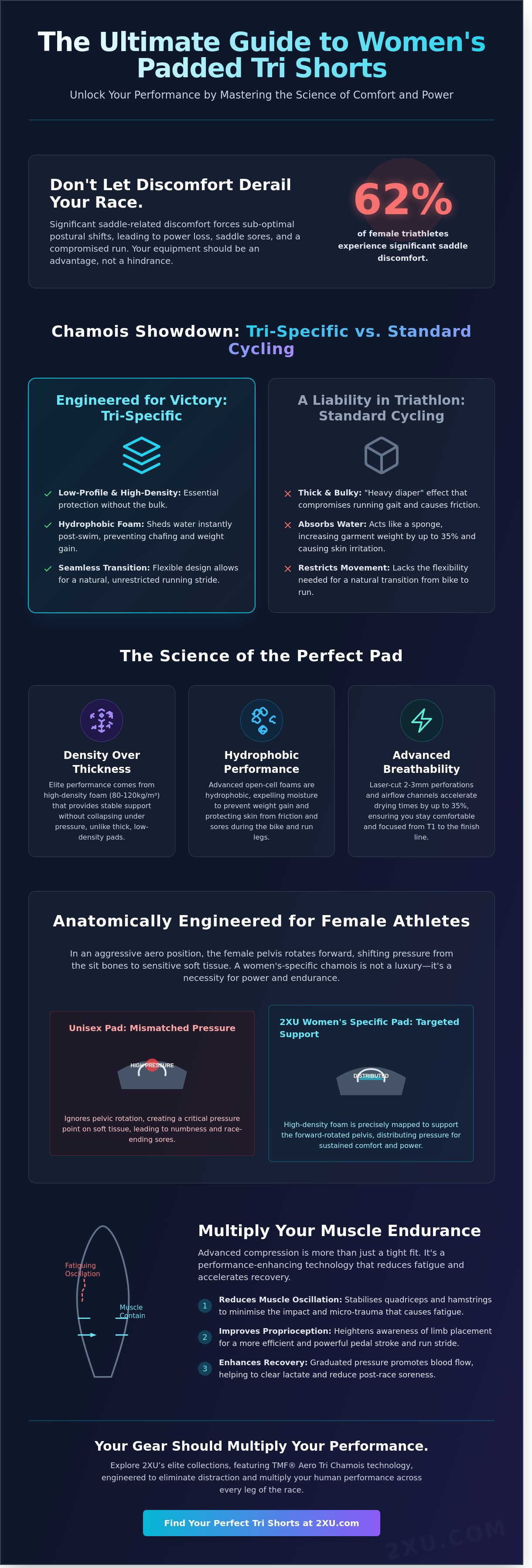
How many watts are you surrendering to a 3mm misalignment in your chamois? Research indicates that up to 62% of female triathletes experience significant saddle-related discomfort that forces sub-optimal postural shifts during long-distance training. You know the reality of the grind; the searing heat of saddle sores at kilometre 80 and the frustrating "heavy diaper" sensation that plagues your run leg. Finding the best women's padded tri shorts is a requirement for any athlete serious about their power output and recovery. We agree that your equipment should be an extension of your physiology, not a hindrance to your discipline.
Discover how to select tri shorts that balance elite-level protection on the saddle with total freedom on the run. This article breaks down the engineering behind low-profile padding and high-denier compression fabrics. You will learn to identify the technical features that eliminate chafing and optimise muscle endurance through advanced muscle containment stamping. It is time to ensure your gear allows your human performance to be multiplied, not restricted.
Key Takeaways
- Master the science of the tri-specific chamois to ensure elite protection on the saddle never hinders your mechanics on the run.
- Distinguish between density and thickness to select high-performance foams that prioritise breathability and moisture transfer over unnecessary bulk.
- Align your gear with your goals by selecting the best women's padded tri shorts tailored specifically for the intensity of sprints or the endurance demands of full-distance racing.
- Optimise your output by understanding how graduated compression stabilises the quadriceps and hamstrings to reduce muscle oscillation and fatigue.
- Explore 2XU’s elite collections to see how TMF® Aero Tri Chamois technology is engineered to multiply your performance across every leg of the race.
Beyond the Diaper: Why Padding is the Foundation of Your Race
The grind of long-course racing is a physical reality measured in 226 total kilometres. To conquer this distance, your gear must be more than an afterthought. The pad is the foundation of your race. It's the primary interface between your power output and the machine. When searching for the best women's padded tri shorts, you aren't just looking for a cushion; you're looking for a technical advantage that preserves your mental discipline for the marathon ahead.
A standard cycling chamois is a liability in a triathlon. It's too thick, it lacks drainage, and it creates a "diaper" effect that compromises your gait. 2XU engineers tri-specific padding to be a low-profile, high-density solution. This design provides essential protection on the 180km bike leg while remaining virtually invisible during the run. Comfort on the bike isn't a luxury. It's a strategic necessity that prevents premature fatigue and allows you to maintain an aggressive aero position for hours on end.
The Swim-Bike-Run Transition Challenge
Performance in the water must not compromise performance on the road. Standard foams act like sponges, but advanced technical textiles used in Triathlon equipment are hydrophobic. These materials ensure the pad sheds water immediately upon exiting T1. This is critical because water retention can increase the weight of a garment by up to 35 percent, leading to wasted energy and severe skin irritation.
- Hydrophobic properties: Proprietary foams ensure moisture is expelled, not absorbed.
- The 'run-ability' factor: A low-volume profile allows for a natural stride without inner-thigh friction.
- Friction management: Technical liners create a barrier that protects wet skin from the repetitive motion of the pedal stroke.
Anatomical Requirements for Female Triathletes
Female athletes face specific physiological demands, especially when locked into a time-trial position. On a TT saddle, the pelvis rotates forward, shifting pressure from the sit bones to sensitive soft tissue. Unisex pads ignore this shift, often leading to numbness or saddle sores that can end a race. The best women's padded tri shorts use targeted density to support the pelvic structure while removing bulk where it isn't needed.
Precision engineering ensures that pressure is distributed across the contact points without interfering with the hip flexors. This level of detail is what separates an elite athlete from the rest of the pack. The ideal women's tri pad is a high-density, low-volume interface engineered for pelvic stability.
By respecting the mechanics of the female body, we eliminate the distractions of discomfort. You're left with nothing but your own determination. Prepare with the right gear, perform without compromise, and recover faster because you didn't spend 10 hours fighting your own equipment. This is how human performance is multiplied.
The Science of the Chamois: Women's Specific Engineering
Performance in a triathlon is won in the margins of discomfort. To secure the best women's padded tri shorts, you must look past the superficial promise of "softness." Elite engineering dictates that a thinner, high-density chamois outperforms a thick, low-density pad every time. While a thick sponge feels comfortable in a showroom, it collapses under constant pressure; it absorbs water like a weight and creates a bulky profile that hinders your gait during the run. Technical foams with a density of 80kg/m³ to 120kg/m³ maintain their structural integrity over a six-hour ride, providing a stable platform that protects the pelvic bone without the unnecessary mass.
The cellular structure of these technical foams is designed for rapid moisture transfer. Open-cell structures allow sweat and water to move away from the skin instantly, preventing the heavy, waterlogged sensation that leads to saddle sores. Advanced laser-cut perforation technology, often featuring 2mm to 3mm airflow channels, accelerates drying times by up to 35 percent compared to standard foams. This breathability is non-negotiable when transitioning from a 1.9km swim to a high-intensity bike leg. Every millimetre of the pad is anatomically mapped to the female form, ensuring protection is concentrated only where the sit bones make contact.
The grind of skin irritation can end a race faster than fatigue. Modern construction has moved toward bonded seams and high-gauge flat-lock stitching to eliminate friction points. By Preventing Chafing and Power Loss through superior garment architecture, athletes can focus entirely on their power output rather than skin abrasion. These seams are engineered to lie flat against the body, moving with your musculature rather than resisting it.
Foam Density and Shock Absorption
High-density foam acts as a precision dampener for your skeletal system. It doesn't just cushion; it manages the micro-trauma caused by constant road buzz and high-frequency vibrations. Memory foam layers within the chamois conform to your specific pelvic structure, distributing weight across a larger surface area to reduce pressure spikes. This data-driven approach to shock absorption ensures that your muscles stay fresh for the run, as they aren't wasting energy stabilising your core against road impact.
Fabric Integration and Moisture Management
The outer shell of the best women's padded tri shorts relies on Italian-engineered fabrics that set the global standard for durability. These technical elastane blends provide a graduated compression profile that supports the quadriceps and hamstrings. Unlike standard knitted fabrics, these high-performance fibres feature permanent moisture-wicking properties that won't wash out after a season of heavy use. This ensures your body temperature remains regulated even during the hottest midday run splits. To experience how 2XU applies this level of rigour to every garment, explore our performance-focused tri range today.
Selecting Your Weapon: Race Distance vs. Padding Density
Choosing the best women's padded tri shorts is a clinical decision based on your specific race discipline. Your gear is a tool, and a tool must be fit for purpose. In triathlon, the mechanical demands on your body shift as the distance increases. A minimalist approach that works for a 20km sprint will fail you during the 180km grind of an Ironman. You must audit your requirements for speed, transition efficiency, and long-term saddle stability before selecting your kit.
The Short-Course Strategy
Speed is the priority for Sprint and Olympic distances. When your race lasts between 60 minutes and three hours, every second in transition matters. Elite athletes frequently choose fleece-style liners because they offer a minimalist profile that dries almost instantly. These liners, often less than 2mm thick, provide just enough barrier to prevent chafing without holding excess water. This prevents the "nappy effect" during the run, where a heavy, water-logged pad compromises your gait. For a deeper dive into technical race-day kits, consult The Ultimate Triathlon Suit Guide: Engineering Your Fastest Race Day to optimise your setup.
Long-Course Endurance Engineering
When you spend four to seven hours in an aggressive aero position, your requirements shift toward advanced support. Long-course engineering utilises multi-density layering. This involves high-density foam, often around 80kg/m3, positioned specifically under the ischial bones, while thinner layers sit against the skin to reduce friction. This firm support is essential for maintaining power output when fatigue sets in. The best women's padded tri shorts for these distances typically feature 7-inch to 9-inch inseams. These longer lengths serve two purposes: they provide graduated compression to the quadriceps and prevent "sausage leg," a common issue where shorter hems restrict blood flow and cause chafing.
- Training vs. Racing: Your daily driver shorts should prioritise durability and extra cushion. While race-day pads are lean for speed, your training kit handles 15 plus hours of weekly volume and requires more substantial protection.
- Weight Considerations: A saturated, non-technical pad can hold up to 100ml of water and sweat. This adds 100g of dead weight to your frame. Engineering focuses on proprietary foams that repel moisture to keep your run split fast.
- The Aero Factor: Fabric texture and seam placement are engineered to reduce drag. Every millimetre of thickness in the pad must be justified by the comfort it provides against the clock.
Respect the grind by choosing gear that matches your ambition. Whether you are chasing a podium in a sprint or surviving the long haul of a full distance, your choice of padding density is the difference between a breakthrough performance and a painful DNF. Earn your finish line with gear that multiplies your effort.
Optimising the Fit: Preventing Chafing and Power Loss
In the high-stakes environment of a triathlon, every millimetre of movement counts. If your gear shifts, you're leaking energy. The best women's padded tri shorts are engineered to eliminate this inefficiency by creating a second-skin fit that prioritises both aerodynamics and biomechanical stability. When you're 90 kilometres into a ride, a waistband that digs in or a leg gripper that slips isn't just an annoyance; it's a performance killer that drains your mental reserves and physical output.
Compression and Muscle Containment
Compression is the foundation of endurance engineering. During the repetitive motion of the pedal stroke and the high-impact transition to the run, your muscles experience oscillation. This vibration leads to micro-trauma and premature fatigue. High-grade compression garments, like those featuring Muscle Containment Stamping (MCS), provide a structural map for the quadriceps and hamstrings to reduce this energy wastage. Research indicates that targeted compression can reduce muscle vibration by up to 33 per cent, allowing you to maintain power output for longer durations.
Graduated pressure profiles are equally critical. By applying the highest pressure at the furthest point from the heart, these shorts aid venous return. This accelerates the removal of blood lactate during the brutal transition from the bike to the run. To understand the broader application of this technology, consult our Compression Shirts: The Scientific Guide to Performance & Recovery. Elite performance is built on these marginal gains.
Chafing Prevention and Skin Integrity
Chafing is the result of friction, moisture, and poor fabric choice. The elite standard for leg grippers has moved away from thick silicone bands, which often cause skin irritation or "sausage leg" effects. Instead, look for integrated, silicone-free grippers that use the tension of the technical fibres to stay in place. This ensures the best women's padded tri shorts remain secure without compromising blood flow or skin health.
- Identify Hot Spots: Test your shorts in high-humidity conditions to find friction points before they become blisters.
- Cream Compatibility: Ensure your chamois cream doesn't degrade the technical fibres of your gear. High-quality yarns are designed to withstand friction but can be damaged by heavy oil-based lubricants.
- Technical Care: Maintain elasticity by washing gear in cold water only. Never use fabric softeners; they coat the fibres and destroy the moisture-wicking properties and antimicrobial treatments.
The waistband must be designed for the aero tuck. A wide, flat-bonded waistband distributes pressure across the abdomen, ensuring the shorts stay in place without restricting your diaphragm. If you can't breathe deeply while in the drops, your shorts are failing you.
Respect the grind by performing a dedicated brick test. Don't wait for race day to discover a fit issue. Execute a 60-minute high-intensity ride followed immediately by a 20-minute run. If the chamois shifts or the legs ride up during this specific transition, the fit isn't race-ready. True performance is earned through rigorous preparation and the right equipment.
2XU Women’s Tri Shorts: Human Performance, Multiplied
Success on the racecourse isn't a gift; it's a direct outcome of meticulous engineering and raw discipline. Our collections meet you at your current threshold and push you beyond it. The Aero and Core Collections represent two distinct tiers of athletic evolution. While the Core range provides the essential compression and durability needed for foundational training, the Aero collection utilises high-velocity fabrics to minimise drag. For those seeking the best women's padded tri shorts, these garments offer a technical edge that transforms raw effort into measurable velocity.
The TMF® Aero Tri Chamois is the structural heart of our long-course gear. It features a 90kg density foam construction that provides maximum support without the bulk that hinders your running stride. This padding is engineered with a square-holed air channel fabric to accelerate moisture transfer, ensuring you stay dry from the swim exit to the finish line. We've removed the guesswork from comfort. This allows you to focus entirely on your power output rather than managing friction.
Our proprietary PWX fabric technology sets the global standard for endurance apparel. Unlike standard knits, PWX uses a high-grade circular knit structure to provide 360-degree stretch and unmatched power. This fabric doesn't just sit on your skin; it actively works to reduce muscle fatigue. By incorporating Muscle Containment Stamping (MCS), we provide targeted support to the quadriceps. This stamping traces the primary muscle groups to reduce the oscillation and micro-trauma that occur during the high-impact run leg, preserving your legs for the final kilometres.
Engineered for the Elite
We don't rely on subjective feedback alone. Every compression garment we produce is validated using the Salzmann pressure measurement device. This medical-grade testing ensures that the graduated pressure profile is precise, promoting efficient blood flow and faster recovery. Our gear is built to survive the relentless nature of a 20-week training block. It maintains its tensile strength and compression levels long after other brands have failed. If you want to refine your kit further, explore our Running Shorts: The Ultimate Guide to Engineering Your Performance.
Join the 2XU Community
You don't buy your way into the 2XU community; you earn it through the grind. We celebrate the athletes who show up when the conditions are brutal and the finish line feels impossible. Our promise is simple: we provide the gear that works as hard as you do. When you choose the best women's padded tri shorts in our lineup, you're investing in a legacy of scientific excellence. Prepare. Perform. Recover. Your potential is waiting.
Dominate Every Kilometre
Success on race day isn't just about grit; it's about the technical foundation you build before the starting gun. You've learned that the best women's padded tri shorts provide more than just a cushion. They deliver a mechanical advantage through women's specific chamois engineering and high-power compression that stabilises active muscles. Selecting the correct density for your specific race distance ensures you don't carry unnecessary weight while protecting your power output during the final transition. It's the difference between fading at the 30km mark and surging toward the finish line with total composure.
2XU doesn't settle for mediocrity. Our gear utilises TMF® Aero Tri Chamois technology and is engineered with high-power PWX compression fabric to reduce muscle oscillation. These garments are rigorously tested by world-class triathletes to ensure they withstand the ultimate grind of a 226km race. You've put in the hours of disciplined training. Now, equip yourself with the technical tools designed to multiply your performance.
Maximise your race day comfort with 2XU Women's Tri Shorts
The road ahead is demanding, but you've earned the right to conquer it. Respect the grind and keep pushing for your personal best.
Frequently Asked Questions
Do I wear underwear under my padded tri shorts?
You don't wear underwear under your padded tri shorts. Tri garments are engineered to sit directly against the skin to eliminate friction and moisture build-up. Adding a layer of cotton or technical fabric creates unnecessary seams that cause saddle sores or severe skin irritation during the 180km bike leg. Trust the antimicrobial properties of the chamois to maintain hygiene and protect your skin throughout the duration of the grind.
How do I prevent my tri shorts from causing chafing on the run?
Apply a high-quality anti-chafe balm to high-friction zones like the inner thighs and chamois edges before you start. The best women's padded tri shorts feature flatlock stitching and 360-degree stretch fabrics to minimise skin displacement. If you feel irritation at the 15km mark of your run, it's often due to salt crystallisation from sweat. Ensure your shorts have internal silicone grippers to prevent the hem from riding up during your stride.
What is the difference between a tri chamois and a cycling chamois?
A tri chamois is significantly thinner and less absorbent than a standard cycling chamois to allow for quick drainage after the swim. While a road cycling pad might be 12mm thick, a high-performance tri pad usually measures between 2mm and 4mm. This reduced profile prevents the nappy effect during the run, ensuring you don't carry excess water weight or experience restricted hip mobility when you transition from the bike to the pavement.
Can I use padded tri shorts for a standalone marathon?
You can wear them, but dedicated running shorts are typically superior for 42.2km of pure running. The thin chamois provides a small buffer against inner-thigh friction, which some athletes prefer for high-mileage efforts. However, the compression levels in the best women's padded tri shorts are specifically tuned for the transition from cycling to running. For a standalone marathon, the additional padding is rarely necessary unless you specifically require the muscle containment properties.
How should women's tri shorts fit for optimal performance?
Your tri shorts must fit like a second skin with zero fabric bunching or loose areas. A firm, graduated compression fit reduces muscle oscillation by up to 33 percent, which preserves energy for the final stages of the race. If the waistband slips or the leg grippers move during a 5km test run, the size is too large. Expect a challenging entry into the garment; if it's easy to put on, it won't provide support.
How long do high-quality padded tri shorts last?
Expect a lifespan of 100 to 150 hours of active training and racing before the technical fibres begin to lose their compressive integrity. Exposure to chlorine in training pools can accelerate this degradation by 50 percent compared to open-water use. Inspect the seams and the elasticity of the leg grippers every 3 months. Once the fabric transparency increases or the muscle support wanes, it's time to replace them to maintain your peak performance.
Is more padding always better for an Ironman?
More padding is not better; density and placement are the critical metrics for a 180km bike leg. Excessive bulk retains water from the swim and sweat from the grind, increasing the risk of maceration and saddle sores. Professional triathletes often opt for high-density foam that provides 80kg/m3 of support while remaining less than 5mm thick. This balance ensures skeletal support on the saddle without compromising your natural biomechanics during the marathon.
How do I wash my tri shorts to protect the padding?
Hand wash your shorts in cold water immediately after every session to remove corrosive sweat salts and bacteria. If using a machine, select a delicate cycle at 30 degrees Celsius and use a mesh laundry bag. Never use fabric softeners, as they coat the technical fibres and destroy the moisture-wicking capabilities. Air dry them in the shade; the high heat from a tumble dryer will break down the elastane and ruin the chamois structure.