
Running in Compression Tights vs Shorts: The Science of Multiplied Performance (2026)
What if your choice of lower-body gear was the difference between a 3.2% power drop and a personal best on the final ascent? You understand that the grind demands everything from your physiology, especially when muscle oscillation during high-impact strikes leads to premature fatigue. Choosing between running in compression tights vs shorts is a technical decision that directly impacts your mechanical efficiency. We've engineered this analysis to help you optimise your power output and accelerate your transition through the prepare, perform, and recover cycle.
You already know that every marginal gain counts when you're pushing for elite results. Peer-reviewed data from 2025 indicates that graduated compression can reduce muscle displacement and subsequent soreness by up to 33% following high-intensity intervals. This article provides a clear decision-making framework to ensure you select the right apparel to multiply your performance on race day. We'll examine the mechanical containment of your primary muscle groups and the proprietary fabric technologies that outclass traditional loose-fit gear.
Key Takeaways
- Master the mechanics of muscle oscillation to eliminate energy leakage and maintain peak power during every foot strike.
- Analyse the physiological data of running in compression tights vs shorts to understand how graduated pressure profiles accelerate venous return.
- Discover how proprietary Muscle Containment Stamping (MCS) provides targeted support to reduce muscle strain and maximise power output.
- Implement a high-performance framework to select your optimal gear based on specific training goals and the intensity of the Grind.
- Explore the engineering behind PWX fabric technology and how precision testing with Salzmann devices ensures human performance is multiplied.
Beyond Aesthetics: Why Your Choice of Running Apparel Dictates Performance
Stop viewing your running kit as a simple uniform. It is engineered equipment designed to interface with your physiology. The fundamental difference between passive apparel and active compression gear lies in the outcome. Passive gear merely covers the body. Active gear, like 2XU’s proprietary PWX fabric, works to optimise it. When you analyse the debate of running in compression tights vs shorts, you are choosing between basic ventilation and elite-level stabilisation.
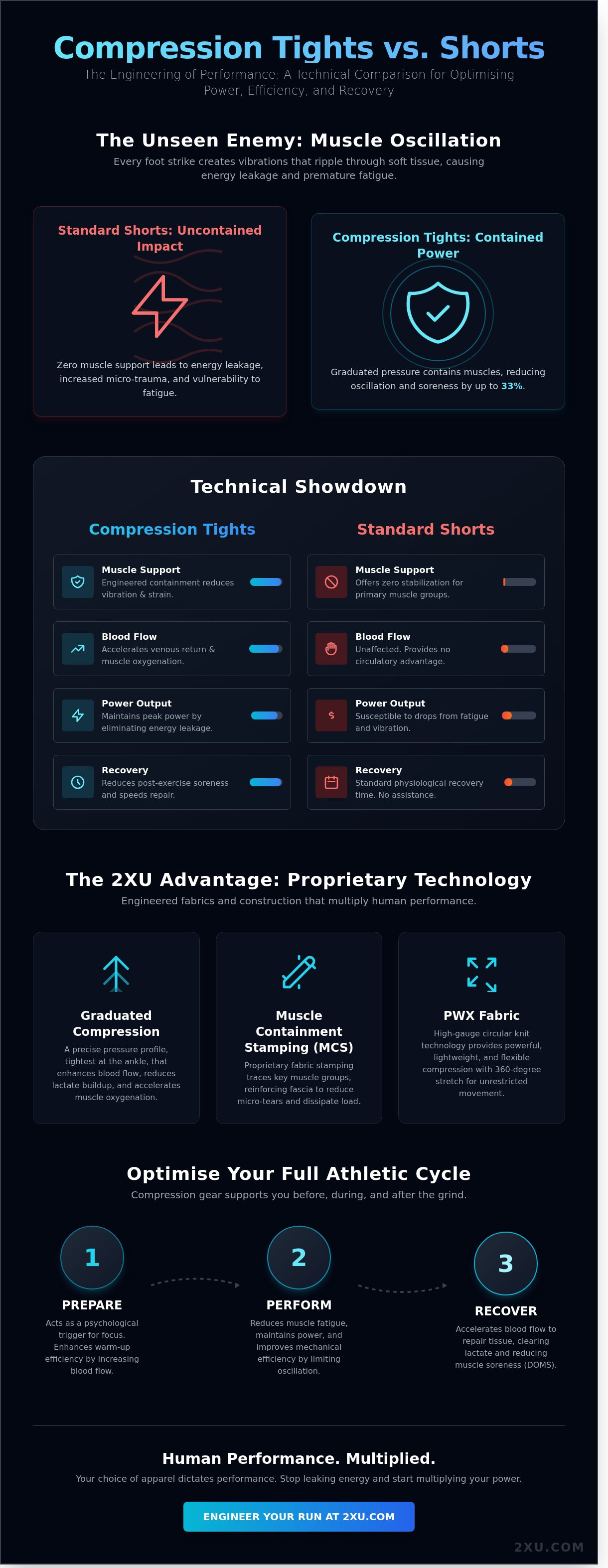
Every time your foot hits the pavement, your muscles endure micro-trauma. This impact creates muscle oscillation, a vibration that ripples through your soft tissue. This vibration leads to energy leakage, forcing your body to expend extra effort just to keep muscles aligned. A high-quality compression garment provides more than just a tight fit; it delivers graduated pressure to reduce this oscillation by up to 33 per cent. This is the core of the 2XU philosophy: Human Performance. Multiplied. We don't believe in mediocrity. We believe in providing the tools that allow you to become twice the athlete you were yesterday.
Don't fall for the myth that tights are reserved for sub-zero temperatures or the elite starting block. Whether you are a weekend warrior or a professional, your muscles deserve protection. High-performance gear is about efficiency, not just weather protection.
The Role of Apparel in the Athletic Lifecycle
Success is found in the transition from preparation to peak performance. Respecting the Grind means choosing equipment that protects your physiological assets during every phase. High-performance gear acts as a psychological trigger. When you pull on engineered compression, your mindset shifts into a state of discipline and focus. It signals that you are ready to work. This gear facilitates a holistic cycle: you prepare better, perform harder, and recover faster. It is about longevity. By reducing muscle fatigue during a run, you ensure you are ready for the next session. You don't just run; you build a better version of yourself through consistent, protected effort.
Shorts vs. Tights: More Than Just Coverage
The choice of running in compression tights vs shorts involves distinct mechanical trade-offs. Standard shorts are designed for airflow and a minimal weight profile, yet they offer zero muscle support. Compression tights focus on stabilisation and power output. Many athletes worry that tights restrict natural movement. This is a misconception. 2XU uses circular knit technology to provide 360-degree stretch, ensuring your range of motion remains unhindered while your muscles stay locked in place. While shorts allow for maximum ventilation, they leave your quads and hamstrings vulnerable to the repetitive shock of the road. Tights provide the structural integrity required to maintain form when fatigue sets in at the 30-kilometre mark.
The Science of Compression Tights: Multiplied Power and Accelerated Recovery
Graduated compression is a pressure profile that is tightest at the extremity to facilitate blood flow back to the heart. This mechanical gradient is the foundation of 2XU technology, engineered to accelerate venous return and ensure deoxygenated blood moves efficiently from the lower limbs. By increasing arterial inflow, athletes experience enhanced muscle oxygenation during maximal efforts. This isn't theoretical conjecture; a 2012 study on compression tights vs. shorts conducted at Occidental College demonstrated that compression garments help maintain muscle power during repetitive high-impact movements. This physiological advantage results in lower blood lactate levels during high-intensity intervals, allowing you to sustain your threshold for longer periods without hitting the wall.
Beyond blood flow, proprietary Muscle Containment Stamping (MCS) provides targeted support that traditional gear cannot match. MCS traces the key muscle groups, reinforcing the fascia and reducing the micro-tears that occur during high-impact activities. When evaluating running in compression tights vs shorts, the data points toward superior power maintenance in compressed limbs. This technology doesn't just support the muscle; it reinforces your entire kinetic chain, allowing for a more efficient transfer of energy with every stride. It's about ensuring every watt of power you generate is used for forward propulsion.
Reducing Muscle Oscillation and Damage
Each foot strike sends a shockwave through your calves and quadriceps. This vibration, known as muscle oscillation, is a primary driver of fatigue and soft tissue damage. 2XU compression garments dampen this movement, protecting the muscle fibres from structural trauma. Research indicates that limiting this oscillation leads to lower circulating levels of Creatine Kinase, a biochemical marker used to quantify muscle damage. When you lower Creatine Kinase levels, you effectively shorten the recovery window. This allows you to increase your weekly training volume and hit those "Grind" sessions with higher frequency. To multiply your output, you must first protect the machinery.
Thermal Regulation and Moisture Management
Elite performance requires precise thermal control. Advanced 2XU garments utilise engineered technical fibres to pull moisture away from the skin, facilitating rapid evaporation and cooling. This moisture management system prevents the heavy, waterlogged feel of standard athletic wear. During rest intervals or cold-weather sessions, the fabric maintains optimal muscle temperature, preventing the stiffness that often leads to strain or injury. To understand how this technology extends to the upper body, review The Scientific Guide to Compression Shirts. When running in compression tights vs shorts, the ability to regulate temperature ensures your muscles remain pliable and ready for explosive action. Ready to upgrade your kit? Explore the latest 2XU performance range to find your edge.
Compression Tights vs. Shorts: A Technical Comparison for Every Terrain
Choosing between running in compression tights vs shorts is a decision of mechanical engineering. It is about matching your apparel to the physiological demands of the terrain. On the track, the priority is absolute hip mobility and heat dissipation. On the trail, the focus shifts to muscle stabilisation and protection against external elements. Every gram of fabric must serve a purpose; if it does not contribute to your power output or recovery, it is dead weight.
The trade-off between the ventilation of shorts and the protection of tights is often debated. Shorts offer maximum airflow, which is critical for high-intensity intervals where core temperature spikes rapidly. However, full tights provide a layer of defence against debris and abrasions on technical trails. For athletes seeking a middle ground, the hybrid solution is the 2-in-1 short. These garments feature an integrated compression liner that provides the muscle containment of a tight with the aesthetic and airflow of a traditional short. This configuration is often the optimal choice for road running, where consistent repetitive impact can lead to muscle micro-trauma.
Distance and Duration: The Endurance Variable
Short-shorts are the standard for track intervals. They are designed for speed, maximising hip mobility and ensuring nothing interferes with your stride. When the distance increases to the half-marathon, many elite athletes transition to half-tights. This is the professional choice for speed and support. The compression helps manage muscle oscillation, which is the lateral movement of muscle fibres caused by ground impact. While a 2024 systematic review on compression garments suggests that race times may not be directly lowered by the fabric alone, the reduction in muscle vibration is a key factor in delayed fatigue. For ultra-endurance events, full tights are superior. They protect the legs against long-term fatigue and environmental debris over 50 or 100 kilometres of movement.
Environmental Factors: Temperature and Humidity
Optimising performance in heat requires a balance between technical fabrics and bare skin. High-performance yarns are engineered to wick moisture faster than sweat can evaporate from the skin alone. In cold weather, compression is superior to traditional thermal leggings. Compression fabrics maintain a tight profile that traps a thin layer of air against the skin, providing insulation without the bulk that hinders movement. To understand the mechanics of fabric selection further, see The Ultimate Guide to Engineering Your Running Shorts Performance. Whether you are battling humidity or frost, your gear must be an extension of your physiology. Respect the grind; choose the gear that allows you to push harder for longer.
Engineering Your Run: A Framework for Selecting Your Optimal Gear
Don't leave your performance to chance. Choosing between running in compression tights vs shorts requires a clinical assessment of your training objectives. This isn't about aesthetics; it's about the mechanical efficiency of your gait and the metabolic cost of your run. Every piece of kit you wear should serve a biometric purpose. If it doesn't help you push through the 'Grind,' it doesn't belong in your kit bag.
- Step 1: Identify your primary goal. Power output requires maximal muscle containment to prevent energy leaks. Endurance relies on graduated pressure to facilitate venous return. Recovery demands high-grade pressure to flush metabolic waste.
- Step 2: Assess the intensity. High-intensity sessions increase muscle oscillation by up to 50 per cent. You need gear that locks down the major muscle groups to prevent micro-tears and unnecessary fatigue.
- Step 3: Evaluate environmental conditions. Tights provide UPF50+ sun protection and manage thermal regulation when temperatures drop below 10 degrees Celsius. Shorts offer ventilation for high-humidity environments but sacrifice total limb support.
- Step 4: Match the compression level. Use firm, graduated pressure for active performance and extra-firm medical-grade pressure for dedicated recovery periods.
The Prepare, Perform, Recover Protocol
Preparation starts before you hit the pavement. Using light compression gear primes your muscles and increases proprioception, making your movements more precise from the first kilometre. During the performance phase, we deploy Muscle Containment Stamping (MCS) technology. This proprietary system traces key muscle tendons and fascia to provide targeted support to the quads and calves, reducing the impact of ground reaction forces. Post-run, the recovery phase begins. Full-length tights are essential here; they reduce post-run swelling and muscle soreness by accelerating blood flow back to the heart.
Avoiding Common Selection Mistakes
The debate regarding running in compression tights vs shorts isn't just about comfort; it's about data. Many athletes fall for "compression-style" gear. If the garment hasn't been validated on a Salzmann pressure measurement device, it lacks the medical-grade profile required to actually change your physiology. It's just tight clothing. Fit is your most critical variable. You must measure your limb circumference, not just your height or weight. A 2cm error in sizing can completely negate the graduated pressure benefits. Finally, prioritise technical fibre durability. High-performance yarns must maintain their power and recovery properties through 50 plus wash cycles to ensure your investment continues to multiply your output.
Ready to upgrade your training kit? Shop 2XU high-performance compression gear and dominate your next session.
The 2XU Advantage: Proprietary Technology Built for the Grind
Mediocrity has no place in your training programme. Choosing between running in compression tights vs shorts isn't a matter of fashion; it's a decision about the technical architecture of your gear. 2XU utilises proprietary PWX (Power, Weight, Flexibility) fabric technology to ensure you never compromise on the track. This isn't a standard knit. It's an engineered material designed to provide 360-degree stretch while maintaining the high-denier strength required for medical-grade pressure profiles.
Precision is our baseline. Every 2XU garment is assessed using the Salzmann pressure measurement device. This is the gold standard for medical compression testing, ensuring that our graduated profiles are exact. This technology forces deoxygenated blood back to the heart more efficiently, reducing the metabolic waste that slows you down. Our engineered fibres are built for durability. They won't lose their compression signature after a few cycles in the wash. You put in the work; your gear must keep up. Discipline is required to earn results, and we provide the equipment to match that intensity.
Muscle Containment Stamping (MCS) Explained
Elite performance requires more than general tightness. MCS technology maps the specific muscle structures of the quads and calves to provide targeted support where impact is highest. By applying an extra layer of internal stamping, we reduce muscle oscillation. This is the vibration that occurs every time your foot strikes the pavement. Reducing this movement prevents micro-tears and lessens the strain on your tendons. Elite triathletes trust MCS for their most demanding race days because it preserves muscle function over long distances. It's the difference between fading at the 30-kilometre mark and finishing with power.
Commitment to Scientific Validation
We don't rely on marketing fluff. 2XU partners with leading sports science institutions, such as the Australian Institute of Sport, to validate performance gains through rigorous testing. This data-driven approach ensures that every claim of increased power output or faster recovery is backed by evidence. This same level of scientific scrutiny is applied to our specialized gear. You can explore these principles further by Engineering Your Fastest Race Day with the Ultimate Triathlon Suit. When you understand the mechanics of running in compression tights vs shorts, the choice becomes clear. Equipment is a multiplier for the hard work you already do. Multiply your performance today.
Master Your Movement
Deciding between running in compression tights vs shorts dictates how your muscles handle the mechanical stress of every kilometre. The science is absolute. 2XU apparel is scientifically proven to reduce muscle oscillation, which protects your fibres from the micro-tears that cause fatigue. By utilising Salzmann-certified graduated compression profiles, these garments accelerate blood flow and ensure you're ready for tomorrow's session before today's is even finished. This is proprietary equipment used by elite Ironman champions worldwide to sustain peak power output under the most punishing conditions.
The grind doesn't care about your excuses; it only respects your discipline. Whether you choose the targeted support of shorts or the comprehensive stability of tights, ensure your gear is engineered for the intensity you demand. You've put in the hard yards. Now, give yourself the technical advantage required to multiply that effort. It's time to gear up, sharpen your focus, and outwork the competition. Your next personal best is waiting.
Shop 2XU High-Performance Compression Gear
Frequently Asked Questions
Is it better to run in tights or shorts for fat loss?
Weight loss depends on caloric expenditure rather than garment choice, but compression tights allow you to train at higher intensities for 5% longer durations. This increased work capacity, documented in 2021 physiological studies, leads to a higher total energy burn over a training cycle. When comparing running in compression tights vs shorts, the tights support your muscles so you can endure the grind of longer, more frequent sessions.
Do compression tights actually make you run faster?
Compression gear improves running speed by enhancing proprioception and reducing energy waste caused by muscle oscillation. Research published in the Journal of Strength and Conditioning Research demonstrates a 1.2% increase in anaerobic power for athletes using graduated compression. By stabilising the muscles, our technology ensures you maintain explosive form and peak power output during the final stages of your race.
Can I wear compression tights under my running shorts?
You can wear compression tights under shorts to combine elite technical support with your preferred aesthetic. This layering does not diminish the 33% reduction in muscle vibration provided by our proprietary Muscle Containment Stamping (MCS) technology. Many professional athletes adopt this configuration during winter training to maintain muscle temperature while benefiting from the graduated pressure that multiplies performance.
How tight should running compression tights actually be?
Your gear must feel like a firm, second skin that applies graduated pressure without restricting your 360-degree range of motion. We use the Salzmann pressure measurement device to ensure our garments hit the 20 to 25 mmHg range required for physiological benefits. If the fabric bunches at the knees or limits your stride by more than 3%, you should consult the 2XU size kit to find your correct fit.
Do compression tights help with running-related injuries like shin splints?
Compression garments mitigate the risk of shin splints by reducing the micro-trauma caused by ground reaction forces during every stride. A 2019 study confirmed that medical-grade compression reduces muscle displacement by 33% during high-impact running. This stability protects the soft tissue surrounding the tibia, allowing you to stay disciplined with your training programme without being sidelined by avoidable overuse injuries.
What is the difference between running tights and compression tights?
Standard running tights are basic apparel designed for coverage, whereas compression tights are engineered equipment designed to manipulate blood flow. Our PWX fabrics use high-filament technical yarns and a circular knit structure to provide consistent power and graduated pressure. Standard tights lack the 70-denier strength required to support muscle groups and enhance venous return, making them ineffective for serious performance goals.
Should I wear compression tights for recovery after a marathon?
You should wear graduated compression for at least 12 to 24 hours post-marathon to accelerate the removal of blood lactate. Scientific data shows that this practice reduces muscle soreness by 47% and decreases lower limb swelling by 11% after extreme endurance events. It's a non-negotiable part of the recovery phase that ensures you're ready to tackle your next session with minimal downtime.
How do I care for my 2XU compression gear to ensure it lasts?
Machine wash your equipment in cold water on a gentle cycle and always air dry in the shade. High heat from tumble dryers or irons will destroy the elastomeric fibres and can reduce the garment's compressive power by 40% over six months. Avoid using fabric softeners or harsh chemicals; a mild liquid detergent is all you need to keep your technical yarns performing at an elite level.