
What to Wear Running in 40 Degree Weather: The Performance Engineering Guide
40 degrees isn't just a temperature; it's a tactical threshold where your performance is either engineered or compromised. Most runners treat this chill as a nuisance, but elite athletes recognise it as a critical variable in the equation of mechanical efficiency. Deciding what to wear running in 40 degree weather is the difference between a session that multiplies your potential and one that leaves you battling muscle stiffness or the dreaded post-run chill. You've likely experienced the frustration of overheating halfway through a threshold set because you over-layered, or the metabolic drain of trying to stay warm in gear that doesn't breathe.
We respect the discipline it takes to face the elements, and we're here to ensure your gear matches your effort. This guide provides the definitive blueprint for mastering thermoregulation in 4°C conditions, promising to help you maintain an optimal core temperature through scientific layering. We'll break down the specific technical yarns and graduated compression systems required to stabilise muscle oscillation and eliminate sweat-soaked discomfort. From the "Ignition" series to advanced moisture management, you're about to learn how to achieve a "human multiplied" state despite the cold.
Key Takeaways
- Apply the 10-20 degree rule to account for metabolic heat production and maintain thermal equilibrium during intense sessions.
- Master the engineered three-layer framework to solve the tactical challenge of what to wear running in 40 degree weather.
- Utilise graduated compression to stabilise muscle oscillation and maintain optimal temperature in your lower extremities.
- Recalibrate your technical gear for environmental variables like wind chill to ensure your core remains protected without compromising breathability.
- Leverage lab-validated apparel to achieve a "human multiplied" state and ensure your gear is a catalyst for peak performance.
The Science of the 40-Degree Threshold: Perceived Thermal Equilibrium
At 4°C, your body exists in a state of thermal tension. This is the transition zone where human thermoregulation is tested to its limits. Understanding what to wear running in 40 degree weather requires a shift from viewing clothing as "warmth" to viewing it as a critical component of your metabolic engine. At this temperature, the air is cold enough to trigger peripheral vasoconstriction, yet your physical output is high enough to generate significant internal heat. If your gear choice is incorrect, you risk a rapid descent from peak performance into metabolic distress.
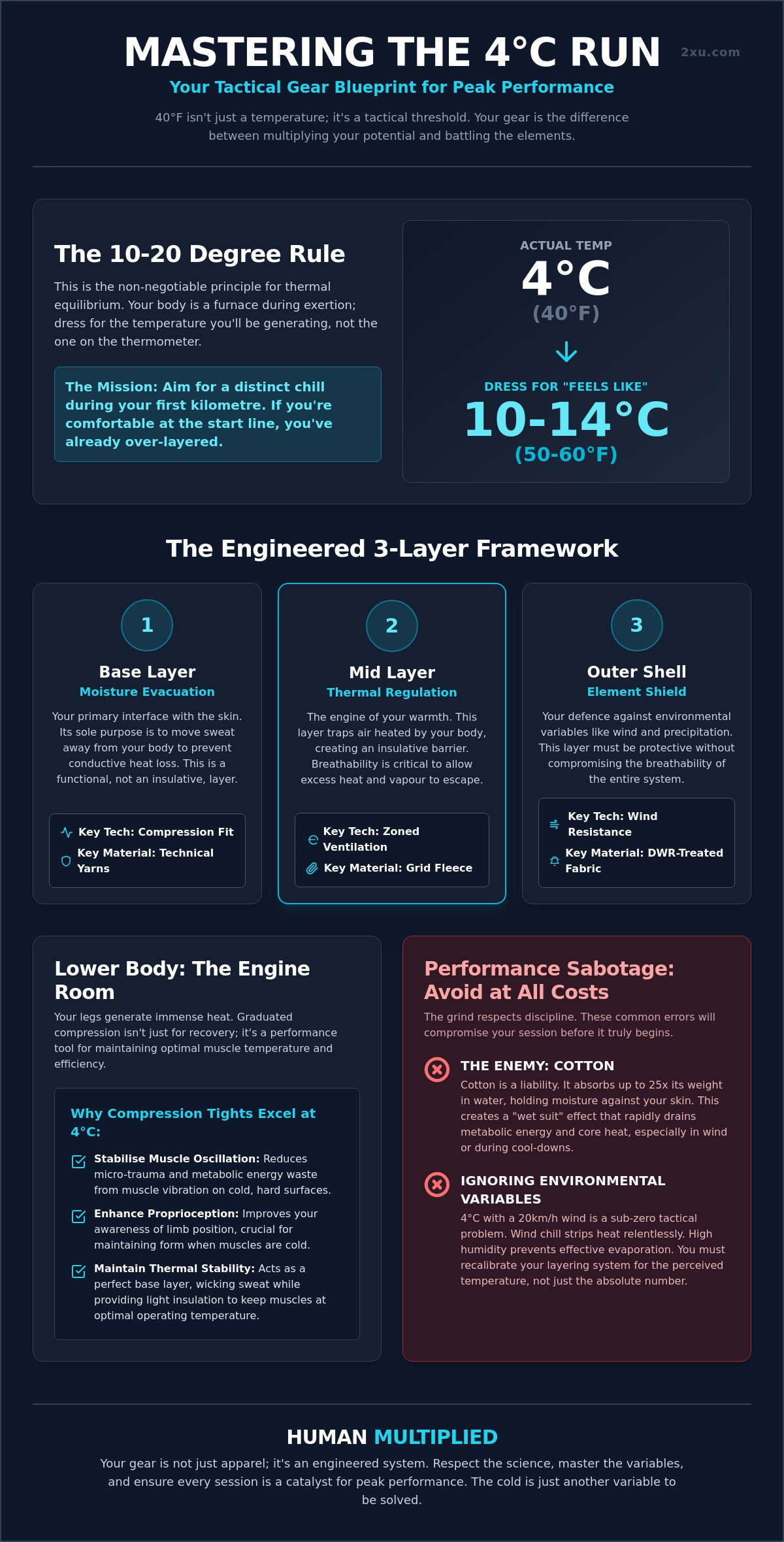
The industry standard 10-20 degree rule suggests dressing as if the ambient air is significantly warmer than the thermometer indicates. This accounts for the exponential increase in heat production during exertion. Relying on The Science of Clothing Physiology, we can see that your "standing temperature" is irrelevant once your heart rate exceeds 120 BPM. If you feel comfortable while standing at the start line, you've already failed the mission. You'll be overheating before the second kilometre is complete.
Metabolic Heat and Running Intensity
High-intensity intervals generate far more thermal energy than a zone 2 recovery jog. A tempo run creates a massive internal heat load that must be managed through efficient venting. If your gear doesn't facilitate rapid heat dissipation, your core temperature rises, triggering a performance drain as the body diverts blood to the skin for cooling rather than to the working muscles. Shivering is a waste of energy; overheating is a waste of potential. Determining what to wear running in 40 degree weather is a calculation of intensity versus insulation. Aim for a distinct chill during your first kilometre to ensure mid-run comfort.
The Perceived Temperature Formula
Environmental variables modify the 40-degree baseline. A 20km/h wind gust can strip heat from exposed skin, making 4°C feel like sub-zero conditions. High humidity further complicates this by saturating the air, which slows down the evaporative cooling process and leaves you damp. Perceived Thermal Equilibrium is the balance between internal heat production and external environmental cooling.
Cotton is the enemy of the grind. It holds water, creating a conductive bridge that pulls heat away from your core once you stop moving or face a headwind. Engineered technical yarns are non-negotiable here. These specialised fibres transport moisture to the outer surface of the garment, ensuring you stay dry and maintain a stable internal climate. Respect the science, or the elements will dictate your results.
The Engineered Layering System: Strategic Moisture Management
Solving the puzzle of what to wear running in 40 degree weather isn't about adding bulk; it's about precision architecture. You need a system that facilitates the rapid transport of vapour before it condenses into liquid sweat. If moisture remains on your skin, it acts as a thermal conductor, accelerating heat loss the moment you face a headwind or lower your intensity. This is why cotton is a liability for the endurance athlete. It absorbs up to 25 times its weight in water and holds it against the body, creating a "wet suit" effect that drains your metabolic energy. Prioritising breathability over simple insulation ensures you remain in the performance sweet spot.
Your goal is to build a micro-climate that adapts to your output. While the 10-20 degree rule gives you a baseline, the specific fabrics you choose determine whether you maintain that equilibrium. Technical yarns are engineered to pull moisture away from the dermis through capillary action, pushing it to the outer surface where it can evaporate. This mechanical process is essential for preventing the post-run chill that occurs when your heart rate drops but your clothes remain saturated. For more practical advice on managing your gear in these conditions, these Cold-Weather Running Tips highlight the importance of protecting your core first.
The Foundational Base Layer
The base layer is your primary interface with the skin. Its job is purely functional: move sweat away. High-performance compression shirts are the gold standard here. They provide a precise fit that eliminates the air gap where sweat pools, while simultaneously supporting postural muscles during the grind. Look for technical yarns engineered with a high surface area to accelerate evaporation. Ensure the garment uses flatlock seams; at 4°C, damp skin is more susceptible to micro-abrasions and chafing, which can derail a high-mileage session. You can explore our range of training apparel to find the right balance of protection and output.
The Secondary Layer: Mid-Weight Protection
When the wind picks up or your intensity fluctuates, a mid-layer provides the necessary thermal buffer. The objective remains breathability. A long-sleeve technical top with a half-zip design is a tactical essential for what to wear running in 40 degree weather. This allows for manual ventilation; as your metabolic heat peaks during a threshold set, you can unzip to dump excess heat instantly. These engineered fabrics offer a superior warmth-to-weight ratio, trapping a thin layer of air to insulate the body without the restrictive weight of traditional heavy gear.
Lower Body Strategy: Compression Tights vs. Performance Shorts
At 4°C, your lower body strategy is a balance between metabolic heat and mechanical stability. This is the temperature where the choice of what to wear running in 40 degree weather shifts from a matter of preference to a tactical decision regarding injury prevention. Cold muscles are less elastic and more prone to strains. Maintaining an optimal muscle temperature is essential for preventing "cold-starts" where your first fast interval leads to a soft-tissue tweak. While your core generates heat, your extremities are the primary sites for heat loss, making your leg-wear choice a critical factor in your overall thermal equilibrium.
Compression tights represent the superior alternative to standard leggings for cold-weather runs. They don't just provide a thermal barrier; they multiply your output by reducing muscle oscillation. Research indicates that minimising muscle vibration through compression can lower fatigue by up to 25% during high-impact activities. By locking the major muscle groups in place, you conserve energy that would otherwise be wasted on involuntary movement. This mechanical advantage allows you to maintain a higher intensity for longer, even as the ambient temperature tries to sap your power.
The Benefits of Compression in the Cold
Proprietary compression fabrics are engineered to provide more than just warmth. They offer graduated compression, typically in the 20-30 mmHg range, which has been shown to potentially reduce muscle soreness by 47%. This pressure gradient facilitates venous return and accelerates the clearing of lactate, ensuring your legs feel fresh during the back half of a long grind. On slippery or uneven winter surfaces, the enhanced proprioception provided by a tight fit improves your mechanical stability and reaction time. Don't settle for average standards; use gear that provides laboratory-validated support.
- Mechanical Stability: Reduction in muscle vibration preserves glycogen stores.
- Biological Recovery: Increased blood flow assists in temperature regulation and waste removal.
- Thermal Maintenance: 2XU technical yarns retain heat without trapping moisture.
When to Choose Performance Shorts
Intensity is the deciding factor in the "shorts vs. tights" debate. For high-output sessions like tempo runs or track intervals, running shorts remain a viable tactical choice. If your pace is fast enough to generate massive metabolic heat, shorts prevent the risk of overheating that can occur in thermal gear. Many elite athletes opt for a "half-tight" compromise or pair shorts with compression calf sleeves to protect the lower leg while allowing the quadriceps to vent. Respect the grind by choosing the kit that matches your planned intensity, not just the weather forecast.
Tactical Adjustments: Wind, Rain, and Environmental Variables
Ambient temperature is only one variable in the performance equation. Wind and precipitation can radically alter your perceived thermal equilibrium, turning a manageable session into a battle for heat retention. When calculating what to wear running in 40 degree weather, you must account for the wind chill factor. A 20km/h gust can strip heat from your body's surface, making a 4°C morning feel closer to -1°C. This convective heat loss forces your metabolism to work harder just to maintain core temperature, which directly diverts energy away from your mechanical output.
Defeating the Wind
Conquering the wind requires a shell that balances protection with vapour transport. A lightweight, packable wind jacket is a tactical essential for the serious athlete. These garments are engineered with specific wind-blocking panels strategically placed on the chest and shoulders, while the back and underarms remain highly breathable. This specific architecture prevents the "greenhouse effect" where internal heat is trapped, leading to sweat accumulation. Maintain a streamlined profile; loose, flapping gear increases aerodynamic drag and wastes mechanical energy that should be driving you forward.
In light rain, choosing a fully waterproof jacket is often a strategic error. These garments frequently compromise breathability, leading to internal saturation from your own sweat. Instead, opt for a water-resistant shell with a high moisture-vapour transmission rate. You want to stay dry from both the external elements and your own metabolic output. When the sun is absent during early morning or evening sessions, the lack of solar radiation means your gear must work harder to retain heat compared to a midday run in the same temperature.
Accessory Engineering
Heat loss through the extremities is a significant performance drain. Your hands and head are highly vascularised areas that can act as radiators if left exposed. Lightweight gloves are critical for the initial phase of the run; they protect the fingers until blood flow increases, at which point they can be easily stored. For the head, a technical headband is often superior to a full beanie in 40-degree conditions. It protects the ears from wind-chill while allowing excess heat to escape through the scalp, preventing the overheating that often occurs during high-intensity intervals.
Visibility is a non-negotiable requirement for the winter grind. Low-light conditions demand high-visibility elements integrated into your kit to ensure safety without sacrificing performance. To complete your tactical setup, browse our range of Athletic Accessories designed for elite output. Don't let the environment dictate your results; engineer your kit to master the conditions.
The 2XU Advantage: Multiply Your Output in the Cold
Your gear is the final piece of the performance equation. While others see 4°C as a reason to stay indoors, you see a window of opportunity to outwork the competition. Deciding what to wear running in 40 degree weather shouldn't be a guessing game; it should be a strategic deployment of lab-tested equipment. 2XU gear is engineered to remove the variables that compromise your output, ensuring that every watt of energy you produce is directed toward forward motion. This is the "Human Multiplied" philosophy in action. We don't just provide apparel; we provide the catalyst for your best run.
Our commitment to laboratory validation distinguishes our gear from competitors who rely on generalised claims. Every garment undergoes rigorous testing to ensure it meets the mechanical and thermal demands of elite athletes. By managing the science of thermoregulation and muscle stability, we allow you to focus entirely on the grind. Your preparation meets our engineering to create an exponential increase in your physical potential.
Elite Performance, Zero Excuses
Professional athletes don't leave their results to chance. They trust compression for cold-weather endurance because it provides a validated mechanical advantage. Our technical fibres are rigorously tested to withstand the elements, maintaining their elasticity and moisture-wicking properties through the harshest sessions. Respect the grind. Use the cold as a training advantage to build mental resilience and physical power. When your gear handles the thermoregulation, you're free to focus on the split times. The right kit removes the excuse of weather, leaving only your discipline as the deciding factor.
For athletic clubs or corporate teams that want to replicate this professional standard with custom-branded gear, brandme.clothing provides high-quality technical apparel designed for performance.
Optimise Your Kit
Audit your gear drawer before your next session. If you're still relying on basic leggings or heavy sweatshirts, you're leaving performance on the table. A complete 40-degree kit requires a hierarchy of specialised items. To maintain the integrity of these technical fabrics, wash them in cold water and avoid the dryer; heat can degrade the specialised yarns that provide graduated compression. Follow this checklist to ensure your arsenal is ready for the threshold:
- Base: Technical singlet or compression tee for core moisture transport.
- Mid: Half-zip technical top for manual ventilation.
- Lower: Graduated compression tights to stabilise muscle oscillation.
- Protection: Water-resistant shell and technical headband for wind-chill management.
Mastering what to wear running in 40 degree weather is a mark of a serious athlete. It proves you understand the mechanics of your own body and the science of your sport. Don't let sub-optimal gear hold you back. Shop 2XU High-Performance Running Apparel and ensure your equipment is as relentless as your ambition.
Dominate the Cold: Your Performance Blueprint
40 degrees is a threshold, not a barrier. Success depends on your ability to maintain thermal equilibrium through precision layering and moisture management. You've learned that prioritising breathability over simple insulation prevents the metabolic drain of sweat accumulation. You also understand that graduated compression is the superior tactical choice for maintaining muscle temperature and mechanical stability. Mastering what to wear running in 40 degree weather ensures that your gear is a catalyst for your output rather than a hindrance to your grind.
For runners who demand a balance between high-performance engineering and city-ready aesthetics, you can learn more about how New York-inspired urban athletic style is shaping the future of technical training gear.
2XU is the choice of elite athletes globally because our gear is built on scientifically validated compression technology. These garments are engineered for durability and peak performance in sub-optimal conditions. Don't let the elements dictate your intensity. Multiply your performance with 2XU engineered running gear and transform the chill into your competitive advantage. The road is yours to claim; get out there and earn your results. Respect the work, trust the science, and push your limits.
Frequently Asked Questions
Should I wear shorts or tights for running in 40 degree weather?
The decision depends entirely on your planned intensity. While high-output sessions like track intervals generate enough metabolic heat for performance shorts, most athletes benefit from tights to maintain muscle elasticity. At 4°C, cold muscles are more susceptible to strains. Tights provide a protective thermal barrier that prevents "cold-starts", ensuring your mechanical efficiency remains uncompromised throughout the entire duration of the grind.
Is it better to be slightly cold or slightly warm when I start my run?
You should always start your run feeling slightly cold to account for the inevitable rise in core temperature. If you feel comfortable at the start line, you're guaranteed to overheat once your heart rate climbs. Adhering to this protocol ensures you reach thermal equilibrium during the working phase of your session. This prevents the performance drain associated with excessive sweating and the subsequent chill that occurs when moisture saturates your apparel.
Does compression gear actually help in cold weather?
Compression gear is a critical tool for cold-weather performance. Beyond providing a streamlined thermal layer, it applies graduated pressure to facilitate venous return and accelerate the removal of metabolic waste. This mechanical support reduces muscle oscillation, which preserves glycogen stores and lowers fatigue. When determining what to wear running in 40 degree weather, compression should be viewed as a functional component that stabilises your physiology against the elements.
What is the best fabric for running in 40 degree rain?
Seek technical yarns engineered with high moisture-vapour transmission rates rather than fully waterproof membranes. Total waterproofing often traps internal heat, leading to saturation from sweat. You need a water-resistant shell that allows vapour to escape while shielding you from external precipitation. Avoid cotton at all costs; it absorbs moisture and creates a conductive bridge that rapidly strips heat from your core, leading to a dangerous post-run chill.
How do I protect my lungs and throat when running in 40 degree air?
Use a lightweight technical neck gaiter to pre-warm the air before it enters your respiratory system. Cold, dry air can cause exercise-induced bronchospasm in some athletes, leading to a constricted throat and reduced oxygen intake. A breathable barrier traps a small amount of moisture and heat, humidifying each breath. This simple tactical adjustment protects your lung function and allows you to maintain high-intensity output without respiratory distress.
Are gloves necessary for 40 degree running?
Gloves are a tactical necessity for the first 15 to 20 minutes of a 4°C run. Because your body prioritises core temperature, blood flow to the extremities is restricted in the cold, leaving your hands vulnerable to numbness. Once your metabolic heat production peaks, you can easily store lightweight gloves. This approach protects your fine motor skills and prevents the initial discomfort that can distract you from your performance goals.
How does wind chill affect what I should wear at 40 degrees?
Wind chill accelerates convective cooling, stripping heat from exposed skin and significantly lowering your perceived temperature. A 20km/h wind can make 4°C feel like sub-zero conditions. When deciding what to wear running in 40 degree weather, you must prioritise a wind-blocking outer shell. This protective layer maintains the micro-climate created by your base layers, ensuring your internal engine doesn't waste energy fighting a losing battle against heat loss.
Can I wear my normal summer running gear with just a jacket at 40 degrees?
Relying on summer gear under a jacket is a strategic error that leads to internal saturation. Summer fabrics are designed for maximum airflow, but when trapped under a shell, they often fail to transport moisture efficiently. This creates a damp environment that increases the risk of chafing and rapid cooling. You need a dedicated layering system engineered for cold-weather moisture management to ensure your performance isn't compromised by poor equipment choices.