
How to Prevent Chafing When Running: The Science of Frictionless Performance
Chafing is not a skin condition; it's a mechanical failure of your gear and moisture management strategy. When you're deep into a high-mileage week, the last thing you need is excruciating skin irritation forcing a change in your gait and degrading your power output. If you want to know how to prevent chafing when running, you must stop relying on messy creams that stain your kit and start mastering the science of frictionless performance. Respecting the grind means ensuring your equipment is as disciplined as your training schedule.
We agree that performance degradation due to pain is an unacceptable barrier to your progress. This guide delivers an elite-level deep dive into mechanical skin protection and fabric engineering designed to eliminate the friction that limits your results. You'll gain a scientific understanding of how to protect the epidermis while utilising gear that manages moisture and stability simultaneously. We'll preview the technical strategies required to create a friction-free running experience, allowing you to multiply your physical potential without the distraction of biological abrasion.
Key Takeaways
- Understand the "Sandpaper Effect" and how salt crystals from dried sweat act as micro-abrasives against the epidermis during high-mileage efforts.
- Discover how to prevent chafing when running by utilising compression garments that act as a high-performance second skin to eliminate skin-on-skin contact.
- Avoid natural fibres that absorb moisture and instead prioritise engineered fibres designed for rapid capillary action and efficient moisture transport.
- Identify high-friction zones and apply mechanical stability strategies to lock garments in place, preventing the sliding that causes irritation and performance degradation.
- Learn how removing the distraction of pain through proper fabric engineering can exponentially increase your physical output and respect the grind.
The Biology of Friction: Why Runners Chafe
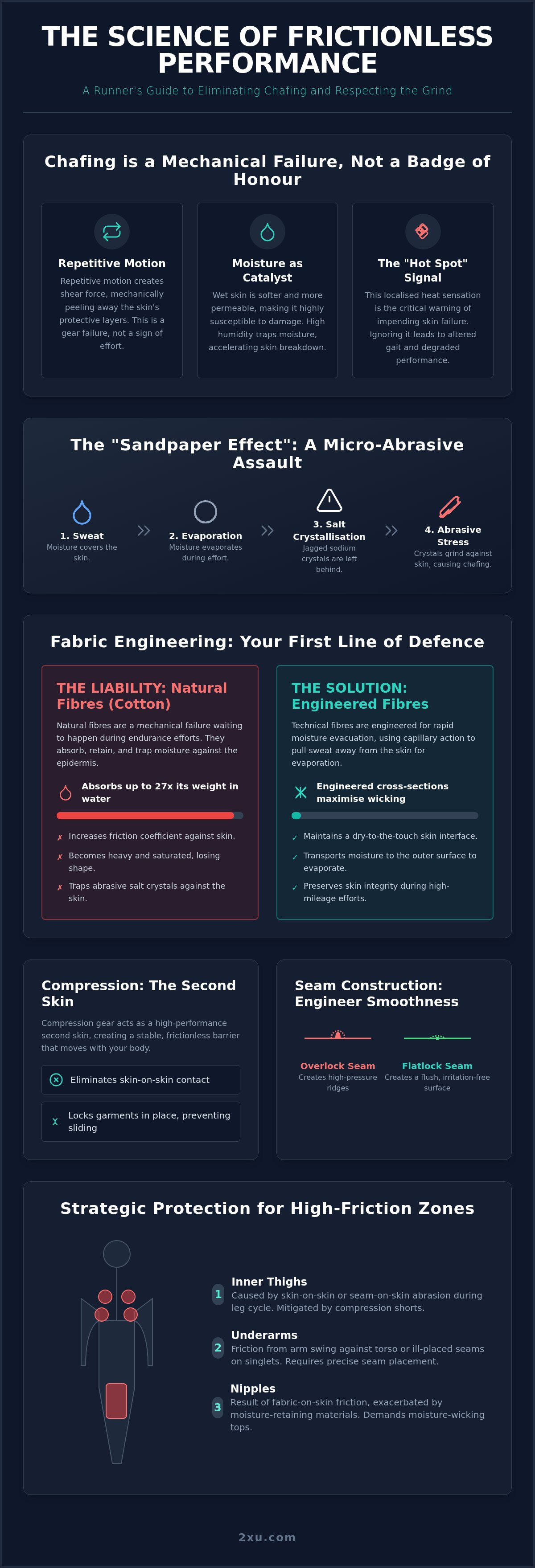
Chafing isn't a badge of honour; it's a signal that your equipment has failed to protect your biological integrity. To understand The Biology of Friction: Why Runners Chafe, we must look at it as a mechanical abrasion of the epidermis. This occurs when repetitive motion, coupled with moisture, creates enough shear force to peel away the skin's protective layers. Whether it's skin-on-skin contact at the inner thighs or fabric-on-skin friction at the nipples and underarms, the result is the same: performance-limiting pain. When you're focused on the grind, these micro-traumas become a massive liability.
Serious athletes monitor for the "Hot Spot". This localised sensation of heat is the critical warning sign of impending mechanical skin failure. If you ignore it, the abrasion progresses from simple irritation to raw, weeping wounds that alter your gait and destroy your training efficiency. Learning how to prevent chafing when running starts with respecting these biological limits. You must intervene before the breakdown occurs. A change in your stride to avoid pain isn't just uncomfortable; it's a recipe for secondary overuse injuries.
The Role of Moisture and Humidity
Moisture is the catalyst for disaster. Wet skin is significantly more permeable and susceptible to shear forces than dry skin. In high-humidity environments, sweat cannot evaporate, leaving the epidermis in a softened, hyper-hydrated state. This vulnerability makes it easier for friction to compromise the skin's barrier. You need technical fibres that move moisture away from the surface instantly to maintain skin integrity. Without efficient moisture transport, you're essentially running in a damp, abrasive environment that invites skin failure.
Salt Crystallisation and Abrasive Stress
The "Sandpaper Effect" is what happens when you push through long efforts. As sweat evaporates, it leaves behind sodium crystals. These microscopic jagged edges act as abrasives between your skin and your kit. During long-duration sessions, the cumulative abrasive load increases exponentially. This is why surface-level solutions like simple creams often fail; they eventually rub off, leaving you exposed to these micro-abrasives. True protection requires a mechanical barrier that locks to the skin and manages the salt load. Understanding how to prevent chafing when running requires a strategy that accounts for this chemical and mechanical reality over many hours of output.
Fabric Engineering: Eliminating Moisture-Induced Friction
Cotton is a liability on the track. While natural fibres are comfortable for recovery, they are a mechanical failure waiting to happen during an endurance effort. Cotton absorbs up to 27 times its weight in water, which significantly increases the friction coefficient against your skin. This moisture retention leads to the "Sandpaper Effect" where salt crystals become trapped against the epidermis. If you are serious about how to prevent chafing when running, you must transition to engineered performance fibres that prioritise rapid moisture evacuation.
Moisture-Wicking Technology
Elite performance apparel relies on yarns engineered with specific cross-sections to maximise surface area. Unlike standard round fibres, these technical polymers are often shaped like a cross or a star to facilitate capillary action. This mechanical process pulls sweat away from the skin surface and transports it to the outer layer of the garment where it can evaporate. This ensures the interface between your gear and your skin remains dry-to-the-touch. This rapid-dry capability is essential for maintaining skin integrity during high-mileage weeks where cumulative abrasive stress is high.
Seam Construction and Placement
Traditional overlock seams create high-pressure ridges that act as saw blades against the skin during repetitive motion. Engineering flatlock seams solves this by butt-joining the fabric edges, creating a flush, irritation-free surface. Beyond the construction method, the placement of these joins is a critical design factor. High-performance gear moves seams away from high-friction zones like the inner thigh and underarms to prevent chafing in easily irritated areas. This level of detail is what separates average kit from professional-grade equipment.
Technical apparel is an investment in your discipline. When your gear manages the environment for you, you can focus entirely on your output. Choosing the right running apparel ensures that pain-induced gait changes never compromise your training cycle. Respect the grind by equipping yourself with machinery designed to multiply your potential, not limit it through mechanical failure.
Mechanical Stability: Compression as a Friction Barrier
Elite performance requires more than just avoiding moisture; it necessitates the total elimination of relative motion between your kit and your skin. While many runners rely on topical Anti-chafing products, these are often temporary interventions that fail during the high-intensity portions of a session. True mechanical protection is achieved through compression apparel. By acting as a high-performance second skin, compression garments eliminate skin-on-skin contact entirely, particularly in the high-risk groin and inner thigh regions. This is a fundamental strategy in how to prevent chafing when running at an elite level.
The primary driver of groin chafing is the shifting of soft tissue. During every foot strike, your muscles undergo oscillation, vibrating and shifting against the fabric or adjacent skin. This repetitive displacement creates the shear forces that lead to epidermal breakdown. Compression locks the garment to the skin, creating mechanical stability that prevents the fabric from sliding across the surface of the body. Professional athletes prioritise compression shorts for their most demanding efforts because they understand that dampening muscle vibration is the only way to ensure the grind isn't interrupted by friction-induced pain.
Compression vs. Standard Tight Apparel
Don't confuse standard spandex leggings with technical compression. Performance compression requires rigorous engineering and graduated pressure. While standard tight apparel might look the part, it lacks the structural integrity to remain anchored during extreme ranges of motion. Technical compression uses high-filament yarns and specialised knit structures to provide 360-degree support. This ensures the garment doesn't migrate or bunch in high-friction zones, a common failure point in lower-tier gear that compromises your training consistency.
How to Choose the Correct Fit for Protection
Sizing is a matter of mechanical precision. A garment that's too loose will inevitably lead to friction as the fabric slides across the skin surface during the stride. Conversely, a fit that's excessively tight will restrict blood flow and compromise your biological recovery. Perform a no-slip test during your warm-up: if the waistband or leg hems migrate even slightly, the mechanical barrier is compromised. The ideal compression fit is a firm, supportive barrier that moves with the athlete, not against them. Mastering how to prevent chafing when running means respecting the data; if the fit is off, the technology cannot do its job.
Strategic Protection for High-Friction Zones
Topical lubricants are a temporary fix for a structural problem. If you want to master how to prevent chafing when running, you must apply specific mechanical solutions to the body's high-friction zones. Generalised advice often fails because it ignores the unique range of motion at each joint. You need a strategy that addresses the inner thighs, upper body, and feet with precision-engineered apparel. Respecting the grind means ensuring every contact point is protected by a functional barrier.
Thigh and Groin Protection
The inner thighs represent the highest risk for skin-on-skin failure. For athletes deep in the grind, half-tights or shorts with integrated compression liners are mandatory. These provide a physical barrier that eliminates the repetitive rubbing of the adductors. Opt for longer inseams, such as 7-inch or 9-inch variants, to ensure total coverage. High-performance gear is designed with specialised knit tensions to ensure the leg hems do not ride up mid-run. This maintains your focus on the effort rather than your kit.
Upper Body and Underarm Management
Upper body management requires a similar level of discipline. In humid conditions, sleeveless singlets reduce the volume of fabric in the axilla, though they expose the skin to potential arm-on-torso friction. Loose-fitting tees are a significant liability. The "sawing" motion of damp, loose fabric is the primary cause of nipple abrasion and underarm irritation. Utilising snug-fitting compression shirts eliminates this movement by locking the fabric to the skin. For female runners, the interface between the sports bra and the ribcage is a critical failure point. Ensure the band is wide and the fabric is engineered for high-velocity moisture transport to prevent sub-mammary chafing.
Strategic protection also extends to these critical areas:
- The Nipple Protection Strategy: Male runners must avoid loose shirts that move independently of the body. A compression base layer is the only way to stop the repetitive abrasive cycle.
- Foot Friction: Toe-on-toe contact leads to blisters that compromise your training block. Technical socks with high-density padding in strike zones manage these friction points by stabilising the foot within the shoe.
Equip yourself with the right athletic sportswear to ensure your next session is defined by your output, not your pain threshold.
The 2XU Standard: Engineered for The Grind
At 2XU, we don't manufacture clothing; we engineer performance machinery. Our philosophy is rooted in the "Human Multiplied" promise, which dictates that every piece of kit must actively enhance your physical output by removing biological distractions. Pain is a distraction. Chafing is a mechanical error. When you master how to prevent chafing when running through the use of our technical apparel, you unlock the ability to train at your absolute limit without the degradation of your gait or focus. We rely on rigorous laboratory validation to ensure our technical fibres meet the unyielding demands of elite athletes.
Advanced Fabric Durability
Average standards are for average runners. Our technical fibres are engineered to maintain their compressive power and moisture-wicking properties over hundreds of kilometres of abrasive stress. While lower-tier apparel loses its structural integrity after a few wash cycles, 2XU gear retains its mechanical stability to provide a consistent friction barrier. Viewing your apparel as a critical component of your injury prevention kit is a mark of a disciplined athlete. High-performance endurance gear must withstand the grind as long as you do, ensuring that your skin protection doesn't fail when the intensity peaks.
For organizations and corporate teams looking to maintain these high standards across their membership, SwagStore.NET offers specialized solutions for bulk custom-branded merchandise and premium corporate gifts.
Final Preparation Checklist
Success is found in the details of your preparation. Before every high-mileage session, you must audit your equipment to ensure 100% mechanical readiness. Follow this elite-level routine to maintain a frictionless environment:
- Prep: Ensure skin is clean and dry before dressing to prevent trapped salt crystals from previous sessions.
- Gear: Inspect seams and compression tension; ensure the fit is firm and supportive without restricting blood flow.
- Lubrication: Use topical balms only as a secondary backup for extremely high-risk areas like the inner groin.
Respect the effort you put into your training. Don't let a gear failure dictate your results or force an unscheduled recovery day. If you want to know how to prevent chafing when running for the long term, you must invest in equipment that matches your ambition. Equip your next run with 2XU compression gear and eliminate the friction that limits your potential.
Master the Frictionless Effort
Eliminating the mechanical failure of skin abrasion is a prerequisite for elite output. You now understand that mastering how to prevent chafing when running requires more than just topical solutions; it demands a disciplined approach to gear selection and moisture management. By prioritising mechanical stability through compression and utilising advanced fibres that reject moisture, you remove the biological distractions that limit your potential. Respect the grind by ensuring your equipment is as resilient as your ambition.
2XU delivers proprietary high-performance fabric technology engineered for maximum durability and moisture management. Trusted by elite athletes globally, our gear is laboratory-validated to withstand the most demanding training cycles. Stop letting friction dictate your pace and start focusing on the mathematical improvement of your results. Multiply your performance with 2XU compression gear and prove that human is multiplied. Earn your place on the track through hard work and equipment that never compromises.
Frequently Asked Questions
Is it better to use lubricant or compression gear for chafing?
Compression gear is the superior mechanical solution for long-term performance. While lubricants provide a temporary reduction in friction, they eventually rub off or become compromised by sweat and environmental debris. Technical compression apparel provides a permanent physical barrier that eliminates skin-on-skin contact. This "second skin" approach ensures that the protection remains consistent throughout the entire duration of your session, regardless of the cumulative mileage or moisture load.
How do I stop my thighs from rubbing when I run in shorts?
The most effective strategy for how to prevent chafing when running in shorts is to utilise integrated compression liners or separate half-tights. You must ensure the garment has an adequate inseam length, typically 7 to 9 inches, to provide total coverage of the adductor region. This creates a frictionless interface between the thighs, preventing the repetitive mechanical abrasion that occurs when bare skin is exposed to moisture and movement.
Why do my nipples bleed when I run long distances?
Bleeding is caused by the repetitive "sawing" motion of damp, loose-fitting fabric against the sensitive epidermis of the chest. As natural fibres or poorly engineered technical garments absorb sweat, they become heavy and abrasive. Switching to a snug-fitting compression base layer locks the fabric directly to your skin. This eliminates the relative motion between the garment and the body, effectively neutralising the friction that leads to painful nipple abrasions.
Can I use petroleum jelly to prevent running chafing?
Petroleum jelly can be used as a secondary backup, but it is not a primary performance strategy. It is non-breathable, can trap heat, and frequently stains high-performance fibres, which may compromise the moisture-wicking properties of your kit. For serious endurance efforts, prioritise engineered anti-chafe balms or, more effectively, mechanical compression barriers. These solutions are designed to manage the specific physiological demands of the grind without damaging your equipment.
What is the best fabric for running to avoid skin irritation?
The gold standard is a technical knit featuring high-filament yarns engineered for rapid moisture transport. You must avoid natural fibres like cotton, which absorb up to 27 times their weight in water and increase the friction coefficient. Instead, choose performance fibres that utilise capillary action to move sweat to the outer layer of the garment. This keeps the skin dry-to-the-touch and prevents the softening of the epidermis that invites injury.
Does hydration affect how much I chafe?
Hydration levels directly influence the salt concentration in your sweat. When you are dehydrated, your sweat becomes more concentrated with sodium, which accelerates the formation of abrasive salt crystals on the skin. This intensifies the "Sandpaper Effect" during long-duration efforts. Maintaining optimal systemic hydration is a critical physiological component of how to prevent chafing when running, as it helps dilute the abrasive load on your skin surface.
For athletes who share the trail with a canine partner, maintaining their hydration is just as essential for endurance; utilizing specialized systems like those from Torus Pet ensures your running companion stays as well-hydrated as you do during the most demanding training cycles.
How should I treat skin that is already chafed?
Clean the affected area immediately with mild soap and lukewarm water to remove salt crystals and bacteria. Apply a restorative barrier cream containing zinc oxide or similar soothing agents to protect the damaged epidermis while it heals. To maintain your training schedule, you must switch to high-coverage compression gear that prevents any further mechanical stress on the site. Avoid loose-fitting apparel that will continue to irritate the raw tissue during movement.
What are the most common areas for runners to experience chafing?
The inner thighs, groin, underarms, and nipples are the primary zones for mechanical skin failure. These areas experience the highest frequency of repetitive motion and are prone to moisture accumulation. Additional friction points include the ribcage, specifically at the sports bra interface for female runners, and the ankles or toes. Each of these zones requires a specific mechanical strategy, such as compression or technical socks, to ensure frictionless performance during high-intensity training.